Undersea Volcanoes Leak Terawatts of Free Heat. At $5 Million Per Kilometer of Cable, the Delivery Fee Decides Who Gets It.
Endurance Energy just raised $54 million from Founders Fund to build generators on the seafloor above undersea volcanoes. Original cable-cost analysis across three distance scenarios reveals a natural market split: Pacific islands save 74–79% on electricity costs, but the US grid remains out of reach.
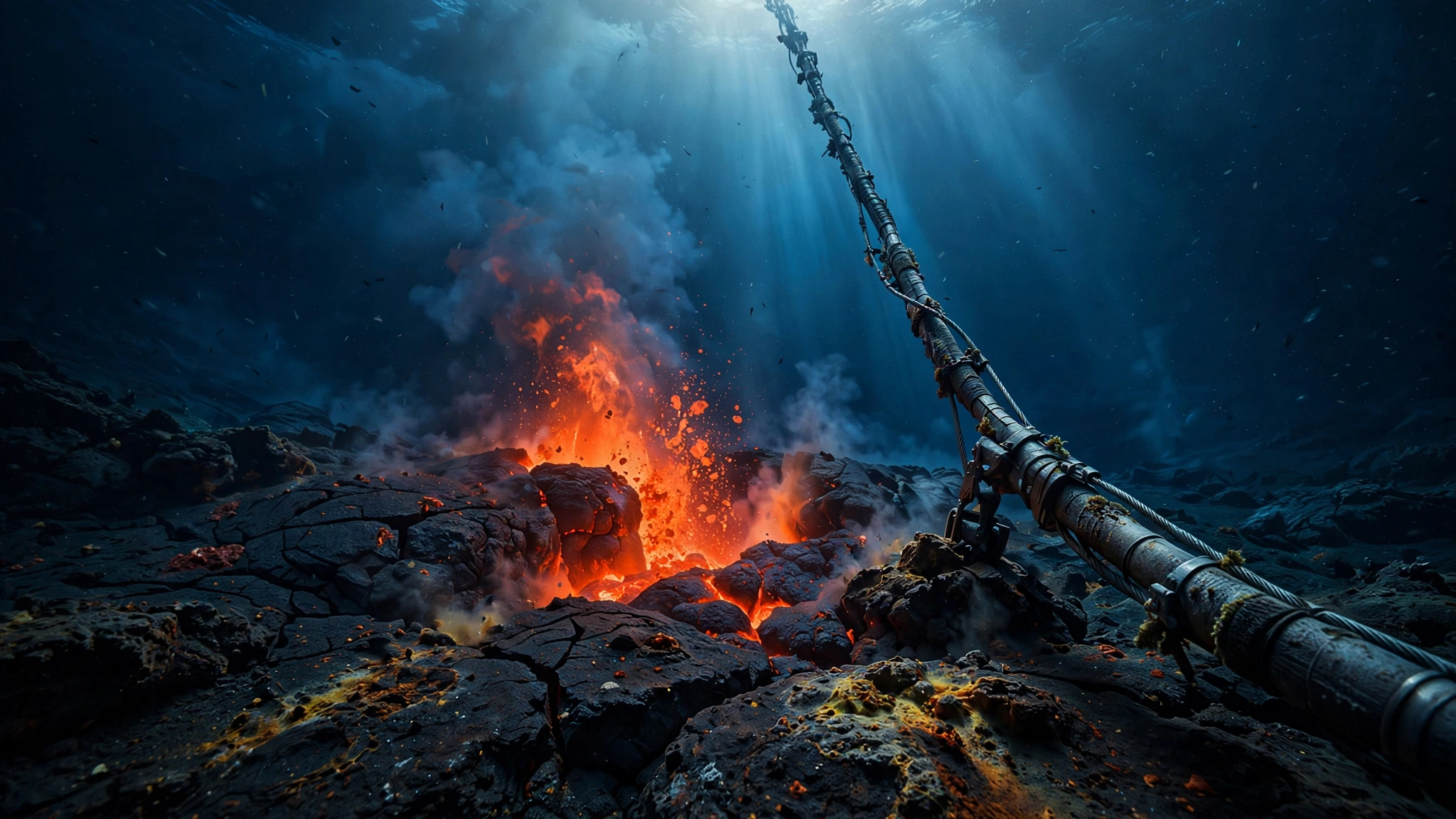
Three hundred and eighty-six degrees Celsius. That is the temperature Endurance Energy recorded at the seafloor during prototype deployments above deep-sea volcanic systems, according to ThinkGeoEnergy. At spreading centers along the Pacific Ring of Fire, tectonic plates pull apart and magma rises to within meters of the ocean floor, heating seawater to temperatures that would melt lead. Nobody has tried. Not once. Endurance Energy, a Seattle startup founded by former SpaceX engineer Andrew Redd, just raised $54 million in Series A funding to build the first power plant on the ocean floor above an active volcanic spreading center, a project that requires solving problems the offshore oil industry spent half a century and hundreds of billions of dollars learning to manage in a fundamentally different context.
Founders Fund led the round, with Felicis, First Round Capital, Point72 Ventures, Riot Ventures, Construct Capital, Ascend, and Voyager Ventures also participating, bringing total funding to roughly $80 million including an earlier seed round of $25–30 million also led by Founders Fund, per Axios. Redd worked on Dragon and Starship at SpaceX before leaving, and twelve of Endurance's 25 employees followed him, along with a VP of engineering recruited from Helion Energy, the fusion startup.
Subsea geothermal has a genuine physics advantage over every land-based competitor, and it shows up cleanly in the thermodynamics. A conventional enhanced geothermal system drills 3–7 kilometers through rock to reach resources at around 200°C, then rejects heat into 25°C ambient air. Carnot efficiency: 37%. In practice, binary-cycle turbines extract about 25% of that thermal energy as electricity.
On the ocean floor the numbers shift dramatically. Endurance's source temperature of 386°C paired with deep seawater at roughly 2°C yields a Carnot efficiency of 58.3%, which translates to practical turbine efficiency around 40%, delivering 60% more electricity per unit of heat than the best land-based geothermal. Why? Two reasons, both rooted in physics rather than engineering cleverness: the hot source is nearly twice as hot, and the cold sink is 23 degrees colder than ambient air on land, a combination that no amount of drilling innovation on the surface can replicate.
And Redd makes a characteristically SpaceX-flavored argument about risk: "If we have a blowout — quote unquote — you're leaking hot water into the ocean, which is already leaking out in terawatts all over the Earth." Six terawatts. That is his estimate of what could be developed around the Ring of Fire within five to ten years, and for context, global average energy consumption sits at roughly 20 terawatts across all sources combined.
But Physics Isn't the Product. The Cable Is.
Generating power on the seafloor means nothing unless you can get it to shore. Subsea HVDC cables are ruinously expensive. According to a 2025 DataIntelo market report, total installed cost runs $1.2–2.8 million per kilometer in shallow water (under 200 meters), $3.5–6 million per kilometer in deep water beyond 500 meters, and up to $12 million per kilometer for dynamic cable systems rated for extreme depths, with cable manufacturing alone accounting for 45–55% of total project cost and three European companies (NKT, Prysmian, and Nexans) controlling 75% of the global HVDC cable market with order backlogs stretching 12 years.
That cable cost imposes what we will call a cable tax on every megawatt-hour Endurance produces, and it varies wildly depending on how far the volcanic resource sits from shore. Run the numbers across three scenarios, using a 90% capacity factor (standard for geothermal), a 25-year plant life, and midpoint cable costs for each depth range.
Scenario 1: Pacific Island (Tonga)
Distance from volcanic arc to shore: 50 kilometers, through moderate water depths of 500–1,500 meters. Cable cost at $2.5 million per kilometer: $125 million for a 50 MW plant. Over 25 years at 90% capacity factor, that plant generates 9.86 million MWh, which means the cable alone adds $12.70 to every megawatt-hour delivered to shore.
Add a generation LCOE of $60–80/MWh (optimistic, reflecting the Carnot advantage and no multi-kilometer land drilling) and total delivered cost lands around $73–93/MWh, which sounds expensive until you compare it to what Pacific islands actually pay. Tonga currently spends $350/MWh for diesel-generated electricity, the 13th most expensive rate on Earth, with roughly 80% of the kingdom's power coming from imported diesel. A switch to subsea geothermal would cut electricity costs by 74–79%. Tonga's Prime Minister Lord Fakafānua has already signed an agreement with Endurance to explore resources in Tongan territorial waters.
Scenario 2: US Pacific Coast (Juan de Fuca Ridge)
Here the math gets harder. Endurance plans to deploy its first 100 kW generator, called Adelie, at the Juan de Fuca ridge off Washington and Oregon this fall. That ridge sits roughly 200 kilometers from shore in water exceeding 2,000 meters, which means cable cost at $5 million per kilometer reaches $1 billion for a 200 MW plant. Over 25 years at 90% capacity that plant produces 39.4 million MWh, making the cable tax $25.40/MWh.
Total delivered LCOE of $85–105/MWh lands well above the US wholesale electricity average of roughly $50/MWh. Dead on arrival for the grid. But data centers are a fundamentally different buyer, willing to pay $80–120/MWh premiums for firm, 24/7 baseload power, which is precisely what geothermal delivers at a 90% capacity factor while solar and wind sit idle half the time. Google's undisclosed power purchase agreement with Fervo Energy, reported in the $80–100/MWh range by industry observers, set the benchmark. At the optimistic end of Endurance's generation costs, subsea geothermal might squeeze into that PPA window.
Scenario 3: Remote Mid-Ocean
Five hundred kilometers of cable through water deeper than 3,000 meters pushes the cost to $6 million per kilometer, or $3 billion for a 500 MW plant, which works out to a cable tax of $30.40/MWh and a total LCOE of $90–110/MWh. At this distance, the cable alone costs more than most onshore power plants, and the generation savings from hotter rock and colder coolant cannot overcome a $3 billion delivery fee. Redd's 6-terawatt claim about the Ring of Fire is geologically sound. Much of that resource, however, lives hundreds of kilometers from any coast with meaningful demand, and cable economics wall off the vast majority of the theoretical resource base.
| Scenario | Distance | Cable Cost | Cable Tax | Total LCOE | Competitor | Verdict |
|---|---|---|---|---|---|---|
| Pacific Island | 50 km | $125M | $12.70/MWh | $73–93/MWh | Diesel $350/MWh | 74–79% savings |
| US Coast | 200 km | $1B | $25.40/MWh | $85–105/MWh | Grid $50/MWh | Data centers only |
| Mid-Ocean | 500 km | $3B | $30.40/MWh | $90–110/MWh | Grid $50/MWh | Uncompetitive |
From 100 Kilowatts to a Gigawatt
Endurance has completed four prototype deployments at depths up to 3,300 meters, impressive for a company under two years old, but the Adelie generator deploying this fall produces 100 kilowatts. One wind turbine does 50–100 times that. Redd's stated goal is gigawatt-scale delivery within two years of Adelie, which means scaling output by a factor of 10,000, a jump that makes SpaceX's seven-year climb from Falcon 1 to Falcon 9 look incremental by comparison, and SpaceX's trajectory was the fastest hardware scale-up in aerospace history. Subsea power infrastructure operates under at least comparable engineering constraints: extreme pressure, corrosion, remotely operated maintenance, and cable supply chains already bottlenecked for a decade.
Operating on the seafloor demands robots for nearly every maintenance task. Saltwater is merciless. Deepwater oil and gas companies have spent decades and hundreds of billions solving these problems, wrestling with the same corrosion, pressure, and remote-operation challenges that Endurance will face, and their wells still cost $40–100 million each. Endurance will inherit some of that expertise, but subsea geothermal introduces a new variable: years-long unattended operation of a complete power plant, not just a wellhead, on the ocean floor.
Limitations
This cable tax analysis uses simple levelized costs without discounting. Real project finance would apply discount rates of 8–12%, which increase the cable's per-MWh contribution. We also assume Endurance's generation costs will reach the low end of conventional geothermal LCOE ($60/MWh), which is speculative for a technology that has never operated at commercial scale. Actual subsea drilling, corrosion management, and robotic maintenance costs are unknown and not publicly disclosed. Our three scenarios assume straight-line cable routes; real submarine cables follow complex seabed topographies that add 15–30% to the distance. If generation costs reach only $100/MWh, the technology works in the Pacific islands but fails everywhere else. We also do not model ecological impact: mid-ocean ridge hydrothermal vents host unique chemosynthetic ecosystems, and industrial-scale extraction at these sites could face permitting challenges and environmental opposition that are difficult to quantify at this stage.
Strongest Counterargument
Fervo Energy reached commercial-scale enhanced geothermal on land in under four years, with project-financed debt from nine banks, on a resource that sits directly under the US grid. Fervo's 400 MW Cape Station in Utah is already under construction and has a Google power purchase agreement for 3 GW of future capacity. Land-based EGS is getting cheaper on a steep experience curve: pre-scale costs of $100–120/MWh are expected to fall to $65–75/MWh with standardization, according to Sage Geosystems CEO Cindy Taff, as reported by Reuters. By the time Endurance proves commercial subsea generation, land-based EGS may have already captured the data center market at lower cost and zero cable tax, using the same shale-drilling supply chain that built America's natural gas boom. The seafloor might be thermodynamically ideal and economically redundant for every customer except remote island nations.
Playbook
If you run energy procurement for a Pacific island nation, this is the most important clean energy development since grid-scale solar, and Endurance's Tonga pilot should be tracked closely. At $73–93/MWh versus $350/MWh diesel, the economics do not require hope, subsidies, or breakthrough technology beyond what has already been demonstrated in adjacent industries. Put Endurance on your shortlist alongside solar-plus-battery and demand a competitive PPA proposal.
Energy investors evaluating Endurance should separate the island business from the US-grid ambition. Islands are real. At $350/MWh diesel, the margins are enormous and the technology does not need to be cheap, just functional. US coastal data centers at $85–105/MWh are a conditional bet: it works only if generation costs hit the optimistic end and cable procurement clears the 12-year backlog that currently chokes the entire offshore wind industry alongside it. Treat these as two entirely different risk profiles housed in the same company.
For engineers working in offshore oil and gas or subsea cable installation, Endurance is hiring people who have solved exactly these problems before. Twelve of their first 25 hires came from SpaceX, but the next hundred will need to come from the offshore energy and subsea cable industries.
Bottom Line
Endurance Energy has found a real thermodynamic arbitrage: volcanic spreading centers produce 386°C heat next to 2°C seawater, yielding 60% more electricity per unit of heat than the best land-based geothermal, and $80 million from Founders Fund and seven co-investors says the engineering talent believes it is buildable. But the cable, not the volcano, is the binding constraint. Our calculation shows the cable tax ranges from $12.70/MWh for Pacific islands to $30.40/MWh for remote mid-ocean resources, and that tax alone determines which markets subsea geothermal can serve. For Tonga, Fiji, the Philippines, Indonesia, and dozens of island economies trapped at $350/MWh diesel, this could be transformative. For the US grid? No. Not at $50/MWh wholesale. The cable math says no, and no amount of thermodynamic elegance changes that arithmetic. Endurance's commercial fate depends on whether they build the island business first and ride the experience curve down, or chase the gigawatt vision and drown in cable costs before proving the economics that matter. SpaceX taught its alumni to think in terawatts. The ocean will teach them to think in dollars per kilometer.