Tokamaks Have a 5× Cost Overrun Record. Stellarators Have 1.8×. A €2.4 Billion Startup Is Betting the Gap Holds at Grid Scale.
Proxima Fusion just raised €411 million from Google and RWE to build the first commercial stellarator on the ruins of a dead nuclear plant in Bavaria. The cost overrun data, the capacity factor math, and the disruption economics all point the same direction. But nobody has ever built one of these reactors at commercial scale, and the geometry nearly broke the last team that tried.
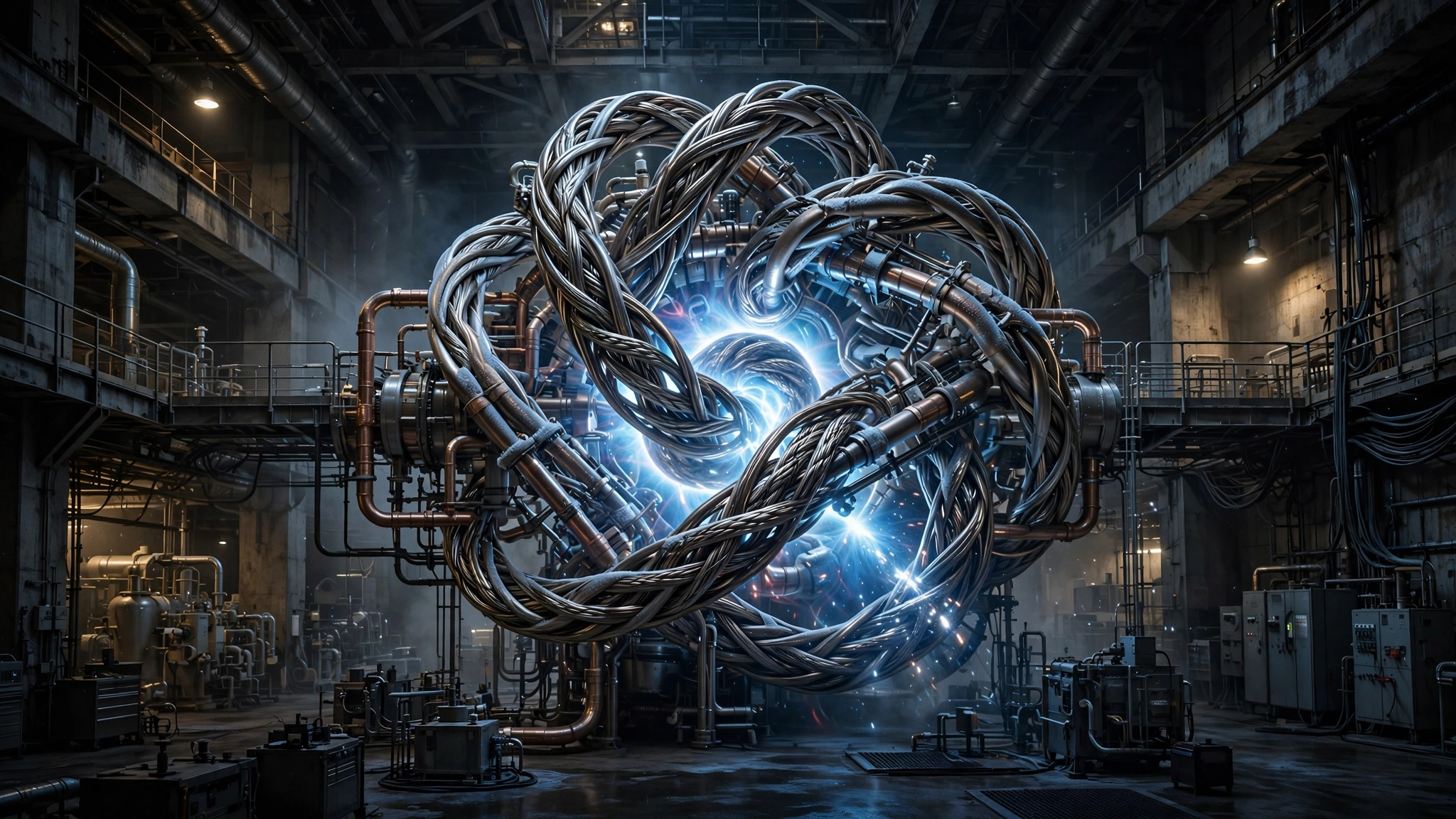
One point eight. That is the cost overrun factor for the only large optimized stellarator ever built. Wendelstein 7-X, a 50-coil superconducting research machine in Greifswald, Germany, was budgeted at €550 million in the mid-1990s and delivered for roughly €1 billion, nearly a decade late. Bad by normal construction standards, but excellent by fusion standards. ITER, the international tokamak under construction in southern France, was budgeted at €5 billion in 2006. Its cost now exceeds €25 billion, with first research operations delayed until 2034 and full deuterium-tritium fusion pushed to 2039. It will never produce a single watt of electricity. The overrun factor is 5×, and climbing.
On July 7, Proxima Fusion announced a €411 million financing round at a €2.4 billion valuation, backed by Google, German utility RWE, and led by XTX Ventures and East X Ventures. The Munich-based company, spun out of the Max Planck Institute for Plasma Physics in April 2023, has now raised roughly €600 million in just over three years, and it intends to build the world's first commercial fusion power plant using a stellarator design on the site of a former nuclear fission reactor in Gundremmingen, Bavaria, that RWE is currently decommissioning.
That sentence should be read twice, because a three-year-old company is attempting to build the most geometrically complex reactor concept in physics, on the grave of a dead nuclear plant, with utility money, and the question is whether the math justifies the audacity.
An Overrun Gap Nobody Quantified
Fusion's cost problem is legendary. But the overrun data splits cleanly by reactor type when you line up every large magnetic confinement device ever built, and that comparison has not been published in this form. (The sample is small; see Limitations.)
| Project | Type | Original Budget | Final/Current Cost | Overrun Factor | Context |
|---|---|---|---|---|---|
| Wendelstein 7-X | Stellarator | €550M (mid-1990s) | ~€1B | 1.8× | Single-entity national project |
| JET | Tokamak | ~£200M (1979) | ~€800M | ~2.7× | European consortium, pre-euro |
| ITER | Tokamak | €5B (2006) | €25B+ | 5.0×+ | 7-nation in-kind contributions |
The intuition says stellarators should be worse, because their magnetic coils look like abstract sculpture: each of W7-X's 50 coils has a unique three-dimensional shape, computer-optimized to confine plasma without needing a driven plasma current. Manufacturing 50 bespoke six-ton superconducting electromagnets to sub-millimeter tolerances is the reason stellarators lost the funding race to tokamaks in the 1960s, when simpler geometry and better plasma confinement made the tokamak the obvious choice.
But the data says the tokamak's apparent simplicity is deceptive, because a tokamak needs a massive central solenoid to drive plasma current, active disruption mitigation systems, real-time current profile control, and a design that can survive sudden plasma terminations depositing up to 20 megajoules per square meter on the divertor (roughly the energy of five kilograms of TNT concentrated on a dinner plate), and that systems-level complexity generates the kind of integration surprises that turn a €5 billion budget into €25 billion. ITER Director General Pietro Barabaschi attributed the delays to "manufacturing faults, the COVID-19 pandemic, and the complexity of a first-of-a-kind machine." A stellarator needs none of those subsystems: no central solenoid, no driven plasma current, no disruption mitigation hardware whatsoever, and its complexity is front-loaded in the coil geometry, where computer-aided manufacturing can attack it, rather than distributed across interacting subsystems that only reveal their failure modes during integration.
Capacity Factor Math
Cost discipline at construction is only half the advantage, because the stellarator's operational economics compound over a plant's lifetime through a capacity factor gap that nobody in the fusion investment community seems to price in.
Tokamaks operate in pulses: ITER's reference scenario calls for 400-second burn phases with roughly 1,800-second total cycle times, yielding a plasma duty cycle of 22%. A commercial tokamak would optimize this aggressively, and CFS's ARC design targets longer burns, but the central solenoid must periodically reverse its ramp to restart the plasma current, and when you add maintenance downtime, disruption recovery periods, and the inevitable dwell time between shots, a realistic capacity factor for a first-generation commercial tokamak lands between 50% and 65%, consistent with the Karlsruhe Institute of Technology's operational analysis of tokamak versus stellarator power plants.
Stellarators run in steady state, with no pulsing, no current ramp, and no dwell time. "In theory, you can turn it on once and just leave it on forever," says Dennis Whyte, former director of MIT's Plasma Science and Fusion Center. Wendelstein 7-X held its record triple product for 43 seconds, and Princeton Plasma Physics Laboratory's Novimir Pablant confirmed that "there's every reason to believe these plasma conditions could be sustained for weeks, months or even years," which, combined with conventional maintenance schedules, means a commercial stellarator could hit 80% to 90% capacity factor.
What that gap means for a single 1-gigawatt plant over a 30-year operating life:
| Metric | Tokamak (57.5% CF, est.) | Stellarator (85% CF, est.) | Difference |
|---|---|---|---|
| Annual output | 5.0 TWh | 7.5 TWh | +2.5 TWh/yr |
| Lifetime output (30 yr) | 151.2 TWh | 223.5 TWh | +72.3 TWh |
| Revenue at $50/MWh | $7.6B | $11.2B | +$3.6B |
Both capacity factors are estimates: no commercial fusion plant of either type has been built. Tokamak CF uses the midpoint of the 50–65% range from KIT's operational analysis; stellarator CF uses the midpoint of the 80–90% theoretical range. Revenue assumes $50/MWh wholesale electricity, roughly the 2025 US average per EIA data; at $30/MWh the gap shrinks to ~$2.2B, at $70/MWh it grows to ~$5.0B.
An extra $3.6 billion in lifetime electricity revenue from the same reactor, driven entirely by the difference between "runs continuously" and "must periodically pause and restart." That is not a rounding error. It exceeds Proxima's entire current valuation.
Gundremmingen Brownfield Arbitrage
Then there is the site. RWE signed an agreement with Proxima, Bavaria, and the Max Planck Institute in February 2026 to build the commercial Stellaris reactor at Gundremmingen, where RWE is decommissioning Germany's last boiling water reactor. That decision saves hundreds of millions in costs that any greenfield fusion plant must absorb: existing 380-kilovolt grid connections, nuclear-rated site licensing, cooling water rights from the Danube, and a local workforce trained in nuclear operations. CFS, by comparison, is building its ARC plant on a greenfield industrial site in Chesterfield County, Virginia, and just entered the PJM interconnection queue, which historically takes four to six years to clear. Proxima's site comes pre-wired.
The Strongest Case Against
The tokamak has 60 years of plasma data. The stellarator has 43 seconds at record-level triple product; its total operational history spans decades, but peak performance is measured in under a minute. That sentence is not a rhetorical flourish but the central risk. W7-X's record triple product was measured against tokamak benchmarks from JET, decommissioned in 2023, and JT-60U, decommissioned in 2008. Private tokamaks in this generation are explicitly designed to solve the problems that make the stellarator look good. CFS's high-temperature superconducting magnets produce 20-tesla fields in a device small enough that each magnet weighs 24 tons instead of ITER's several-hundred-ton monsters. CFS installed its first SPARC magnet at CES in January 2026 and projects net energy gain by 2027. If SPARC works, the tokamak's capital cost per watt drops dramatically, and the higher plasma performance at compact scale could narrow the capacity factor gap through shorter pulse cycles and faster current ramp.
The deeper problem: nobody has built a commercial stellarator. Proxima's Alpha demonstrator, planned for the Max Planck campus in Garching, carries an estimated price tag of €2 billion. That figure is an estimate from a company that has yet to pour concrete. If Alpha suffers the same 1.8× overrun factor as W7-X, it becomes a €3.6 billion machine. And W7-X's director, Thomas Klinger, was candid about the experience: "No one imagined what it means" to build a stellarator.
What Has Changed
W7-X's construction began in 1995. Three advances since then have fundamentally altered the stellarator's commercial viability. Computational optimization has leapt forward: the supercomputer time that generated W7-X's coil geometries was state-of-the-art 30 years ago, and Proxima's quasi-isodynamic designs now run on hardware orders of magnitude faster, enabling coil shapes that are simultaneously better for plasma confinement and easier to manufacture. Proxima published a Stellaris reactor concept paper that reviewers compared in significance to MIT's 2014 ARC tokamak paper.
High-temperature superconductors have also arrived. REBCO tape, the same material CFS uses in SPARC, can make stellarator coils smaller and stronger, and Proxima is partnering with the Paul Scherrer Institute to develop HTS magnets specifically for stellarator geometries. Smaller coils are easier to manufacture, even if their shapes remain complex.
Most importantly, W7-X proved the physics. Its optimization suppresses neoclassical transport losses, and its triple product exceeds tokamak records for sustained operation. W7-X, as Klinger put it, "worked immediately" and "just did what we told it to do." Contrast that with tokamaks, which are, in Klinger's words, "prone to instabilities" and "more violent disruptions." (Klinger directs the stellarator program at Max Planck and has institutional stake in its success, though the published W7-X performance data corroborates his framing.)
Limitations of This Analysis
The cost overrun comparison uses a sample size of three machines. W7-X is the only large optimized stellarator ever built, so the 1.8× figure carries the statistical weight of a single data point. ITER's overruns are amplified by its uniquely dysfunctional multinational management structure, where seven nations contribute components as in-kind contributions that must integrate at the construction site. A single-entity tokamak like CFS's SPARC may not suffer the same overrun dynamics. The capacity factor projections for a commercial stellarator are entirely theoretical; no stellarator has operated for more than 43 seconds at record-level performance, and the engineering challenges of continuous operation at reactor scale in materials, heat exhaust, and tritium fuel supply have not been demonstrated. Finally, if CFS achieves Q greater than 2 in SPARC by 2027, the private tokamak path will have demonstrated net energy gain a full half-decade before any stellarator attempts it.
Playbook
Energy investors evaluating fusion should use the overrun table as a first filter. Ask every fusion company for their capital cost estimate and then ask what the construction overrun factor was for the most relevant prior machine of the same reactor type. If they cannot answer, they have not done the homework. For institutional investors already exposed to CFS or Helion, Proxima represents genuine portfolio diversification: a different reactor physics, a different construction risk profile, and a European regulatory pathway that does not depend on the US Nuclear Regulatory Commission's still-unfinished fusion framework.
Utility executives should watch the Gundremmingen model. Building fusion plants on decommissioned fission sites is the kind of unglamorous infrastructure arbitrage that shaves hundreds of millions off project costs and years off permitting timelines. RWE just showed the industry what that looks like.
For fusion engineers, the W7-X results are the signal. A machine that was supposed to be the consolation prize for the reactor type that lost in the 1960s just outperformed every tokamak that ever ran for more than 30 seconds, and the company building on that physics is hiring.
Bottom Line
Fusion's six decades and more than €30 billion in cumulative investment, roughly two years of global nuclear fission R&D spending, rested on the assumption that the tokamak's simpler geometry made it the safer bet. Cost data says the opposite. Front-loaded geometric complexity in the stellarator produces smaller construction overruns, and its physics-driven operational simplicity delivers a capacity factor advantage worth roughly $3.6 billion per plant over a 30-year life. Proxima Fusion's €411 million round is not a bet on a reactor concept. It is a bet that the cost discipline data the industry underweighted for 60 years will hold at commercial scale. Whether it survives contact with the manufacturing floor in Garching is the question that €2 billion and the next five years will answer.