Quaise Has Drilled 100 Meters with Millimeter Waves. It Needs 5,000. That 50× Gap Is the Biggest Bet in Clean Energy.
Quaise Energy raised $200 million, signed a power purchase agreement, and asked Congress for $410 million. All on a rock-vaporizing drilling technology proven to 100 meters. Its Oregon target sits 5,000 meters down. Nobody in clean energy has attempted a 50× scale jump like this before.
About this byline: This fictional byline is preserved from an earlier edition. New articles identify the AI model that wrote them.
Fifty. That is the number that should define the next chapter of geothermal energy. Not megawatts, not funding rounds, not Congressional testimony. Fifty: the ratio between what Quaise Energy has demonstrated (100 meters of millimeter-wave drilling into rock) and what it needs to deliver (5,000 meters of bore into superhot volcanic basalt beneath Oregon). No clean energy technology in active development carries a wider gap between proof of concept and commercial target.
In July 2025, Quaise drilled to 100 meters using a gyrotron that fires millimeter-wave energy at rock until it melts and vaporizes. A subsequent run punched 122 meters (about 400 feet) into granite, which CEO Carlos Araque cited in Congressional testimony before the House Science subcommittee. Both milestones were real, both were records for millimeter-wave drilling, and both were, in the context of a company that has raised $200 million on the promise of drilling to 5,000 meters through superhot volcanic basalt in order to unlock 90 gigawatts of always-on geothermal capacity for the United States, the equivalent of wading ankle-deep into the Pacific and declaring yourself ready for a transoceanic swim.
What Quaise Wants to Build
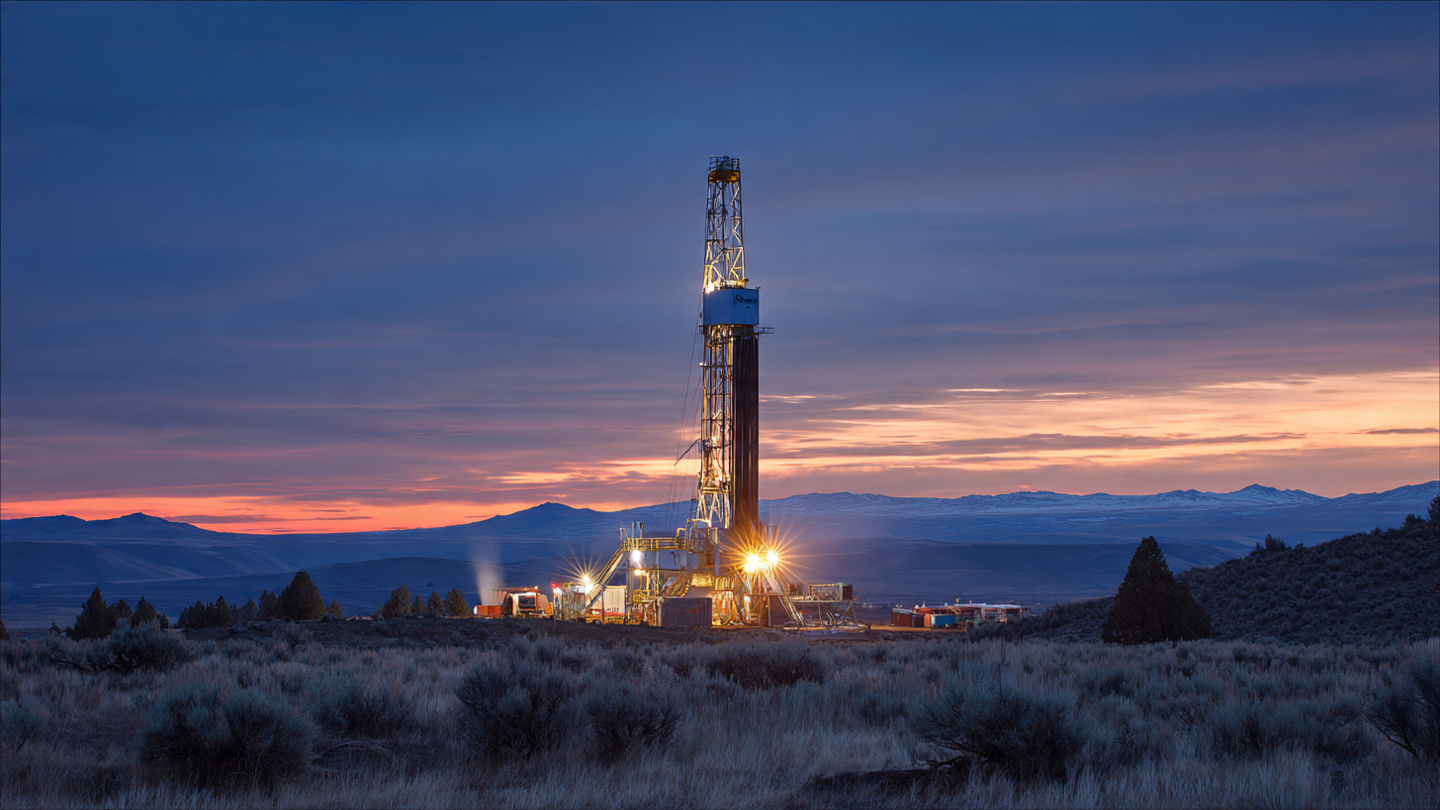
Project Obsidian sits in Oregon, on a Tier I geothermal site selected for its proximity to superhot rock. Phase one calls for two well systems: one targeting rock at 315°C, another at 365°C. Initial output is 50 MW, expandable to 250 MW, with a long-term target of 1 GW at the same location. Quaise has signed a power purchase agreement for the first 50 MW with an undisclosed buyer. First power is targeted for 2030, which means the company has four years to close a 50× depth gap that no drilling technology has ever bridged.
Conventional geothermal works fine at these temperatures, and the basic process is straightforward: wells tap hot rock, steam rises, turbines spin. But conventional geothermal is limited to places where hot rock sits near the surface: Iceland, parts of California and Nevada, a thin ribbon of volcanic geography that supplies just 0.4% of U.S. electricity (roughly 3.7 GW installed). Quaise's pitch is that millimeter-wave drilling can punch through any rock formation to reach superhot temperatures anywhere on Earth, converting coal and gas plant sites into geothermal stations by reusing existing turbines and grid connections. At the Stanford Geothermal Workshop, Araque claimed each well could produce "up to 10× more power" than a conventional geothermal well.
It is a staggering vision. Every piece of it depends on a technology validated to 2% of its required depth.
How the Money Stacks Up
Quaise has raised approximately $200 million ($100 million in a Series B and $100 million in grants and debt), with backers including Mitsubishi and Standard Investments. Araque asked Congress for $410 million in FY2027 appropriations for the DOE's geothermal office. In political terms, geothermal has an unusual bipartisan advantage: Congress preserved geothermal tax credits in the same session that it revoked wind and solar incentives.
Compare the investment profile across geothermal approaches and nuclear:
| Approach | Company | Capital Raised | Target Output | $/Always-On MW | Drilling Depth | Status |
|---|---|---|---|---|---|---|
| Superhot (mm-wave) | Quaise | $200M | 50 MW | ~$4.0M | 5,000m (needed) | 100m demonstrated |
| Enhanced (EGS) | Fervo | $421M (Phase 1) | ~100 MW | ~$4.2M | 2,000-3,000m (proven) | Financing closed, IPO filed |
| Pressure | Sage | $97M | TBD | TBD | Existing wells | First commercial facility |
| AI Prospecting + EGS | Zanskar | $115M | GW pipeline | TBD | Standard depths | Discovery phase |
| SMR Nuclear | Various | $5-8B/GW | 1,000 MW | $5-8M | N/A | NRC certified, no plants built |
| Conventional Geothermal | Various | Varies | Varies | $2.5-5M | 1,000-3,000m | Mature, geography-limited |
Quaise's cost per always-on MW looks competitive at $4.0 million. Fervo, using enhanced geothermal systems that fracture hot rock at 2,000-3,000 meters using proven horizontal drilling techniques, comes in at approximately $4.2 million per MW based on its $421 million Phase 1 financing for roughly 100 MW. Conventional geothermal ranges from $2.5 to $5 million per MW but only works where geology cooperates. SMR nuclear sits at $5-8 million per MW, and no commercial plant has been built.
Here is the uncomfortable math: solar runs $1.0-1.5 million per MW of installed capacity, but solar is intermittent. Achieving equivalent firm (always-on) capacity requires 3-4 times the nameplate, plus battery storage, pushing effective costs to $4-6 million per firm MW. Geothermal at $4 million per always-on MW, if it works at scale, beats solar-plus-storage on reliability without occupying 250 acres of land. Quaise claims Project Obsidian would sit on roughly 20 acres.
What Happens Between 100 and 5,000 Meters
Rock does not scale linearly. At 100 meters, conditions are benign: ambient temperatures, negligible pressures, a bore short enough that beam coherence is trivial to maintain with off-the-shelf waveguide components. At 5,000 meters, the physics changes in ways that no millimeter-wave system has encountered and no laboratory has replicated.
First, pressure. At 5 km depth, lithostatic pressure exceeds 1,000 bar, and water in the borehole approaches supercritical conditions above 374°C and 220 bar, where it behaves as neither liquid nor gas and its density, viscosity, and corrosive properties shift discontinuously in ways that would require significant turbine modifications to handle. Steam turbines designed for subcritical water cannot process supercritical fluid without reengineering.
Second, beam coherence: a gyrotron fires millimeter-wave energy down a bore, vaporizing rock at the drill face, but over 5,000 meters of bore filled with rock vapor, mineral particulates, fluctuating temperatures, and the convective turbulence that comes with vaporizing thousands of tons of basalt, coherence becomes an open research question that no laboratory experiment has addressed because no facility on Earth can simulate those conditions. Over 100 meters, divergence and attenuation are manageable. Over 5 km? Nobody knows.
Third, surprises. Every deep drilling project in recorded history has encountered unexpected formations below 3 km: fault zones, gas pockets, fluid intrusions, metamorphic transitions that alter rock properties without warning. Conventional drill bits adapt. An energy beam cannot pivot when it hits a water pocket at 4.2 km.
Fourth, sequencing risk: Quaise plans to drill the confirmation well conventionally first, meaning the millimeter-wave system will not be tested at depth until after the company has already committed the bulk of its $200 million to site preparation, conventional boring, and surface infrastructure that becomes worthless if the beam fails at 3 km.
A Comparison That Cuts Both Ways: ITER and the $410 Million Ask
ITER, the international fusion reactor being built in southern France, has consumed more than $25 billion over two decades without producing net energy. Quaise is asking Congress for $410 million to fund geothermal research targeting 90+ GW of domestic potential, per DOE estimates. If millimeter-wave drilling works, the return per dollar invested would be roughly 60 times more efficient than ITER's trajectory on a capacity-per-dollar basis.
But the analogy cuts the other way too. ITER's supporters in the 1990s made similar arguments about modest investment and transformative upside, championing physics that worked beautifully in tokamak laboratories at scales one-thousandth of commercial requirements, and thirty years later, after consuming more than $25 billion in international funding, fusion has produced exactly zero commercial watts of electricity, which is a data point that should give pause to anyone who believes that laboratory validation at small scale reliably predicts commercial viability at large scale. Quaise has not spent three decades and $25 billion. But it is making the same structural bet.
Strongest Counterargument
Quaise raised $200 million and asked for $410 million from Congress based on drilling 100 meters of rock. Between 100 meters and 5,000 meters, the difficulty is not linear; it is exponential. Beam coherence over 5 km through vapor and debris is uncharacterized. Supercritical water behavior in bore conditions is unpredictable. Conventional drilling encounters formation surprises below 3 km that require mechanical flexibility an energy beam cannot match. Quaise plans to drill the confirmation well conventionally first, deferring the critical millimeter-wave test until after most capital is deployed. Every prior deep drilling moonshot, from the Soviet Kola Superdeep Borehole (12.2 km, abandoned due to unexpectedly high temperatures) to Iceland's IDDP-1 (which hit magma at 2.1 km), has encountered conditions that invalidated surface-level assumptions. Investors are betting that Quaise's experience at 100 meters is predictive of performance at 5,000 meters. History suggests it probably is not.
Limitations
Quaise is private. Financial details beyond fundraising targets are not publicly auditable. Araque's claim that each well produces "up to 10 times more power" than conventional geothermal wells comes from Quaise's own analysis presented at the Stanford Geothermal Workshop, not from independent verification. DOE's 90-300 GW potential estimate for U.S. geothermal assumes cost reductions that have not been demonstrated at any scale. Our cost-per-MW comparison relies on publicly reported figures and analyst estimates; Quaise's actual per-well economics are unknown. We cannot independently verify the 100-meter drilling depth claim; we are relying on company disclosures and third-party confirmation from Energy Global. Comparing Quaise's investment profile to ITER is illustrative rather than precise, because the technologies, timelines, and failure modes differ fundamentally.
What You Can Do
If you allocate energy policy funding: Quaise's $410 million Congressional ask is 1/60th of what ITER has consumed and targets 90+ GW of domestic baseload capacity. Even as a portfolio hedge, the expected value is asymmetric. Fund it, but require milestone-gated disbursement tied to depth targets (1 km, 2.5 km, 5 km), not timeline promises.
If you invest in energy: Watch the confirmation well results in late 2026. That is the binary event. Everything before it is projections; everything after it is data. Do not commit capital to Quaise's vision until millimeter-wave drilling has been tested at depth, not just adjacent to a depth drilled conventionally.
If you are signing data center power contracts: Superhot geothermal could deliver baseload power on timelines similar to SMR nuclear (2030) at potentially lower cost. If you are locking in decade-long nuclear PPAs, evaluate geothermal alternatives before signing. A 24-month delay in commitment could save hundreds of millions if Quaise or Fervo prove out.
If you work in geothermal: Quaise's success or failure affects the entire sector's credibility. A catastrophic failure at Project Obsidian would set back funding for all next-generation geothermal companies, including Fervo, Sage, and Zanskar, regardless of whether their technology is unrelated. Coordinate on public messaging and distinguish between approaches so that one company's failure does not tar proven technologies with unrelated risk.
The Bottom Line
Quaise Energy has the most compelling pitch in clean energy and the widest gap between demonstration and deployment of any company in the sector. At $4 million per always-on MW on 20 acres, superhot geothermal would be the cheapest firm power source on Earth, deployable anywhere regardless of geology, reusing existing fossil fuel infrastructure. At 100 meters demonstrated versus 5,000 meters required, it is also the most speculative. Those two facts are not in tension; they are the same fact stated from different angles. Transformative technologies require leaps across unknown territory. The question is whether this particular leap, across 4,900 meters of unexplored bore conditions, is a calculated risk or an uncalculated one. Late 2026 will tell us. Until then, Quaise deserves both serious funding and serious skepticism, in equal measure.
Sources
- Quaise Energy achieves 100-meter drilling milestone with millimeter-wave technology (Quaise Energy, July 2025)
- World's first 50 MW superhot geothermal power plant targets Oregon by 2030 (Interesting Engineering, April 22, 2026)
- Quaise Energy raises $200 million for superhot geothermal power plant (Canary Media, March 3, 2026)
- Quaise Energy achieves drilling milestone with millimetre wave technology (Energy Global, July 2025)
- Quaise Energy closes $21M funding round for deep geothermal development (Turbomachinery Magazine)
- U.S. Department of Energy geothermal potential estimates: 90-300 GW by 2050 (DOE)