⚡ Energy
Fervo Energy Wants $6.5 Billion to Turn Fracking Rigs Into Clean Power Plants. Its Contracted Revenue Already Exceeds That.
The Houston startup filed for the largest geothermal IPO in history, planning to use oil-and-gas drilling technology to more than double U.S. geothermal capacity. A valuation-per-megawatt analysis reveals the market is pricing Fervo below its own signed contracts, implying investors see enormous upside if the company simply executes.
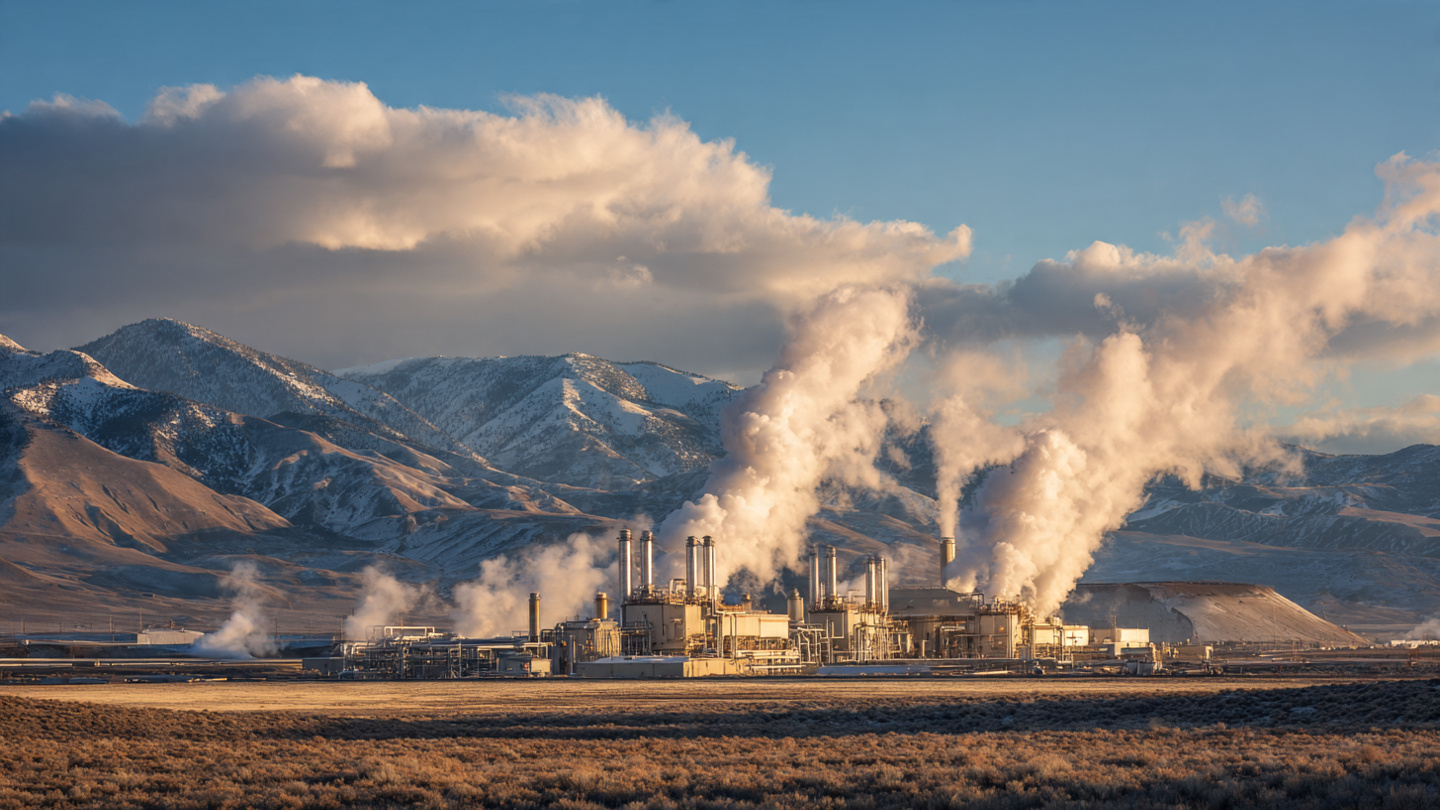
$6.5 billion. That is the valuation Fervo Energy is targeting in its SEC filing for an initial public offering on Nasdaq under the ticker FRVO, making it the largest geothermal IPO ever attempted. Fervo plans to raise up to $1.3 billion by offering 55.6 million Class A shares at $21 to $24 apiece, according to the registration statement filed April 17. J.P. Morgan and Bank of America are leading the underwriting. What makes this filing unusual is not the size of the number but what it buys: a company that has exactly 3 megawatts of operating generation capacity, lost $70.5 million last year, and has never produced commercial-scale electricity from its flagship technology.
What it also has is 658 megawatts of binding power purchase agreements representing $7.2 billion in potential revenue backlog, a 500-megawatt power plant under construction in Utah that will begin producing electricity by the end of this year, and 3.65 gigawatts of projects in various stages of development across the American West. If Fervo builds out just its most advanced site, Cape Station in Beaver County, Utah, at full permitted capacity of 1.5 gigawatts, it would add roughly 40% to the 3.8 gigawatts of conventional geothermal currently on the U.S. grid. If it develops the site's full 4.3-gigawatt geological potential, it would more than double the nation's entire installed geothermal base.
That is the bet. Here is the math.
A Paradox in the Numbers
Run Fervo's IPO valuation against its contracted revenue and a strange picture emerges. Fervo's 658 megawatts in binding power purchase agreements with Southern California Edison, Shell, and other buyers carry a projected lifetime revenue of $7.2 billion. At $6.5 billion, the IPO valuation sits below that figure, at a ratio of 0.90 to 1. Investors are paying less than one dollar for every dollar of signed contracts. In infrastructure finance, where contracted revenue typically trades at a premium because future cash flows are locked in, this ratio signals something specific: the market believes the contracts are real but assigns substantial probability that Fervo cannot deliver the megawatts on time, on budget, or at all.
Slice the valuation differently and the picture sharpens.
| Measure | Capacity | Implied Value per kW | Context |
|---|---|---|---|
| Operating capacity | 3 MW | $2,170,000/kW | Meaningless; pure option value |
| Contracted (binding PPAs) | 658 MW | $9,878/kW | 1.4x Fervo's $7,000/kW build cost |
| Pipeline (all stages) | 3,650 MW | $1,781/kW | Below build cost; priced as speculative |
| Total leased potential | 42,000 MW | $154/kW | Land-rights option only |
The contracted megawatts carry an implied value of $9,878 per kilowatt, which is 1.4 times Fervo's stated construction cost of $7,000/kW. That means the market expects Fervo to deliver those specific megawatts at a modest margin, and nothing beyond. But the broader 3.65-gigawatt pipeline is priced at only $1,781/kW, well below even the company's aspirational $3,000/kW target cost, and Wall Street is giving Fervo essentially zero credit for anything beyond its signed contracts. Across 600,000 leased acres in the western United States, the 42 gigawatts of theoretical capacity register at $154/kW, roughly the price of unimproved ranch land with interesting geology.
Fracking's Clean Energy Conversion
Fervo's core technology is enhanced geothermal systems, or EGS. It drills horizontal wells thousands of feet into hot rock, fractures the formation using hydraulic pressure, and circulates water through the resulting fracture network to extract heat. Mechanically, the process is almost identical to the hydraulic fracturing that enabled the U.S. shale revolution and turned America into the world's largest oil and natural gas producer. "We do not need to build domestic supply chains from scratch," CEO Tim Latimer wrote in the filing. "We can leverage existing oilfield services providers."
Latimer worked in oil and gas before co-founding Fervo in 2017 with Jack Norbeck, and progress came fast: between 2022 and 2025, the company cut per-foot drilling costs by 70% and drilling times by 75%, a learning curve that tracks the early years of the American shale revolution when horizontal wells went from curiosity to industry standard across every major basin. Its most recent appraisal well at Cape Station confirmed subsurface temperatures exceeding 555°F, according to a company press release. Six hundred days. That is how long Project Red in Nevada has operated continuously, delivering 3 megawatts to the grid under a contract with Google.
The political alignment is striking: Energy Secretary Chris Wright, the former CEO of Liberty Energy, an oilfield services company, personally invested in Fervo before joining the administration. Geothermal tax credits survived the One Big Beautiful Bill Act when most clean energy incentives were cut. Last month, the House passed legislation exempting certain geothermal projects from federal permitting requirements that currently make well approvals take twice as long as oil and gas permits on federal land. Even the Department of Energy's $14 million April announcement for an EGS demonstration in eastern Pennsylvania was framed not as clean energy policy but as an extension of proven oil and gas technology.
Capacity Factor: What Nobody Mentions
Most comparisons between clean energy sources focus on cost per kilowatt of installed capacity or levelized cost per megawatt-hour. Both metrics obscure a critical variable that makes geothermal fundamentally different from solar and wind: capacity factor, the percentage of theoretical maximum output a plant actually delivers.
| Source | Capacity Factor | GW Needed for 1 GW Baseload Equivalent |
|---|---|---|
| Geothermal (EGS) | ~90% | 1.1 GW |
| Nuclear | ~93% | 1.1 GW |
| Onshore wind | ~35% | 2.9 GW |
| Utility solar | ~25% | 4.0 GW (+ storage) |
| Natural gas (combined cycle) | ~57% | 1.8 GW |
Geothermal runs around the clock. Rain or shine, summer or winter, without batteries, without backup. A 1-gigawatt geothermal plant operating at 90% capacity factor produces roughly 7,884 gigawatt-hours of electricity per year. Matching that with solar panels at a 25% capacity factor requires installing 3.6 gigawatts of panels, plus battery storage to cover nighttime and cloudy periods, which Lazard's 2025 LCOE+ analysis puts at $45 to $65 per megawatt-hour for solar-plus-storage systems. That is significant because Fervo claims its current Cape Station costs of $7,000 per kilowatt, spread over a 30-year operating life at 90% capacity factor with negligible fuel costs and minimal operations and maintenance, yield a levelized cost in the range of $30 to $40 per MWh. If the company hits its $3,000/kW target, the math drops to approximately $15 to $20 per MWh, which would be the cheapest baseload power source ever built, undercutting even existing natural gas plants that carry fuel price risk.
That conditional is doing a lot of work. Nobody has built an enhanced geothermal plant at $3,000/kW. Nobody has built one at $7,000/kW either. Cape Station's Phase 1, targeting 100 megawatts by early 2027, will be the first real data point.
Google's Shadow
Google appears 36 times in Fervo's S-1 filing, a frequency that signals both the company's most important relationship and its largest concentration risk. In March 2026, the two signed a 3-gigawatt Geothermal Framework Agreement covering potential power delivery through 2033. "Potential" is doing all the work in that sentence. It is non-binding. "The GFA is a non-binding agreement, and does not obligate Google to purchase power from us," the filing states explicitly. Google can reject any project Fervo proposes and is under no obligation to execute a single power purchase agreement under the framework.
What the framework does impose are constraints on Fervo, and they cut deep: under the agreement, Google holds priority over the company's near-term development pipeline, restricts who can invest in or finance Fervo by excluding a "broad category of entities defined as competitors," and limits the company's flexibility to pursue alternative commercial arrangements. Fervo structured its clean energy future around a handshake from a single customer whose own capital expenditure plans change quarterly. Google's parent Alphabet reported $17.2 billion in capital expenditures for Q1 2026 alone, most of it directed toward AI infrastructure, but the company is not contractually obligated to spend a cent of it on Fervo's geothermal power.
What We Don't Know
The honest list of uncertainties is long. Enhanced geothermal systems are first-of-kind at commercial scale. No one has operated an EGS plant for 15 years, which means the long-term behavior of fractured hot rock under continuous water circulation is genuinely unknown. If subsurface temperatures decline faster than modeled, or if fracture networks close under sustained pressure cycling, Fervo's capacity factor assumptions and cost projections fail. Stephanie Diaz, an analyst at BloombergNEF, told E&E News that it "won't be fully known how its plant affects drilling equipment 15 years from now until it's operational."
Geography is another constraint, and it is a stubborn one. The best EGS resources sit west of the Mississippi, where subsurface temperatures are highest, but data center operators building facilities in Virginia, Texas, or the Southeast would need transmission infrastructure that does not currently exist to access Utah or Nevada geothermal. Fervo's filing lists $1.2 billion in expected 2026 capital expenditures, of which $940 million for Cape Station Phase 2 is "mostly unfunded," according to Heatmap's analysis of the filing. That gap is real, and IPO proceeds are explicitly earmarked to cover part of it.
Then there is the industry's dependence on Fervo itself: BloombergNEF has noted that the company constitutes roughly half of all venture capital and private equity funding raised by geothermal startups since 2016. "Without Fervo, geothermal's fundraising totals are paltry," BNEF wrote. If Fervo stumbles, the entire next-generation geothermal sector could lose its primary funding signal.
Strongest Case Against
The most credible objection to Fervo's thesis is not technical but economic. Solar-plus-storage costs continue to fall, with Lazard's 2025 estimates putting the combination at $45/MWh and declining. Battery costs dropped 14% in 2025 alone. By the time Fervo reaches its $3,000/kW target, possibly in the early 2030s, solar-plus-storage may be at $30/MWh or below, which would eliminate much of geothermal's cost advantage while offering the flexibility of distributed deployment that geothermal's geology-dependent siting cannot match. The strongest version of this argument is that geothermal will always be a niche technology, valuable in specific regions and applications, but structurally unable to achieve the manufacturing-driven cost declines that make solar and batteries global commodities. Every solar panel is the same. Every geothermal well is unique.
What You Can Do
If you manage energy procurement for a data center, hospital, or industrial facility that needs guaranteed 24/7 power, request proposals from enhanced geothermal developers alongside your solar and wind bids. The economics are newly competitive, and PPAs from companies like Fervo, Sage Geosystems, and XGS Energy are now available in western markets. If you are an investor evaluating the IPO, the critical metric is not the $6.5 billion valuation but the per-kilowatt cost Fervo demonstrates at Cape Station Phase 1: anything below $7,000/kW with 90%+ capacity factor would validate the thesis. Watch for the first quarterly earnings report after power delivery begins in late 2026, because that filing changes everything. If you work in oil and gas and see the industry contracting, the EGS skill transfer is real: Fervo's workforce uses the same rigs, the same drilling techniques, and the same service contractors. BNEF's geothermal hiring data shows demand for directional drillers and completion engineers in the sector tripled between 2024 and 2025.
The Bottom Line
The same horizontal drilling and hydraulic fracturing technology that made America the world's largest fossil fuel producer is now being repurposed to extract heat from the Earth at industrial scale. Fervo's IPO is the first real test of whether public markets will finance this conversion, and at $6.5 billion, the market is simultaneously saying the technology works and that the company might not. The contracted revenue exceeds the valuation. The pipeline is priced as speculation. If Cape Station delivers 100 megawatts by early 2027 at or near the stated cost, the gap between what investors are paying and what the company is worth closes rapidly. If it doesn't, enhanced geothermal loses its flagship and the sector's most visible funding signal in a single failure. The rigs are already drilling. The first answer arrives in seven months.