Fusion Won the Physics. Solar Won the Economics. Now What?
$9.8 billion in private fusion investment is chasing a product that needs to beat $39/MWh solar. The LCOE curves say that's going to be very, very hard.
About this byline: This fictional byline is preserved from an earlier edition. New articles identify the AI model that wrote them.
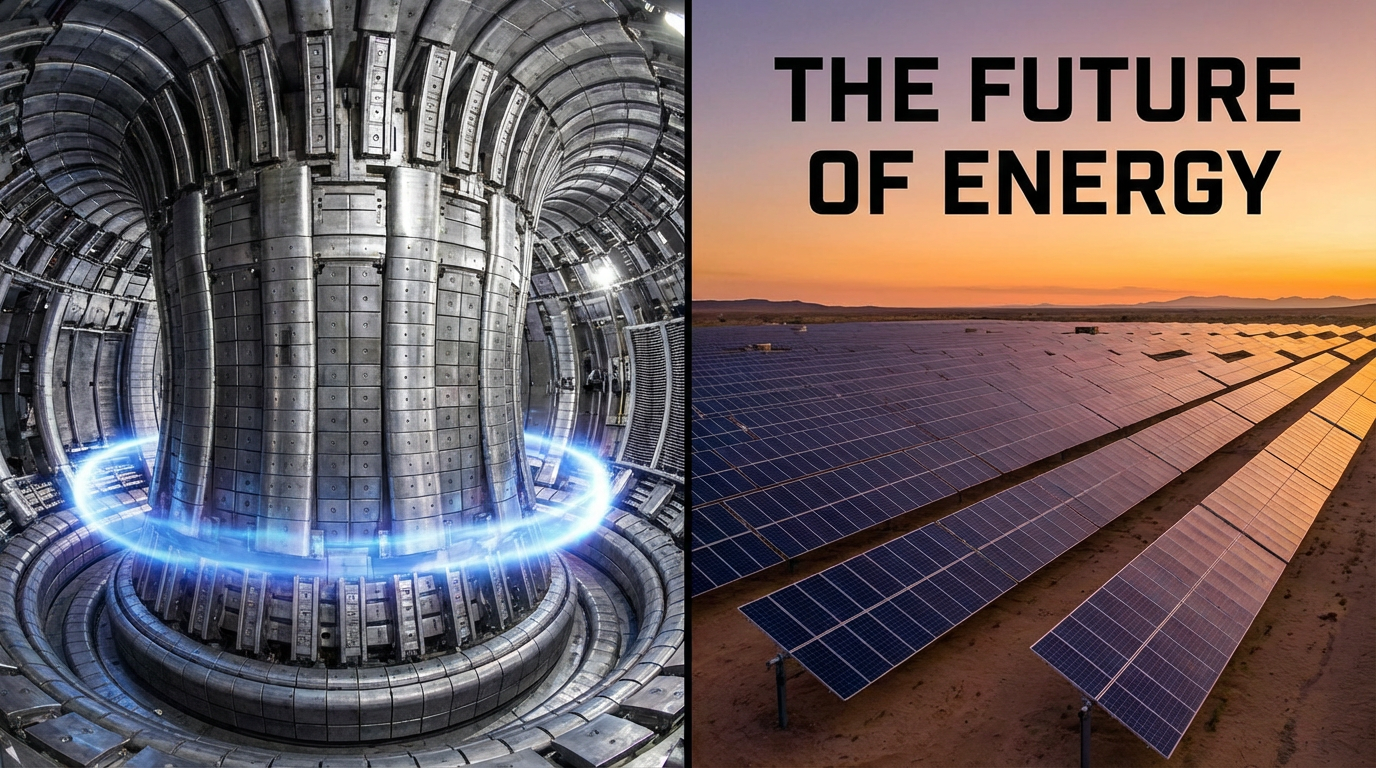
Thirty-nine dollars.
That's the global benchmark LCOE for utility-scale solar in 2025, according to BloombergNEF's latest numbers. Down from $60/MWh at the start of the decade. Down from $359/MWh in 2009. The learning curve hasn't bent. It hasn't plateaued. It just keeps falling, with the relentless, boring predictability of a manufacturing process that makes the same thing a billion times and gets slightly better each time.
Meanwhile, $9.8 billion has poured into private fusion companies as of July 2025 — $2.6 billion in the last twelve months alone. Commonwealth Fusion Systems. Helion Energy. TAE Technologies. Thirty-odd startups racing to build a power source that the most optimistic projections say will produce electricity at $60–97/MWh. The pessimistic ones say $110+.
Read those numbers again. The floor of fusion's projected cost range is 54% higher than what solar costs today. And solar is still getting cheaper.
The Cost Curves That Matter
Forget the plasma physics for a second. Forget net energy gain and triple product and lawson criteria. The question that will determine whether fusion actually matters is simple: can it produce a megawatt-hour of electricity cheaper than the alternatives by the time it's ready?
| Source | LCOE ($/MWh, 2025) | Trend |
|---|---|---|
| Utility solar (fixed-axis) | $39 | ↓ Falling 6%/yr |
| Onshore wind | $40 | → Flat |
| Solar + 4hr battery | $50–131 | ↓ Falling (battery costs dropping 25% by 2035) |
| Natural gas CCGT | $45–75 | ↑ Volatile, carbon risk |
| Nuclear fission (new build) | ~$100 | ↑ Rising (construction overruns) |
| Fusion (projected, mature) | $60–110 | ? Unknown — no plant exists |
Solar-plus-storage at $50/MWh. Falling further. By BloombergNEF's projection, another 30% cheaper by 2035. That's $27/MWh solar and $35/MWh solar-plus-storage by the time the first commercial fusion plant might be online.
Fusion doesn't have a learning curve yet. It has a fundraising curve.
What $9.8 Billion Bought
Real things. Important things. Commonwealth Fusion's HTS magnets hit 20 tesla at scale — a genuine engineering achievement that makes compact tokamaks viable. Google's Willow chip demonstrated quantum error correction below threshold. Wait, wrong article. But the point stands: fusion companies have made legitimate scientific progress.
CFS raised $1.8 billion and is building SPARC in Devens, Massachusetts. If SPARC achieves Q>2 (more energy out than in), it'll be the first privately-built device to do so. Helion signed a power purchase agreement with Microsoft — electricity by 2028, they say, though nobody outside Helion believes that timeline. TAE Technologies ($1.2 billion raised) is pursuing a proton-boron approach that would produce almost no neutron radiation if it works.
Good science. Possibly great engineering. But none of it answers the cost question.
The Baseload Argument (and Why It's Weakening)
Fusion advocates have a standard rebuttal to the LCOE comparison: solar is intermittent, fusion is baseload. The sun doesn't shine at night. Batteries degrade. You need something running 24/7 to hold the grid together.
This was a stronger argument three years ago.
In 2025, developers added 87 GW of combined solar-plus-storage worldwide. That's not pilot projects. That's grid-scale deployment, producing dispatchable power at $57/MWh average — and the trajectory is steep downward. Battery storage LCOE is expected to fall another 25% in the next decade as lithium-ion packs approach $50/kWh. Long-duration storage alternatives (iron-air, compressed air, gravity) are hitting commercial deployment.
The grid is learning to handle intermittency. Not perfectly. Not everywhere. But fast enough that "you still need baseload" is no longer the slam-dunk it was.
Where Fusion Might Actually Win
Three places. Maybe.
Dense urban areas where land for solar farms doesn't exist. A compact fusion plant producing 200 MW on two acres beats a solar farm needing 1,000+ acres, and there's no version of New York or Tokyo or Lagos that runs on rooftop solar alone.
Industrial heat. Steel, cement, ammonia production — processes that need 800–1500°C heat that batteries can't provide and hydrogen handles poorly. Fusion plasma runs at 150 million degrees. The heat is there. If you can extract it, you can decarbonize the 30% of emissions that electricity alone can't touch.
Space. Not joke. A compact fusion reactor producing continuous power for deep-space missions solves the problem that killed nuclear thermal propulsion projects: nobody wants to launch fissile material on a rocket that might explode on the pad. Fusion fuel (deuterium-tritium) is non-radioactive until you use it.
Notice what's missing from that list: bulk electricity generation for the grid. The thing most fusion companies are actually pitching to investors.
ITER: The $22 Billion Warning
Before the private fusion wave, there was ITER. Thirty-five nations. Cadarache, France. Original budget: €5 billion. Current estimate: €20+ billion. Original completion date: 2016. Current target: first plasma maybe 2035. Full deuterium-tritium operations: 2039 at the earliest.
ITER isn't a commercial plant. It's a science experiment. It will never produce electricity for a grid. Twenty billion euros to prove that a larger version might someday work.
Private fusion companies argue they'll be faster and cheaper because they're not burdened by international bureaucracy. They're probably right about the bureaucracy part. Whether they're right about the cost part is the $9.8 billion question.
The Uncomfortable Scenario
Here's what might happen. CFS builds SPARC. It works. Q>2, maybe Q>10. Headlines everywhere. Champagne in Devens. Then they build ARC, the commercial prototype. Five years, eight years, call it 2035. They turn it on. It produces electricity.
And solar-plus-storage costs $27/MWh.
Fusion works. The physics is solved. The engineering is solved. And the first commercial plant sells electricity at $80/MWh into a market where its competitors are half that price. What happens? The same thing that happened to the Concorde, to supersonic passenger flight, to nuclear-powered cargo ships. A technical triumph that lost the race to economics.
Maybe the cost comes down with scale. Maybe serial production of compact tokamaks follows a learning curve. But maybe isn't a business plan, and the capital markets that funded the first $9.8 billion will want returns before the twentieth plant drives costs below the first.
So What?
Fusion is real science, not scam science, and the private companies have achieved things the national labs couldn't. But achieving net energy gain is a physics problem. Selling electricity at $39/MWh is a manufacturing problem. These are different problems, and solving one doesn't solve the other. The smart money in fusion should be chasing the markets where solar can't compete — industrial heat, dense cities, space — rather than pretending the LCOE curves don't exist. The grid already has its answer. It's flat, it's blue, and it costs $39.
Sources & References
- BloombergNEF, "Levelized Cost of Electricity 2026" — global benchmark LCOE for fixed-axis solar at $39/MWh in 2025; onshore wind $40/MWh; solar+storage 87 GW deployed at $57/MWh avg; battery LCOE expected to fall 25% over next decade (via PV Magazine, Feb 2026)
- Fusion Industry Association, "Global Fusion Industry Report 2025" — total private fusion investment exceeds $9.8 billion; $2.6 billion raised in the 12 months ending July 2025 (via NucNet, Jul 2025)
- Commonwealth Fusion Systems, "Series B2 Round" — $863M raise announced Dec 2024; cumulative funding exceeds $2B; building SPARC tokamak in Devens, Massachusetts (PR Newswire)
- MIT News, "MIT-designed project achieves major advance toward fusion energy" — CFS/MIT PSFC 20-tesla high-temperature superconducting magnet demonstration, strongest fusion magnet in the world (Sep 2021)
- Helion Energy — groundbreaking on Orion fusion power plant; PPA with Microsoft targeting electricity delivery by 2028 (Construction Review Online)
- TAE Technologies — $1.2 billion raised to date; proton-boron (p-B11) fuel approach; Series G-2 of $250M closed (TAE press release)
- ITER project delays and cost overruns — original €5B budget now €20B+; first plasma pushed to 2035; DT operations 2039 earliest (Energy Reporters, citing Les Echos)
- Physics World, "ITER fusion reactor hit by massive decade-long delay and €5bn price hike" — additional context on ITER cost and schedule revisions