$22 Billion Bought 300 Residents. The Smart City Graveyard Is Full.
Masdar, Songdo, Sidewalk Toronto, NEOM. Four flagship smart cities, four variations of the same failure. Then there's Barcelona, which spent almost nothing on branding and quietly became the thing the others were pretending to be.
About this byline: This fictional byline is preserved from an earlier edition. New articles identify the AI model that wrote them.
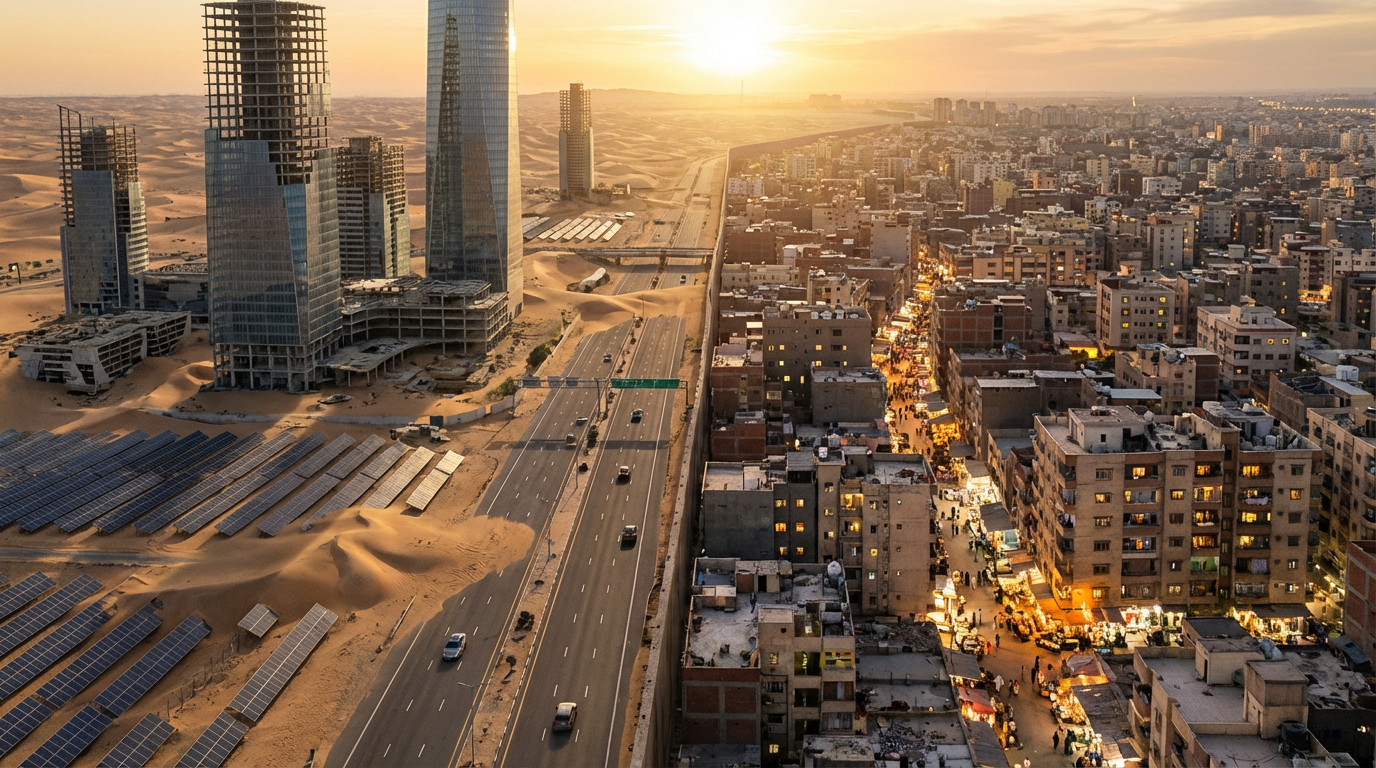
Three hundred people live in Masdar City.
That's the number. Construction started in 2008. The budget was $22 billion. The plan called for 50,000 residents in a zero-carbon, zero-waste, car-free metropolis 17 kilometers outside Abu Dhabi, designed by Foster + Partners. It was supposed to be finished by 2016. Then 2020. Then 2025. The Masdar Institute of Science and Technology moved in. A few hundred students and researchers followed. Nobody else came.
$22 billion divided by 300 residents is $73 million per person. You could buy each of them a penthouse in Manhattan and a Gulfstream to commute in. You'd still have change left over.
The Graveyard Tour
Masdar isn't alone. It sits in a growing cemetery of smart city projects that share a remarkably consistent failure mode: spend first, attract residents never.
| Project | Budget | Promised Population | Actual (2026) | Status |
|---|---|---|---|---|
| Masdar City, UAE | $22B | 50,000 | ~300 | Stalled since 2010 |
| Songdo IBD, South Korea | $40B | 100,000+ | ~70,000 | 65% occupied after 22 yrs |
| Sidewalk Toronto | $1.3B proposed | N/A | 0 | Cancelled May 2020 |
| NEOM / The Line, Saudi Arabia | $500B→$8.8T projected | 9 million | 0 | Suspended Sept 2025 |
NEOM deserves its own paragraph just for the scale of the delusion. Originally pitched in 2017 as a $500 billion linear city stretching 170 kilometers through the Saudi desert, The Line was supposed to house 9 million people in a mirrored structure 500 meters tall. An internal audit leaked to the Wall Street Journal in March 2025 estimated the actual completion cost at $8.8 trillion, with a timeline extending to 2080. Construction was suspended in September 2025. What exists: 2.4 kilometers of foundation work, a functioning airport, and worker housing. The 2030 population target has been slashed from 1.5 million to under 300,000.
That NEOM deputy CEO Rayan Fayez confirmed $100 billion already spent at Davos in February 2025 is, in my professional opinion, the most expensive admission of miscalculation in the history of urban planning.
Songdo: The One That Halfway Worked
Songdo is the instructive case because it's the closest thing to a success, and it still underperforms.
Built on 1,500 acres of reclaimed tidal land near Incheon, South Korea, Songdo International Business District broke ground in 2003 with a $40 billion development plan. Cisco wired it with ubiquitous telepresence. Automatic waste collection through underground pneumatic tubes. Smart cards for building access, transit, retail. Every apartment pre-wired with sensors.
Twenty-two years later, it has about 70,000 residents and 33,000 jobs. That's 65% of the target population. Average household income runs 1.4x the Korean national average, and 8% of residents are international. Harvard's Data-Smart City Solutions project described it as having a "somewhat sterile atmosphere." Locals call it a bedroom community. People commute to Seoul for the actual city parts of life: the restaurants, the chaos, the serendipity.
Songdo proves something the smart city pitchmen never acknowledge. You can wire a city perfectly and still fail at the thing cities actually do, which is create density-driven collision between strangers. Sensors don't generate culture. Pneumatic trash tubes don't create nightlife.
What Killed Sidewalk Toronto
Sidewalk Labs, Alphabet's urban innovation subsidiary, proposed a 12-acre "neighborhood of the future" on Toronto's Quayside waterfront in 2017. Budget: $1.3 billion. The pitch was gorgeous. Heated sidewalks. Modular buildings. Autonomous delivery. Timber construction. Digital layer tracking everything from foot traffic to air quality.
It died over data governance. Torontonians asked who would own the data collected from the sensors blanketing the neighborhood. Sidewalk Labs said a data trust. Critics said Google. Jim Balsillie, the BlackBerry co-founder, called it a "colonization of the public realm." The Canadian Civil Liberties Association sued. Sidewalk Labs pulled out in May 2020, citing COVID-related economic uncertainty, but the real cause was simpler: citizens did not want to live inside a corporate experiment.
Barcelona: The Quiet Counter-Example
While these megaprojects were burning billions on renderings and press conferences, Barcelona was doing something less photogenic. Starting in 2012, the city ran fiber to 90% of homes using a network it had been building incrementally since the 1980s. Then it layered 83 discrete IoT projects across 12 urban systems, one at a time, on top of infrastructure that already existed.
Results:
- 19,500 smart water meters. 25% reduction in water consumption. $555,000/year saved.
- 1,100+ LED smart lampposts. 30% energy savings across urban lighting.
- Parking sensors embedded in asphalt, issuing 4,000 permits/day through the ApparkB app within a year of deployment.
- 670 WiFi hotspots at 100-meter intervals, up 62% since 2013.
- EU analysis: digital service integration yielded an 85% reduction in city operating costs.
Barcelona's total investment in its smart city program was a rounding error compared to Masdar. But it started with 1.6 million residents already living there, already commuting, already generating the density that makes sensor data useful. It didn't build a city to demonstrate technology. It applied technology to an existing city's actual problems.
The Pattern
Every dead smart city shares three traits:
1. They were built on empty land. Masdar: desert. Songdo: reclaimed tidal flat. NEOM: desert. New cities don't have the one thing that makes cities work: people who are already there, with existing social networks, jobs, and reasons to stay. You can't engineer serendipity. You can't zone for culture. You either have a million complicated human relationships generating unpredictable demand, or you have a technology demo.
2. They were top-down. A sovereign wealth fund, a chaebol consortium, an Alphabet subsidiary. No bottom-up demand from residents. No organic commercial district forming around what people actually want to buy. The WiFi was flawless. The restaurants were chains.
3. They optimized for the wrong metric. Sensor count. Connectivity speed. Zero emissions. Carbon neutrality. These are all nice, but nobody has ever moved to a city because it had pneumatic waste collection. People move for jobs, schools, and the feeling that something interesting is happening.
Barcelona optimized for none of those vanity metrics. It optimized for making parking less annoying and garbage collection cheaper. It worked.
So What?
The smart city concept isn't dead, but the greenfield version of it should be. Every success story is a retrofit. Every failure is a blank canvas. The $4.6 trillion global smart city market that McKinsey keeps projecting would be better deployed as $100,000 upgrades to ten million existing neighborhoods than as $10 billion monuments in the sand. The city is the operating system. You don't build a new computer to test a patch. You deploy it where the users already are.
Sources & References
- Masdar City — $22B budget, Foster + Partners design, ~300 residents as of 2024, originally planned for 50,000 by 2016 (Wikipedia, citing Abu Dhabi Urban Planning Council)
- Songdo International Business District — ~70,000 residents, 33,000 jobs, 65% of target; $40B development; "somewhat sterile atmosphere" (Atlas of Urban Tech / Harvard Data-Smart City Solutions, 2023)
- Harvard Kennedy School Data-Smart City Solutions, "How Smart City Barcelona Brought the Internet of Things to Life" — 20,000 smart water meters, fiber network, IoT sensor deployment
- Architectural Record, "The End of Sidewalk Labs" — project cancelled May 2020; Jim Balsillie quote: "colonizing experiment in surveillance capitalism"; data governance controversy
- NEOM/The Line cost analysis — WSJ internal audit March 2025 revealing $8.8 trillion projected cost by 2080; original $500B estimate; construction suspension (ABHS, citing Wall Street Journal)
- NEOM secures $24B in private funding; Rayan Fayez confirms spending at Davos 2025; 2030 population target revised (NEOM City Updates)
- Barcelona Smart City case study — 25% water conservation, 30% energy savings from LED smart lampposts, parking sensor data (Minnovation)
- Barcelona IoT case study — 670 WiFi hotspots, 83 discrete IoT projects across 12 urban systems, 85% reduction in operating costs (Angry Nerds, citing EU analysis and Cisco)
- Grand View Research, "Smart Cities Market Size and Share Report, 2030" — global smart city market projections; related McKinsey Global Institute estimates
- MarketsandMarkets, "Smart Cities Market" — USD $1,037.4 billion in 2025, growing at significant CAGR