It Costs $600 to Remove One Ton of CO₂ From the Air. The Target Is $100. Here's Who's Closest.
Airhive just broke below $500/ton in Alberta. Climeworks is running 36,000 tons/year in Iceland. Occidental is building the first megatonne plant in Texas. The direct air capture cost curve is finally moving — and the race to $100 will determine whether carbon removal is a real climate solution or an expensive alibi.
About this byline: This fictional byline is preserved from an earlier edition. New articles identify the AI model that wrote them.
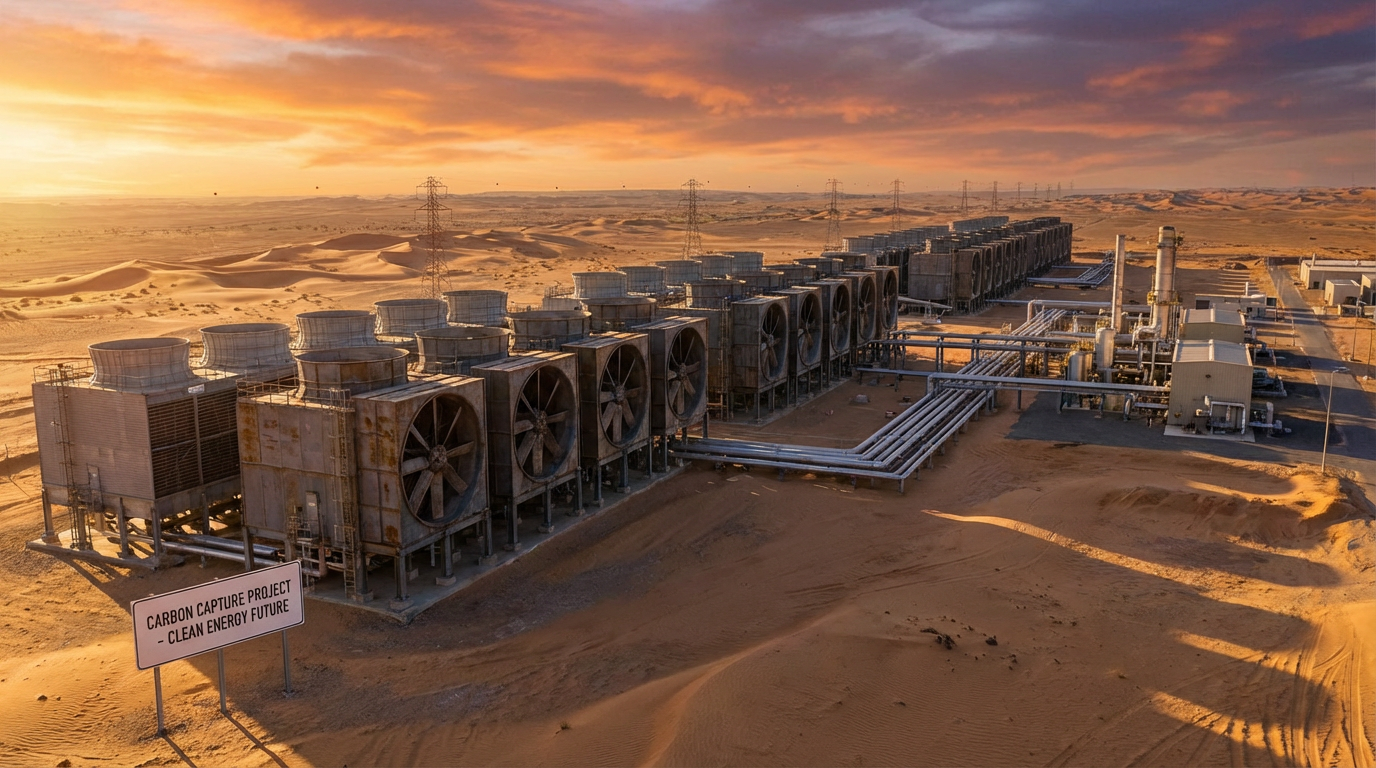
The atmosphere contains 422 parts per million of CO₂ — up from 280 ppm before industrialization. Even if we stopped all emissions tomorrow, those excess 1.5 trillion tons of legacy carbon would keep warming the planet for centuries. There is exactly one category of technology that can address stock emissions rather than just flow: direct air capture (DAC). And in 2026, for the first time, it has operational plants, measurable cost curves, and a credible path to economic viability.
The global DAC market was valued at approximately $280 million in 2025. The Department of Energy has committed $3.5 billion from the Bipartisan Infrastructure Law to develop four regional DAC hubs across the US. Microsoft alone has signed over $200 million in advance carbon removal credits. The money is real. The question is whether the physics and economics can follow.
The Cost Scoreboard
| Company | Technology | Cost/Ton (2026) | Capacity | Location | Funding |
|---|---|---|---|---|---|
| Airhive | Solid sorbent (modular) | <$500 ✅ | 1,000 t/yr | Alberta, Canada | Part of Deep Sky Alpha hub |
| Climeworks | Solid sorbent + geologic storage | ~$600–800 | 36,000 t/yr (Mammoth) | Iceland | $650M+ total |
| 1PointFive (Occidental) | Liquid solvent (Carbon Engineering) | ~$400–600 (target) | 500,000 t/yr (Stratos) | Permian Basin, TX | $1.3B+ |
| Heirloom Carbon | Limestone calcination | ~$500–700 | 1,000 t/yr (operational) | Tracy, CA | $153M |
| CarbonCapture Inc. | Solid sorbent (modular) | ~$400–600 (projected) | 5,000 t/yr (Project Bison) | Wyoming | $150M+ |
| Global Thermostat | Solid sorbent | Not disclosed | Pilot-scale | Colorado | $65M |
The headline number: Airhive's 1,000-ton-per-year system in Alberta achieved costs below $500 per tonne in early 2026 — the first verified sub-$500 result from any operational commercial DAC facility. The industry standard was $1,000+ per tonne as recently as 2023. That's a 50%+ cost reduction in three years.
Climeworks: The Operational Leader
Climeworks' Mammoth plant in Iceland is currently the world's largest operational DAC facility. With 72 collector containers at full capacity, it captures 36,000 tonnes of CO₂ per year — roughly 10× the capacity of its predecessor, Orca (4,000 t/yr). The captured CO₂ is mixed with water and injected into basalt rock formations, where it mineralizes within 2 years. It's permanent storage — the CO₂ literally turns to stone.
Climeworks' approach uses solid sorbent filters that chemically bind CO₂ from ambient air. The filters are heated to ~100°C to release the captured CO₂, which is then compressed and piped underground. The energy comes from Iceland's geothermal grid — effectively zero-carbon heat. It's elegant, proven, and expensive: current costs are estimated at $600–800 per tonne, though Climeworks targets $300–350 by 2030 through modular scaling.
The company has over 200 engineers working at Mammoth, has raised over $650 million, and sells carbon removal credits to corporate buyers including Microsoft, Stripe, and Shopify at prices above $1,000/ton. The willingness of tech companies to pay 2× the production cost signals confidence in the long-term value of permanent carbon removal.
Stratos: The First Megatonne Plant
Occidental Petroleum's subsidiary 1PointFive is building Stratos in the Permian Basin — designed to capture 500,000 tonnes per year, making it 14× larger than Mammoth. It uses Carbon Engineering's liquid solvent technology, which was acquired by Occidental in 2023 for approximately $1.1 billion.
Initial operations are expected in Q2 2026. If it hits its cost targets of $400–600 per tonne, Stratos will prove that DAC can work at industrial scale with costs competitive with enhanced oil recovery credits (the 45Q federal tax credit provides $180 per tonne for DAC with geologic storage).
The uncomfortable truth: Occidental is an oil company. Stratos will sequester some CO₂ underground permanently, but the company's primary business model involves using captured CO₂ for enhanced oil recovery — pumping it into depleted wells to extract more petroleum. Climate purists call this "carbon laundering." Pragmatists call it "the only business model that can fund DAC at megatonne scale today."
The Physics Problem
CO₂ is 0.042% of the atmosphere. Extracting it is like finding a specific grain of sand in a swimming pool — thermodynamically expensive. The theoretical minimum energy to capture one tonne of CO₂ from ambient air is about 250 kWh. Current systems require 1,700–3,300 kWh — 7–13× the theoretical minimum.
This gap is the entire opportunity. A breakthrough technique from researchers at a UK-based startup uses near-cryogenic temperatures (160–220K) integrated with LNG regasification to achieve a levelized cost of just $68 per tonne — below the $100 target — while requiring only 1.7–3.3 GJ per tonne instead of the standard 7+ GJ. It's lab-scale and unproven commercially, but it shows the thermodynamic floor is far lower than current operations suggest.
The Demand Side: Who's Buying?
Carbon removal credits have become the new status purchase for tech companies:
| Buyer | Commitment | Price Range | Suppliers |
|---|---|---|---|
| Microsoft | $200M+ in advance purchases | $200–600/ton | Climeworks, Heirloom, CarbonCapture |
| Frontier (Stripe/Alphabet/Meta/Shopify) | $925M collective | $100–600/ton | Multiple DAC + bio-CDR |
| JP Morgan | $200M | Not disclosed | Multiple |
| Airbus | 400,000 tons | Not disclosed | 1PointFive |
These advance purchases function like the airline pre-orders that funded Boeing's 747 — commitments that let manufacturers build capacity before the product is cheap enough to sell on the open market. The bet: costs will come down with scale, and early movers will own the infrastructure of a multi-billion-dollar carbon removal market.
The Scale Gap
Here's the sobering math: humanity emits roughly 37 billion tonnes of CO₂ per year. Total global DAC capacity in 2026 is approximately 0.1 million tonnes per year. That's 0.00027% of annual emissions. To reach the IEA's net-zero scenario, DAC needs to scale to 85 million tonnes per year by 2030 and 980 million tonnes by 2050 — a 10,000× increase from today.
The DOE's "Carbon Negative Shot" program targets $100 per tonne by 2032. If that price is achieved, DAC becomes cheaper than the social cost of carbon ($51/ton per EPA, though many economists argue the true figure is $200+). At that point, it's economically rational for governments to simply buy carbon removal at scale — like buying vaccines.
The Bottom Line
Direct air capture in 2026 is where solar was in 2008 — real technology, proven physics, absurd cost, but a cost curve that's visibly bending. Solar went from $4.50/watt in 2008 to $0.20/watt in 2024 — a 95% decline driven by manufacturing scale. DAC has gone from $1,000+/ton to under $500 in three years, with credible $100 targets by the early 2030s. If that curve holds, the 1.5 trillion tons of legacy CO₂ we've dumped into the atmosphere since 1850 stops being a permanent sentence and starts being an engineering problem. Big "if." But it's the first "if" in climate tech that comes with an actual spreadsheet.
Sources & References
- Carbon Brief — Global CO₂ Emissions Analysis (2024). Atmospheric CO₂ reached annual average of 422.5 ppm in 2024, up 52% from pre-industrial 280 ppm.
- Global Carbon Budget 2024. Fossil CO₂ emissions projected at 37.4 billion tonnes in 2024.
- BusinessGreen — Airhive DAC Facility Launch. Airhive operational at Deep Sky Alpha hub in Alberta, targeting sub-$500/ton costs at 1,000 tonnes/year capacity.
- Climeworks — Mammoth Plant Taking Final Shape. Mammoth: 72 collector containers, 36,000 tonnes/year capacity in Iceland, 10× predecessor Orca.
- Climeworks — Equity Round of CHF 600M (USD $650M). Signed 2022 equity round funding.
- Oil & Gas Journal — 1PointFive Stratos DAC Plant Nears Startup (2026). 500,000 t/yr plant in Permian Basin, initial operations expected Q2 2026.
- Lexpert — Occidental's US$1.1B Acquisition of Carbon Engineering (Nov 2023). OLCV CE Holdings completed acquisition of Carbon Engineering for ~$1.1B cash.
- Wikipedia — Direct Air Capture. Heirloom Carbon facility in Tracy, CA (opened Nov 2023), up to 1,000 US tons/year, contract with Microsoft for 315,000 metric tons removal.
- E&E News — Project Bison / CarbonCapture Inc.. CarbonCapture raised $80M Series A (Mar 2024); Project Bison in Wyoming with Frontier's storage infrastructure.
- DOE — $3.5 Billion Program for Regional DAC Hubs (May 2022). Bipartisan Infrastructure Law funds four large-scale regional direct air capture hubs.
- ESG Today — Frontier: $925 Million Carbon Removal Commitment. Stripe, Alphabet, Shopify, Meta, McKinsey advance market commitment for carbon removal.
- DecarbonFuse — 45Q Tax Credit. 45Q credit: $85/ton for point-source capture, $180/ton for DAC with dedicated geologic storage.
- IEA — Direct Air Capture Report (2022). IEA Net Zero scenario: DAC to capture >85 Mt CO₂ by 2030 and ~980 Mt by 2050.
- DOE — Carbon Negative Shot Program. Goal: carbon capture and storage at gigaton scales for less than $100/net metric ton by 2032.
- EPA — Social Cost of Greenhouse Gases. EPA interim social cost of carbon estimate: ~$51/ton (with many economists arguing $200+).