A $2,000 Drone Drains a $413 Million Magazine. At 2,151:1 Exchange Ratios, Lasers Aren’t Optional — They’re Arithmetic.
Original magazine-drain calculation reveals that 96 Shahed-class drones costing $192,000 total can force a US Navy destroyer to empty its entire $413 million missile loadout. NATO just committed $40 billion to counter-drone technology. Directed energy weapons at $13 per shot break even after 94 intercepts.
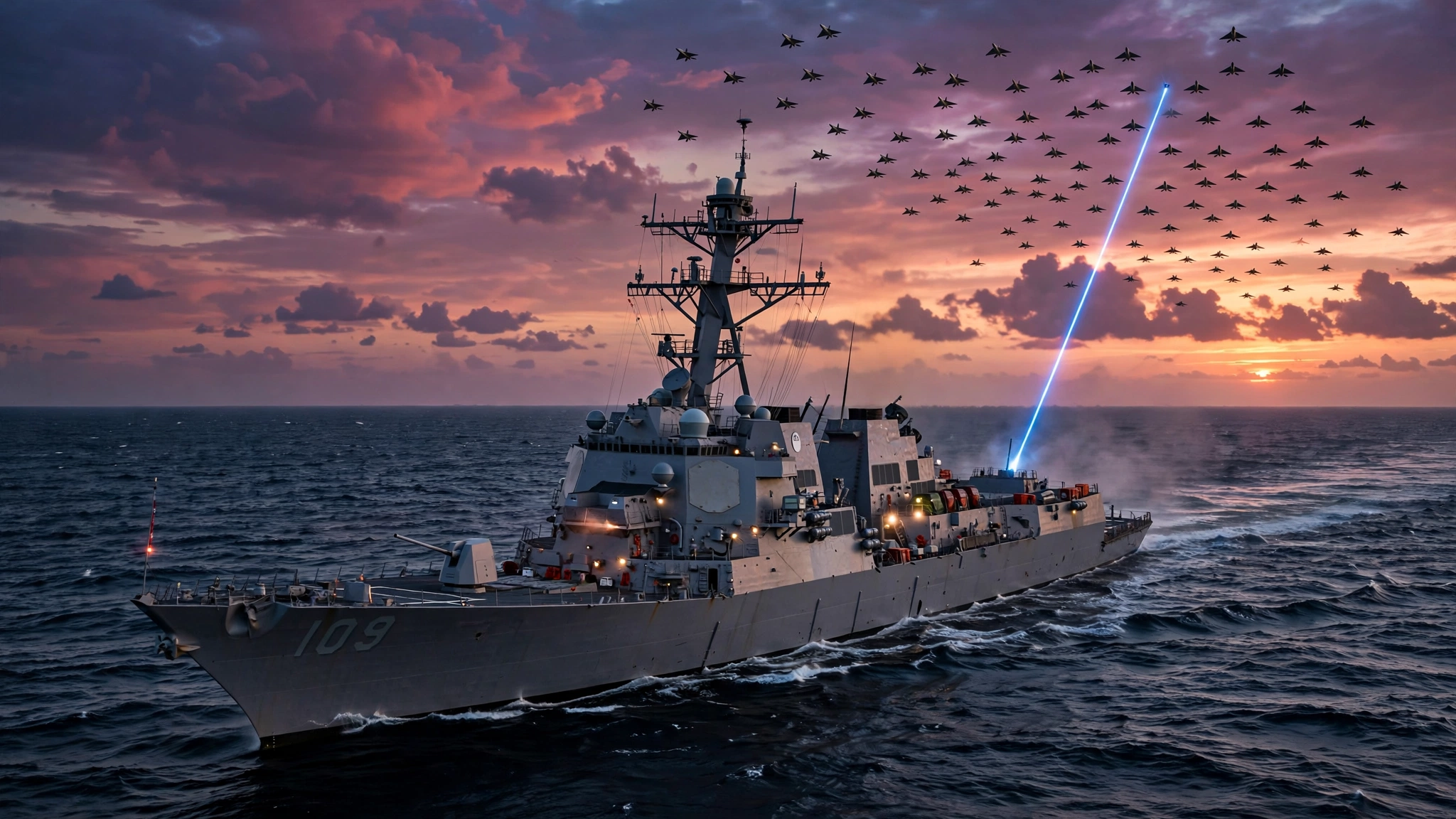
Two thousand one hundred and fifty-one to one. That is the cost-exchange ratio between the missiles loaded aboard a US Navy Arleigh Burke-class destroyer and the Shahed-class drones needed to exhaust every single one of them, calculated from the Navy's own FY2025 budget documents and published drone production cost estimates. It is, by a wide margin, the most extreme attacker-defender economic asymmetry in the history of modern warfare, and three separate combat theaters proved it real in the span of six months.
On July 13, US Central Command confirmed that three Saronic Corsair unmanned surface vessels struck Iran's Bandar Abbas Naval Base, marking the first time American forces employed sea drones in combat. Hours earlier, Reuters reported Germany funding 50,000 autonomous FPV strike drones for Ukraine at roughly €1,800 each, the largest known single drone purchase by a Western government. And on July 7, NATO Secretary General Mark Rutte announced a $40 billion collective investment in counter-drone capabilities over five years, alongside plans for an Amazon-style drone marketplace and a fivefold increase in drone operator training by end of 2027.
Three announcements in one week. All pointed in the same direction: the cost curve of warfare has inverted, and the institutions built around expensive weapons are scrambling to adjust to a world where the cheapest weapon wins.
The Magazine Drain Model
Start with the ship. An Arleigh Burke-class guided-missile destroyer costs approximately $2.2 billion to build and carries 90 to 96 vertical launch system cells. Its FY2025 budget requested $533.2 million for 125 SM-6 Block IA missiles, putting unit cost at $4.27 million each, and $43 million for 17 SM-2 Block IIIC missiles at $2.53 million apiece, per the Congressional Research Service.
Load a destroyer entirely with SM-6 interceptors. Ninety-six cells times $4.27 million equals $409.9 million in missiles aboard a single hull. Round it to $413 million including integration and logistics.
Now price the threat. Iran's Shahed-136 one-way attack drone costs between $2,000 and $5,000 per unit in volume production, according to estimates from the Royal United Services Institute and the International Institute for Strategic Studies. Use the low end: $2,000.
Ninety-six Shaheds at $2,000 each: $192,000, which is what it costs to force a destroyer to fire every missile in its magazine, not to sink the ship, just to drain its ammunition. Exchange ratio: $413 million divided by $192,000 equals 2,151 to 1. A sum that would not cover a down payment on a house in San Francisco forces the expenditure of more than four hundred million dollars in interceptors, and the destroyer, now empty, must sail to port and reload over days while the attacker produces another 96 drones in hours.
None of this is theoretical. USS Carney fought the most intense naval air defense engagement since World War II in the Red Sea, and American warships have expended over $1 billion in interceptors against Houthi-launched weapons since late 2023, with the cost-exchange ratio ranging from 220:1 to 2,500:1 in the Houthis' favor according to MissileStrikes.com analysis of published engagement data.
What LUCAS Concedes
CENTCOM noticed. In February 2026, American forces used the LUCAS drone in combat for the first time against Iranian military targets during Operation Epic Fury, a weapon whose name, Low-cost Uncrewed Combat Attack System, advertises its own philosophy. LUCAS is a reverse-engineered copy of the Shahed-136, built by Arizona-based SpektreWorks, at $35,000 per unit.
Absorb what that means: a military that operates $20-to-$40-million MQ-9 Reapers, $2 million Tomahawk cruise missiles, and $170 million F-35 fighters captured an Iranian drone from a battlefield, disassembled it, rebuilt it with American components, and started mass-producing copies at $35,000 each because the cheap version delivered more tactical value per dollar than platforms costing a thousand times more. Washington owns the intellectual property, meaning any manufacturer can produce it, and the FLM-136 designation makes no attempt to disguise its parentage.
Concession.
LUCAS deployment contributed to an 83% decline in Iranian drone attacks during the early phase of the conflict, according to defense officials cited by TechSpot, and a former senior defense official called it "the Toyota Corolla of drones," a description that would have been unthinkable five years ago from anyone inside the building. Congress authorized a $1 billion Drone Dominance Program in the One Big Beautiful Bill Act of 2025 to scale production further.
Sea Drones Cross the Combat Threshold
Cost inversion extends beyond the air. Saronic, an Austin-based startup founded by former SEAL Team Six operator Dino Mavrookas, builds the Corsair: a 24-foot autonomous surface vessel with a 1,000-nautical-mile range, 35-knot top speed, and 1,000-pound payload capacity, reportedly priced under $1 million per unit.
In December 2025, Saronic won a $392 million production contract from the Navy, moving from prototype to production in under 12 months, a timeline that Secretary of the Navy John Phelan called the new standard. On July 13, three Corsairs hit the port at Bandar Abbas Naval Base, marking the first use of American sea drones in combat operations, and weeks earlier a Corsair rescued two Army Apache helicopter pilots from the Gulf of Oman, the first-ever drone boat personnel recovery.
Saronic closed a $1.75 billion Series D in April 2026 at a $9.25 billion valuation, and is expanding its Louisiana shipyard by 300,000 square feet. Stated goal: half the Navy's surface fleet unmanned. Originally designed for the Pentagon's Replicator program, the Corsair was built to field swarms of thousands of expendable platforms to deter a Chinese invasion of Taiwan.
Consider the unit economics: one Corsair costs under $1 million, while an Arleigh Burke destroyer costs $2.2 billion, meaning a single destroyer's budget buys 2,200 Corsairs, each carrying 1,000 pounds of payload across 1,000 nautical miles. Nobody is replacing destroyers with drone boats, but every operational role a Corsair fills is a role that no longer demands a $2.2 billion hull and 330 sailors.
Directed Energy Break-Even
If interceptor missiles cost too much, the obvious question is whether anything cheaper can shoot down a drone. Scotland delivered the answer in late 2025.
MBDA won a £316 million contract ($403 million) from the UK Ministry of Defence to deploy DragonFire, a 50-kilowatt directed-energy weapon, on a Type 45 destroyer by 2027. During trials at the MOD's Hebrides Range, DragonFire intercepted drones flying at 650 km/h, accurate enough to hit a £1 coin from a kilometer away. Cost per engagement: roughly £10, or $13.
Thirteen dollars against a $4.27 million SM-6 missile. Read that ratio: 328,462 to 1.
Run the break-even. DragonFire's full contract costs $403 million, and each intercept that would have required an SM-6 saves $4.27 million, so dividing gives 94.4 intercepts to fully amortize the laser system against the missile inventory it replaces. After the 95th drone kill, every subsequent engagement is essentially free relative to the old model. In the Red Sea, where American warships fired over 100 interceptors in a few months, DragonFire would have paid for itself before the Carney came home.
Washington is moving faster still. On July 10, defense officials signed two Joint Laser Weapon System agreements with nLIGHT Defense and Lockheed Martin Aculight worth $86 million initially and up to $847 million at full ceiling, with initial prototypes at 150 kilowatts and a roadmap to 300–500 kW, enough to stop cruise missiles. Australia's Electro Optic Systems claims its 150 kW Apollo system can destroy 20 to 50 drones per minute.
US Army prototypes ran at White Sands Missile Range in March 2026, reporting engagement costs of approximately $300 per shot, while Israel's Iron Beam system targets sub-$3.50 per intercept. Between $3.50 and $300, directed energy spans three orders of magnitude in cost, but between $900,000 (the cheapest US ship-launched missile, the RIM-116) and $4.9 million (SM-6), conventional interceptors span barely half an order. Lasers already win by a factor of at least 3,000 at the expensive end of their range.
NATO's $40 Billion and What 388:1 Means
At the Ankara summit on July 7, NATO committed $40 billion in counter-drone investment over five years, a figure that sounds decisive in isolation but reveals the depth of the cost asymmetry when placed alongside the offensive numbers.
Germany bought 50,000 attack drones for €90 million ($103 million). Divide NATO's $40 billion by that $103 million and the ratio is 388: NATO's counter-drone spending is 388 times the cost of Germany's entire offensive drone package, which means that for what the alliance plans to spend defending against cheap drones, you could purchase 19.4 million FPV attack drones at Germany's negotiated price.
In a conventional weapons market, defenders might spend 2 to 5 times the cost of a threat on countermeasures, a manageable premium for the security advantage. At 388:1, defense becomes an economic siege, because an attacker does not need to destroy the defender's military when the attacker needs only to outlast the defender's budget.
EOS, the Australian laser manufacturer, frames it with an engineer's bluntness: "For every million dollars spent on attacking someone, defenders may spend 50 times more to stop it. Unless defenses are carefully engineered, the economics of conflict can bankrupt you before they kill you."
Even that 50:1 estimate is conservative by Red Sea standards, where realized ratios exceeded 2,000:1. Traditional defensive advantages like superior training, more sophisticated systems, and information superiority all remain real, but they no longer compensate for a four-order-of-magnitude cost gap.
Where $40 Billion Actually Goes
If directed energy works, why does NATO need $40 billion? Because lasers solve the per-shot cost problem but not the deployment problem. A 50 kW laser on a Type 45 destroyer protects one ship, while NATO has 30 member nations, thousands of kilometers of border, and critical infrastructure spanning refineries, pipelines, power grids, ports, airfields, and telecommunications networks across a continent. Drones do not need to find a warship to find a target, and a transformer is just as vulnerable as a flight deck.
Reuters documented how Russia used fiber-optic-cable-guided FPV drones to bypass Ukrainian electronic warfare defenses and destroy autotransformers worth $3.5 million each inside 330 kV substations, with the drones navigating around concrete sarcophagi and anti-drone netting by cutting holes with a first drone and sending a second through the gap. These drones are immune to jamming because they carry no radio signals at all; they are tethered to their operators by a physical wire that electronic warfare cannot touch.
Defending a warship at sea against a drone is an engineering challenge. Defending a continent's electrical grid against fiber-optic-guided drones that cost less than a used laptop is a civilization-scale resource allocation problem. NATO's $40 billion begins to look less like an investment and more like a down payment.
Limitations
This analysis uses published cost estimates that carry significant uncertainty. Shahed-136 unit cost estimates range from $2,000 to $50,000 depending on the source and variant; our 2,151:1 ratio uses the RUSI/IISS low-end figure, and the ratio falls to 86:1 at the $50,000 high end, which remains historically unprecedented but is a much less dramatic number. SM-6 unit costs vary by block and production lot. Our magazine-drain model assumes every VLS cell holds an SM-6, which overstates cost since real loadouts mix SM-2, SM-6, ESSM, Tomahawk, and other munitions with varying price points. We do not model the operational constraint that a single Shahed cannot sink a destroyer; magazine drain matters because the ship becomes defenseless after expending its missiles, but attrition warfare requires sustained waves, not a single salvo. Directed energy break-even calculations use acquisition cost only, excluding maintenance, power generation, cooling, and crew training costs that will increase real operating expense, making the 94-intercept figure optimistic. DragonFire's 50 kW output may be insufficient against larger, faster, or armored targets because the weapon is designed for small UAS, not cruise missiles, though the 300–500 kW roadmap addresses this gap. Iron Beam's sub-$3.50 cost excludes system procurement; published Israeli government cost is $50 million per battery. All cost-per-shot figures for directed energy reflect marginal energy cost and exclude amortized capital expenditure.
Strongest Counterargument
A more serious objection is that cost-per-unit and combat effectiveness are not the same thing. An SM-6 at $4.27 million does not just intercept drones; it also kills cruise missiles, engages ballistic missiles in their terminal phase, and conducts anti-surface warfare, capabilities no current directed-energy weapon can replicate. Removing SM-6 from the magazine in favor of lasers would leave ships defenseless against sophisticated threats that drones do not replace. Correct architecture is layered: lasers handle the cheap swarm, missiles handle the fast, maneuvering, high-value threat. Israel's Iron Dome works this way already, with Tamir interceptors at $40,000–$50,000 handling low-end threats while David's Sling ($1 million) and Arrow ($2–3 million) address ballistic missiles. Cost-exchange ratios against drones are not an argument to eliminate expensive interceptors but rather an argument to stop using them against targets they were never designed for, and the real scandal is not the SM-6's price but the 20-year procurement gap that left the Navy without a cheaper alternative.
The Playbook
If you are in defense procurement: Red Sea engagements proved that shooting $4 million missiles at $2,000 drones is fiscal suicide, and directed energy is no longer speculative. Britain, America, Israel, and Australia all have systems in testing or early deployment, with DragonFire reaching operational capability on a warship in 2027 and Army prototypes running at White Sands as recently as March. Procurement decisions made in the next 18 months will determine whether NATO's forces face the next drone swarm with $13 laser shots or $4 million missiles, and the break-even math requires just 94 intercepts, a threshold Red Sea engagements exceeded in weeks.
If you are an investor: Saronic ($9.25B valuation, $1.75B Series D) and SpektreWorks (LUCAS manufacturer, government-owned IP but sole current producer) represent opposite ends of the drone cost spectrum. Saronic builds the expensive autonomous platforms the Navy wants to field at scale. SpektreWorks builds the expendable ones. Directed energy companies, nLIGHT (LASR, public), Lockheed Martin (LMT), and MBDA (private, BAE/Airbus joint venture), hold the long-dated optionality on the counter-drone market that NATO just sized at $40 billion over five years. EOS (public, ASX: EOSau) claims the highest engagement rate at 50 drones per minute.
If you manage critical infrastructure, refineries, power stations, ports, or telecommunications: the fiber-optic drone threat demonstrated in Ukraine applies directly to you. Electronic jamming, the cheapest counter-drone layer, does not work against wired drones. Physical hardening (netting, concrete) was defeated by sequential drone attacks. Budget for layered point defense, not just perimeter security, and track NATO's counter-drone marketplace when it launches.
Bottom Line
Warfare's cost curve has inverted. For most of modern military history, defenders held an economic advantage: fortifications, air defense networks, and interceptors cost less per engagement than the platforms they defeated, but that arithmetic broke sometime between late 2023 and mid-2026, when the Red Sea proved it at sea, Ukraine proved it on land, and the Iran campaign proved it in the air. Ninety-six Shahed-class drones costing $192,000 can force a destroyer to fire $413 million in missiles. Germany bought 50,000 attack drones for $103 million. NATO committed $40 billion to counter them, producing a defense-to-offense spending ratio of 388:1, and the US military's response was to copy its adversary's cheapest weapon, manufacture it for $35,000, and call it LUCAS. Directed energy at $13 per shot is the only technology that restores the defender's cost advantage, breaking even after 94 intercepts, but lasers protect points, not continents, and a fiber-optic-guided drone costing less than a laptop can navigate around concrete walls to destroy a $3.5 million transformer. What inverted was not just the cost curve but the fundamental assumption that defense is cheaper than offense, and the side that adjusts faster to that inversion will define the next era of military power while the attackers keep winning the budget war by four orders of magnitude.