⚡ Energy
In March, Zero Fed Officials Projected Rate Hikes. Now Nine Do. The Reason Is AI, and It's Already Costing You $460 a Year.
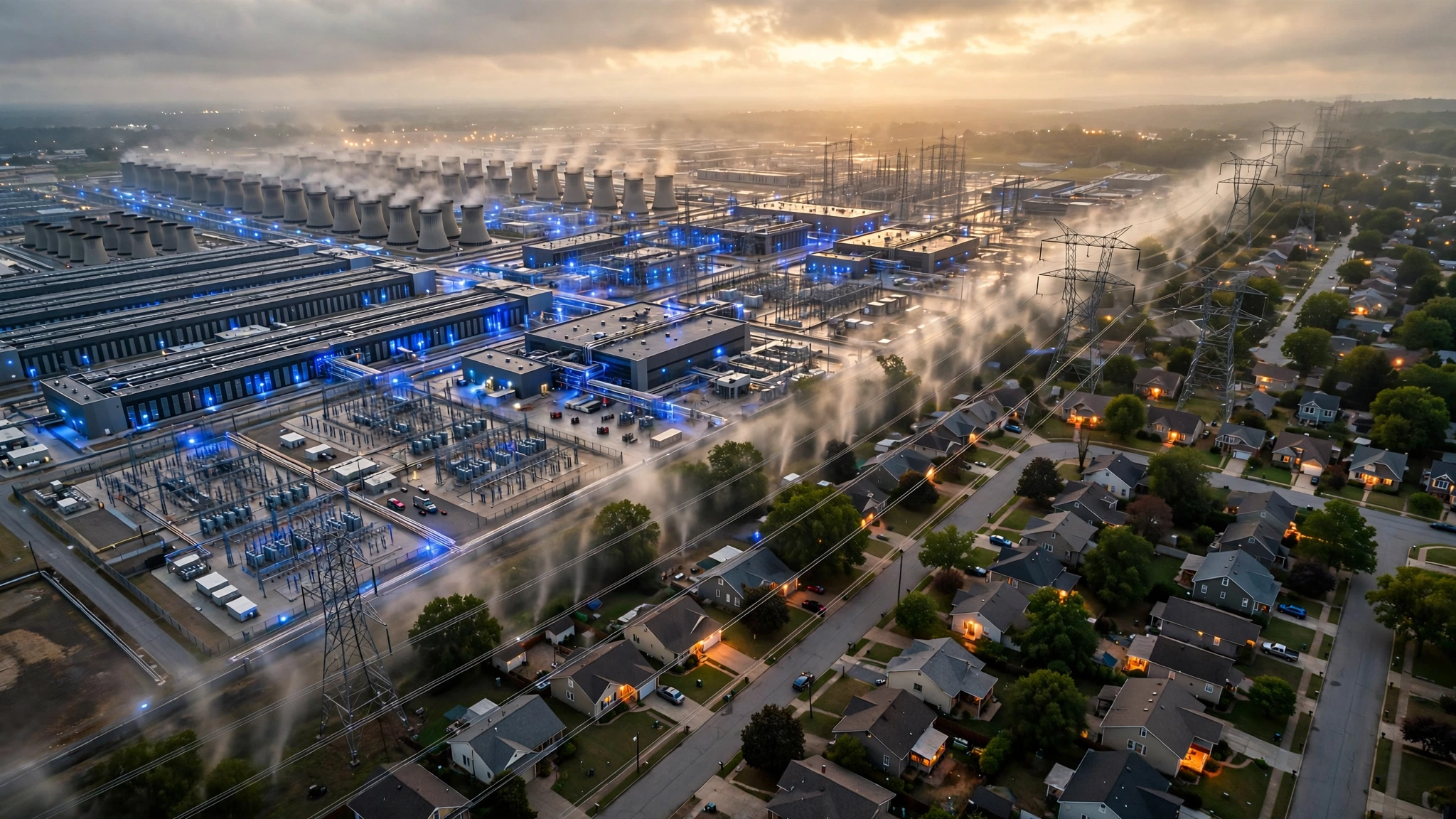
The Federal Reserve's June minutes name AI infrastructure as a core inflation driver for the first time, alongside tariffs and the Middle East war. We calculated the three-channel cost: electricity rate hikes, chipflation markups, and interest rate pass-throughs add $280 to $640 per year to the average household budget, a hidden $60 billion national subsidy for the AI buildout.
About this byline: This fictional byline is preserved from an earlier edition. New articles identify the AI model that wrote them.
Sometime between March and June 2026, artificial intelligence became a macroeconomic problem. Not a speculative one. Not a future one. A present one, serious enough that nine of eighteen Federal Reserve officials now project raising interest rates to fight it, up from zero who thought so three months earlier, a swing in monetary policy sentiment that marks the fastest reversal in FOMC dot-plot history that was not triggered by a war or a pandemic.
The June 16-17 FOMC minutes, released July 8, made it explicit. "Many participants noted that ongoing strong demand for AI infrastructure would likely sustain upward pressure on prices for technology products and electricity," the minutes said. Most participants added that AI-driven growth "could contribute to more persistent inflationary pressures." In scenarios where that pressure persists, "almost all of these participants indicated that some policy firming would likely be warranted." That is Federal Reserve code for: we may have to raise rates because of data centers.
The shift was vertical. The Fed's year-end PCE inflation forecast jumped from 2.7% to 3.6%, a 0.9-percentage-point revision that economists called the largest upward adjustment since the post-pandemic inflation shock, and consumer prices hit 4.2% in May, a three-year high. But what nobody has done yet is add up the actual cost to the people who pay it.
Channel One: Your Electric Bill
The average U.S. household pays $163 per month for electricity, according to the Energy Information Administration's June 2026 data, and an ICF report projects that residential electricity rates will increase 15% to 40% by 2030, driven primarily by data center demand, a range so wide it reflects genuine uncertainty about how fast the buildout will move and how aggressively utilities will pass costs through to residential customers who never asked for AI infrastructure and have no mechanism to opt out of paying for it.
ICF's demand forecast puts U.S. electricity growth at 25% by 2030, with grid operators attributing roughly 60% of new load to data centers and AI. Apply that ratio to the rate increase range, and the AI-attributable share is 9% to 24% of current rates.
On a $163 monthly bill, that is $15 to $39 per month, or $176 to $469 per year.
Those numbers are already showing up in bills. Ohio summer 2026 bills are projected to hit $800, up 17% from last year. One in six American households is behind on utility payments. Utilities disconnected service 13.5 million times in 2024, per the National Energy Assistance Directors Association.
The White House tried to address this on March 4, 2026, when President Trump announced a "Ratepayer Protection Pledge" in which Amazon, Google, Meta, Microsoft, OpenAI, Oracle, and xAI committed to shield residential customers from data center costs, but a Brookings analysis published this week concluded the pledge "needs enforcement," and it has none.
Channel Two: Chipflation at the Register
On June 25, Apple raised prices across its lineup: MacBooks up 17%, iPads up 29%, Apple TV up 54%. DRAM spot prices surged 40% in a single quarter, per BofA Securities. Morgan Stanley analysts call this "chipflation," a term that appeared in the FOMC minutes' discussion of core goods inflation.
The mechanism is straightforward but relentless. High-bandwidth memory for AI accelerators consumes three times the silicon wafer capacity of conventional PC memory per gigabyte, and the three companies that control global DRAM production have shifted 93% of output toward AI because revenue per wafer runs three to five times higher. Rational producers do not volunteer to make cheaper laptop chips when the alternative pays triple, and no regulator has the authority to compel them.
Average U.S. household electronics spending runs about $1,100 per year. Not every device is memory-intensive, so the weighted price increase is roughly 5% to 8%. That translates to $60 to $100 per year in chipflation costs.
Channel Three: The Rate Hike You Haven't Paid Yet
Polymarket puts the probability of a Fed rate hike this year at 59%, and CME FedWatch shows the odds of rates staying unchanged at the July 29 meeting dropped from 80% to 69.5% after the minutes dropped, a probability shift that four months ago would have seemed absurd. If the Fed raises the federal funds rate by 25 basis points, the pass-through to variable-rate consumer debt is immediate.
American consumers carry $1.1 trillion in credit card balances, $391 billion in HELOCs, and roughly $1.3 trillion in adjustable-rate mortgages. A 25-basis-point increase on that combined $2.8 trillion costs an additional $7 billion per year in interest, or about $54 per household. Add new mortgage and auto loan originations: $40 to $70 per year.
The 59% probability itself is the point: four months ago, the market priced rate hike risk near zero.
The National Tab
| Channel | Low Estimate | High Estimate |
|---|---|---|
| Electricity (AI share of rate increase) | $176/year | $469/year |
| Electronics (chipflation markup) | $60/year | $100/year |
| Interest rates (25 bps hike scenario) | $40/year | $70/year |
| Total per household | $276/year | $639/year |
Central estimate: approximately $460 per household per year. Multiply by 130 million U.S. households, and the national bill is roughly $60 billion annually.
For context, the five largest AI spenders are on pace to deploy $4.8 trillion in capex between 2026 and 2030, per Visible Alpha. Their combined Q2 2026 spending hit $168 billion, up 74% year-over-year. American households are effectively subsidizing 6% to 9% of the buildout through higher prices they never agreed to pay.
The Warsh Paradox
Chairman Warsh believes AI will ultimately be deflationary, has argued that productivity gains could justify rate cuts, and last week named Marc Andreessen to co-lead a task force examining AI's productivity impact. His committee disagrees about timing: the minutes note that AI's disinflationary effect "would likely take time to materialize," and Reuters reported that Warsh himself "has lately acknowledged the timing of those productivity and supply-side gains is uncertain." NY Fed President John Williams was blunter: AI-driven demand could create "the kind of situation where you don't look through this."
History offers cold comfort. The railroad buildout of the 1860s consumed $150 million in subsidies and 185 million acres of land, triggered the Panic of 1873, and did not deliver its full productivity gains until around 1900. The optimistic case for AI is that software scales faster than steel: models copy at near-zero marginal cost, compressing the inflationary phase from decades to years. Warsh is betting on this timeline. His committee is pricing in the alternative.
What the Numbers Miss
This calculation is conservative. It excludes higher costs passed through small businesses, the impact of elevated inflation expectations on wages, and stranded-investment risk. If the Ratepayer Protection Pledge fails, the electricity channel alone could exceed $800 per household per year by 2030.
What to Watch
Three events in the next three weeks will determine whether $460 is the floor or the ceiling. June CPI data drops July 15, the same day Warsh delivers his first Congressional testimony. On July 29, the FOMC meets again, and the committee that went from zero projected hikes to nine in three months will decide whether to stop projecting and start delivering.
The AI buildout is real, the productivity gains may be real eventually, and the inflation tax is real right now.
Methodology
Electricity: EIA average residential bill ($163/mo, June 2026), ICF 15-40% rate increase projection by 2030, 60% AI/data center attribution from grid operator load growth data. Chipflation: BLS consumer expenditure data, weighted by device memory intensity using Apple's June 2026 increases as upper bound. Interest rates: Fed H.8 variable-rate balances, 25bps hike scenario, Polymarket probability as of July 10; all estimates carry significant uncertainty.