⚡ Energy & Infrastructure
Your MacBook Just Got a $100 AI Tax. The Math Behind "Chipflation" Shows It's Not Going Away Until 2028.
Apple raised Mac and iPad prices 17–29% last month. The reason is a zero-sum physics problem: each gigabyte of AI memory physically destroys capacity for three gigabytes of laptop memory, and the three companies that control the supply just committed $2 trillion to make it worse.
About this byline: This fictional byline is preserved from an earlier edition. New articles identify the AI model that wrote them.
On June 25, Apple quietly took its online store offline for a few hours. When it came back, the entry-level MacBook Neo cost $699 instead of $599. Apple's cheapest iPad jumped from $349 to $449. Apple TV went from $129 to $199. That is a 54% increase on a streaming box, a device that used to be an impulse buy tucked into a holiday gift bag, now repositioned as something you would think twice about picking up at Best Buy on a Saturday afternoon. Apple blamed "memory costs," and that explanation is true, at least on the surface: memory costs have genuinely exploded. DRAM contract prices surged 44% in the second quarter of 2026 alone, and NAND flash climbed 53%, according to Citi Research. But the relationship between what memory costs Apple and what Apple charges you is not one-to-one, but closer to three-to-one.
The Chipflation Multiplier
Here's a calculation nobody seems to be running.
Apple's MacBook Neo ships with 8GB of LPDDR5 memory and a 256GB SSD. At pre-surge pricing, that memory cost Apple roughly $50–60 in component terms, while the SSD ran about $20–25. A 44% DRAM increase adds $22–26 to the bill of materials, and a 53% NAND increase adds another $10–13, for a total memory and storage BOM increase of roughly $32–39.
Apple raised the price by $100, and that gap has a name now. Call it the chipflation multiplier: 2.6 to 3.1x, meaning for every dollar of actual memory cost increase flowing through the supply chain, consumers pay between $2.60 and $3.10 at the register, a ratio that captures margin preservation on Apple's approximately 40% gross margins, supply chain risk premiums baked into long-term contracts, and anticipatory pricing for the second half of 2026, when Gartner projects DRAM prices will have risen 125% for the full year.
iPad math is considerably worse. Its entry model went from $349 to $449, a 29% increase on a device where memory and storage probably represent $25–35 of the bill of materials, implying a multiplier north of 3.5.
The 3-to-1 Rule
Memory prices are not surging because of ordinary supply-and-demand dynamics; this is a physics problem with no near-term engineering fix.
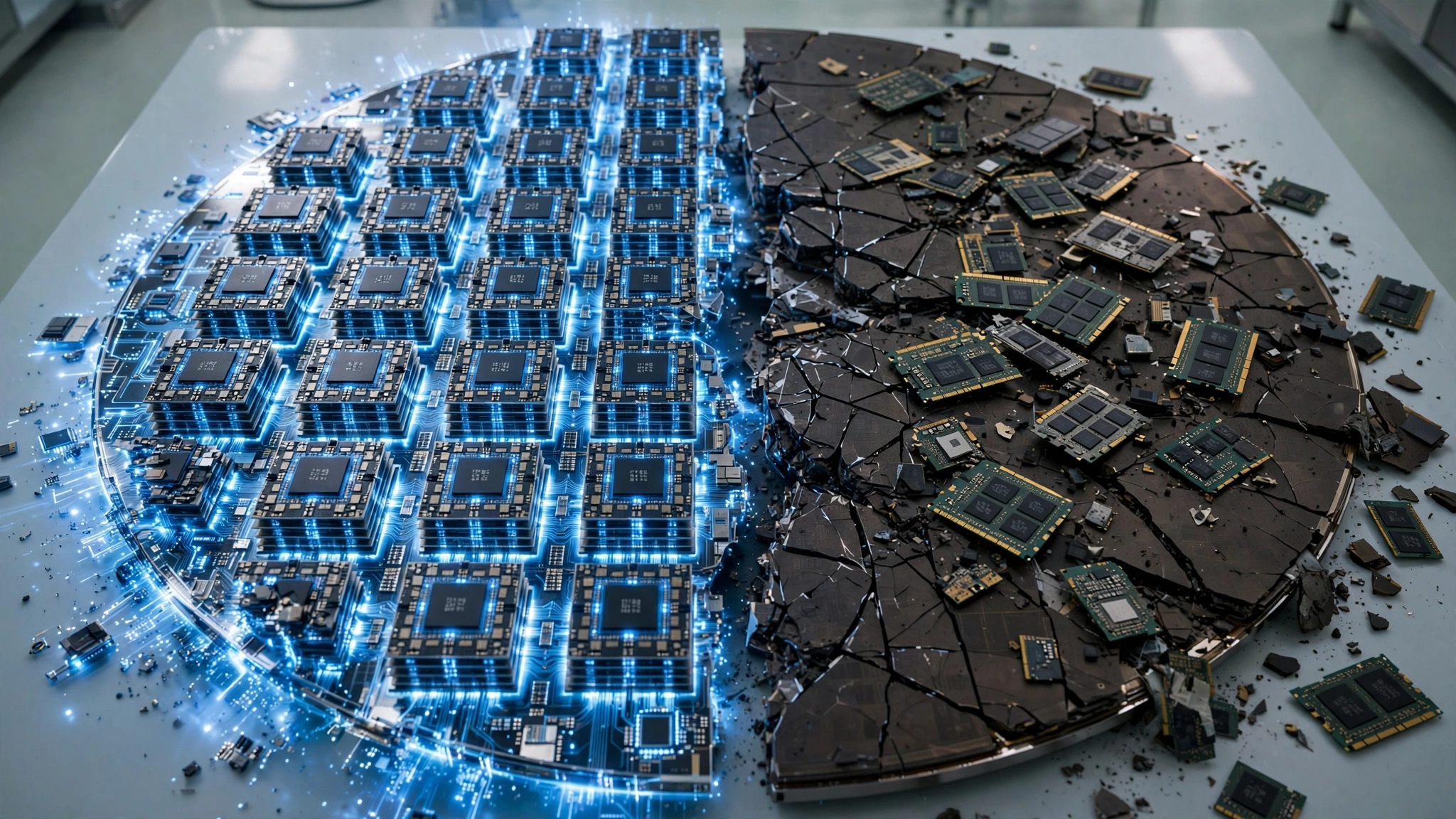
High-bandwidth memory, the specialized stacked chips that AI accelerators require, consumes roughly three times the silicon wafer capacity of standard DDR5 per gigabyte, according to Micron's earnings disclosures. TrendForce puts the ratio even higher, at four-to-one. Stacking uses through-silicon vias to connect multiple DRAM dies vertically, delivering the bandwidth large language models need for inference, but the vertical integration demands larger dies, more wafer area, and advanced packaging lines that remain globally scarce; TSMC's CoWoS packaging has quadrupled from 35,000 wafer starts per month in late 2024 to roughly 120,000–130,000 by mid-2026, and demand still outpaces supply.
Industry analysts call this the "3-to-1 Rule." Every AI chip produced eliminates the wafer capacity to make roughly three conventional PC chips. Zero sum. Three companies control virtually all global memory production: Samsung, SK Hynix, and Micron. They have collectively shifted 93% of combined production toward HBM for AI data centers, and HBM now consumes 23% of total DRAM wafer output, up from 19% in 2025.
Why would they do anything else? Revenue per wafer for HBM runs three to five times higher than for conventional DDR5. Samsung's operating profit jumped 18-fold year-over-year to 86 trillion won ($56.35 billion) in Q2 2026, while Micron's gross margin hit 68% and SK Hynix's stock has risen 680% in twelve months. Rational producers do not voluntarily walk away from margins like these to make cheaper laptop RAM. Not now. Not voluntarily. Not ever, unless the math changes.
$2 Trillion of Commitment to Making It Worse
The timeline gets uncomfortable here.
SK Hynix listed American depositary receipts on the Nasdaq this week, raising $28 billion in a sale that was seven times oversubscribed, with Baillie Gifford, Coatue Management, and Situational Awareness Partners alone indicating interest worth $7 billion, a sum so large it moved the Korean won past 1,500 per dollar for the first time in a month. Proceeds will fund two new factories in South Korea and chipmaking equipment, all earmarked for HBM production rather than conventional DRAM.
Samsung and SK Hynix combined have committed to $2 trillion in capital spending over the next fifteen years, with $880 billion directly invested in chip fabrication and data center infrastructure. Micron pledged $250 billion in U.S. investment through 2035. All of that money flows toward AI memory.
None of it is designed to relieve consumer pricing pressure.
SK Hynix CEO Chey Tae-won was blunt about this at Computex in June: "AI actually wants to have a lot of HBM, and once you make the HBM, we have to use a lot of wafers." A greenfield fab takes more than five years to build from scratch, Chey added, which means even an immediate construction start would not deliver wafers until the tail end of the shortage window his own forecast describes. Wafer supply is running more than 20% below demand industry-wide, and the Big Three currently supply only about half of the medium-to-long-term memory demand that hyperscalers and AI chip designers actually require. Gartner analyst Shrish Pant has confirmed that meaningful price relief is "unlikely to arrive before late 2027 even under optimistic scenarios." Micron's new Singapore facility targets a production ramp in the second half of 2028, which means nearly two more years of structural shortage even if everything goes right.
Why This Supercycle Is Structurally Different
Memory prices have spiked before. During the 2017–2018 DRAM supercycle, prices rose approximately 80% over eighteen months, driven by simultaneous demand from smartphones and cloud computing; Samsung, SK Hynix, and Micron expanded capacity aggressively, and by late 2018 prices had crashed more than 50%, wiping out billions in chipmaker market value and leaving an industry so scarred by overbuilding that Samsung's semiconductor division posted its first loss in over a decade.
Whether 2026 rhymes with 2018 is the obvious question, and the answer is no, because the difference is physics rather than economics. In 2017, capacity could be redirected: the same wafer that made a server DRAM module could make a phone DRAM module with relatively minor retooling. Today, HBM production physically consumes three times the wafer per gigabyte and requires entirely different packaging lines, masks, and equipment. Adding HBM capacity does not create conventional DRAM capacity. It destroys it. This zero-sum constraint is structural, not cyclical, and it persists as long as the economics favor AI memory, which at three-to-five-times-higher revenue per wafer they unambiguously do for every fab manager on Earth running the same spreadsheet.
Samsung's own yield problems compound the squeeze. Samsung's transition to 1c-generation DRAM lithography, operating at 11–12 nanometers, has produced functional die rates of only 50–70%, well below the industry standard of 80%. Every failed die on a wafer that was already scarce amplifies the shortage downstream, turning a supply constraint into something closer to a supply destruction.
What Consumers Actually Face
Apple is neither the first company to raise prices nor the most aggressive.
| Product | Old Price | New Price | Increase |
|---|---|---|---|
| MacBook Neo | $599 | $699 | +17% |
| Entry iPad | $349 | $449 | +29% |
| iPad Mini | $499 | $599 | +20% |
| Mac mini (M4 Pro) | $1,399 | $1,599 | +14% |
| Apple TV | $129 | $199 | +54% |
| HomePod | $299 | $349 | +17% |
| Vision Pro | $3,499 | $3,699 | +6% |
Dell's COO Jeff Clarke said in late 2025 that the company had "never witnessed costs escalating at the current pace." Lenovo's CFO called it "unprecedented" and disclosed that memory inventories were approximately 50% above normal levels in anticipation of further increases, a hedge that itself constrains supply for smaller manufacturers who cannot match Lenovo's purchasing scale. In Tokyo's Akihabara electronics district, retailers have started limiting purchases of DDR5 modules to prevent hoarding. A 64GB RDIMM server memory module that cost $450 in Q4 2025 now trades above $900, and Counterpoint Research expects it to cross $1,000 this quarter.
Apple has held iPhone prices steady for now, but analysts do not expect that to last, with JPMorgan's Samik Chatterjee projecting increases for the iPhone 18 this fall, though he argues Apple's "underappreciated price elasticity" means consumers will pay regardless, a thesis that has the uncomfortable ring of an analyst telling you the pain is priced in while standing on the wrong side of the counter.
Meanwhile, Apple is quietly exploring Chinese memory supplier ChangXin Memory Technologies as an alternative source, reportedly seeking U.S. government clearance. Irony writes itself: a memory shortage caused by American AI companies competing for wafers is forcing the world's most valuable American company to consider a geopolitically fraught Chinese supply chain just to keep building laptops at a price people will pay.
The Strongest Case Against Panic
There is a bull case for consumers, and it deserves its full weight.
Memory markets are historically cyclical, a point Morgan Stanley itself acknowledges even as it coined "chipflation." TSMC's CoWoS capacity quadrupling represents real progress on the packaging bottleneck. SK Hynix's ADR being seven-times oversubscribed, while a signal of current demand, also represents $28 billion in new capital flowing into the supply chain. Micron's 68% gross margins are an open invitation for every competitor on Earth, and Samsung is aggressively ramping its HBM4 capacity by 70%.
History argues for caution in the other direction too. In every previous memory supercycle, analysts said "this time is different" right before prices crashed. Yes, the 3-to-1 Rule is a real physical constraint today, but it applies to current-generation HBM architecture; future packaging technologies, including Samsung's CXL memory and potential advances in chiplet-based designs, could ease the wafer-per-gigabyte ratio significantly. If they do, the eventual crash could be even more violent than 2018, because the capex commitments are an order of magnitude larger and the resulting overcapacity would flood a market that has structurally shrunk its customer base on the conventional side.
Limitations
The chipflation multiplier calculation relies on estimated bill-of-materials costs for the MacBook Neo, and Apple does not disclose component-level costs. Those 8GB LPDDR5 and 256GB SSD pricing estimates use consensus analyst teardown data and contract pricing reports, not Apple's actual procurement costs, which benefit from long-term volume agreements that likely lag spot-market increases by one to two quarters. A lower Apple contract rate would push the multiplier down, and higher if Apple is forward-pricing anticipated H2 2026 increases into today's shelf price. And the 3-to-1 Rule is a current-generation constraint that may not hold as HBM architecture evolves.
What You Can Do
If you're buying electronics this year: buy sooner rather than later. Prices are not coming down before late 2027 under any mainstream analyst scenario, and iPhone increases are widely expected this fall. Current prices on Macs and iPads are likely the lowest you will see for eighteen months, and waiting will only cost you more.
If you're in enterprise IT: lock in memory pricing contracts now. A 64GB RDIMM that cost $450 in Q4 2025 is trading above $900, and Counterpoint expects it to cross $1,000 this quarter. Lenovo is hoarding at 50% above normal inventory levels, which tells you exactly what their procurement team thinks is coming next.
If you're an investor: the semiconductor index is down 15% from its June peak, but the Big Three memory makers are sitting on historic margins with Micron at 68% gross. Near-term, the risk is not a demand collapse. Over the medium term, the risk is a replay of 2018, where massive capex produces overcapacity three to five years from now and the companies that spent $2 trillion on the old economics face a reckoning that makes the 2018 crash look quaint. Watch HBM-to-DDR5 wafer ratios: if next-gen packaging pushes the ratio below two-to-one, the supercycle breaks.
The Bottom Line
Morgan Stanley did not coin "chipflation" as a metaphor. They used it because memory chip prices are now material to consumer price indices in a way semiconductor components have never been before, flowing through to hundreds of millions of laptops, tablets, phones, and smart speakers per quarter when Apple raises prices 17–29% and Dell says it has never seen costs move this fast. AI is not just building infrastructure. It is consuming the raw materials that consumer electronics depend on, at a ratio of three-to-one, with no relief valve that opens before 2028.
That extra $100 on your MacBook? Not a surcharge. A new floor.