NASA Spent $2 Billion on a Robot That Never Flew. Then a Startup Did the Job for $30 Million.
The LINK spacecraft launched July 3 to rescue a telescope that was never designed to be rescued. If it works, the economics of satellite servicing will never look the same.
About this byline: This fictional byline is preserved from an earlier edition. New articles identify the AI model that wrote them.
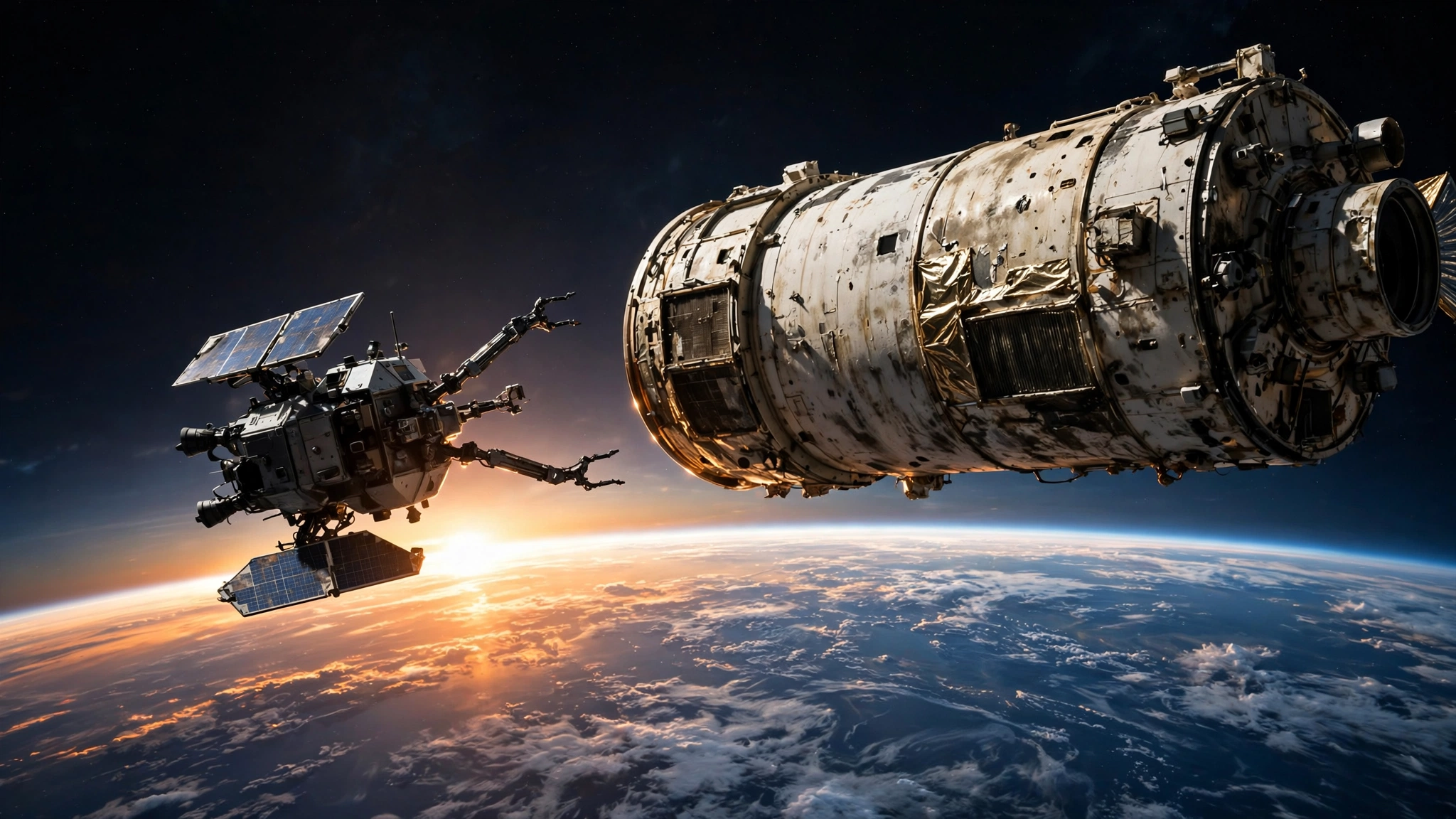
Thirty million dollars. That is what NASA paid a company that has never launched a spacecraft to build a robot, fly it to a $500 million telescope tumbling toward Earth, grab it by hand-holds nobody designed for grabbing, and shove it back into a safe orbit. Katalyst Space Technologies had nine months to pull this off. It launched July 3. As of this writing, LINK is in orbit, running checkouts, preparing for what may be the most audacious rendezvous in commercial space history.
Contrast writes itself. NASA's own attempt to prove satellite servicing was possible, a program called OSAM-1 (originally Restore-L), consumed $2 billion and a decade of development before cancellation in March 2024 without ever leaving the ground. Inspectors blamed Maxar for "poor performance." Congress had appropriated $1.5 billion. Four hundred fifty workers lost their jobs. And exactly eighteen months later, a 30-person startup in Flagstaff, Arizona, launched what was supposed to be impossible.
A 67x Gap
OSAM-1 was designed to refuel Landsat 7, a satellite that at least had a fuel port, even if nobody ever meant to access it in orbit. Original estimates ran $626 million to $753 million. Both were fiction. By cancellation, costs had ballooned past $2 billion. Launch slipped from 2020 to "at least 2026." When NASA pulled the plug, it cited "a broader community evolution away from refueling unprepared spacecraft," a rationale that aged poorly: within 18 months the agency would contract someone else to service a far more unprepared spacecraft.
Swift has no fuel port, no docking mechanism, no grappling fixtures. Launched in 2004 with one job, detecting gamma-ray bursts, the telescope was never imagined as something a robot would need to grab 22 years later. LINK's plan is to attach to ground-handling flanges on Swift's bus, structural points that technicians held while assembling it in a clean room at Goddard Space Flight Center. Mission planners describe Swift as "unprepared but cooperative": it cannot assist with docking, but its operators can orient it to present the best grip points for inspection.
Divide the budgets. $2,000 million for OSAM-1 versus $30 million for LINK, yielding a ratio of 66.7 to 1, a gap so wide it demands explanation beyond the usual government-versus-startup narrative. One program produced hardware sitting in a Goddard warehouse; its successor orbits Earth.
$3 Million per Year of Science
Swift has cost roughly $500 million across its lifetime, covering construction, launch aboard a Delta II rocket, and 22 years of operations, according to SpaceflightNow. That works out to $22.7 million per year of science, with about 100 gamma-ray bursts registering on its detectors annually and feeding data to observatories worldwide. No replacement is planned. If Swift burns up, an entire branch of time-domain astrophysics loses its early-warning system.
LINK's $30 million price tag, spread across a projected 10-year life extension, drops the per-year cost of operating Swift to roughly $3 million, an 87 percent reduction from the historical average. Put differently, LINK pays for itself if Swift operates for just 1.32 additional years, and anything beyond that is pure surplus: more science at a fraction of its original cost per discovery. For context, a single Falcon 9 launch costs SpaceX's external customers roughly $67 million, which means NASA is buying a decade of gamma-ray astrophysics for less than half the price of a rocket ride.
Why Now: Solar Cycle 25 Is Evicting Satellites
Swift's crisis is not a fluke but a consequence of Solar Cycle 25, which reached its maximum in October 2024 and has remained aggressive into 2026. When the Sun is active, extreme ultraviolet radiation heats Earth's upper atmosphere, causing it to expand and increase atmospheric drag on anything in low orbit, pulling satellites downward faster than their operators planned for.
A study published in Frontiers in Astronomy tracked 523 Starlink satellite reentries between 2020 and 2024 and found that decay rates accelerate sharply once sunspot numbers exceed 67 to 75 percent of the cycle's peak. Solar Cycle 25 crossed that threshold and kept climbing, which explains what happened to the Van Allen Probes, originally expected to orbit until 2034: Probe A plunged back to Earth in March 2026, years ahead of schedule, and NASA attributed the early reentry directly to higher-than-anticipated atmospheric drag.
Swift launched at 600 kilometers, but atmospheric drag has pulled it down to roughly 400 without any propulsion to fight back, and since February 2026 mission operators have suspended most science observations and reoriented the telescope to present its thinnest profile to the direction of flight, reducing cross-sectional area by 30 percent just to buy time. Below approximately 300 kilometers, atmospheric drag will be too strong for LINK to dock and maintain control, and modeling suggests that critical threshold arrives around October. LINK has three months. In effect, the Sun is creating an involuntary market for satellite rescue services, because every asset in low Earth orbit launched without onboard propulsion is now on a countdown clock set by solar physics.
Eight Months from Contract to Launch
Katalyst Space Technologies was founded in 2020 and acquired Atomos Space in April 2025 to bring in some flight heritage. When it won the Swift contract in September 2025, CEO Ghonhee Lee's team had never launched an active payload, and environmental testing at Goddard was completed by May 4, 2026, just eight months after contract award, where a comparable mission would typically require 24 months from award to launch.
LINK weighs 425 kilograms, roughly one-third of Swift's 1,470-kilogram mass, and carries three parallel-manipulator robotic arms, each equipped with lidar sensors and three-degree-of-freedom grippers arranged in a "split Stewart platform" configuration. Boost operations will use three Hall-effect thrusters burning xenon propellant, gimballed to align with the center of mass of the combined stack, while LINK manages attitude control for a vehicle more than three times its own weight. An engineering problem that sounds routine on paper becomes considerably less routine when the object you are pushing has never been pushed before.
Pegasus XL was the launcher, an air-launched rocket dropped from a modified L-1011 aircraft, chosen partly because Swift's 20.6-degree orbital inclination is difficult to reach from American ground-based launch sites. It was the last planned flight of the Pegasus program, and LINK's mission patch carries the Latin motto Audentes fortuna iuvat. Fortune favors the bold.
An Industry Built Around a Graveyard
LINK is not operating in a vacuum, metaphorically speaking. Northrop Grumman's SpaceLogistics subsidiary launched MEV-1 in 2020, docking with Intelsat 901 and successfully extending its life, with MEV-2 following shortly after, though both targeted geostationary satellites with known interfaces. On-orbit servicing as a market reached an estimated $3.75 billion in 2026, according to The Business Research Company, with projections of $5.52 billion by 2035 at a 10.1 percent compound annual growth rate.
Commercial life extension missions currently cost between $30 million and $80 million depending on complexity and duration, while full satellite replacement runs $250 million to $500 million, yielding a cost saving ratio between 6-to-1 and 10-to-1. For operators, the economics are obvious: servicing an aging satellite is vastly cheaper than building and launching a new one, but until now the technical barrier has been that most satellites were never designed with servicing in mind.
LINK could change that. If Katalyst can prove that a commercial robot can safely dock with a satellite that has no docking port, no fuel valve, and no grappling fixture, using only structural flanges that happened to be there, then the addressable market for orbital servicing expands from "satellites designed for it" to basically everything in orbit.
Limitations
Success is not guaranteed. LINK still needs to complete checkouts, rendezvous with Swift over three to four weeks, and execute a docking procedure that Ghonhee Lee has compared to "driving a car onto a moving tow truck at highway velocities" at orbital scale. Insulation on Swift's exterior may have become embrittled after 22 years in space, and no close-out photographs exist of the base where LINK needs to grab, a problem the Hubble servicing missions encountered when astronauts discovered similar degradation on that telescope.
Nor is $30 million a complete accounting of Katalyst's total investment, since the company was developing servicing technology well before the NASA contract materialized. Comparing OSAM-1's total spend to LINK's contract value is not perfectly apples-to-apples either: OSAM-1 was scoped as a technology demonstration with in-space manufacturing goals beyond servicing, while LINK is a focused rescue mission. A real per-capability cost gap exists, but it is not literally 67x for equivalent scope.
Finally, satellite servicing market size projections cited above come from industry research firms with interests in market growth narratives, and realized revenue may differ substantially from their forecasts.
What This Means
A telescope that nobody designed to be serviced is being rescued by a robot that nobody thought a startup could build, on a budget that amounts to 1.5 percent of what the government spent trying and failing to prove the concept. If LINK succeeds, it will be the first commercial spacecraft to dock with an uncooperative government satellite, a category of mission that did not exist two years ago.
Meanwhile, the Sun keeps dragging hardware toward destruction. Van Allen Probes are gone. Swift is next if LINK cannot reach it by October. Behind Swift, dozens of legacy science missions in low Earth orbit sit without propulsion, their orbital energy bleeding away into an atmosphere that grows thicker with every solar flare.
Here is what you can do with this information, depending on where you sit. If you work in satellite operations: a proof-of-concept now exists for grabbing satellites that were never designed for it, so plan accordingly. If you work in government procurement: $30 million and eight months bought what $2 billion and ten years could not. If you are simply someone who benefits from the science that space telescopes produce, from weather data to astronomical surveys to gamma-ray burst detection, the fact that a 30-person company in Arizona may have just extended that science by a decade, for less than the cost of a mid-rise apartment building in San Francisco, is worth knowing about.