🚀 Space
China Caught a Rocket in a Net. Matching SpaceX Requires 360 More.
On its maiden flight, China's Long March 10B dropped its booster into a net, skipping landing legs and saving 2,000 kg of dead weight per flight. At full reuse, that cuts launch costs to $813/kg. Deploying 13,000 Guowang satellites still requires 360 more flights.
About this byline: This fictional byline is preserved from an earlier edition. New articles identify the AI model that wrote them.
9,447 satellites. That is the gap between China's orbital constellation and SpaceX's Starlink fleet, and on July 10 a net stretched across a ship in the South China Sea started to close it.
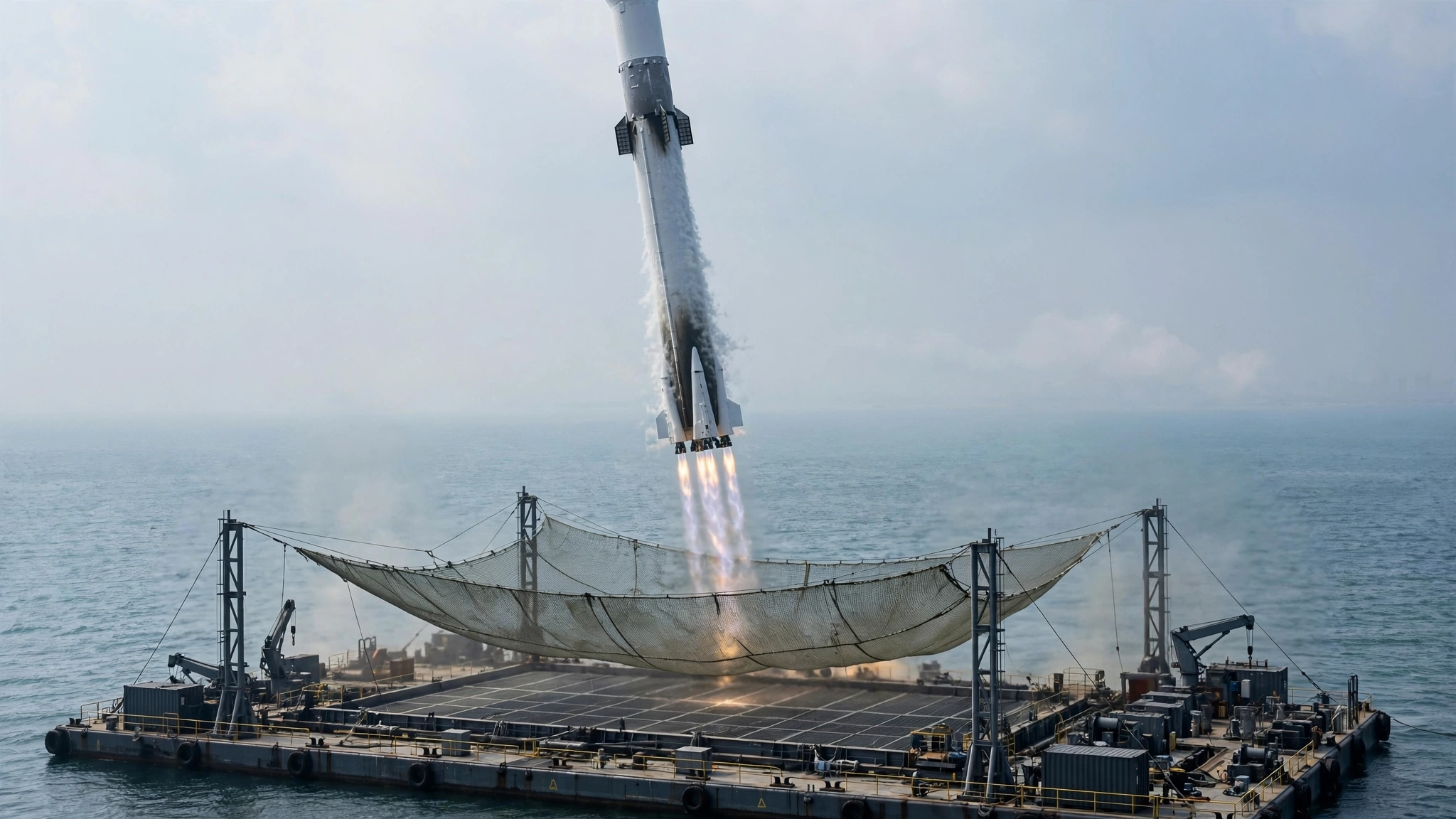
China's Long March 10B lifted off from Wenchang, Hainan at 12:15 PM local time on its maiden flight, hauling a test payload to low Earth orbit with 16,000 kilograms of reusable lift capacity, and six minutes after stage separation the first stage descended onto an offshore platform and dropped into a wire-and-net capture system for the first time in Chinese spaceflight history. No landing legs, no hoverslam. CALT, the state-owned subsidiary that developed both the rocket and its recovery system, deployed an approach no other space program has attempted at orbital scale: catching a returning booster in a suspended net rather than landing it upright on legs. "Net-based recovery helps simplify the rocket's onboard structure, reduces vehicle mass and increases payload capacity," CALT engineer Chen Muye told Reuters.
China plans to reuse this first stage before year's end: a five-month turnaround compared to the 15.3 months SpaceX needed between its first Falcon 9 landing and first reflight.
What Landing Legs Actually Cost
SpaceX's Falcon 9 pays a steep reusability tax: in expendable mode it lifts 22,800 kg to low Earth orbit, but in reusable mode that drops to roughly 15,600 kg, a 31.6% payload penalty driven by the structural mass of landing legs (approximately 2,000 kg) and the propellant reserved for entry burn, landing burn, and boostback maneuver. Net capture eliminates the legs entirely, shedding an estimated 1,500 to 2,500 kg of structural mass while requiring far less retro-propulsion than Falcon 9's terminal hoverslam, which decelerates a 25-ton booster from supersonic speeds to zero in eight seconds.
On its maiden flight, Long March 10B demonstrated 16,000 kg of reusable payload to LEO, within 3% of Falcon 9's 15,600 kg reusable figure despite being a first-generation vehicle powered by seven YF-100K kerosene engines that had never flown.
What the Net Saves in Dollars
Falcon 9 lists at $62 million per launch, though SpaceX's internal cost for Starlink missions runs approximately $28 million, yielding $2,720/kg at list price or $1,795/kg internally. Elon Musk has stated the booster represents roughly 75% of total vehicle cost, with refurbishment running about 10% of a new build. China has not disclosed Long March 10B pricing, and current expendable Chinese rockets cost $5,000 to $8,000 per kilogram, but applying the Falcon 9 economic model to the new rocket yields a strikingly different picture:
| Parameter | Value |
|---|---|
| Estimated total vehicle cost | $40M |
| Booster share (75%) | $30M |
| Booster cost after 10 flights | $3M/flight |
| Upper stage + operations | $10M/flight |
| Total cost per flight | ~$13M |
| Payload (reusable, LEO) | 16,000 kg |
| Cost per kilogram | $813 |
$813 per kilogram. Less than half of SpaceX's internal Starlink rate, but a projection that requires ten reflights of a booster that has flown exactly once, using a capture system that has never operated at production tempo.
Why Cadence Matters More Than the Catch
Reusability is an economic argument that requires volume, and volume is precisely where China's math falls apart. SpaceX flew approximately 150 Falcon 9 missions in 2025, with Starlink deployment generating nearly all of that demand, which means each reusable booster flies roughly ten times per year, spreading construction cost across enough flights to make expendable launch economically irrational. China conducted 67 total orbital launches in 2025, across all rocket types. If Long March 10B captures 30% of that manifest, each booster might fly five times annually, not ten. Half the cadence, half the savings.
360 Launches to Close the Gap
One signal could change that: Guowang. China's planned 13,000-satellite megaconstellation competes directly with Starlink, and SpaceNews reported that Long March 10B was built to deploy it, with 11,000 kg of capacity to Guowang's 900 km sun-synchronous orbit. At roughly 300 kg per satellite, comparable to Starlink v1 spacecraft, each flight carries approximately 36 Guowang satellites to the target orbit, and deploying the full constellation takes about 361 launches.
| Launch Rate | Years to Deploy Guowang |
|---|---|
| 20 LM-10B flights/year (30% of current manifest) | 18 years |
| 50 LM-10B flights/year | 7.2 years |
| 100 LM-10B flights/year | 3.6 years |
SpaceX deployed approximately 10,800 Starlink satellites in six years at 150+ annual launches, which means China would need to roughly triple its current total launch rate and sustain that pace for the better part of a decade to match SpaceX's deployment timeline. Prior to July 10, China had failed at booster recovery twice: both LandSpace's Zhuque-3 and CASC's own Long March 12A failed controlled descent in December 2025. One success does not create a production reuse capability.
Limitations
Landing-leg mass savings and Chinese launch costs in this analysis are estimated by analogy to Falcon 9, because China discloses neither figure, and satellite mass for Guowang is estimated at 300 kg based on comparable architectures while actual specifications remain undisclosed. Cost projections assume China achieves economic structures comparable to what took SpaceX a decade of iterative improvement to reach. Starship's Super Heavy has already demonstrated mechanical-arm catch at Starbase, targeting costs below $500/kg, making Falcon 9 potentially the wrong benchmark by the time Guowang reaches full deployment.
Strongest Counterargument
Net capture might solve the wrong problem. China's bottleneck is launch cadence and satellite manufacturing: SpaceX produces Starlink satellites at 40+ per week from its Bastrop, Texas factory, while China has not demonstrated Guowang production at comparable scale. SpaceX's real advantage is a captive customer generating 150 launches of internal demand per year; Guowang does not yet have paying customers, a completed regulatory framework, or a proven satellite bus at production readiness.
The Bottom Line
China's net-capture system is genuinely clever engineering that solves a real structural mass problem, and at scale with ten reflights it could deliver payloads to orbit for $813/kg, roughly half of SpaceX's internal rate. But reusability is an economic argument, not merely a technical one. SpaceX flies 150 times a year because Starlink needs 150 flights a year. China's net caught one rocket. Catching 360 more requires not better nets, but a reason to launch that often.
What You Can Do
If you invest in space or defense stocks, watch Guowang satellite production rate, not booster recovery, because manufacturing throughput determines whether Long March 10B's cost advantage translates to competitive pressure on SpaceX.
If you follow geopolitics, 1,353 versus 10,800 is the number that frames everything: China needs roughly 360 dedicated launches over 7 to 18 years to deploy Guowang, which means SpaceX's orbital infrastructure lead remains durable for at least a decade with strategic implications for GPS alternatives, secure communications, and space-based intelligence.
If you work in aerospace engineering, study net capture seriously, because eliminating 2,000 kg of landing legs changes structural loads throughout a vehicle, and tolerance for landing-point deviations addresses propulsive landing's persistent failure mode: what happens when an engine fails during terminal descent.