🤖 Robotics
Tesla Needs 43 Optimus Robots to Match One Model S Battery. That's the Point.
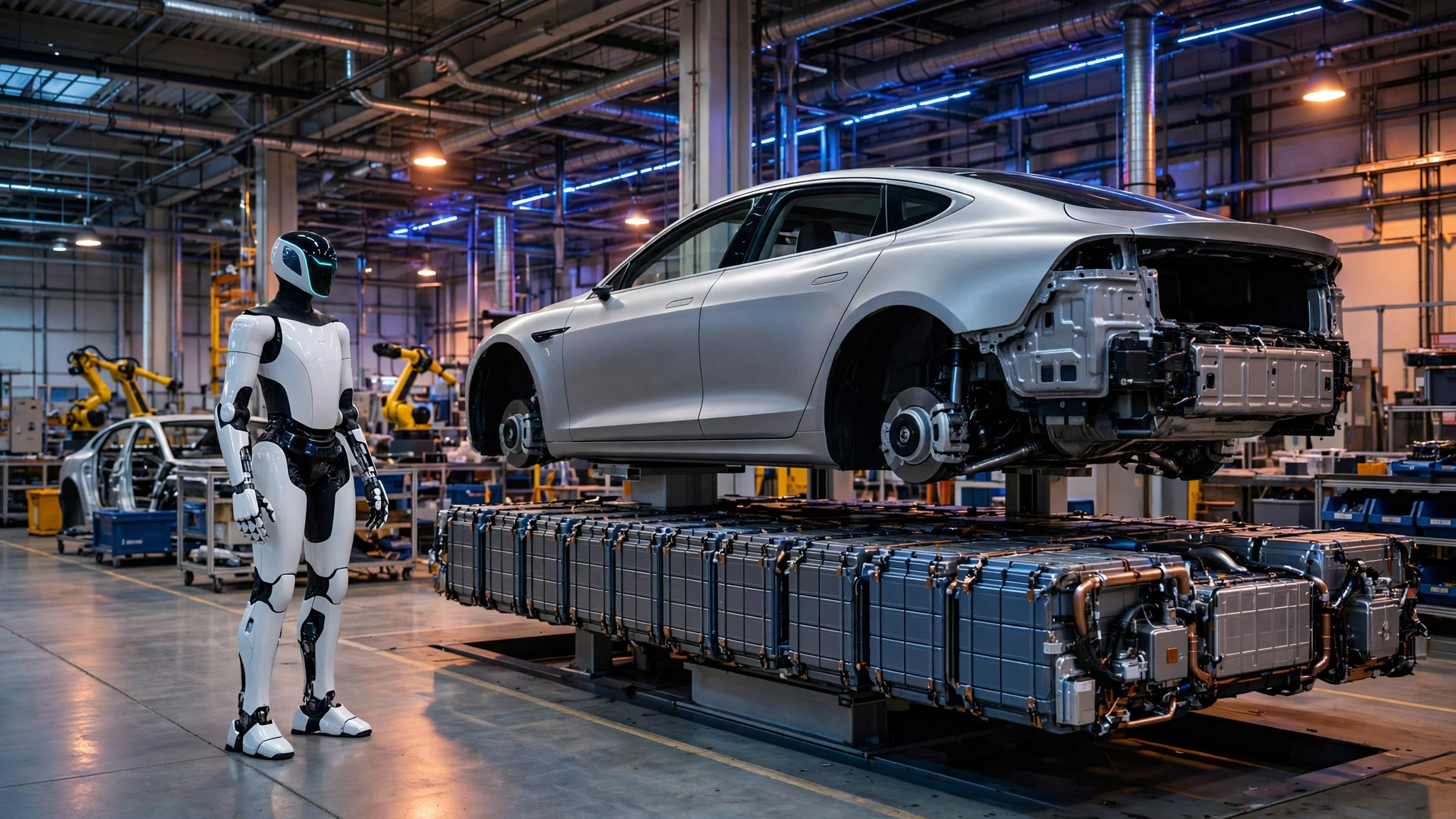
A Model S carries 100 kWh of batteries worth $11,000. An Optimus robot carries 2.3 kWh worth $300. When Tesla retooled the factory, it didn't just swap products. It inverted the battery industry's entire value equation.
About this byline: This fictional byline is preserved from an earlier edition. New articles identify the AI model that wrote them.
$300. That is what the battery inside a Tesla Optimus Gen 2 robot costs, according to Morgan Stanley's component-level teardown: a 2.3-kilowatt-hour, 52-volt pack that represents exactly 0.54% of the robot's $55,000 bill of materials. Divide a Model S battery by that figure and you get 43.5 robots. Forty-three complete robots. Tesla could build that many Optimus units and still have battery capacity left over from one sedan.
In January 2026, Elon Musk gave the Model S and Model X an "honorable discharge" on Tesla's Q4 2025 earnings call. Both vehicles that built the brand, the ones whose 100-kilowatt-hour packs once defined what a premium EV could be, accounted for just 3% of Tesla's deliveries and saw a 40% sales decline in 2025. Their Fremont production lines are being retooled for Optimus Gen 3, with a stated long-term target of one million robots per year. On July 1, Musk posted a photo of himself walking the new manufacturing line, where initial production is expected to begin in late July or August, though Musk recently cautioned that "Optimus production will be extremely slow at first, as everything is new. This is not like making a car."
He is right about that in a way he may not have intended. It is not like making a car because the battery—the component that defines an EV's range, price, margin, and competitive position—is essentially irrelevant to the robot's economics.
The $300 Component
Morgan Stanley's teardown of the Optimus Gen 2 lays bare an extraordinary cost structure, and here is where the money actually goes:
| Component | Cost | Share of BOM |
|---|---|---|
| Locomotion (legs) | $21,300 | 38.6% |
| Core stability (waist, pelvis, shoulders) | $15,600 | 28.4% |
| Hands (12 actuators, force sensors) | $9,500 | 17.2% |
| Head / AI compute (FSD chips, cameras) | $2,100 | 3.8% |
| Battery (2.3 kWh, 52V) | $300 | 0.5% |
| Other | $6,200 | 11.3% |
| Total BOM | $55,000 | 100% |
All that intelligence, the FSD-derived chips, the camera array, the neural network inference engine, sits inside a head unit costing $2,100. Less than 4% of the total. Its battery costs $300 and accounts for half a percent. Meanwhile, the legs alone cost $21,300, or more than seventy times the battery. Seventy-one times over. Not the brain. Not the battery. Always the legs. Mechanical engineering is the binding constraint on humanoid robot economics.
Compare this cost structure to a Model S sedan. Its 100-kilowatt-hour battery pack, at the current industry average of roughly $110 per kilowatt-hour, costs approximately $11,000, about 13.75% of the vehicle's $80,000 sticker price. It is the single most expensive component and the axis around which range, weight, charging speed, and margin all rotate. Double the battery and you roughly double the car. Double the battery in a robot and you barely change the robot at all, because even at 4.6 kWh the pack would still represent barely 1% of the total cost. In a single platform shift, the battery went from the product's economic spine to a line item barely worth mentioning in the bill of materials.
Value per Kilowatt-Hour Deployed
This inversion gets sharper when you measure what each kilowatt-hour actually produces in economic value. A Model S generates $80,000 in revenue from 100 kWh of installed battery capacity: $800 per kilowatt-hour deployed. An Optimus, at its current $55,000 BOM, generates $23,913 per kilowatt-hour deployed. Even at Musk's target price of $25,000, each robot produces $10,870 of value per kilowatt-hour: 13.6 times what a luxury sedan does.
For the battery industry, this represents completely unfamiliar territory. In EVs, the cell maker is the kingmaker: battery cost determines whether a vehicle is profitable, battery range determines whether consumers buy it, and battery supply determines whether the factory runs. In humanoid robots, the cell maker is a commodity supplier shipping a $300 component into a $55,000 system where the real margin belongs to whoever can mass-produce precision actuators, tendon-driven biomimetic hands, and the AI compute stack that makes fifty joints move like a human body.
And yet, despite this apparent irrelevance, LG Energy Solution is racing to lock up robot battery contracts. In recent weeks, the Korean battery giant secured supply deals with the top three American humanoid robot developers: Tesla, Boston Dynamics, and a third company that multiple Korean-language sources identify as Figure AI. LG has disclosed it now supplies cylindrical cells to six major robotics companies, describing them as "most of the leading players one could readily name." Why chase a market where each unit needs $300 worth of your product?
The Volume Math
Because a million $300 orders is $300 million, and LG sees the market growing by a factor of a thousand.
TrendForce projects that global humanoid robot shipments will exceed 50,000 units in 2026, a 700% year-over-year increase. At an average of 2.3 kWh per robot, that is a paltry 0.115 gigawatt-hours of battery demand, roughly equivalent to 1,150 Model S sedans. It barely registers.
But TrendForce also projects that by 2035, battery demand from humanoid robots will reach 74 gigawatt-hours, a 1,000-fold increase from 2026. At that scale, robot batteries become equivalent to the entire output of a large-scale EV battery gigafactory. The Korea JoongAng Daily quoted an industry analyst estimating that humanoid robot battery demand "could eventually reach roughly 20 to 40 percent of today's EV battery market." That is not a rounding error. That is a new industry.
Scale matters here. The math for Tesla's stated ambition reveals just how enormous the gap is between today's robot battery demand and tomorrow's projected fleet:
| Scenario | Units | kWh per Robot | Total GWh | EV Equivalent (80 kWh avg) |
|---|---|---|---|---|
| 2026 (industry) | 50,000 | 2.3 | 0.115 | ~1,400 EVs |
| 2028 (Tesla target) | 1,000,000 | 2.3 | 2.3 | ~28,750 EVs |
| 2028 (8-hr shift battery) | 1,000,000 | 6.0 | 6.0 | ~75,000 EVs |
| 2035 (TrendForce) | Millions | 3–6 | 74 | ~925,000 EVs |
One million Optimus robots at current battery specs would consume just 2.3 gigawatt-hours of batteries, a fraction of the estimated 110+ gigawatt-hours that Tesla's roughly 1.79 million vehicles consumed in 2023. Robot fleet battery demand would equal just 2.1% of what the car fleet consumes, barely a rounding error. Even if each robot graduates to a 6-kilowatt-hour pack sufficient for an eight-hour factory shift, a million units still consume only 6 GWh, just 5.5% of Tesla's current vehicle battery appetite.
Electricity: The Other Cost That Doesn't Matter
Operating economics paint an equally lopsided picture. A walking, manipulating Optimus draws roughly 500 watts on average, which means an eight-hour shift consumes just 4 kWh of electricity. At the American industrial average of $0.08 per kilowatt-hour, each robot costs $0.32 per shift to power, or $117 per year. Thirty-two cents per shift.
An American minimum-wage worker earns $15 per hour, or $30,000 for 2,000 hours of annual work. The robot's annual electricity bill is 0.39% of that worker's salary. Even at Musk's ambitious target price of $20,000–$30,000, an Optimus pays for its own hardware in its first year of operation and runs on roughly $10 per month of electricity thereafter. The value proposition is not about the battery or the energy; it is about whether the robot can actually do the job, and for how many hours before it needs to recharge or swap packs.
The Eight-Hour Problem
That runtime question is the one technical constraint where batteries still determine the product's viability. Tesla's Optimus Gen 2 manages approximately two hours of dynamic operation (walking, lifting, bending) on its 2.3-kWh pack. Figure's F.03 battery claims five hours of peak performance from the same 2.3 kWh, though "peak performance" for a warehouse-focused robot may involve less aggressive locomotion than Tesla's factory tasks. Boston Dynamics' Atlas carries 3.7 kWh, the largest pack in the current generation of shipping humanoid robots, though even that remains insufficient for a full industrial shift.
No shipping humanoid robot delivers an eight-hour shift on a single charge. Not quite yet. Two approaches are emerging: hot-swappable batteries (Agility Robotics' Digit and Apptronik's Apollo both support 24-hour runtime with battery rotation) and larger packs. At 6–8 kWh per robot, sufficient for a full shift, battery cost would rise from $300 to roughly $780–$1,040 at current NCM prices. Still under 2% of the total BOM, and still irrelevant to the unit economics. Energy density per kilogram, not cost per kilowatt-hour, is the real constraint. A robot can only carry so much weight in its torso before the actuators in its legs start to struggle.
This is why TrendForce flags solid-state batteries as the critical enabler: solid-state cells promise 500 Wh/kg versus 300 Wh/kg for current high-nickel lithium-ion, which means the same mass of battery delivers 67% more runtime. Samsung SDI is targeting solid-state cells at 900 Wh/L volumetric density. One enormous if. If those numbers materialize, a 2-kilogram battery compartment could hold 4 kWh instead of 2.3 kWh, enough for three to four hours of dynamic work, which starts to approach the half-shift threshold where hot-swapping becomes practical once rather than continuously.
Why LG Is Right to Chase $300 Orders
LG Energy Solution's robot play makes sense when you stop thinking about kilowatt-hours and start thinking about customer stickiness and margin quality. Robot batteries are not commodity cells. They require specific cylindrical form factors (LG's 46-series), custom battery management systems for high-rate discharge during sudden movements, and safety certifications (UN38.3, UL2271) that create qualification barriers. Once a robot maker validates a cell chemistry and embeds it in its thermal and structural design, switching suppliers is expensive and time-consuming.
The gross margin on a premium 46-series cylindrical cell for a humanoid robot is substantially higher than on an LFP pouch cell for grid storage, even though the ESS market moves more kilowatt-hours. LG is essentially running the same playbook Intel used in the early PC era: chase the high-margin, high-stickiness design win in an emerging platform, because the volume will follow the installed base, not the other way around.
Chinese competitors are already circling this opportunity. Morgan Stanley estimates that shifting Optimus to a non-Chinese supply chain would nearly triple the BOM to $131,000, largely because China controls 63% of the global actuator, motor, and reducer market. But Korean battery makers have one edge their Chinese counterparts do not yet possess: ultra-high-nickel ternary cathode technology at scale. "Even Chinese robotics companies themselves are now approaching Korean battery makers for supply," an industry source told the Korea JoongAng Daily. "High-nickel ternary technology is something China simply does not yet possess."
Limitations
Just one teardown. This entire analysis rests on Morgan Stanley's Gen 2 estimate. Tesla has not disclosed Gen 3 costs, and the production ramp has not begun, and actual unit economics at scale could diverge significantly. Musk's one-million-unit target remains aspirational rather than committed, and the robot contains 10,000 unique parts, every one of which must be independently sourced and qualified before volume production can begin. TrendForce's 74-GWh-by-2035 projection assumes deployment trajectories that no physical product has matched in the industrial robotics space. Battery chemistry will shift: if solid-state cells arrive at $600–$800/kWh by 2030, battery cost per robot rises from $300 to $1,380–$1,840 at 2.3 kWh, or to $3,600–$4,800 at 6 kWh. Still well below 10% of BOM, but no longer the footnote it is today.
The strongest case against battery irrelevance is that robots will not stay at 2.3 kWh, since the whole industry is racing toward 6–8 kWh packs sufficient for a full-shift deployment. At those capacities, with premium solid-state cells, battery cost rises to 6.5–8.7% of the total BOM. Not the 13.75% that defines an EV, but enough to show up on a procurement officer's spreadsheet. The battery might graduate from footnote to paragraph, even if it never becomes the chapter.
The Bottom Line
When Tesla converted the Model S line into an Optimus factory, it made a statement about the future of manufacturing that had nothing to do with batteries and everything to do with actuators, artificial intelligence, and the cost of mechanical dexterity. For twenty years, the battery industry methodically made itself the indispensable center of the transportation revolution. In robotics, it is starting from zero—a $300 line item in a $55,000 system where the legs cost seventy-one times more than the power source.
What You Can Do
If you invest in battery stocks expecting humanoid robots to be the next EV-sized demand driver, temper your timeline. At current specs, a million-unit robot fleet would consume fewer batteries than a mere 29,000 cars. That 74 GWh figure analysts cite is a 2035 projection requiring a thousand-fold growth from today's base. Battery makers that win in robotics will win on margin quality and design-lock-in, not on volume.
If you work in manufacturing automation, the unit economics are clearer than the capability story. An Optimus that can reliably do four hours of dynamic work costs $117/year in electricity and amortizes in under twelve months against a single minimum-wage position. What constrains deployment is not the battery, the price, or the energy cost. It is whether the robot can actually perform useful work autonomously. Watch Tesla's Q2 2026 earnings call on July 22, where the first concrete Optimus production numbers will reveal whether the factory conversion is producing at anything approaching commercial scale.
If you follow the China supply chain, the $131,000 fully non-Chinese BOM versus $46,000 at full Chinese sourcing is the number that matters for trade policy. The current $55,000 BOM sits between those extremes, reflecting a partial Chinese supply mix. Unitree already sells a functional humanoid for $16,000 in China. If Western robot makers cannot close that gap through manufacturing scale, the humanoid industry could follow the EV industry's pattern: designed in America, built in Asia. Supply chains decide.