🛡️ Defense
The Pentagon Just Bought Its Way Out of the $4 Million Missile Trap. Each Laser Shot Costs $3.50.
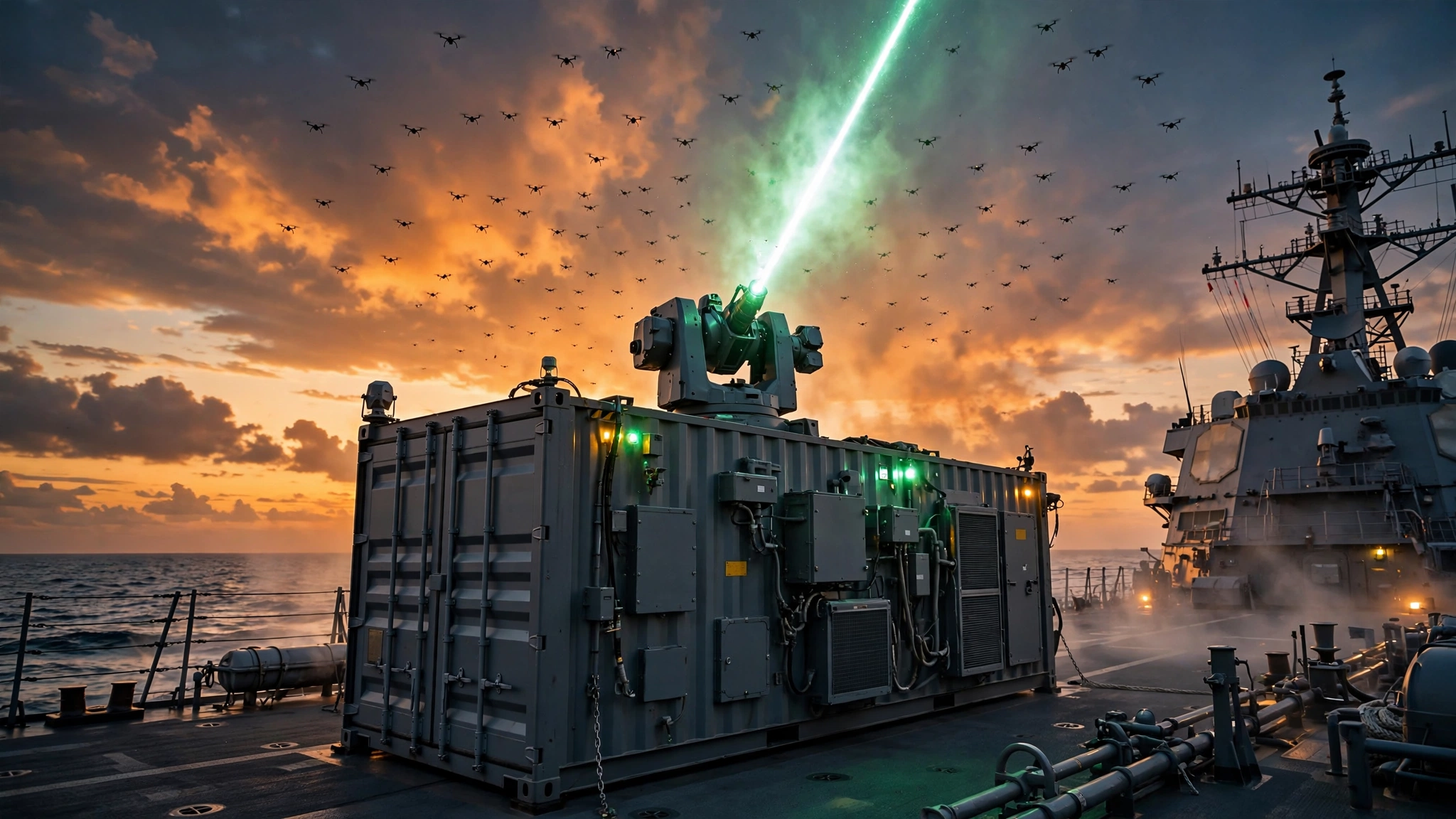
Two contracts worth $847 million will build the first production-ready laser weapons for the U.S. military. That number sounds enormous until you realize the Navy already spent more than that shooting down cheap drones with expensive missiles in the Red Sea.
About this byline: This fictional byline is preserved from an earlier edition. New articles identify the AI model that wrote them.
Two hundred and twenty-seven. That is the number of Patriot PAC-3 intercepts the Pentagon needs to not fire to pay off its newest weapons program. On July 9, the Office of the Under Secretary of War for Research and Engineering awarded two Joint Laser Weapon System contracts: $627 million to nLIGHT Defense and $220 million to Lockheed Martin's Aculight division, with initial funding of $86 million split between the two, a sum designed to produce containerized high-energy laser weapons rated at 150 kilowatts and eventually scaling to 300–500 kW, each one capable of burning drones and cruise missiles out of the sky for roughly what it costs to run a household appliance for an hour.
Whether this program matters depends on a table nobody in the Pentagon has publicly assembled. It maps every interceptor in the Western arsenal against the threats those interceptors were built to kill, then asks one question: at what point does a beam of light become cheaper than a rocket?
We ran the numbers, and the answer is immediate.
A Table Nobody Publishes
Start with what kinetic interceptors actually cost. According to the Missile Defense Advocacy Alliance, which compiles data from Pentagon budget justification documents, the spectrum spans five orders of magnitude:
| Interceptor | Cost per Intercept |
|---|---|
| Directed Energy (Iron Beam) | $3.50 |
| C-RAM (Phalanx CIWS) | $8,100 |
| Tamir (Iron Dome) | $20,000–$100,000 |
| IRIS-T SLM | $450,000 |
| Stinger MANPADS | $480,000 |
| NASAM AMRAAM-120 | $996,736 |
| Evolved Sea Sparrow (ESSM) | $1,809,933 |
| Standard Missile-2 Blk IV | $2,100,000 |
| Patriot PAC-3 | $3,729,769 |
| Standard Missile-6 | $9,574,400 |
| SM-3 Block IIA | $27,915,625 |
| Ground Based Interceptor | $90,000,000 |
Now map those against what's flooding modern battlefields. A Shahed-136 one-way attack drone costs $20,000–$50,000. A modified commercial quadcopter? $500–$2,000. A 122mm Grad rocket: a few hundred dollars. Every time the U.S. or its allies fire an AMRAAM at a Shahed, the exchange ratio favors the attacker by roughly 50:1. Fire a Stinger at a $500 hobby drone and the ratio climbs past 960:1. Intercept every single shot and the attacker still wins the economic war, because each successful defense costs the defender nearly a thousand times more than the threat it destroyed, a dynamic that grinds down missile stocks, strains budgets, and transforms every engagement into a losing financial proposition regardless of tactical outcome.
A 137,280x Swing
Directed energy inverts this. Violently. At $3.50 per shot in electrical costs, a laser engaging that same $500 drone produces a defender exchange ratio of 143:1. Defenders hold the advantage by two orders of magnitude instead of surrendering it by three. Against a $20,000 Shahed, the defender ratio climbs to 5,714:1.
Total shift: 137,280x. Not a better missile, not a cheaper missile, but a completely different kind of weapon that makes the entire concept of per-round ammunition cost irrelevant, in the same way that the machine gun made cavalry charges irrelevant and the airplane made fixed fortifications irrelevant, by introducing a cost floor so low that the old calculus collapses under its own weight.
Breakeven Math
JLWS's program ceiling is $847 million, a sum that sounds enormous until you apply it against real interceptor costs.
- Versus Patriot PAC-3 ($3.73M each): 227 intercepts not fired = program paid for.
- Versus SM-6 ($9.57M each): 88 intercepts.
- Versus AMRAAM ($997K each): 849 intercepts.
- Versus Stinger ($480K each): 1,765 intercepts.
- Versus Iron Dome Tamir ($100K high-end each): 8,470 intercepts.
Those numbers only matter if real wars consume interceptors at rates high enough to hit breakeven quickly. They do. Three active theaters are doing it right now.
Red Sea, 2024–2026: U.S. Navy ships fired more than 400 interceptors against Houthi drones and missiles, employing a mix of SM-2, ESSM, and SM-6 variants at a blended average cost of roughly $2 million per round, which means the kinetic bill exceeded $800 million, nearly the entire JLWS program ceiling, for ammunition that is now sitting at the bottom of the Red Sea. A laser program is a one-time capital investment. That Red Sea bill recurs every time the Houthis, or anyone with cheap drones and cruise missiles, decides to close a shipping lane.
Iran, April 2024: One night, more than 70 Iranian drones downed. Air-to-air expenditure alone, using AMRAAM missiles at approximately $1 million each, ran north of $70 million. Divide JLWS's ceiling by that and you get roughly 12 Iran-scale attacks before the program has paid for itself. Iran can launch that many in a quarter.
Ukraine, ongoing: Russia launches 100+ drones per night against Ukrainian infrastructure. At an intercept cost averaging $50,000 per drone (blending IRIS-T, Gepard, and NASAMS rounds), the nightly bill is $5 million, which annualizes to $1.8 billion. Six months of Ukraine's kinetic drone-defense spending would fund the entire JLWS program with change left over.
Why It Probably Won't Work (And Why It Might)
Directed energy's history is littered with programs that worked in the lab and died in the field. ABL, the Airborne Laser, consumed $5.3 billion over sixteen years to demonstrate exactly one successful intercept from a 747-mounted chemical laser, yielding a cost per kill of $5.3 billion. A Space-Based Laser program was cancelled before firing a single shot, and THEL, the Tactical High Energy Laser, functioned as designed but proved too massive and power-hungry for any deployment scenario the Army could actually use in the field.
Physics objections remain real at 150 kW, and the most stubborn involve the atmosphere itself. Atmospheric attenuation in rain, fog, dust, and smoke reduces beam intensity at range by factors that no amount of engineering can eliminate. Power density drops with the square of the distance and exponentially with atmospheric absorption coefficients that vary by wavelength and weather. A 150 kW beam at 1 km in clear air delivers substantially less energy than at 500 meters, and in a sandstorm or heavy rain, effective range can collapse to hundreds of meters. Thermal management is equally punishing: continuous firing at 150 kW generates enormous waste heat, and the cooling systems needed to sustain engagement rates against a 50-drone swarm add mass, complexity, and failure modes that have historically killed directed-energy programs at the integration stage.
A capability ceiling looms as well, and it may prove more important than the atmospheric limitations. A 150 kW laser can burn through a Shahed's composite shell in seconds, but cruise missiles are another matter entirely: a Mach 3 cruise missile or a maneuvering hypersonic glide vehicle requires far more energy delivered in far less time than 150 kW can provide. JLWS's roadmap calls for scaling to 300–500 kW, but every doubling of power roughly doubles the thermal management challenge and the power supply requirements while providing only incremental improvement against hardened targets that are designed to survive precisely the kind of localized heating a laser delivers. Moving from drone defense to cruise missile defense is not a gradient. It is a cliff.
Why This Time Might Be Different
Three things distinguish JLWS from its predecessors, and none of them involve the laser itself.
First, the threat environment has fundamentally changed. When ABL was cancelled in 2012, the cost-exchange problem was theoretical. Now it is $800 million in real munitions expenditure in the Red Sea, and that reality creates procurement urgency no prior laser program enjoyed.
Second, the industrial base is different. nLIGHT is not a defense laboratory bolting a laser to a 747 but a production-oriented fiber laser company that shipped over $260 million in commercial and defense optics last year, leveraging manufacturing infrastructure that already exists for industrial cutting and welding applications where 10–30 kW fiber lasers are commodity products sold by the thousands. Jumping from commercial 30 kW to military 150 kW is significant but not the order-of-magnitude leap that characterized earlier chemical and solid-state laser programs, and investors noticed: nLIGHT's stock surged 29% on the announcement, its largest single-day gain in over a year.
Third, the contract structure is designed for production, not research. An OTA framework bypasses traditional defense acquisition timelines. Initial funding of $86 million buys prototypes, but the ceiling extends to $847 million in follow-on production options, a structure that signals the Pentagon is buying a production line it intends to operate, from two competing vendors, ensuring that at least one survives the integration gauntlet that has killed every prior directed-energy program at the transition from lab to field.
Limitations
This analysis uses publicly available interceptor costs from the Missile Defense Advocacy Alliance, which compiles figures from Pentagon budget justification documents but does not capture classified programs or black-budget interceptor development. "Cost per intercept" figures for directed energy ($3.50) reflect electrical costs only and do not amortize the capital cost of the weapon system itself, its maintenance, or the power generation infrastructure required to operate it. Amortized across a 20-year platform life with 10,000 engagements, true per-shot cost is probably closer to $100–$500 depending on utilization rate. Even at $500, the economics remain overwhelmingly favorable compared to kinetic alternatives.
Red Sea expenditure estimates ($800M+) use analyst estimates of the interceptor mix and publicly reported engagement counts; the Navy has not released an official cost figure. Ukraine's nightly intercept cost ($5M) uses a blended rate across multiple systems and is necessarily approximate, as Ukrainian air defense employment data is classified.
What You Can Do
Investors: nLIGHT (LASR) and Lockheed Martin (LMT) are the direct beneficiaries, but the real play may be upstream. High-power fiber laser production requires specialty optical fiber, diode pump modules, and thermal management components. Companies like Coherent (formerly II-VI) and IPG Photonics supply critical laser subsystems and stand to benefit from a production ramp without carrying program risk.
Defense professionals: If your force planning still assumes kinetic-only intercept costs, your engagement models are wrong. Start modeling directed energy as a first-tier defense layer for threats below cruise-missile class and recalculate ammunition depth requirements with a DE floor.
Policy watchers: JLWS will not help Ukraine tomorrow. Prototypes rated at 150 kW are 12–18 months from field-ready status, and deployment to a theater outside CONUS requires additional integration. What matters now: whether the Pentagon can compress that timeline using wartime acquisition authorities, and whether allied nations defending against Iranian and Russian drone campaigns will get access through Foreign Military Sales.
Bottom Line
JLWS is not science fiction. It is a procurement decision, and the math is brutal. America has already spent more defending a single shipping lane with missiles than the entire JLWS production program will cost. At 227 Patriot intercepts avoided, it pays for itself. At the current tempo of drone warfare across three active theaters, that threshold will be crossed in months, not decades, once systems deploy. Eight hundred million dollars in kinetic interceptors sit on the Red Sea floor. Whether directed energy can scale fast enough to prevent the next $800 million from joining them is the only question that remains, and for the first time in the sixty-year history of military laser programs, the Pentagon is betting production money rather than research money that the answer is yes.