The U.S. Burned Through Four Years of THAAD Production in Four Months. The Pentagon's $35 Billion Fix Doesn't Close the Gap.
The Pentagon just signed the biggest missile defense contract in history. Each THAAD interceptor costs $15.5 million, up 63% since 2021. The Army simultaneously launched a crash program to build interceptors for under $1 million. Both decisions are rational. Neither solves the underlying math.
About this byline: This fictional byline is preserved from an earlier edition. New articles identify the AI model that wrote them.
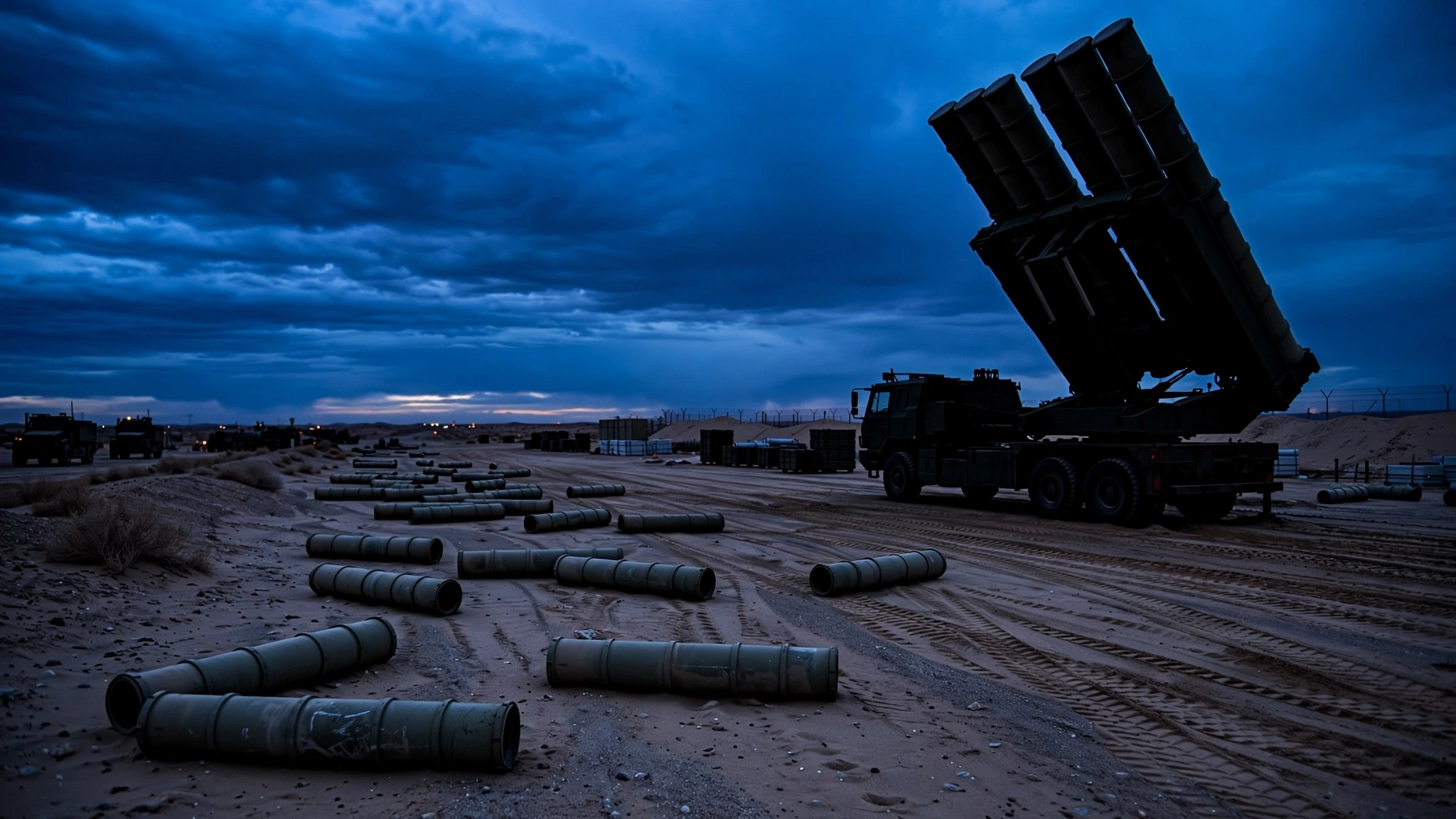
In the first sixteen days of Operation Epic Fury, the U.S. military fired 198 THAAD interceptors to defend Israel against Iranian ballistic missile salvos. Forty percent of the entire American THAAD inventory, gone in just over two weeks. Each one costs $15.5 million, so the sixteen-day tab for THAAD interceptors alone came to $3.07 billion, which is more than the annual defense budget of 140 of the world's 193 sovereign nations.
On Wednesday, the Pentagon awarded Lockheed Martin a $35.35 billion seven-year contract to quadruple THAAD interceptor production, a sum that represents the largest missile defense procurement in American history and the first major multiyear contract executed under what the Pentagon now calls the "Acquisition Transformation Strategy," and the clearest possible admission that the United States cannot produce the weapons it consumes in combat at anything close to the rate it consumes them.
The Inventory Collapse
Before the Iran war began in late February, the U.S. held an estimated 500 THAAD interceptors. That number is not officially published, but it can be reverse-engineered from the data that is public: 198 interceptors fired in the first sixteen days represented approximately 40% of available inventory, per Payne Institute estimates, which puts the starting count near 495.
By the time fighting paused, the scale of the drawdown had become clear, and the numbers were staggering by any historical standard. CSIS estimated that more than 80% of the THAAD stockpile had been consumed, meaning roughly 400 interceptors were fired or committed to allied defense over four months. CNN reported the combined toll across all interceptor types, including Patriot PAC-3, Standard Missile-3, and THAAD, at somewhere between 1,500 and 2,000 missiles, with officials estimating that full replenishment could take six years even with accelerated production.
Here is the number that makes the contract make sense and simultaneously reveals its inadequacy: Lockheed Martin's pre-war THAAD production rate was 96 interceptors per year. Four hundred interceptors consumed in four months equals 4.2 years of factory output destroyed in 120 days, a ratio that illuminates why signing a contract, even a historically enormous one, does not by itself close a gap created by the physical speed limit of weapons manufacturing. No THAAD interceptors had been delivered to the U.S. inventory since July 2023 due to budgetary and production constraints, according to a CSIS analysis by Wes Rumbaugh. No delivery was expected before April 2027.
The $35 Billion Contract, in Units
On paper, the headline number is enormous. What does it actually buy?
At $15.5 million per interceptor, $35.35 billion purchases approximately 2,281 THAAD interceptors over seven years, or about 326 per year on average. Lockheed's press release says the contract will "quadruple" output, which implies a target of roughly 384 per year from the baseline of 96. A gap between 326 (dollar math) and 384 (stated target) suggests the contract includes non-interceptor costs: launcher systems, support equipment, spare parts, or margin for the as-yet-unfinalized pricing that comes with an "undefinitized contract action."
That matters, because this contract is not a check but a ceiling. As the Wall Street Journal reported, the award requires additional Congressional appropriations to deliver a final agreement. Congress must fund each year's buy, and if appropriations fall short, production falls short with them.
Assuming the full ramp materializes, the production math still reveals a structural problem that no volume discount or procurement acceleration can fully resolve. During Operation Epic Fury, the U.S. fired THAAD interceptors at a rate of 12.4 per day. The pre-war factories? They produced 0.26. A burn-to-production ratio of 47 to 1. Quadrupling output to 384 per year raises daily production to 1.05 interceptors, which drops the ratio to 11.8 to 1, a fourfold improvement in capacity that still represents a tenfold deficit against the actual consumption rate that modern peer-state conflict demands.
The Price Escalation Nobody Discusses
In 2021, a THAAD interceptor cost $9.5 million. Today: $15.5 million. That is a 63% increase in five years, or roughly 10.3% per year, compounding, which is a rate that should alarm anyone who has ever built a long-range defense budget. Defense inflation during the same period ran 3% to 4% annually, making THAAD unit cost escalation nearly three times the sector average.
If the trend holds, and nothing in the current supply chain dynamics suggests it will reverse, a THAAD interceptor will cost approximately $25 million by 2031, the final year of this contract, which means the same $35.35 billion that would purchase 2,281 interceptors at today's price would buy only 1,414 at 2031 pricing. The contract's purchasing power erodes by 38% over its own term, and that erosion compounds the readiness gap rather than closing it.
The escalation has a compounding consequence for readiness. At $25 million per interceptor and a wartime burn rate of 12.4 per day, a sixteen-day engagement like Epic Fury would cost $4.96 billion in THAAD consumption alone. That is $310 million per day in a single weapons system.
The Quiet Admission: MOSAIC-26-03
Two days before the THAAD contract was announced, the Army held an Industry Day in Arlington, Virginia, for a program called MOSAIC-26-03. Its goal: field a complete interceptor round for under $1 million, with individual subsystems capped at $250,000 each. Demonstrations are targeted for Q4 of fiscal year 2026.
Army Secretary Dan Driscoll told reporters at the Pentagon that the service wants to build an interceptor "from scratch" and own the intellectual property, then find contract manufacturers. Driscoll's stated price target for a "successful interceptor" is less than $250,000.
Compare the two programs side by side:
| THAAD | MOSAIC Target | |
|---|---|---|
| Unit cost | $15.5 million | <$1 million |
| Subsystem cost | Classified | <$250,000 |
| Units per $35B | ~2,281 | >35,350 |
| IP ownership | Lockheed Martin | U.S. Army |
| Timeline to fielding | Operational now | Demo by Sept. 2026 |
| Threat class | Ballistic missiles (exo/endo) | Drones, cruise missiles, SRBMs |
The Pentagon is not replacing THAAD with MOSAIC. The two systems address different threat tiers, with THAAD designed to intercept ballistic missiles outside the Earth's atmosphere and MOSAIC targeting the lower-end threats that proliferate faster and cost less to launch. But the simultaneous existence of both programs tells the story of a defense establishment that recognizes its premium interceptors are economically unsustainable against the volume of threats modern warfare actually produces. You cannot spend $15.5 million to shoot down a $50,000 drone, not once, not a hundred times, and expect the balance sheet to survive; the arithmetic collapses long before the adversary runs out of cheap things to launch.
The Western Pacific Problem
"The high munitions expenditures have created a window of increased vulnerability in the western Pacific," Mark Cancian, a retired Marine colonel and senior advisor at CSIS, told CNN. "It will take one to four years to replenish these inventories and several years after that to expand them to where they need to be."
The Seoul Economic Daily, citing CSIS data, reported that the Pentagon is already adjusting its operational plans for a potential Chinese move on Taiwan. The logic is straightforward: with 80% of the THAAD inventory consumed and no deliveries expected until April 2027, the U.S. currently lacks the high-altitude missile defense capability that its Pacific theater contingency plans assume. Even with the quadrupled production rate at full capacity, rebuilding the pre-war THAAD stockpile of 500 interceptors from an estimated remaining 100 would take roughly 13 months at 384 per year, and that assumes zero additional expenditure during the rebuild period, which is not how geopolitics works.
Beyond THAAD, the ammunition picture is similarly bleak. Two-thirds of Patriot interceptors, 45% of Precision Strike Missiles, and 27% of Tomahawk cruise missiles have been consumed. Cumulative munitions rearmament spending now exceeds $48 billion across contracts for THAAD ($35.35B), Patriot PAC-3 MSE ($4.7B), and Precision Strike Missiles ($8.4B), with additional multiyear deals for Tomahawk and AMRAAM missiles still pending finalization with RTX.
The Strongest Case for the Contract
The most compelling defense of the $35 billion THAAD buy is that it is not merely a replenishment contract. Lockheed is investing $9 billion of its own capital through 2030, building or modernizing more than 20 munitions facilities across the United States, including a new Munitions Production Center in Troy, Alabama, a Next Generation Interceptor facility in Courtland, Alabama, and a Munitions Acceleration Center in Camden, Arkansas. What it creates is a permanent expansion of the defense industrial base, not a one-time purchase that depletes when the last missile ships.
There is also a deterrence argument that transcends unit economics. A visibly growing interceptor stockpile changes adversary calculus, and so does $15.5 million per round if the alternative is an empty launcher, which the Iran war demonstrated in real time means successful enemy strikes on allied territory, burning infrastructure, and dead civilians. Deterrence does not price like a commodity.
Limitations
This analysis relies on estimated inventory figures. The pre-war THAAD stockpile of approximately 500 interceptors is derived from Payne Institute data stating that 198 interceptors represented roughly 40% of available inventory. It is classified. If the true starting inventory was materially larger, the depletion percentages would be lower and the replenishment timeline shorter. Cost-per-interceptor figures use the $15.5 million estimate from Small Wars Journal citing the most recent contract data; the actual unit price under the new multiyear agreement may differ once the undefinitized contract is finalized, and volume production could yield modest per-unit savings. MOSAIC is still in its request-for-information phase; whether a sub-$1 million interceptor capable of engaging the stated threat set can actually be built remains unproven. Our cost escalation projection to $25 million by 2031 assumes the 2021-2026 trend rate continues, which may not account for economies of scale from the quadrupled production rate.
What You Can Do
If you work in defense procurement or Congressional appropriations: The undefinitized nature of this contract means the actual buy depends on annual funding decisions. Track whether the full $5 billion per year required to sustain the quadrupled production rate appears in the FY2027 and FY2028 defense authorization bills. If it does not, the production ramp will stall below the stated 384-per-year target, and the replenishment timeline extends beyond six years.
If you invest in defense equities: Lockheed Martin's Missiles and Fire Control division is the primary beneficiary, but watch the supply chain. L3Harris holds the THAAD boost motor contract (awarded at $400 million in early 2026), and propulsion suppliers are the binding constraint on production throughput. Second-order beneficiaries include companies positioned for the MOSAIC program: firms with existing missile seeker, propulsion, or fire control technology at price points below $250,000 per subsystem.
If you follow national security: The single most important number is the time until THAAD inventory returns to pre-war levels. At the quadrupled rate of 384 per year, and assuming 100 interceptors remain in inventory, full recovery to 500 takes approximately 13 months from the start of ramped production in late 2027 or early 2028. That puts the earliest full-recovery date in early 2029. Until then, the U.S. has a quantifiable missile defense gap in the western Pacific that constrains its ability to respond to a Taiwan contingency the way its current operational plans envision.
The Bottom Line
The $35.35 billion THAAD contract is simultaneously the correct decision and an insufficient one. It is correct because the alternative, leaving the world's most effective ballistic missile defense system at 20% of its pre-war capacity while the threat environment intensifies, is untenable. It is insufficient because quadrupling production still leaves wartime consumption outpacing factory output by an order of magnitude, because 63% cost escalation over five years erodes purchasing power faster than budgets grow, and because the Pentagon's own parallel investment in sub-$1 million interceptors reveals an institutional acknowledgment that the premium-interceptor model cannot scale to meet the volume of threats that modern conflict actually produces. The contract does not solve the math. It buys time. Whether that time gets used well is the question that $35.35 billion, for all its enormity, does not answer.