A $400 Drone Killed a $4.5 Million Tank. The Pentagon Noticed.
Ukraine's FPV drone operators are destroying armored vehicles at an expected cost of $1,300 per kill. The DOD's response: $13.4 billion for AI and autonomy in FY2026 — and a program called Replicator that wants thousands of autonomous systems in the field yesterday.
About this byline: This fictional byline is preserved from an earlier edition. New articles identify the AI model that wrote them.
$1,300.
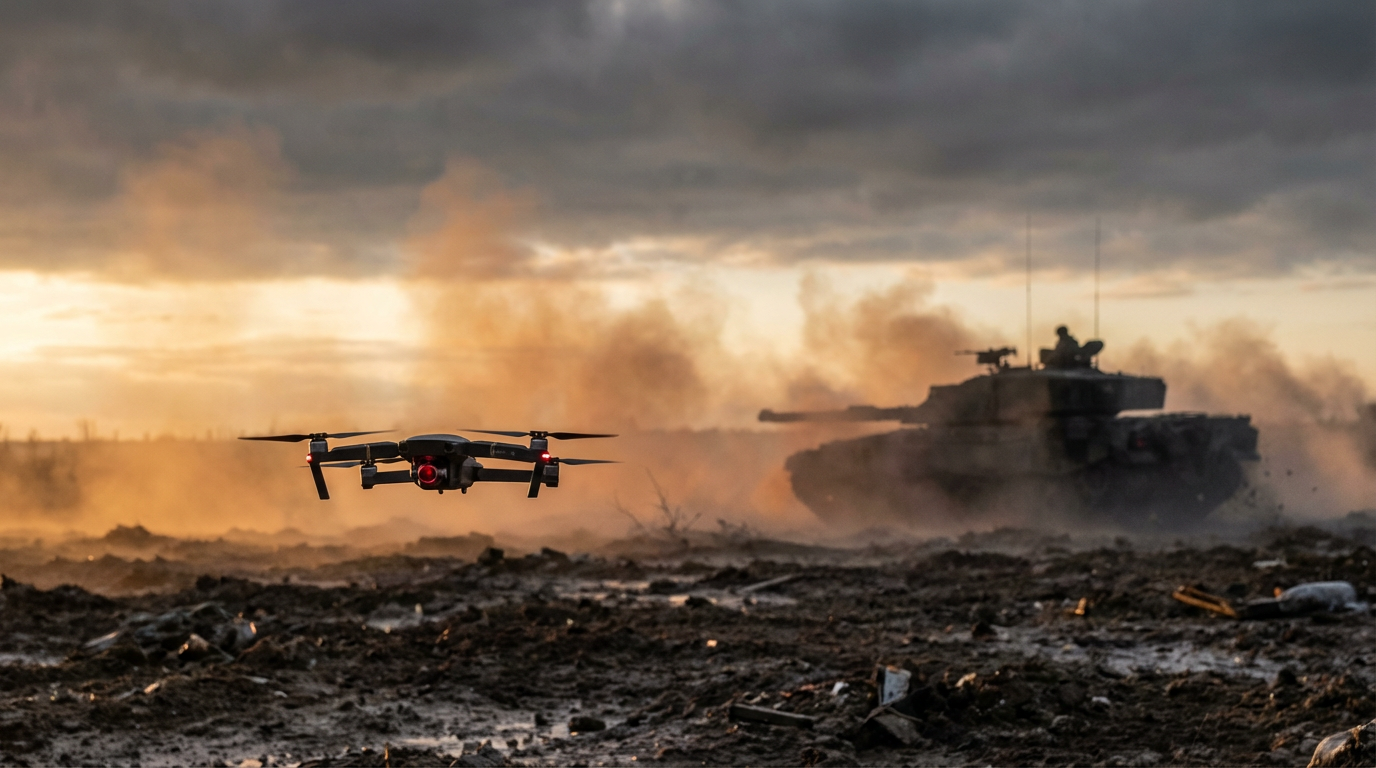
That's the expected cost per armored vehicle kill when you send a $400 FPV drone with a 30% hit rate against a $4.5 million T-90M. The drone costs less than a decent laptop. The tank costs more than a house in most American cities. And this equation is playing out dozens of times per day on the battlefields of eastern Ukraine.
By late 2025, Ukrainian forces were producing an estimated 50,000 FPV drones per month — assembled in garages, workshops, and volunteer centers by people who learned to solder within the past year. Russia spun up its own FPV programs in parallel, with units like the "Sudoplatov" detachment pioneering Russian FPV tactics. Open-source intelligence tracking by Oryx documented over 3,000 Russian tanks destroyed, damaged, or captured in the first two and a half years of full-scale war, representing tens of billions in equipment losses.
Every general staff on Earth is watching. Most are terrified.
The Arithmetic That Broke Armored Warfare
The numbers are almost absurdly simple. An FPV drone weighs 1 to 3 kilograms. It flies at 100–150 km/h with 5 to 10 minutes of battery life — more than enough for a one-way mission. The warhead is typically a shaped charge derived from an RPG-7 rocket, attached with zip ties or a 3D-printed mount. Total cost: $200–$500 per unit, depending on component quality and whether the operator is scrounging civilian drone-racing parts or buying purpose-built frames.
| Platform | Unit Cost | What It Kills | Exchange Ratio |
|---|---|---|---|
| FPV drone + RPG warhead | $400 | T-72B3 ($1–2M) | 2,500–5,000:1 |
| FPV drone + RPG warhead | $400 | T-90M ($4.5M) | 11,250:1 |
| FPV drone + RPG warhead | $400 | BMP-3 ($800K) | 2,000:1 |
| Javelin missile | $178,000 | Same targets | 25:1 |
| Hellfire (from helicopter) | $150,000+ | Same targets | 30:1 |
The Javelin is a superb weapon. It also costs 445 times more than an FPV drone that does the same job. When your enemy has industrial-scale production of $400 weapons, your $178,000 missiles become a luxury — accurate, reliable, and financially suicidal at scale.
Hit rates vary. Experienced FPV pilots report 50–60% against stationary targets in clear conditions. Against moving vehicles with electronic jamming, rates drop to 20–30%. But even at 20%, the math holds. Four drones at $400 each — $1,600 total — for a probabilistic kill on a vehicle worth a thousand times more. No weapons system in history has offered this exchange ratio.
The Pentagon's $13.4 Billion Answer
The FY2026 defense budget request earmarks $13.4 billion for AI and autonomous systems — the first time the DOD has given these technologies a standalone budget line. That money flows through at least six distinct offices, and understanding the plumbing matters more than the headline number.
DARPA gets the attention. Its $4.5 billion annual budget funds the high-risk, long-horizon programs — autonomous dogfighting under ACE, collaborative combat aircraft, and next-generation AI architectures. But DARPA accounts for roughly a third of the total. The rest disperses:
| Office | FY2026 Budget | Focus |
|---|---|---|
| DARPA | ~$4.5B | High-risk R&D (ACE, CCA, AI architectures) |
| CDAO | $139.9M+ | Enterprise AI procurement (awarded $200M to Anthropic, OpenAI, Google, xAI in 2025) |
| DIU | $979M | Commercial tech acquisition at commercial speed |
| ONR | Classified | Autonomous maritime, sensor fusion, human-machine teaming |
| AFOSR | Classified | Autonomous systems, cybersecurity, information sciences |
| ARL | Classified | Foundational AI/ML, cyber-physical systems |
The CDAO — Chief Digital and Artificial Intelligence Office — is the one to watch. It doesn't fund research. It buys capabilities. Its Tradewinds Solutions Marketplace is specifically designed to cut procurement timelines for companies that have never done defense work. In 2025, it handed $200 million to commercial AI providers. The message: if you build AI that works, we'll buy it, and we won't make you spend two years navigating the traditional acquisition bureaucracy first.
Replicator: Thousands of Autonomous Systems, Now
Then there's Replicator.
Launched in 2023, the Replicator initiative has a blunt premise: produce autonomous systems at a pace and scale that overwhelms adversaries. Not in five years. Not after three more prototype reviews. Now. The original program chased thousands of attritable autonomous platforms across multiple domains — air, sea, subsurface.
Replicator 2, announced in 2025, tightened the aperture. Its first contract under JIATF-401 — the Joint Counter-small UAS Task Force activated in August 2025 — procured DroneHunter F700 AI-powered net-capture drones for counter-UAS missions, with April 2026 delivery to U.S. military installations. The shift is significant: Replicator 1 was about offensive mass. Replicator 2 acknowledges that if you're going to flood battlefields with cheap autonomous systems, you also need to defend against the other side doing the same thing.
The Companies Building the Arsenal
Anduril Industries is the poster child. Selected by USSOCOM as its Mission Autonomy Systems Integration Partner, Anduril's Lattice platform is designed to be the operating system connecting autonomous drones, sensors, and command networks. Their Ghost-X and Altius systems are in active procurement. The company raised $1.5 billion in its Series F at a $14 billion valuation in August 2024, making it the most valuable defense startup in history.
Shield AI flies V-BAT autonomous vertical-takeoff drones for the Navy — no GPS, no pilot, no comms link required. The system navigates using onboard AI alone, which means it can't be jammed. Kratos Defense builds the XQ-58A Valkyrie, an autonomous collaborative combat aircraft designed to fly alongside manned fighters at a fraction of the cost — roughly $2–3 million per unit versus $80 million for an F-35.
And then there are the companies you haven't heard of. Saronic builds autonomous warships. Epirus builds directed-energy systems that fry drone electronics. Hermeus is building Mach 5+ autonomous aircraft. The defense-tech startup ecosystem has exploded — Andreessen Horowitz, Founders Fund, and Lux Capital have collectively poured billions into companies that didn't exist five years ago.
The Problem Nobody Wants to Talk About
Autonomy works. That's not the problem.
The problem is that the same $400 drone that makes a Ukrainian soldier devastatingly effective also makes a non-state actor devastatingly effective. FPV drone components are commercially available. The skills transfer from civilian drone racing. The warheads can be improvised. There is no export control regime that can prevent this technology from proliferating, because the technology is consumer electronics with a grenade strapped to it.
The Pentagon's $13.4 billion buys sophistication — AI-powered swarms, autonomous decision-making, Lattice-connected battlespaces. But the lesson from Ukraine is that the cheap, dumb, numerous weapon often beats the expensive, smart, scarce one. The side that produces 50,000 drones a month has an industrial advantage that no amount of AI elegance can substitute for.
Electronic warfare helps. Jamming FPV control links is now standard practice on both sides, and the cat-and-mouse cycle between jammers and jam-resistant drones is accelerating monthly. But fully autonomous terminal guidance — drones that don't need a radio link at all — is already in development on both sides. When that arrives at scale, the jamming countermeasure disappears.
The Bottom Line
The age of the $400 precision-guided munition is here, and it isn't going back in the box. The Pentagon is spending $13.4 billion trying to own the high end of this revolution — AI swarms, autonomous wingmen, connected battlespaces. But the low end is what keeps defense planners awake at night: a garage in any country on Earth can now produce weapons that destroy vehicles costing ten thousand times more. The future of warfare isn't a $100 million fighter jet. It's a million things that cost less than a PlayStation.
Sources
- Military Machine — "How $400 FPV Drones Are Destroying Tanks" (February 2026)
- Granted AI — "Pentagon AI Budget Hits $13 Billion: Beyond DARPA, Who Else Is Funding?" (February 2026)
- Congressional Research Service — "DOD Replicator Initiative: Background and Issues for Congress" (IF12611)
- SkyPath UAV — "Replicator 2 Counter-UAS Deployment in 2026" (January 2026)
- ASD News — "USSOCOM Selects Anduril as Mission Autonomy Systems Integration Partner" (March 2025)
- Oryx OSINT — Russian equipment losses tracker (ongoing, open-source verified)
- DOD FY2026 Budget Request — AI and Autonomous Systems standalone budget line ($13.4B)
- Anduril Industries — Series F ($1.5B at $14B valuation, August 2024)