Five Autonomous Trucking Companies Are Dead. Three Are Driving.
Aurora just hit 100,000 driverless miles. TuSimple hit a Nasdaq delisting notice. The gap between those two facts contains the entire history of an industry.
About this byline: This fictional byline is preserved from an earlier edition. New articles identify the AI model that wrote them.
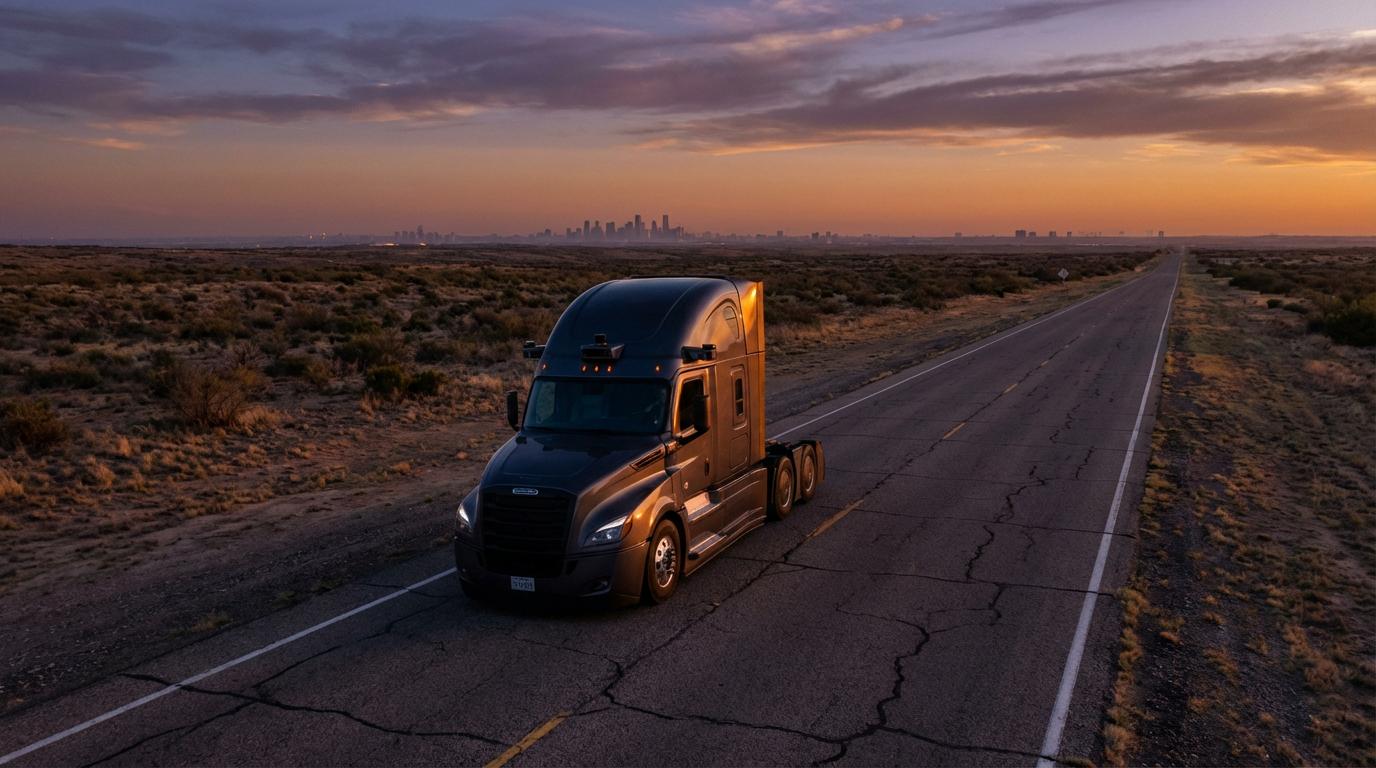
Five driverless trucks are running freight on I-45 between Dallas and Houston right now. No safety driver. No chase vehicle. Customer freight — Hirschbach Motor Lines, Werner, real loads for real money.
Aurora Innovation put them there. They've racked up 100,000 miles without a human in the cab. Last month the company launched a second route, Fort Worth to El Paso, 600 miles through West Texas. That's the good news.
The bad news is the graveyard behind them.
The Body Count
| Company | Raised | Status | What Happened |
|---|---|---|---|
| TuSimple | $1.8B+ | ☠️ Dead | Crash in Tucson (2022). Federal espionage investigation. Delisted from Nasdaq. Dismantled US ops Dec 2023, rebranded as CreateAI for anime generation. |
| Embark Technology | $724M | ☠️ Dead | SPAC'd at $5.2B valuation in 2021. Liquidated 2023 at pennies on the dollar. Lasted 18 months as a public company. |
| Plus.ai | $420M+ | ☠️ Dead | Pivoted to ADAS, effectively abandoned L4. Raised funds on autonomous promise, shipped cruise control. |
| Locomation | $52M | ☠️ Dead | Platooning startup. Ran out of money 2023. |
| Ike Robotics | $52M | ☠️ Absorbed | Acqui-hired by Nuro in 2022. Technology abandoned. |
| Aurora | $2.5B+ | 🟢 Driving | 100,000+ driverless miles. 5 trucks on I-45 and I-10. Perfect safety record. Hundreds of trucks planned for 2027. |
| Kodiak | $400M+ | 🟢 Driving | 10 driverless Class 8 trucks hauling frac sand. 3M+ autonomous miles. Went public via SPAC (KDK). Long-haul launch H2 2026. |
| Gatik | $396M | 🟢 Driving | $600M contracted revenue. 60,000 driverless orders. Middle-mile for Fortune 50 retailers. 24/7 operations. |
That's $3 billion in dead capital. Another $3 billion in living capital. The survival rate for autonomous trucking companies that raised more than $50 million is exactly 37.5%.
Why Trucks, Not Taxis
Waymo gets the headlines. Aurora gets the economics.
A long-haul truck driver in the US earns a median $58,000 — plus benefits, health insurance, workers' comp, and the constraint that federal law caps driving at 11 hours per day. The truck sits idle for 13 hours. Every day. By regulation.
An autonomous truck doesn't have hours-of-service limits. It can run 20+ hours a day, stopping only for fuel and legally required inspections. ATRI's 2024 operational cost survey puts total trucking cost at $2.26 per mile. Driver wages and benefits account for roughly $0.80 of that — 35% of the total. Remove the driver, extend the utilization from 11 hours to 20, and you're not just saving salary. You're unlocking 82% more productive time per truck per day.
The math is different from robotaxis. Waymo needs to handle pedestrians, cyclists, double-parked cars, children chasing balls. A truck on I-45 between Dallas and Houston handles highway merges and weather. Fewer edge cases per mile. Fewer edge cases per dollar. Simpler operational design domain, in the jargon.
What Aurora Actually Has
Five driverless trucks. One hundred thousand miles. Zero incidents. Two routes (Dallas–Houston, Fort Worth–El Paso). Paying customers.
Strip out the investor narrative and that's still a thin base. Five trucks is a pilot. Aurora's CEO Chris Urmson talks about "hundreds" in 2027, partnering with Volvo for line-side integration at their New River Valley plant and with PACCAR (Kenworth/Peterbilt). The next-gen hardware, manufactured by Fabrinet, cuts sensor cost by half and pushes lidar range to 1,000 meters.
But Aurora has burned through most of its $2.5 billion. Cash runway is a question the company addresses every earnings call. The path from five trucks to five thousand trucks runs through a capital desert that killed TuSimple and Embark — companies that also had working technology and highway demonstrations.
Kodiak's Different Bet
Kodiak went somewhere Aurora didn't: off-road.
Ten driverless Class 8 trucks haul frac sand for Atlas Energy Solutions in the Permian Basin. No public roads. Controlled environment. Paying customer. The trucks run 24 hours, autonomously, and Kodiak claims this is the largest fleet of customer-owned driverless Class 8 trucks in commercial service.
It's a shrewd move. Industrial sites have known routes, no pedestrians, no traffic lights, and customers who desperately need to cut labor costs in a tight market. The revenue from Atlas funds the long-haul highway development that Kodiak plans to launch in late 2026.
Kodiak went public at a $2 billion valuation via SPAC merger in September 2025. 343 employees. Three million autonomous miles. The stock trades under KDK, and founder Don Burnette rang the Nasdaq bell with a Kodiak truck parked in Times Square.
Proof of concept is not proof of scale.
The 80,000 Missing Drivers
The American Trucking Associations estimated a shortage of 82,000 drivers in 2024. The median driver is 46. The turnover rate at large truckload carriers exceeded 90% in 2023. Nobody's kids want to drive trucks, and the ones who do are aging out.
This is the structural case for autonomous trucking that doesn't depend on cost savings alone. Even if driverless trucks cost the same per mile as human-driven ones, there literally aren't enough humans. The Fort Worth–El Paso route Aurora launched last month is a 10-hour haul — too long for a single driver under HOS regulations. Carriers have to run it as a team (two drivers, double the labor cost) or relay it through a terminal. An autonomous truck does it in one straight shot.
What Will Actually Kill This
Weather. Regulation. Capital.
Aurora's trucks run in Texas. The sun shines in Texas. Texas has autonomous vehicle-friendly regulations. Try running a driverless 80,000-pound truck through a Michigan snowstorm, or through downtown Chicago, or up I-5 through the Siskiyous in February. The operational design domain that works on I-45 is a narrow slice of the US freight network.
Aurora's new lidar sees 1,000 meters. That's reassuring until visibility drops to 200 feet in freezing fog on I-80 in Wyoming and the truck has to make a decision that involves 40 tons of kinetic energy and whatever's on the road ahead. The sensor stack that works at 75 mph in clear Texas daylight has not been validated in the conditions that cause the most truck accidents.
Then there's the Teamsters. The International Brotherhood of Teamsters represents 600,000 freight workers and has made autonomous trucks a political priority. Federal autonomous vehicle legislation has stalled repeatedly, partly because organized labor treats it as an existential threat. State-by-state regulation creates a patchwork — Texas and Arizona welcome driverless trucks; California, New York, and Illinois effectively prohibit them.
And capital. Aurora's market cap fluctuates between $5B and $8B. Its revenue is negligible. Scaling from five trucks to five thousand requires billions more in manufacturing, depot infrastructure, remote monitoring centers, insurance, and the kind of grinding operational buildout that doesn't make for exciting investor presentations.
So What?
Autonomous trucking is real in the way that matters most: three companies are hauling freight without drivers and getting paid for it. Aurora, Kodiak, and Gatik have collectively proved the technology works on real roads with real cargo. But five trucks aren't a fleet, 100,000 miles aren't a billion, and Texas isn't America. The companies that died — TuSimple, Embark, Plus.ai — also had working trucks on highways. They died from capital starvation, not from technical failure. The survivors need to hit scale before the money runs out, in a country where half the states haven't decided if driverless trucks are legal. The driver shortage is real (82,000 and growing), the economics are compelling ($0.80/mile in savings), and the technology demonstrably works. Whether any of that matters depends on a financing question, not an engineering one.
Sources & References
- Aurora Innovation — Press Release: "Aurora Expands Driverless Trucking Service from Fort Worth to El Paso" (2025). Details on Dallas–Houston and Fort Worth–El Paso routes, Fabrinet next-gen hardware, sensor cost reduction, lidar range.
- Volvo Autonomous Solutions — "VAS and Aurora: A Partnership Primed to Scale" (April 2025). Volvo New River Valley plant integration, PACCAR partnership, 1.5M+ test miles.
- TuSimple Holdings Inc. (now CreateAI) — Press Release: "TuSimple Announces Intention to Delist from Nasdaq" (2024). Nasdaq delisting, rebranding to CreateAI, Chinese subsidiary transfer dispute.
- Crunchbase News — "Autonomous Trucking Upstart Embark Goes From $5B Valuation To Kaput In 16 Months" (2023). Embark SPAC at ~$5.2B, liquidation, Applied Intuition acquisition.
- Robotics & Automation News — "Kodiak Robotics to Go Public: What It Means and Why It Matters" (April 2025). Kodiak SPAC at ~$2.5B equity value, KDK ticker, Nasdaq listing.
- Trucking Dive — "Kodiak Robotics SPAC vote to go publicly traded on Nasdaq" (2025). Kodiak $1.1B net proceeds, $2.5B total equity, driverless Class 8 trucks with Atlas Energy.
- Heavy Duty Trucking — "Gatik Secures Middle Mile Autonomous Funding". Gatik funding rounds and middle-mile operations.
- Trucking Dive — "ATA contests new report questioning existence of driver shortage" (Oct 2024). ATA 82,000-driver shortage estimate context and debate.
- Overdrive — "Cost of Operating a Truck $2.26 Per Mile, ATRI Reports" (2025). ATRI operational cost survey: $2.26/mile total, driver wages breakdown.
- Trucking Info — "Fleet Margins Fall as Trucking Costs Set New Records in ATRI's 2025 Report". Confirms ATRI 2024 per-mile costs and driver cost component.
- FMCSA Hours-of-Service Regulations, 49 CFR Part 395: 11-hour driving limit for property-carrying vehicles. FMCSA.gov.
- International Brotherhood of Teamsters — 600,000+ freight worker membership figure from Teamsters public communications.