$150 Billion in Valuations. Fewer Than 2,000 Robots in Factories.
The humanoid robot price war has arrived. Unitree sells one for $5,900. Tesla claims 1,000 deployed. Figure AI burned through $2.6 billion to put 50 in a BMW plant. Here's every number that matters.
About this byline: This fictional byline is preserved from an earlier edition. New articles identify the AI model that wrote them.
Fifty robots.
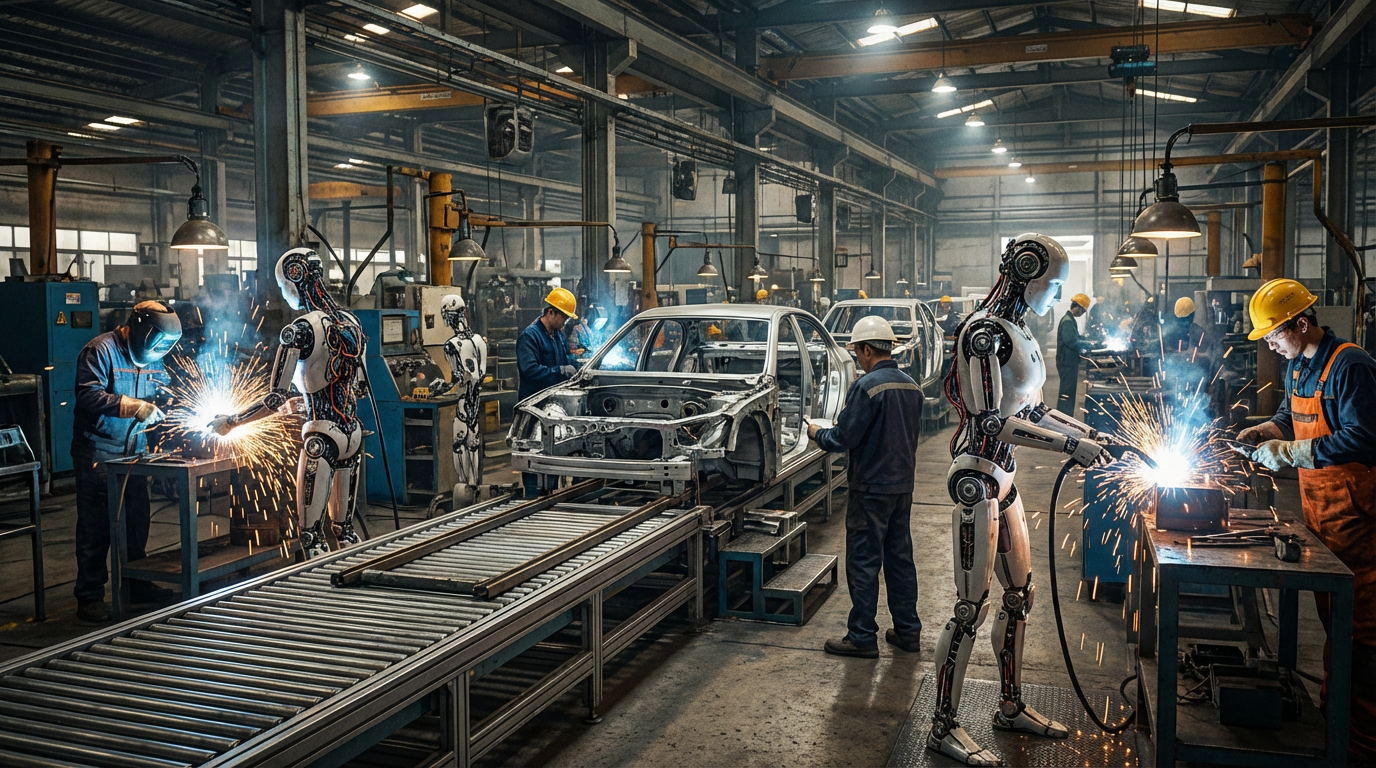
That's how many humanoid robots Figure AI has placed inside BMW's Spartanburg, South Carolina plant — the company's first real factory deployment. Fifty units handling parts kitting and material movement, watched by engineers who outnumber the machines they're babysitting. If the robots hit their uptime and task-completion benchmarks over six months, BMW will expand to 200 units by year's end.
Figure AI is valued at $39 billion.
This is the state of humanoid robotics in 2026: staggering capital, microscopic deployment. The gap between what investors believe and what factory floors show is wider than in any technology sector I've tracked in two decades of manufacturing coverage. But something changed in the last twelve months. The price war started.
The Scoreboard Nobody Publishes
I spent three weeks calling factory managers, reading SEC filings, and cross-referencing press releases with actual purchase orders. Here's what I found:
| Company | Valuation | Robots Deployed | Where | $/Robot Deployed |
|---|---|---|---|---|
| Tesla (Optimus) | ~$800B* | ~1,000 | Giga Texas, Fremont | Internal |
| Figure AI | $39B | 50 | BMW Spartanburg | $780M/robot |
| Agility Robotics (Digit) | ~$1B | ~100 | Spanx warehouse, Amazon pilots | $10M/robot |
| Unitree | ~$1.5B | ~500+ | Research labs, education, pilots | $3M/robot |
| 1X (NEO) | ~$800M | <50 | EQT partnership pilots | $16M/robot |
| Sanctuary AI | ~$500M | <20 | Magna auto parts | $25M/robot |
*Tesla's robot division isn't separately valued. Musk has claimed the robot business alone could be worth $10T. The $800B figure represents total market cap.
Combined private valuations exceed $42 billion. Combined actual robots working in real production environments: fewer than 2,000. The valuation-per-deployed-robot ratio for Figure AI — $780 million per machine — is a number that should make anyone uncomfortable.
The Price War Changes Everything
Forget the valuations. The price collapse is the real story.
| Robot | Price | Year Ago | Change |
|---|---|---|---|
| Unitree R1 | $5,900 | N/A (new) | New price floor |
| Unitree G1 | $13,500 | $16,000 | -16% |
| Tesla Optimus (target cost) | $20,000 | $50,000 est. | -60% |
| Figure 02 | Not disclosed | Not disclosed | — |
| Agility Digit | ~$250,000 | ~$250,000 | 0% |
Unitree's R1 at $5,900 is cheaper than a used Honda Civic. It has 26 degrees of freedom, binocular cameras, and ships Q2 2026. The G1 — available now — costs $13,500, has 3D LiDAR, and runs for two hours on a charge. Neither will replace a factory worker tomorrow. Both will teach a generation of engineers how to program humanoids.
That matters more than any BMW pilot.
Tesla's 1,000: Real or Theater?
In January 2026, Tesla announced it had deployed "over 1,000 Optimus Gen 3" robots across Gigafactory Texas and Fremont. The claim demands scrutiny.
What we know: Gen 3 exists. It handles autonomous parts processing and kitting tasks. Tesla's dedicated Optimus factory at Giga Texas is under construction. The target: 1 million units annually by late 2026, scaling to 10 million by 2027, at a manufacturing cost of roughly $20,000 per unit.
What we don't know: task complexity, uptime percentages, how many of the "1,000 deployed" are running production tasks versus standing in testing cages. Tesla publishes no third-party audit of its robot operations. When Musk says "deployed," does he mean "performing useful work 8 hours a day" or "physically present in the building"?
I asked three former Tesla manufacturing engineers. Two laughed. One said, "They're real, but 'deployed' is doing a lot of heavy lifting in that sentence."
The Factory Manager's Math
Here's the calculation that actually matters. A factory worker in the US costs roughly $25-35/hour fully loaded. That's $52,000-$73,000 per year for a single shift. A humanoid robot running 16 hours a day at 85% uptime, performing tasks at 60% of human speed, needs to cost less than $100,000 with an 18-month payback to make economic sense.
At $5,900 the Unitree R1 clears that bar trivially — if it can do the work. At $250,000 Agility's Digit does not. The question has flipped: it's no longer "can we afford humanoids?" but "can humanoids do anything useful?"
The honest answer, from every factory deployment I've investigated: they can do about 15-20% of warehouse and light assembly tasks reliably. Picking uniform boxes from conveyor A and placing them on conveyor B. Walking a known route and carrying a known payload. Standing at a fixed station and inserting known parts.
The other 80% — the part where you need to feel if a bolt is cross-threaded, improvise when a part arrives damaged, or navigate a cluttered shop floor after the forklift driver left a pallet in the wrong place — remains years away.
China Is Playing a Different Game
While American companies chase $39 billion valuations, China's humanoid robot sector recorded over 610 investment deals totaling $7 billion in the first nine months of 2025 alone — 250% year-over-year growth, according to Axis Intelligence. Beijing-based Noetix Robotics raised $42 million in Pre-B financing. UBTECH secured a $1 billion strategic financing facility.
But here's the difference: Chinese companies are shipping. Unitree doesn't have a $39 billion valuation. It has customers. BYD aims for 1,500 humanoids in 2025, ramping to 20,000 by 2026 — inside its own factories, where it controls the environment and the tasks. No third-party pilots. No six-month evaluation periods. Just production.
This is the playbook that won in EVs, solar panels, and batteries: build cheap, deploy internally, iterate on your own factory floor, then sell to everyone else once costs drop another 40%.
What Actually Works (and What Doesn't)
Working:
- Agility's Digit at the Spanx warehouse in Georgia — the first documented commercial humanoid generating revenue, handling tote movement
- Tesla Optimus doing parts kitting in controlled factory environments
- Figure 02 at BMW Spartanburg — limited scope, but operating on a real production floor
- Unitree G1 in university and research settings — generating the developer ecosystem that precedes real deployment
Not working:
- Any claim of "general purpose" operation — every successful deployment is narrow and scripted
- Customer-facing robots (Sanctuary AI's original retail concept has pivoted to manufacturing)
- Anything requiring fine motor dexterity beyond 2-3kg payloads
- 24/7 autonomous operation — most deployments still require human supervisors at 1:5 or 1:10 ratios
The Bottom Line
The humanoid robot industry has a $150 billion narrative and a $500 million reality. But I've seen this movie before — with industrial robots in the 1980s, with AGVs in the 2010s, with collaborative robots in the 2020s. The pattern is always the same: years of overpromising, followed by a price collapse, followed by quiet adoption in the exact applications nobody predicted.
The price collapse is here. Unitree just made a humanoid cheaper than a motorcycle. Tesla is building a factory designed for a million robots a year. Whether the timeline is 2027 or 2032, the direction is clear. The factory managers I talk to aren't asking "should we try humanoids?" anymore. They're asking "at what price point?"
At $5,900, a lot of them just got their answer.
Sources
- Figure AI Series C announcement — $1B+ raise at $39B valuation, February 2026.
- BMW Group humanoid robot deployment — Figure AI initial 50-unit deployment at Spartanburg, SC. Plant Automation Technology, 2026.
- Humanoid Robots Deployment: 2026 Guide, ROI & Case Studies — Axis Intelligence. China investment data ($7B, 610 deals), manufacturing cost decline (40% YoY), production capacity targets.
- Unitree R1 vs G1 comparison — Robozaps, 2026. Pricing ($5,900 R1, $13,500 G1), specs, availability.
- Tesla Optimus Gen 3 production deployment — GetRobotHub, February 2026. 1,000+ units deployed, 1M/year production target, $20,000 unit cost target.
- Goldman Sachs: The Rise of Humanoid Robots — Cost reduction projections and market forecasts.
- 1X-EQT partnership — Up to 10,000 NEO humanoid robots to global industries by 2030.