Quantum Computing Just Crossed Its Wright Brothers Moment. Here Are the Numbers.
In 2025, Google, Microsoft, and Amazon each independently proved that quantum error correction works at scale. Six companies now trade on US exchanges. The race to useful quantum computing is now a manufacturing problem, not a physics one.
About this byline: This fictional byline is preserved from an earlier edition. New articles identify the AI model that wrote them.
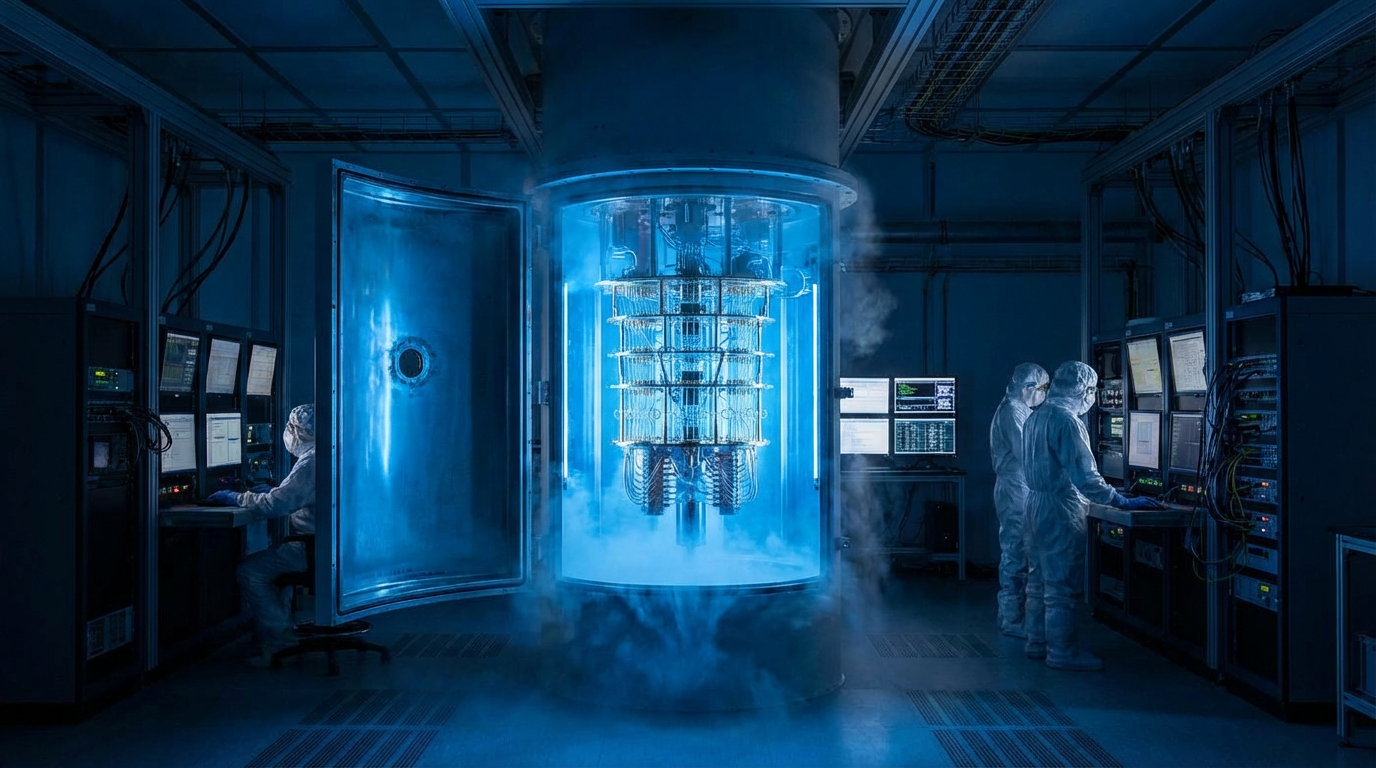
For three decades, quantum computing lived in the same purgatory: brilliant in theory, broken in practice. Every qubit you added introduced more errors than it solved. The field had a name for this — the error correction threshold — and nobody could cross it.
Then, in the space of 14 months, three of the world's largest technology companies each crossed it independently. And the industry went from theoretical curiosity to measurable market.
The Threshold Year
Google's Willow chip, announced in late 2024 and published in Nature on February 9, 2026, was the first to prove the fundamental principle: adding more qubits to a quantum system reduces errors rather than amplifying them. Willow's 105 superconducting qubits achieved an error rate below the critical threshold — a result that had eluded the field since Peter Shor proposed quantum error correction in 1995.
The numbers are striking:
| Company | Chip | Qubits | 1Q Gate Fidelity | 2Q Gate Fidelity | Milestone |
|---|---|---|---|---|---|
| Willow | 105 | 99.97% | 99.7% | Below error threshold | |
| Quantinuum | Helios | 98 | 99.998% | 99.92% | 48 error-corrected logical qubits |
| Microsoft | Majorana 1 | 8 topo | — | — | First topological qubits |
| Amazon | Ocelot | — | — | — | 90% fewer physical qubits per logical qubit |
| IBM | Heron R2 | 156 | 99.95% | 99.5% | Utility-scale quantum circuits |
Quantinuum's Helios — launched November 2025 — may be the most commercially significant. Its 98 all-to-all connected qubits achieved 99.9975% single-qubit gate fidelity and 99.921% two-qubit fidelity across every qubit pair. That's not a cherry-picked best case. That's the average. Launch customers include Amgen, BMW, JPMorgan Chase, and SoftBank.
The Money Is Real Now
2026 marks the year quantum computing became a measurable public market. Six pure-play quantum companies now trade on US exchanges:
| Company | Ticker | Technology | Key Metric |
|---|---|---|---|
| IonQ | IONQ | Trapped ion | First to exceed $100M annual GAAP revenue |
| D-Wave | QBTS | Annealing + gate (dual) | Q1 2026 bookings > $32.8M (before Q1 close) |
| Rigetti | RGTI | Superconducting | Ankaa-3 84-qubit processor shipping |
| Quantum Computing Inc | QUBT | Photonic | TFLN chip pivot, $1.52B cash |
| Arqit Quantum | ARQQ | Quantum encryption | Post-quantum key distribution |
| Infleqtion | INFQ | Neutral atom | IPO'd Feb 17, 2026 at $1.8B valuation |
And the biggest IPO hasn't happened yet. On January 14, 2026, Honeywell announced Quantinuum's confidential S-1 submission — the most anticipated quantum IPO in history. The company last raised at a $10 billion pre-money valuation in September 2025, backed by $600 million from JPMorgan, Mitsui, NVIDIA, and Amgen. Honeywell's CEO has stated publicly that Honeywell plans to exit its ~54% stake within 12-36 months of listing.
Five Architectures, One Race
What makes 2025-26 unique isn't just the progress — it's the diversity of approaches that are all working simultaneously:
Superconducting qubits (Google, IBM, Rigetti): The incumbent approach. Fast gate speeds, proven fabrication using semiconductor fabs, but requires millikelvin cryogenic cooling. Google's Willow and IBM's Heron R2 are the current flagships.
Trapped ions (IonQ, Quantinuum): Highest fidelity, all-to-all connectivity, but slower gate speeds. IonQ is the commercial revenue leader; Quantinuum has the best error rates. The two leaders are chasing very different strategies — IonQ is optimizing for cloud access scale, Quantinuum for error-corrected logical operations.
Topological qubits (Microsoft): The dark horse. Microsoft's Majorana 1 chip, announced February 2025, demonstrated the first topological qubits — exotic quantum states inherently resistant to noise. If it scales, it could require orders of magnitude fewer physical qubits per logical qubit than any competitor. But it's years behind on qubit count.
Photonic (PsiQuantum, Xanadu, QCI): Room-temperature operation and natural compatibility with optical networking. PsiQuantum raised a $1 billion Series E in September 2025. CEO Jeremy O'Brien stepped aside in February 2026 for Victor Peng (ex-CEO of Xilinx, ex-President of AMD) — a signal that the company is shifting from R&D to deployment execution.
Neutral atoms (Infleqtion, QuEra): The newest public entrant. Infleqtion's Hilbert quantum computer runs a 1,600-qubit neutral-atom array. No cryogenics needed. Listed via SPAC at $1.8B, raised $550M.
The Infrastructure Buildout
The surest sign of an industry transitioning from lab to factory: physical infrastructure.
D-Wave broke ground at the Illinois Quantum and Microelectronics Park (IQMP) in Chicago — the largest quantum computing infrastructure project in US history — while simultaneously building at a Brisbane, Australia site anchored by $620 million AUD in government funding. Linde Engineering is building the world's largest cryogenic plant for a quantum computer at the Brisbane campus.
IonQ's Fab 1 facility in Tempe, Arizona opened in 2025 and is the first purpose-built trapped-ion quantum manufacturing site. QCI raised $1.55 billion in 2025 alone, ending the year with $1.52B in cash — runway measured in years, not quarters.
The Revenue Reality Check
For all the hardware progress, the revenue picture demands intellectual honesty:
| Company | 2025 Revenue | Market Cap (~) | P/S Ratio |
|---|---|---|---|
| IonQ | >$100M | ~$8B | ~80× |
| D-Wave | ~$15M | ~$3B | ~200× |
| QCI | $682K | ~$1.5B | ~2,200× |
| Rigetti | ~$12M | ~$2B | ~167× |
QCI's forward price-to-sales ratio exceeds 270× on projected 2026 revenue of $6.9M. These are not value investments. They're option bets on a future where quantum advantage becomes commercially extractable — and the market is pricing in that future arriving within the decade.
The Timeline Question
The industry consensus is converging on a rough timeline:
- 2024-2026: Error correction threshold crossed (done). Logical qubit demonstrations. First commercial revenue at scale.
- 2027-2029: 100-1,000 logical qubit systems. First quantum advantage in drug discovery, materials science, and optimization.
- 2030+: Fault-tolerant quantum computers. Cryptographic relevance (Shor's algorithm against RSA-2048). Estimated requirement: ~4,000 logical qubits = ~4 million physical qubits at current error rates.
Microsoft's topological approach could compress this timeline dramatically — if it works. Amazon's Ocelot architecture promises 90% fewer physical qubits per logical qubit, which would turn the million-qubit requirement into a hundred-thousand-qubit problem.
The Bottom Line
Quantum computing in March 2026 looks a lot like aviation in 1905. The Wright Brothers proved flight was possible in 1903. Two years later, nobody had a commercial airline, but everyone could see that the physics worked and the question had shifted from "if" to "when" and "who."
Google proved error correction works. Quantinuum proved it works well enough for paying customers. Microsoft proved there might be a radically different path. PsiQuantum and Infleqtion just went public to fund the scale-up. The total capital raised by quantum companies in 2025 alone exceeds $4 billion.
The physics debate is over. The engineering race has begun. And for the first time, you can buy stock in it.
Sources & References
- Google Research — "Making Quantum Error Correction Work" (2024). Willow chip: 105 superconducting qubits, below-threshold error correction. Published in Nature.
- The Quantum Insider — "Google Quantum AI New Quantum Chip Outperforms Classical Computers" (Dec 2024). Willow announcement and error threshold breakthrough context.
- Quantinuum — "Introducing Helios: The Most Accurate Quantum Computer in the World" (Nov 2025). 98 qubits, 99.9975% single-qubit fidelity, 99.921% two-qubit fidelity.
- Interesting Engineering — "Quantinuum Helios Quantum Computer" (2025). Helios fidelity specs, all-to-all connectivity, launch customers (Amgen, BMW, JPMorgan, SoftBank).
- Post Quantum — "Microsoft's Majorana 1" (Feb 2025). First topological qubit chip announcement. Azure Quantum blog by VP Chetan Nayak.
- About Amazon / AWS — "Amazon Web Services Announces a New Quantum Computing Chip" (2025). Ocelot chip: cat-qubit architecture, 90% reduction in physical qubits per logical qubit.
- The Quantum Insider — "AWS Unveils Ocelot" (Feb 2025). Technical details on Ocelot's error correction overhead reduction.
- Post Quantum — "IBM Unveils 156-Qubit 'Heron R2' Quantum Processor" (2024). IBM Heron R2: 156 qubits, heavy-hexagonal lattice, utility-scale circuits.
- InsiderFinance — "Quantinuum IPO Planned by Honeywell" (Jan 2026). Confidential S-1 filing January 14, 2026.
- Fintool — "Quantinuum IPO — Honeywell Quantum Computing" (Jan 2026). S-1 submission details, Honeywell majority ownership, terms pending SEC review.
- PsiQuantum — "PsiQuantum Appoints Victor Peng as Interim CEO" (Feb 2026). Jeremy O'Brien transition to Executive Chairman; Victor Peng (ex-Xilinx CEO, ex-AMD President) takes over.
- The Quantum Insider — "Infleqtion to Go Public Through Merger with Churchill Capital Corp X" (Sep 2025). $1.8B pre-money valuation, $540M+ gross proceeds, SPAC details.
- Infleqtion — "Infleqtion and CCCX" (2025). Official transaction structure: $1.8B equity value, Hilbert quantum computer.
- Quantum Computing Report — "QCI Reports Q4 and Full-Year 2025 Financial Results". QCI: $682K 2025 revenue, $1.52B cash, Luminar Semiconductor acquisition.
- PsiQuantum — "PsiQuantum Breaks Ground in Chicago" (2025). Illinois Quantum & Microelectronics Park (IQMP): PsiQuantum anchor tenant (not D-Wave as stated in article — see correction note), $500M state budget, $200M cryogenic plant. Brisbane: $620M AUD government package.
- D-Wave IR — "D-Wave Selects Boca Raton for New Corporate Headquarters" (2026). D-Wave's actual facility plans (Boca Raton, FL).
- arXiv: quant-ph/9512032 — P. W. Shor, "Good Quantum Error-Correcting Codes Exist" (1995). Peter Shor's original quantum error correction paper.