100 Microwatts of Nuclear Power Just Reached Orbit. The $77 Million Plutonium Pipeline Serves a Different Universe.
On July 7, Miami-based City Labs launched BOHR, the first commercial nuclear-powered satellite, aboard SpaceX Transporter-17. Its NanoTritium betavoltaic battery generates roughly 100 microwatts from tritium decay. That is 1.1 million times less power than NASA's $77 million plutonium RTGs. It doesn't matter. America's RTG pipeline can build one power system every 3.2 years. Betavoltaics could put 100 autonomous sensors on the Moon for less than the cost of a single RTG mission.
Thirty-five kilograms. That is how much weapons-grade plutonium-238 the United States has left for every future deep-space mission NASA will ever fly, and roughly half of that stockpile has degraded past usability without blending. The Department of Energy restarted Pu-238 production in 2015 after a 27-year hiatus, but the pipeline connecting Idaho National Laboratory, Oak Ridge, and Los Alamos remains, in the GAO's clinical phrasing, "still in the experimental stage." Target output is 1.5 kilograms per year, and each RTG consumes 4.8 kilograms. Do the division and the answer is uncomfortable: America can build one deep-space nuclear power system every 3.2 years, assuming nothing in a three-lab, multi-state radiochemistry chain goes wrong.
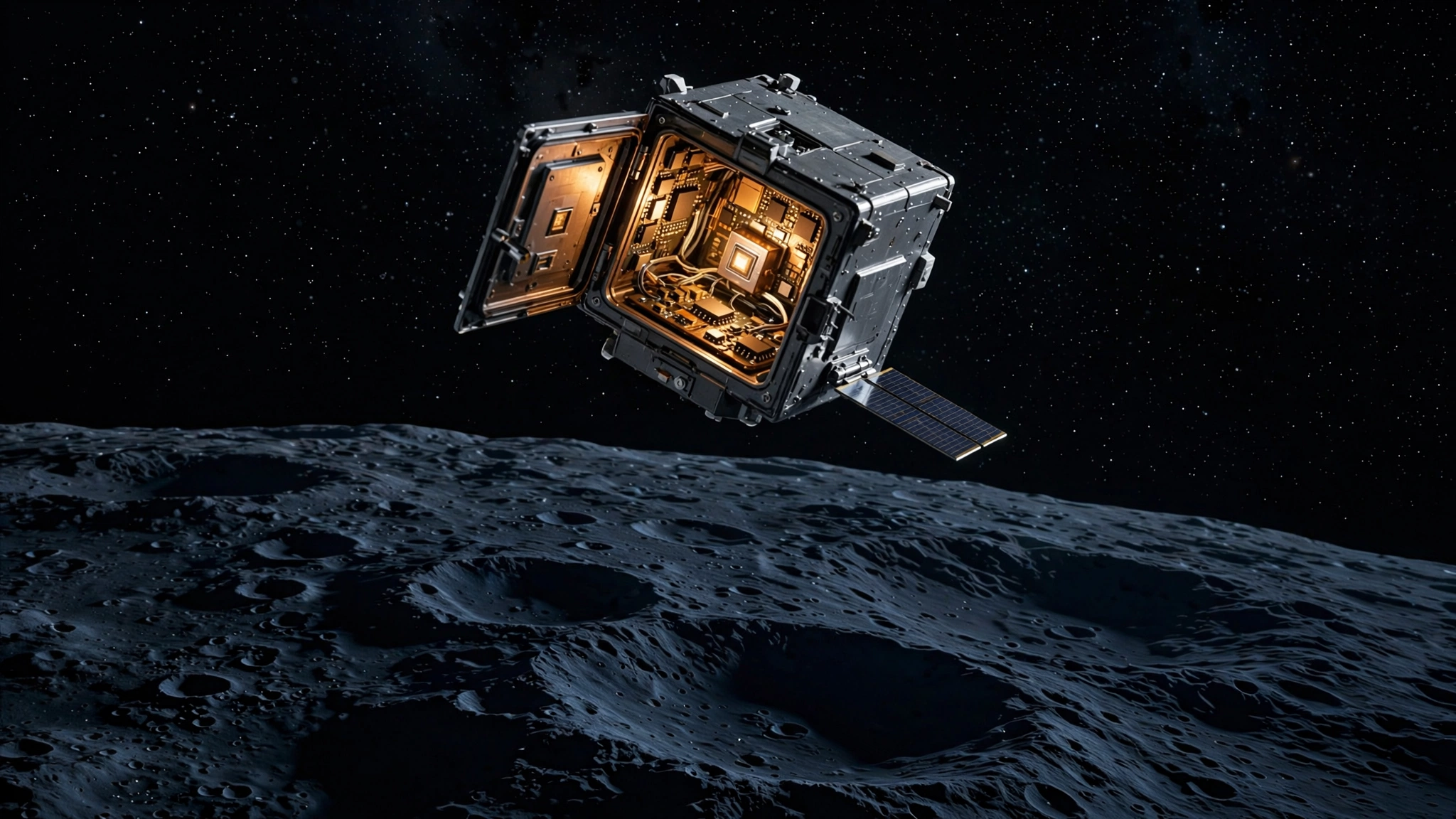
On July 7, a CubeSat the size of a loaf of bread left Vandenberg Space Force Base carrying a nuclear power source that sidesteps the entire plutonium economy. City Labs' BOHR satellite runs on tritium, a hydrogen isotope with a half-life of 12.3 years that decays into helium-3 and emits low-energy beta particles. A solid-state semiconductor junction catches those electrons and converts them directly into current. No moving parts, no liquid electrolytes, and virtually no fire risk. Each device ships under a US Nuclear Regulatory Commission general license, meaning any company in America can receive one without holding a radiation permit.
It produces about 100 microwatts.
Why 100 Microwatts Is Not a Punchline
A standard LED draws 20,000 microwatts, and a smartphone at idle burns 500,000. NASA's Multi-Mission Radioisotope Thermoelectric Generator on the Curiosity rover produces 110 watts at beginning of life, which is 1,100,000 times more power than BOHR's NanoTritium battery, and cost approximately $77 million according to GAO's 2017 audit of the Pu-238 program, a figure that includes fuel production, safety testing, and assembly across three national laboratories. Comparing 100 microwatts to 110 watts looks absurd on the same axis.
But they are not on the same axis, and this is the calculation nobody has run: for missions that need microwatts, not watts, in places where there is no sunlight, the RTG is not an alternative. It is a 45-kilogram, $77 million piece of equipment designed for a fundamentally different problem, and nothing smaller exists in the plutonium ecosystem. Betavoltaics do not compete with RTGs for the same mission set. RTGs power everything a spacecraft needs; betavoltaics power a mission class that is currently empty.
The Dead Zone Between Solar and Plutonium
Consider what happens when you need a sensor to operate autonomously for 20 years in a location without sunlight. The Moon's south pole contains more than 300 permanently shadowed regions where temperatures drop below minus 230 degrees Celsius and no photon from the Sun has hit the surface in billions of years. NASA has explicitly floated tritium betavoltaics as a power source for autonomous sensors in these craters, which are suspected to harbor water ice critical to any sustained lunar presence.
Walk through the alternatives for powering a 20-year micro-sensor in one of these craters:
| Power Source | Mass | Cost | Life Span | Verdict |
|---|---|---|---|---|
| RTG (MMRTG) | ~45 kg | ~$77M | 14 years optimal | Cannot fit on micro-sensor; supply bottleneck limits to 1 per 3.2 years |
| Solar panel | varies | ~$500/W | indefinite (with sun) | Zero photon flux in PSR; physically impossible |
| Lithium-ion battery | ~70 g for 17.5 Wh | ~$50 | ~3 years (self-discharge) | Self-discharges 2-3%/month; dead in 3 years; fails below −20°C |
| NanoTritium betavoltaic | <50 g | est. $5K-$50K | 20+ years | Only viable option; validated −55°C to +150°C |
The lithium calculation: 100 microwatts sustained for 20 years requires 17,520 milliwatt-hours of total energy, which a lithium cell weighing 70 grams could theoretically store. But lithium self-discharges at 2 to 3 percent per month at room temperature and faster in cold, draining the cell to zero in roughly three years even if nothing draws power, and deep discharge damages the cell irreversibly. No chemical battery chemistry currently manufactured can sustain even microwatt-level loads for two decades unattended.
That leaves one column of the table functional. One.
The Sensor Swarm Math
This is where the economics stop being theoretical. NASA's Commercial Lunar Payload Services program currently prices delivery to the lunar surface at roughly $1 million per kilogram, a figure expected to fall as Intuitive Machines, Firefly, and Astrobotic mature their landers. A NanoTritium-powered micro-sensor weighing 100 grams would cost approximately $100,000 to deliver.
Run the numbers on deploying 100 autonomous temperature, seismicity, and volatile-detection sensors across the Moon's permanently shadowed regions:
- Betavoltaic batteries: 100 units × $25,000 (estimated midpoint commercial price) = $2.5 million
- Micro-sensor fabrication: 100 units × $10,000 = $1 million
- Lunar delivery: 100 units × 100 g × $1,000/g = $10 million
- Total: ~$13.5 million for 100 sensors operating 20+ years
Compare that to a single RTG-powered mission to one location: $77 million for the power system alone, before you account for the rover, the lander, or the launch vehicle, with a 14-year optimal operating window before Pu-238 decay degrades output past usefulness. A hundred scattered sensors cost 5.7 times less and cover 100 times more area. If ten sensors fail, 90 percent of the network survives. If the single RTG mission fails, the investment is gone, and you wait 3.2 years for the next power system.
The Military Case Is Already Funded
The Air Force has not been subtle about where it sees this going. City Labs holds a $3.8 million SBIR Phase II contract titled "Enhanced Tritium Power Source for Autonomous Nuclear Tritium Sensors" under topic AFX234-DCSO1, targeting exactly the application the BOHR mission validates: long-duration autonomous sensor systems in space for intelligence, surveillance, reconnaissance, and space domain awareness.
Strategically, the logic writes itself. A constellation of 50 tritium-powered CubeSats for persistent orbital monitoring might cost $200,000 per unit including bus, battery, and rideshare slot on a Transporter mission, totaling $10 million for the network. A single traditional ISR satellite runs $500 million to $2 billion. Lose ten CubeSats to debris, adversarial action, or plain failure, and 80 percent of your monitoring network still functions. Lose one exquisite satellite and you have a gap in coverage and a congressional hearing.
The Pentagon's own Defense Innovation Unit has acknowledged this math, noting that "the Joint Force's reliance on low-density, high-value 'exquisite' (>$30 million) manned and unmanned aircraft is unsustainable," and soliciting cheaper, more attritable platforms that accept inevitable losses.
The Strongest Case Against
Every number above is built on a power source that would struggle to illuminate a single watch dial, and the honest comparison with RTGs is not flattering on the dimension that matters most. An MMRTG produces enough electricity to run a full science suite with spectrometers, cameras, communications antennas, heaters, and a rover drivetrain. A NanoTritium battery produces enough electricity to run a temperature sensor that wakes up once an hour, records four bytes, and goes back to sleep.
Sensors powered by this technology are fundamentally limited: ultra-low-power microcontrollers logging simple environmental data, accumulating readings in flash memory, and transmitting in rare, brief bursts that last fractions of a second. You cannot run a camera, a drill, or a radio link on 100 microwatts. City Labs' own SBIR filing for an enhanced 100-microwatt version describes it powering the Michigan Micro-Mote, a computing system smaller than a grain of rice, for over three years with no maintenance. Impressive, but the Micro-Mote does not take photographs of Martian geology.
Comparing betavoltaics to RTGs in a table implies competition, and that framing is misleading. RTGs and betavoltaics are not alternatives. Nobody choosing between them would hesitate. What matters is whether the missions betavoltaics enable are worth doing at all, and whether 100 data-logging thermometers scattered across the Moon's south pole produce more science per dollar than one mobile laboratory with a drill and a mass spectrometer. Reasonable people can disagree.
What We Don't Know
City Labs has not disclosed commercial pricing for NanoTritium units, so the $25,000 per-unit estimate above is interpolated from the SBIR contract value, industry commentary, and the observation that devices shipping under a general license to any U.S. buyer without radiation infrastructure suggest a cost structure incompatible with six-figure price tags. Actual pricing could be higher or lower by a factor of two, which shifts the sensor swarm total between $8 million and $19 million but does not change the order-of-magnitude comparison with RTGs.
A milliwatt-scale betavoltaic that City Labs has described as a goal in a separate SBIR Phase II, targeting 5 watts per kilogram through stacked ultra-thin III-V semiconductor junctions, remains aspirational engineering rather than demonstrated hardware. If it materializes, the mission-accessible power budget jumps from tens of microwatts to hundreds, opening applications like persistent low-bandwidth communications and simple imaging, but the timeline and physics challenges are nontrivial. Betavoltaic efficiency has inched from 8 percent to just over 10 percent across a decade of work.
Lockheed Martin tested NanoTritium devices in 2008 and City Labs reports they still function 18 years later, but that validation occurred on the ground. BOHR is the first orbital test, and space introduces radiation bombardment, thermal cycling between direct sunlight and Earth's shadow, and atomic oxygen erosion that no terrestrial test fully replicates. Results are expected within weeks to months.
Finally, tritium supply itself depends on nuclear reactor operations, primarily Canadian CANDU reactors that produce tritium as a byproduct of heavy-water moderation. If global nuclear capacity contracts or Canada restricts exports, tritium availability could tighten, though current commercial production far exceeds betavoltaic demand at the quantities involved, which are measured in grams rather than the kilograms required for RTG fuel.
The Bottom Line
BOHR is not a competitor to RTGs and will not power the next Mars rover. It is a proof of concept for a category of space mission that has not existed because nothing could power it: autonomous sensors operating for decades in permanently dark, bitterly cold, or deliberately hidden locations where solar panels are useless and plutonium is overkill. The United States has 35 kilograms of Pu-238 and a production pipeline that produces one RTG's worth every 3.2 years; it has a commercial tritium supply chain that can produce thousands of betavoltaic cells without touching a single national laboratory.
If you work in spacecraft power systems, small satellite design, or defense acquisition for persistent ISR, BOHR is worth tracking closely: the SBIR contract number is AFX234-DCSO1 and the company is City Labs, Inc. of Miami. If you are a planetary scientist designing a proposal for the next Discovery or New Frontiers competition, map your instrument power budget against betavoltaic output and ask whether a mesh of cheap persistent sensors produces more publishable data than a single exquisite platform that goes where the Pu-238 schedule allows. If you invest in space infrastructure, watch whether City Labs announces commercial pricing for the P200 series, because the distance between 100 microwatts and 1 milliwatt is where this technology either stays a curiosity or becomes a commodity.