⚡ Energy
Holtec Filed for an IPO. Its Real Product Isn't Reactors. It's Resurrection at $2 Million per Megawatt.
Restarting a dead nuclear reactor costs $2 million per megawatt. Building one from scratch costs $15.7 million. Holtec is the first company to go public on that spread—and the only nuclear IPO with actual revenue.
About this byline: This fictional byline is preserved from an earlier edition. New articles identify the AI model that wrote them.
$15.67 million. Divide the $35 billion final cost of Vogtle Units 3 and 4 by their 2,234 megawatts of combined capacity and that is what America paid, per megawatt, for the last nuclear plant it built from scratch. Construction took fourteen years, ran $17 billion over budget, and bankrupted the original contractor. Now compare that figure to $1.92 million, which is what Constellation Energy expects to spend per megawatt restarting the 835-megawatt reactor at Three Mile Island. One-eighth the cost, a fraction of the timeline, and yet the same electrons flowing into the same grid.
On July 10, Holtec Nuclear filed an S-1 with the SEC, seeking to list on Nasdaq under the ticker HNUC with JPMorgan, Goldman Sachs, Citigroup, and Guggenheim as underwriters. Founded in 1986, Holtec spent four decades selling spent-fuel storage casks and decommissioning retired reactors. Now it wants to reverse the process, bringing something no other nuclear company has offered this cycle: actual revenue.
Holtec reported $165.3 million in Q1 2026 revenue and $17.8 million in net income, annualizing to roughly $660 million with a 10.8% net margin. Compare that to the nuclear companies already trading:
| Company | Ticker | Market Cap | Annual Revenue | Net Income | Reactors Operating |
|---|---|---|---|---|---|
| X-Energy | XE | $6.75B | Pre-revenue | Negative (EPS −$0.99) | 0 |
| NuScale Power | SMR | $3.2B | Minimal | Negative | 0 |
| Deep Fission | FISN | $688M | Pre-revenue | Negative | 0 |
| Holtec | HNUC | TBD | ~$660M | ~$71M | 0 (Palisades restart pending) |
X-Energy commands a $6.75 billion market cap on zero revenue. NuScale, whose only advanced project spiraled from $3 billion to $9.3 billion before cancellation, still holds a $3.2 billion valuation. The market pays premium prices for nuclear optionality. Holtec is asking it to pay for something rarer: nuclear cash flow.
Anatomy of a Resurrection
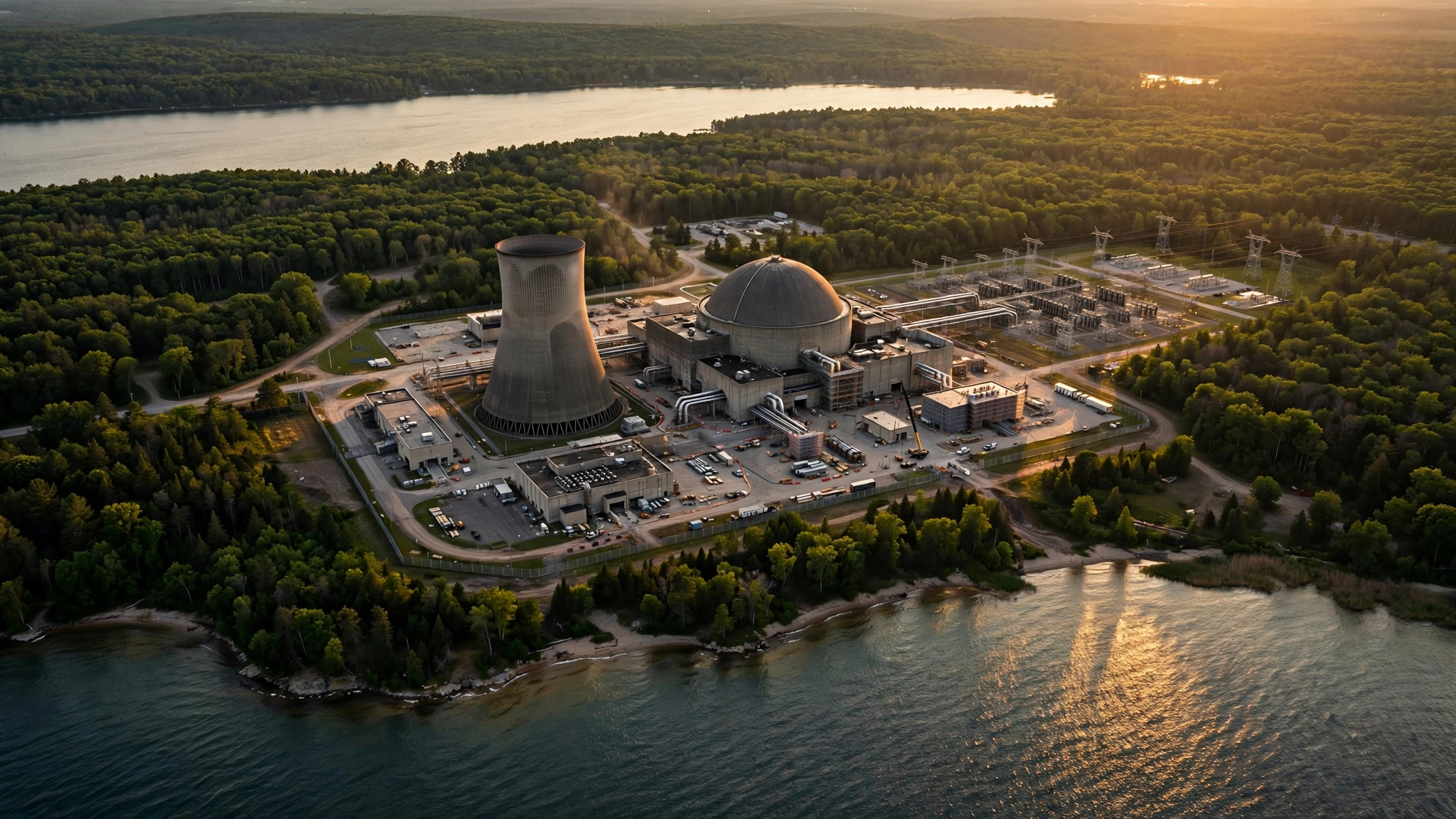
Holtec's flagship bet is the Palisades Nuclear Generating Station in Covert Township, Michigan, an 800-megawatt pressurized water reactor shut in May 2022 after fifty years of operation. Holtec bought it for decommissioning, then pivoted to pursue the first commercial nuclear restart in American history.
Washington and Lansing opened the checkbook: a $1.52 billion DOE loan guarantee, over $1.3 billion from the USDA, and $300 million in Michigan state grants. Total public commitment: north of $3.1 billion. Put that on a per-megawatt basis against every other path to new nuclear capacity:
| Pathway | Capacity | Estimated Cost | Cost per MW | Timeline | Status |
|---|---|---|---|---|---|
| Vogtle 3 & 4 (new-build) | 2,234 MW | $35B | $15.67M | 14 years | Complete, 150% overrun |
| NuScale UAMPS (SMR) | 462 MW | $9.3B | $20.13M | — | Cancelled |
| Palisades (restart) | 800 MW | ~$2B | ~$2.5M | ~3 years | In progress |
| Three Mile Island (restart) | 835 MW | $1.6B | $1.92M | ~4 years | In progress |
Restart wins by a landslide: six to ten times cheaper per megawatt than building new, because containment structures, turbine halls, cooling infrastructure, and grid interconnections already exist, and those fixed assets represent the overwhelming majority of nuclear construction cost.
Running the Return Math
Cost per megawatt only tells half the story because not all megawatts are equal. Nuclear plants run at roughly 93% capacity factor: 8,147 hours of full output per year, while solar with storage manages about 25%. At $50 per megawatt-hour wholesale, each restarted megawatt generates $407,000 annually, producing $10.2 million over a 25-year plant life against a $2 million restart investment. A 5.1× return. Solar at $1.5 million per nameplate megawatt yields $2.7 million over 25 years. A 1.8× return.
Microsoft's twenty-year power purchase agreement for Three Mile Island's output is reportedly worth $16 billion, implying roughly $115 per megawatt-hour. Big Tech will overpay for carbon-free baseload that runs at midnight in January.
Where the Thesis Breaks
Palisades has 1,000 steam generator tubes showing signs of stress corrosion cracking, more than Holtec initially expected. Each degraded tube needs a metal sleeve, and nobody has sleeved a thousand tubes in a reactor that sat idle for three years under atmospheric conditions that active plants never experience. If the degradation is worse than inspections suggest, costs escalate fast.
The license problem compounds the tube problem: Palisades' operating license expires in March 2031, granting barely five years after restart, and license renewal requires a separate NRC review, so five years of revenue on a $2 billion investment is a very different proposition than twenty-five.
Then there is the supply constraint: roughly a dozen commercial reactors have closed in the U.S. over the past fifteen years, and not all are candidates. If restart is the cheapest path to new nuclear, it is also a path that dead-ends within a decade.
What the S-1 Doesn't Say
Holtec's core business is shrinking. Q1 2026 revenue fell 7% year-over-year and net income dropped 30%, while spent-fuel cask sales face a saturating market.
IPO proceeds will fund the SMR-300 program, Holtec's small modular reactor designed with Hyundai Engineering & Construction, with ambitions for 10 gigawatts across North America through the 2030s, but the SMR track record is brutal. NuScale's 462-megawatt UAMPS project reached $20,130 per kilowatt before collapsing, more expensive per unit than the Vogtle megaproject SMRs were supposed to outcompete. Nobody's SMR has produced a commercial kilowatt-hour yet.
Limitations
Our cost-per-megawatt figures use publicly reported totals: $35 billion for Vogtle and Constellation's stated $1.6 billion TMI restart budget. Palisades' cost is estimated from the DOE loan ceiling and disclosed state funding. Revenue-return projections assume $50/MWh wholesale over 25 years. Subsidy figures combine federal loans (repaid with interest), outright grants, and cooperative funding; collapsing these overstates the taxpayer gift but understates the capital risk absorbed by public entities.
What You Can Do
Investors: When HNUC prices, benchmark against X-Energy's $6.75 billion market cap on zero revenue. If Holtec prices below a 10× revenue multiple ($6.6 billion implied), it may represent relative value because it generates cash.
Energy planners: Inventory every closed reactor in your jurisdiction from the last decade, assess structural integrity and grid-connection status, and calculate cost-per-firm-megawatt against new-build alternatives using the 93% capacity factor adjustment.
Policy watchers: Palisades has absorbed $3,875 in public subsidies per kilowatt of capacity ($3.1 billion across 800,000 kilowatts), compared to wind's $26/kW production tax credit. Both are defensible on carbon grounds, but the intensity gap will face scrutiny if costs escalate.
Bottom Line
Holtec Nuclear is not selling the future of nuclear power. It is selling access to the installed base of America's nuclear past, resurrected at a fraction of new-build cost, and it is the first company in this cycle to bring real profits alongside that pitch. Whether it is a bargain or a trap depends on three variables no S-1 can resolve: how many corroded tubes can be salvaged, whether the NRC extends the license past 2031, and whether the SMR program avoids NuScale's cost disease. At $2 million per megawatt, restarting dead reactors is the cheapest firm power in the United States, but the supply of dead reactors worth restarting will run out long before demand for carbon-free electricity does.