⚡ Energy
Three Nuclear Reactors Reached Criticality in 10 Months. The Last Company to Try Took 16 Years and Never Sold a Watt.
Trump's Reactor Pilot Program just hit its July 4 deadline with three working chain reactions at Idaho National Laboratory. But a 694x production gap separates these microreactors from America's 50-gigawatt data center appetite.
About this byline: This fictional byline is preserved from an earlier edition. New articles identify the AI model that wrote them.
Ten months. That's it. From selection to self-sustaining nuclear chain reaction, that is how long it took three companies to achieve what America's nuclear industry spent decades failing to do. Antares Nuclear, Valar Atomics, and Deployable Energy each reached criticality at national laboratories before today's July 4 deadline, and Antares went from machining its graphite core to splitting atoms in nine months flat.
For context, NuScale Power spent 16 years working toward the same general goal, threading a regulatory needle that no American nuclear startup had successfully pushed through since the industry's last construction wave in the 1970s. Founded in 2007, the company submitted a 12,000-page application to the Nuclear Regulatory Commission in 2017, accompanied by over two million pages of supporting documents. It received final design certification in January 2023, watched its estimated power cost rise 53% from $58 to $89 per megawatt-hour, and then saw its flagship Idaho project cancelled. Not a single commercial watt ever reached the grid. Zero.
State that ratio plainly: this new Reactor Pilot Program compressed the path to criticality by roughly 19 times. Not incrementally. Not by half.
What Actually Happened
President Trump signed Executive Order 14301 in May 2025, directing DOE to select advanced reactor developers and get at least three to criticality by July 4, 2026, the nation's 250th birthday. Eleven projects from 10 companies were selected in August 2025: Aalo Atomics, Antares Nuclear, Atomic Alchemy, Deep Fission, Last Energy, Oklo, Natura Resources, Radiant Industries, Terrestrial Energy, and Valar Atomics. Each company funded its own hardware, while Washington provided land at national laboratories, technical expertise, and a blanket exemption from the NRC's multi-year licensing gauntlet.
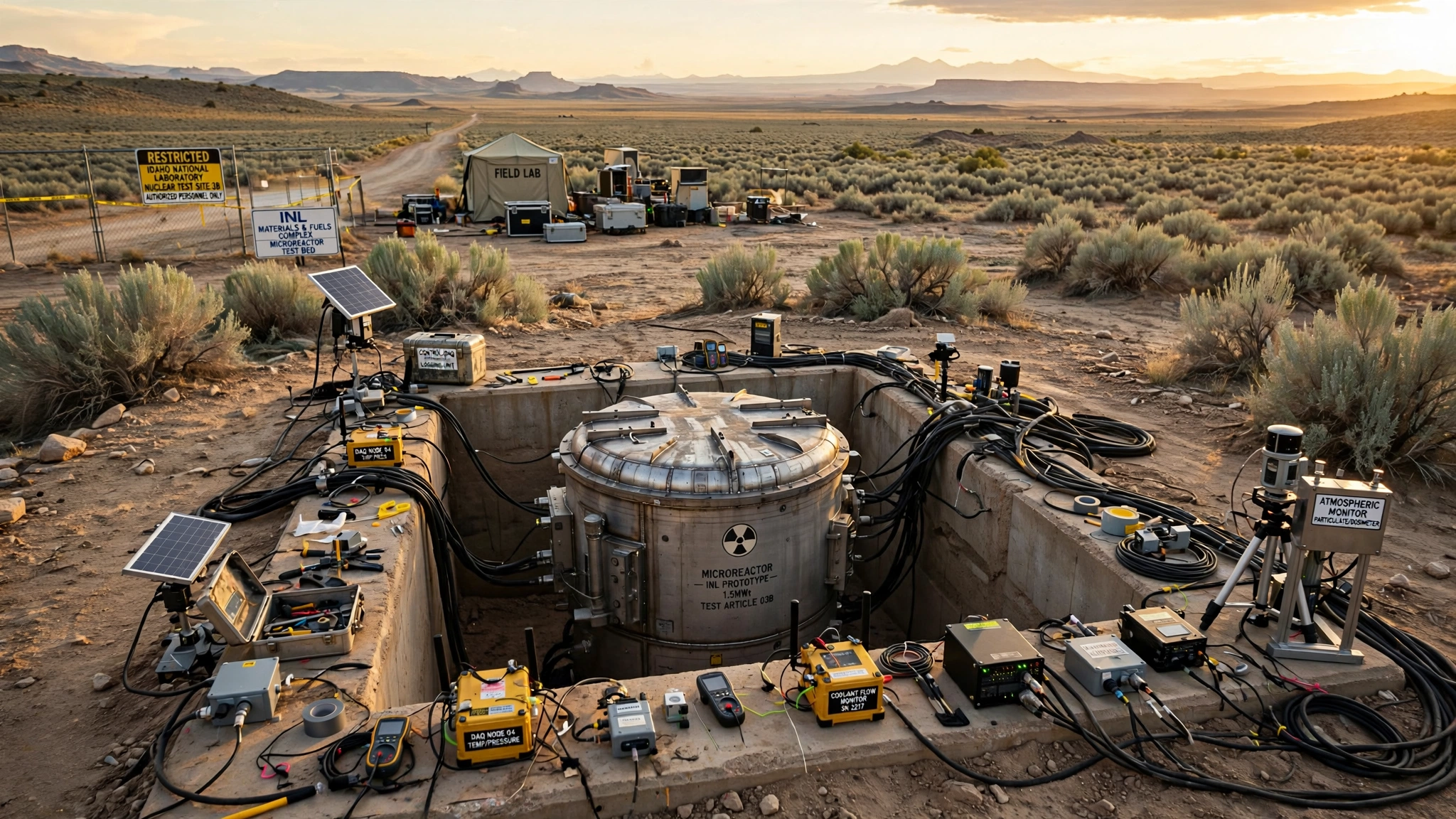
Antares crossed the line first. On June 4, its Mark-0 microreactor achieved zero-power criticality at Idaho National Laboratory's Materials and Fuels Complex, becoming the 53rd reactor ever built at INL and the first novel reactor design to go critical there in more than 50 years. Half a century. Energy Secretary Chris Wright called it historic: "For the first time in more than four decades, a new privately developed non-light-water reactor has reached criticality in the United States."
Valar Atomics followed with its Ward 250, a high-temperature gas reactor that had already made military history in February when a C-17 Globemaster III airlifted it from March Air Reserve Base to Utah's San Rafael Energy Lab. Dubbed "Operation Windlord," it was the first military airlift of a nuclear microreactor ever conducted, a logistical proof-of-concept that demonstrated these machines could be deployed to forward bases in theaters where grid power does not exist.
Deployable Energy completed the trio on July 1, bringing its Unity demonstration microreactor to zero-power criticality at INL's National Reactor Innovation Center in just 150 days from construction start. A fourth company, Aalo Atomics, was on the verge of criticality as the deadline arrived. Aalo grew from two founders in 2023 to nearly 200 employees and built its sodium-cooled test reactor in five months. From scratch.
Why It Happened So Fast
Speed here is not magic but regulatory arbitrage — a deliberate decision to route reactor companies around the NRC licensing process that has consumed a decade or more of every prior attempt — and understanding that mechanism explains why the timeline collapsed so dramatically.
Under the traditional NRC path, a reactor developer submits a design certification application and then waits. According to the United States Government Accountability Office, planning, licensing, and building a nuclear power plant takes 10 to 12 years. NRC review alone can consume five to six years. NuScale's 42-month review was considered fast, and the company had started preliminary work at Oregon State University in the early 2000s. Total elapsed time from concept to certification: roughly two decades.
Trump's Reactor Pilot Program sidestepped all of that. Under the Atomic Energy Act, DOE can license reactors under agency control, bypassing the NRC entirely for demonstration purposes, and companies still ran comprehensive safety analyses despite the streamlined timeline. Antares completed a Documented Safety Analysis that DOE-Idaho approved, and its reactor operated within a tightly bounded safety envelope. But bureaucratic timelines collapsed from years to weeks.
Commercial licensing remains unsolved by this program, and every one of these companies will eventually need NRC approval to sell electricity. Two new regulatory pathways approved in April 2026 could accelerate that step: Part 53, a technology-inclusive licensing framework for advanced reactors that replaced light-water-reactor-only Part 50 rules, and Part 57, which aims to approve microreactor licenses in six to twelve months. Compare that to NuScale's six years under the old regime.
What Criticality Actually Means
Precision matters here. Criticality means a nuclear chain reaction sustains itself: neutrons produced by fission exactly balance those lost to absorption or leakage, and the reactor holds steady without increasing or decreasing in power. INL Laboratory Director John Wagner was explicit: "What Antares achieved is specifically zero-power criticality. This is not electricity generation. It is not full-power operation."
Think of it as starting a car engine in neutral. Running, yes. Driving? No.
And then the timelines diverge sharply from the headlines, because the distance between a self-sustaining chain reaction and kilowatt-hours flowing through a meter is measured not in months but in years of engineering, licensing, and construction nobody has started. Antares says electricity production comes in 2027, with power to military installations by 2028. Valar targets commercial power sales in 2028. Aalo Atomics plans full-power demonstration in late 2026 and commercial operation by 2029. Deployable Energy has not published a commercial timeline. Silence, for now. Between criticality and commercial electricity sits at minimum another one to three years of power-ramp testing, NRC licensing, and grid interconnection.
A 694x Production Gap
Here is the pitch for microreactors: AI data centers are ravenous for power, renewables are intermittent, grid connections take years, and a small nuclear reactor parked behind the fence provides 24/7 baseload without a transmission line. Aalo Atomics explicitly designed its sodium-cooled reactor for data center applications. DOE's own framing ties the program to "America's electricity boom, driven largely by AI data centers."
Run the numbers, and a more complicated picture emerges.
In July 2025, DOE estimated the U.S. needs 100 GW of new peak capacity by 2030, with 50 GW attributable to data centers. BloombergNEF projects 106 GW of data center demand alone by 2035, a 36% increase over its own forecast from seven months prior. Within PJM Interconnection territory, stretching from Illinois to North Carolina, data centers will account for 30 of 32 GW of projected peak demand growth by 2030.
None of this is hypothetical stress, either. During the same week these microreactors celebrated criticality, PJM day-ahead power prices tripled to $2,000 per megawatt-hour as a heat wave collided with data center load. Capacity auction prices hit $333.44 per megawatt-day, up 11-fold from $28.92 just three auctions earlier. Independent monitors attributed 63% of that run-up directly to data center demand, adding $9.3 billion in costs for ratepayers.
Now consider what these microreactors actually produce. Antares's R1 generates 100 kilowatts to 1 megawatt, Valar's Ward 250 scales to 5 MW, and Aalo's design reaches 10 MW. Using a generous weighted average of 5 MW per unit and a conservative 50 GW target, you need 10,000 microreactors. At the current production rate of roughly 3.6 per year, meeting that demand would take 2,778 years. Absurd math. Deliberate math.
| Metric | Value |
|---|---|
| Data center demand by 2030 (DOE, conservative) | 50 GW |
| Data center demand by 2035 (BloombergNEF) | 106 GW |
| Avg. microreactor output (weighted by design) | ~5 MW |
| Microreactors needed for 50 GW | 10,000 |
| Current production rate | ~3.6/year |
| Years to meet demand at current rate | 2,778 |
| Required annual production for 2030 target | ~2,500/year |
| Scale-up factor needed | ~694x |
A 694x gap separates proof-of-concept from industrial relevance, and these companies know it, which is exactly why every reactor in this program was designed from the start for factory production rather than bespoke on-site construction. Antares designed its R1 for "manufacturability rather than maximum power density." Aalo eliminated high-pressure containment domes by running liquid sodium at atmospheric pressure, and chose air-cooled condensers so its reactors need no external water supply. Outside the RPP entirely, AMPERA just 3D-printed its first full-scale reactor module, a spherical silicon-carbide core for a 30 MW thorium reactor designed to run 30 years without refueling. Factory production exists in prototype form, but whether it can scale 694x remains an open question that no amount of demonstration-phase enthusiasm can answer.
A Fuel Pipeline That Does Not Exist
Most advanced reactors run on HALEU, or high-assay low-enriched uranium, enriched to just under 20% U-235 compared to the roughly 4% used in conventional reactors. No U.S. commercial enricher produces HALEU at scale today. Not one. Centrus Energy's demonstration cascade in Piketon, Ohio has delivered just over 920 kilograms total under a DOE contract, enough for a handful of demonstration reactors but nowhere close to the thousands of metric tons an industrial fleet would consume every year across fueling cycles, maintenance reserves, and initial core loads for new construction.
In May 2026, Antares signed what Urenco described as "the world's first multi-year commercial HALEU supply contract," sourcing enrichment from Urenco's Advanced Fuels Facility at Capenhurst in the UK. That facility comes online in 2031, producing up to 27 metric tons per year, enough for roughly 30 reactors. At 10,000 units needed, you would require 333 Capenhurst-scale facilities or a completely different enrichment paradigm.
AMPERA's thorium-fueled design sidesteps this HALEU constraint entirely, using tri-structural isotropic thorium kernels instead. Thorium is roughly three times more abundant than uranium in Earth's crust and does not require enrichment. But thorium reactors carry their own challenge: zero commercial infrastructure exists for this fuel chain, and AMPERA's design is subcritical, meaning it needs an external neutron source to sustain fission.
Against Our Thesis
Edwin Lyman, director of nuclear power safety at the Union of Concerned Scientists, has been direct: "There is no business case for microreactors, which, even if they work as designed, will produce electricity at a far higher cost than large nuclear reactors, not to mention renewables like wind or solar." Solar's levelized cost sits around $30-40 per megawatt-hour, while wind runs $30-45. NuScale's larger SMR could not get below $89, and it still cancelled. Nobody has published a cost-per-MWh figure for any microreactor that has actually generated electricity. Not one. None of them have.
And here is where the counterargument gets specific and compelling enough to deserve serious engagement, because it challenges the entire economic premise on which the microreactor pitch depends. Renewables are intermittent and require either massive battery storage or grid backup, while a nuclear microreactor provides uninterrupted 24/7 power behind the meter, eliminating the years-long grid interconnection queue that currently delays data center construction. For a hyperscaler willing to pay a premium for guaranteed uptime and speed-to-power, $89/MWh or even higher might be acceptable if it means generating power two years sooner than waiting in line for grid access. Microsoft, Amazon, and Google have collectively signed contracts for more than 10 GW of new nuclear capacity in the last year alone.
Lyman's critique holds for grid-scale economics, where microreactors producing electricity at unknown but certainly high cost-per-megawatt-hour compete against solar at $30-40 and onshore wind at $30-45 on a level playing field where price is the only variable that matters. Whether it holds for behind-the-meter data center power, where the real alternative is waiting years on a grid interconnection queue rather than choosing between energy sources, remains genuinely unknown.
Limitations
Several caveats constrain this analysis. Our 19x timeline compression compares NuScale's end-to-end journey from founding to design certification against the RPP's sprint from selection to criticality, which are fundamentally different milestones: NuScale sought NRC commercial design certification, while RPP companies achieved zero-power criticality under DOE authorization that does not qualify them to sell electricity. A fairer comparison will emerge once RPP companies complete NRC licensing, and the ratio may shrink. Our demand gap calculation assumes all new data center capacity would come from microreactors alone, which nobody proposes; they would supplement natural gas, grid-scale nuclear, and renewables rather than replace them. Microreactor cost projections remain unavailable because no unit has generated commercial power. And our 694x scale factor assumes no evolution in reactor size; several companies plan larger commercial models that would reduce the unit count required.
What You Can Do
If you develop data centers: Track NRC Part 57 applications starting now. Initial microreactor commercial licenses under this six-to-twelve-month pathway will signal whether the regulatory bottleneck is truly broken or merely relocated. Aalo Atomics plans to file its NRC application later this year, and that timeline is your leading indicator.
If you invest in energy: Watch the HALEU supply chain more closely than the reactors themselves. Centrus Energy's 920 kg of total HALEU production is the binding constraint on everything that follows. Reactor designs work, but fuel pipelines do not exist at scale, and whoever solves enrichment captures the bottleneck premium. Everything else waits.
If you pay electricity bills in PJM territory: A $9.3 billion data center surcharge already sits in your capacity market costs, adding $16-18 per month to your utility bill regardless of what microreactors accomplish in the next five years. Push your utility commissioner on data center cost-allocation rules now, before the next capacity auction.
Bottom Line
Something real happened at Idaho National Laboratory this summer. Three companies proved advanced nuclear fission works — that an American startup can design, build, fuel, and sustain a chain reaction in a novel reactor within months rather than the decades that characterized every prior attempt since the industry's post-Three-Mile-Island paralysis. DOE authorization instead of NRC certification represents the most significant institutional innovation in American nuclear energy since the Atomic Energy Act itself. But criticality is a car engine idling in a driveway. Just idling. Between here and 10,000 factory-built reactors powering America's AI appetite lies an unbuilt fuel supply chain, an untested cost structure, and a commercial licensing process that has never approved a microreactor. What happened was a sprint, and what comes next is a marathon that has not started. Clock's ticking.