China Now Has Three Mass-Production Robotaxi Programs. The U.S. Has Two.
XPeng rolled the first mass-produced vision-only robotaxi off its Guangzhou line on May 18, packing 3,000 TOPS of in-house silicon and zero LiDAR sensors. Geely unveiled a 43-sensor purpose-built cab with no steering wheel. Baidu already runs 250,000 paid rides a week across 20 cities. Three companies, three fundamentally different architectural bets, one market. No other country is running this experiment.
Three. Not three prototypes, not three pilot programs, not three press releases with renderings and a launch date that will slip. Three distinct, mass-production-capable robotaxi architectures competing in China's autonomous vehicle market as of this week, each built on a different engineering philosophy about how self-driving cars should see, think, and be manufactured. America has two.
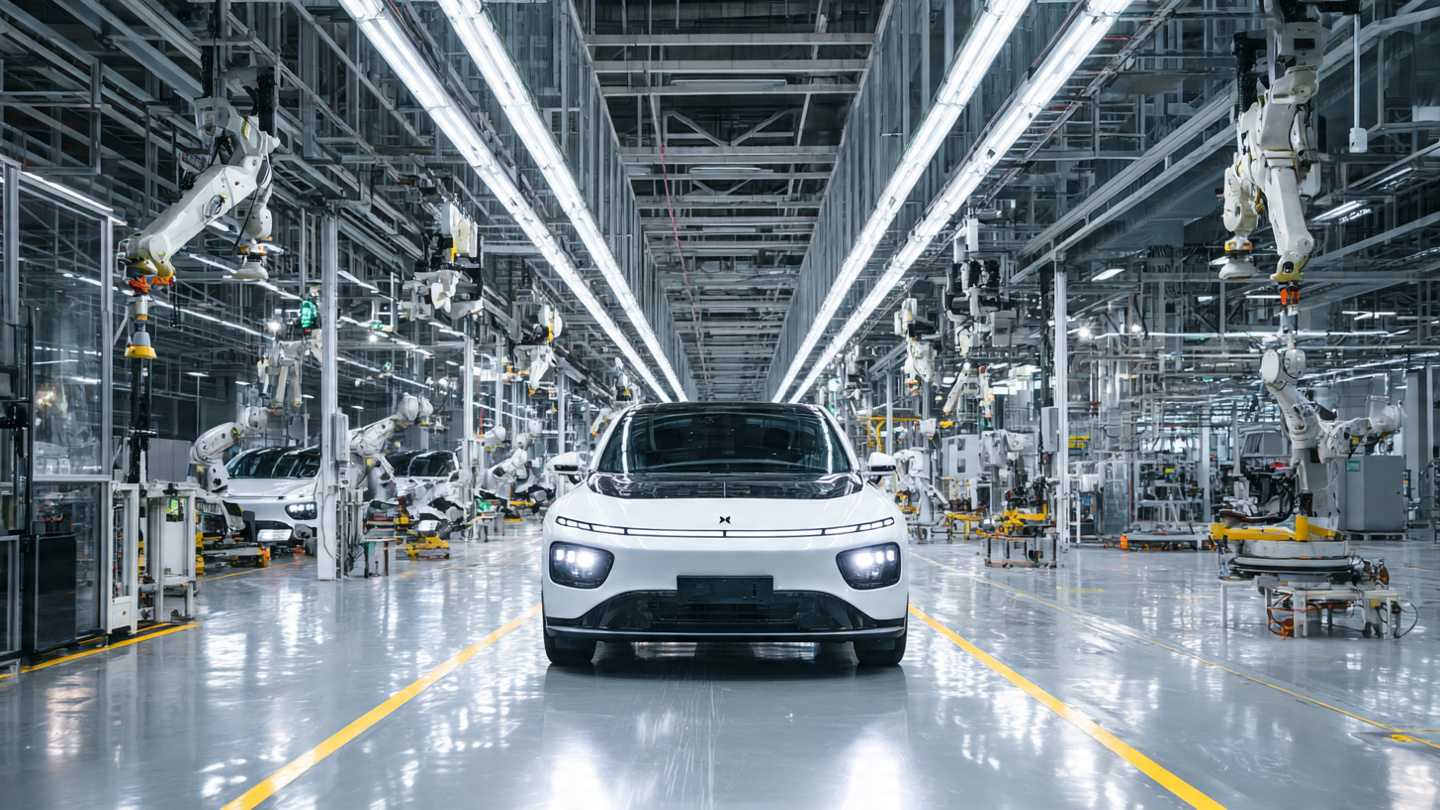
On May 18, XPeng rolled the first unit of its mass-produced robotaxi off the production line in Guangzhou. A Chinese automaker had achieved full-stack, in-house robotaxi mass production for the first time: the silicon, the AI model, the vehicle platform, the manufacturing. Four proprietary Turing AI chips deliver 3,000 TOPS of computing power. No LiDAR. No high-definition mapping. Just cameras and an end-to-end vision model called VLA 2.0 that XPeng claims compresses response latency to under 80 milliseconds.
Days earlier at Auto China 2026, Geely had pulled the cloth off the EVA Cab, its own robotaxi built on the opposite premise: no steering wheel, no pedals, no provision for a human driver at all, just dual Nvidia Drive Thor-U processors delivering 1,400 TOPS and forty-three sensors bristling from its body with LiDAR prominent among them. Deployment is planned for 2027 through CaoCao Mobility's existing 60-city ride-hailing network.
Baidu skipped the manufacturing debate entirely, and its Apollo Go service already operates more than 250,000 paid robotaxi rides per week across 20-plus Chinese cities using third-party vehicles outfitted with its autonomous driving software. Baidu's bet is simpler: the fleet is the product, not the car.
Architecture Matrix
What makes China's robotaxi moment structurally interesting is not that three companies are building self-driving taxis. Plenty of companies have done that. It is that they have placed three orthogonal bets on the most contested questions in autonomous vehicle design, and all three will be testable against real passengers, in the same cities, under the same regulatory regime, within 18 months of each other.
| Dimension | XPeng | Geely EVA Cab | Baidu Apollo Go |
|---|---|---|---|
| Compute | 3,000 TOPS (4× Turing, in-house) | 1,400 TOPS (2× Nvidia Thor-U) | Varies by partner vehicle |
| Perception | Vision-only (cameras) | 43 sensors incl. LiDAR | LiDAR + cameras (varies) |
| Vehicle | Shared platform (GX consumer SUV) | Purpose-built, no human controls | Third-party chassis |
| Silicon | Proprietary (Turing AI) | Nvidia | Varies |
| Ride network | New build (Amap/SDK) | CaoCao Mobility (60 cities) | Apollo Go (20+ cities) |
| Timeline | Pilots H2 2026, unsupervised early 2027 | Deployment 2027 | Already operational |
For comparison, the U.S. market runs on two architectures. Waymo operates the most mature commercial service globally: hundreds of thousands of weekly rides across San Francisco, Los Angeles, Phoenix, and Austin, using Jaguar I-PACE vehicles loaded with LiDAR and radar. Tesla launched its robotaxi service in Austin in June 2025 with safety monitors, began unsupervised operations in January 2026, and has since expanded to Dallas and Houston while ramping Cybercab production at Giga Texas. Two companies. Two bets. Neither shares its platform with a consumer car line the way XPeng does.
Compute Economics Nobody Ran
Here is the calculation that reveals the sharpest divergence between these bets. XPeng packs 3,000 TOPS into its robotaxi using four proprietary Turing AI chips at 750 TOPS per chip, manufactured and designed in-house, which means XPeng pays the wafer cost and packaging cost but not the margin that Nvidia charges OEMs for its silicon.
Geely buys two Nvidia Drive Thor-U processors at 700 TOPS each for 1,400 TOPS total, and at Nvidia's volume pricing for automotive-grade chips each Thor-U module costs an estimated $2,000 to $3,000, putting Geely at roughly $4,000 to $6,000 per vehicle in compute silicon alone before factoring in the LiDAR and 41 additional sensors.
XPeng's in-house silicon cost is opaque, but the economics of chip design at scale follow a well-documented curve: McKinsey estimates that fabless chip companies achieve 55 to 65% gross margins on mature-node designs when shipping millions of units, and XPeng's consumer GX SUV uses the same four Turing chips, meaning the silicon R&D amortizes across both the consumer and robotaxi product lines. If XPeng ships 100,000 GX vehicles per year (consumer plus robotaxi combined), the per-unit R&D allocation drops to roughly $800 to $1,200, with wafer and packaging costs adding perhaps $1,500 to $2,000. Total compute cost per vehicle: approximately $2,300 to $3,200.
That gives XPeng 2.1 times Geely's compute headroom at 58% to 75% of the silicon cost. Huge gap. But the tradeoff cuts deep: XPeng's Turing chips are unproven in L4 edge cases at scale, while Nvidia's Thor has the entire global automotive supply chain validating its silicon across dozens of OEMs.
What the Orders Say
Demand data from Pony AI provides a real-time signal on consumer adoption: during China's Labor Day holiday (May 1 to 5), average daily paid robotaxi orders surged 544% year-over-year, with a 155% increase over the New Year holiday period, while Pony AI deployed hundreds of seventh-generation robotaxis to transport 3,000 concertgoers and now targets more than 3,000 vehicles on the road by year-end. It also launched Europe's first commercial robotaxi service. In Zagreb.
A 544% year-over-year surge in a market that barely existed 24 months ago is not a pilot being tolerated — it is a category being born, and the growth curve suggests Chinese consumers have already made their decision about whether climbing into a driverless car is acceptable.
Platform Sharing as Strategy
XPeng's most contrarian bet is not its vision-only approach; Tesla already validated that strategy directionally by operating unsupervised vehicles in Austin without LiDAR. Platform sharing is the real gamble.
XPeng's GX robotaxi rides on the same architecture as the $58,000 GX consumer SUV launched at Auto China 2026: same four Turing chips at 3,000 TOPS, same VLA 2.0 autonomous driving stack, same Bosch steer-by-wire and six-layer safety redundancy, but with the driver-focused layout stripped out and gravity seats, privacy glass, and independent rear displays installed in 5-seat, 6-seat, and 7-seat configurations. Same car. Different interior.
This mirrors Tesla's early strategy of using Model 3 and Model Y to gather driving data while developing the Cybercab, but XPeng goes further because its robotaxi is literally the same car on the same line with a different interior, meaning consumer GX sales generate revenue today while validating every sensor, every chip, and every meter of the autonomous stack in real-world traffic.
Geely's EVA Cab is a clean-sheet robotaxi with no consumer revenue stream, which means every dollar invested is pure R&D cost until the first commercial ride: design optimization unconstrained by consumer-vehicle compromises, but CaoCao Mobility absorbs the full development cost without any offset from retail sales.
Strongest Counterargument
Production is not deployment. XPeng has rolled exactly one robotaxi off its assembly line and logged exactly zero L4 operational miles with paying passengers — while Baidu has years of ride data, Waymo has years, and Tesla has months of unsupervised operations across three Texas cities. Geely's EVA Cab remains an unveil, not a service.
Building the car is not the hard part. Surviving the ten-millionth edge case is: a rain-slicked turn in Shenzhen at 11 PM when a delivery scooter runs a red light from behind a parked bus, the kind of scenario where manufacturing capability and deployment capability reveal the enormous, unforgiving canyon of real-world validation that separates them. XPeng's pilot operations have not even started, and its "fully unsupervised by early 2027" target is aggressive in the technical sense and aspirational in the operational sense.
Limitations
XPeng's claim of "5x better performance than competitors on takeover rates" is self-reported, unverified, and measured on internal benchmarks that have not been disclosed, and its sub-80ms latency figure has not been independently benchmarked. Pony AI's 544% year-over-year growth is calculated from a small base during a holiday period and should not be extrapolated as a sustained trend, and no Chinese robotaxi operator has disclosed per-ride unit economics. CaoCao Mobility's 60-city figure refers to its entire ride-hailing network, not autonomous-ride coverage, and our compute cost estimates for XPeng's Turing silicon rely on industry-standard fabless margins and amortization models rather than XPeng's actual cost structure, which is not public.
What to Watch and What to Do
China is running the most comprehensive architectural experiment in autonomous vehicle history: three companies with three production-capable programs, each testing a different answer to the three hardest questions in the field — vision-only or sensor fusion for perception, shared platform or purpose-built for the vehicle, in-house or third-party for the silicon.
If you are an investor, fleet operator, or policymaker in autonomous transport, the next 18 months of Chinese operational data will be more informative than the previous five years of pilot programs anywhere else. Watch XPeng's H2 2026 pilot results and takeover rates in dense urban traffic; watch Geely's CaoCao deployment throughput and whether its LiDAR investment translates into measurably lower incident rates; watch whether Baidu's asset-light model can sustain profitability as its hardware partners demand margin.
If you are evaluating AV stocks or ETFs, the compute cost gap documented above suggests XPeng's vertical integration creates a structural margin advantage that Geely cannot replicate without either designing its own silicon or accepting permanently higher per-vehicle costs, a dynamic worth pricing in before the H2 pilot data lands. If you are a municipal transportation planner considering autonomous ride-hailing partnerships, China's three-way experiment means architecturally diverse vendor options within two years, and the worst strategic move is locking into a single-vendor contract now. Answers will not come from whitepapers. They will come from the growth curve of Chinese consumers who have decided that climbing into a driverless car is just how you get across town.