BYD Generates 112 Million Miles of Driving Data Per Day. Tesla Took a Decade to Reach 10 Billion Total.
BYD's free God's Eye system, installed on 2.85 million vehicles, now collects 180 million kilometers of driving data every 24 hours. At that rate, BYD accumulates in 89 days what Tesla's Full Self-Driving fleet took its entire operational history to reach. Waymo's fully driverless fleet has logged 170 million miles with 92% fewer serious injuries than human drivers. Three companies are running three fundamentally different races, and the scoreboard only shows one number.
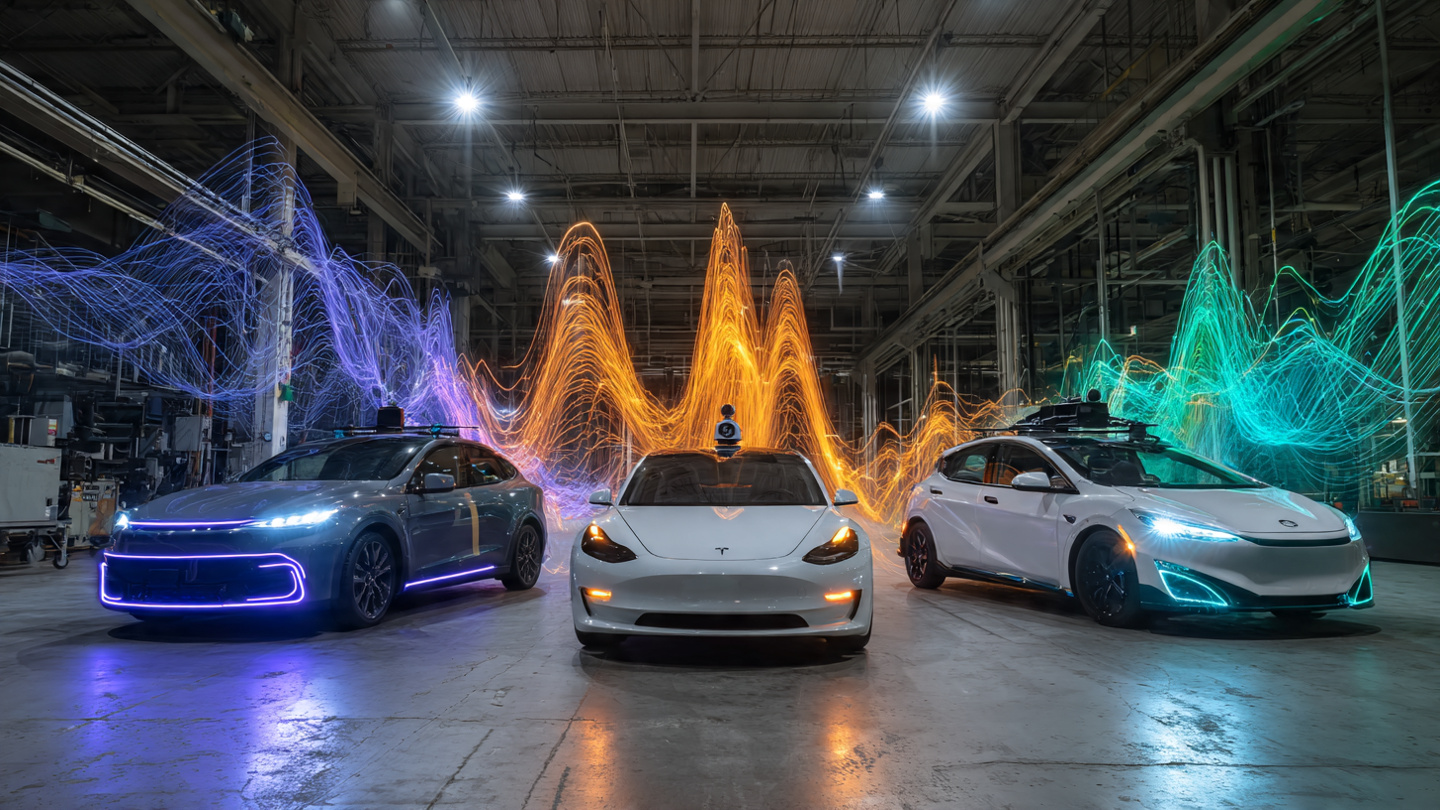
One hundred and twelve million miles. Every single day. That is the volume of driving data flowing into BYD's servers from its God's Eye advanced driver-assistance system, according to figures disclosed by Li Yunfei, BYD's brand and PR general manager, in March 2026. The number converts from 180 million kilometers daily across 2.85 million equipped vehicles, each one streaming lane markings, steering corrections, brake interventions, and obstacle classifications back to Shenzhen. Tesla's FSD fleet, by contrast, crossed 10 billion cumulative miles in early May 2026, a milestone that took the company roughly a decade of consumer data collection to achieve. At BYD's current ingestion rate, that entire Tesla corpus would take 89 days to replicate in raw volume.
Nobody in the autonomous driving industry disputes that data matters. The fight is over what kind of data matters, how much of it you need, and what you can learn from each mile. That fight is about to determine which model wins a market projected to reach $103 billion in the United States alone by 2034.
The Numbers, in Context
Before comparing anything, the raw data landscape needs a denominator. Here is what each company actually collects, as of May 2026:
| Metric | BYD God's Eye | Tesla FSD | Waymo |
|---|---|---|---|
| Vehicles collecting data | 2.85 million | ~2 million (FSD-equipped) | ~3,700 |
| Daily data volume | 112 million miles | ~20 million miles | ~570,000 miles |
| Annual rate | ~40.9 billion miles | ~7.3 billion miles | ~208 million miles |
| Cumulative total | ~18 billion miles* | 10 billion miles | 170.7 million miles |
| Autonomy level | L2 (driver-assist) | L2+ (supervised FSD) | L4 (fully driverless) |
| Cost to vehicle buyer | $0 (standard) | $8,000 or $99/month | N/A (ride-hail only) |
| Days to reach 10B miles | ~89 | ~3,650 (historical) | ~48,000 |
*BYD estimate based on mass deployment beginning mid-2025. Waymo daily rate estimated from 4 million miles/week (Q1 2026 disclosure). Tesla daily rate from FSD milestone analysis.
BYD's advantage is staggering in pure volume. It generates 5.6 times more driving data per day than Tesla, and 197 times more than Waymo. Every 89 days, BYD's fleet produces a dataset equal to Tesla's entire operational history. Waymo's cumulative total of 170.7 million fully autonomous miles, a dataset the company has spent years assembling, represents roughly 36 hours of BYD's daily collection rate.
If volume were the only variable that mattered, the race would be over. It is not.
Three Races, One Scoreboard
The fundamental problem with comparing these numbers is that "miles of driving data" is not a unit, any more than "pages of writing" is a unit. A page of a patent filing, a page of a grocery list, and a page of a doctoral thesis are all one page. The information density per mile differs so dramatically across these three systems that the comparison borders on meaningless without quality adjustment.
BYD's God's Eye data comes from Level 2 driver-assistance features: adaptive cruise control, lane centering, automated parking, and, on higher-end models, urban navigation assist. The system processes camera and radar inputs (LiDAR on newer models like the 2026 Seagull) and logs when its interventions are overridden by the human driver, when obstacles are detected, and when lane markings are ambiguous. This is valuable training data for refining ADAS algorithms, and the sheer volume means BYD encounters rare edge cases (a pedestrian stepping into traffic during a rainstorm, a construction zone with hand-held signs) far more frequently than smaller fleets. But the God's Eye system is not attempting to drive the car; the human is driving, the system is assisting, and the data captures a correspondingly narrower decision space.
Tesla's FSD data occupies a middle tier in information density. Tesla's approximately 2 million FSD-equipped vehicles run a full neural network stack that processes eight camera feeds into a unified 3D occupancy model and generates driving decisions in real time, even when the human is physically controlling the vehicle. Shadow mode compares what the AI would have done against what the human actually did, creating a continuous stream of supervised learning pairs. Each mile carries richer information than BYD's ADAS telemetry because the neural network is processing the complete driving task, not a subset of it. Tesla has 3.76 billion city miles specifically, where the decision density per mile is highest. When Elon Musk set the 10-billion-mile threshold for unsupervised driving in January 2026 (raised from a previous target of 6 billion), the implicit argument was that FSD miles contain enough information per mile that 10 billion of them are sufficient for safe autonomy.
Waymo's data is the densest by far. Every one of Waymo's 170.7 million miles was driven with no human driver, meaning the system made every decision: when to accelerate, when to yield, when to change lanes, when to stop for a jaywalker, when to navigate around a double-parked delivery truck. Each mile also carries a complete LiDAR point cloud, multi-camera fusion, and radar returns. Waymo's data is a fully labeled, fully autonomous decision record. It is the doctoral thesis. And Waymo's March 2026 safety report showed what those 170.7 million miles produced: 92% fewer crashes causing serious or fatal injuries compared with human drivers, 83% fewer airbag deployments, and 82% fewer injuries of any type.
An analogy sharpens the distinction: imagine training a surgeon. BYD's approach is watching 112 million hours of operating room video daily, including footage of nurses, janitors, and anesthesiologists alongside the surgeon. Enormous coverage. Broad context. Tesla's approach is watching 20 million hours of video per day, all shot from the surgeon's exact perspective, with an AI predicting what the surgeon will do next and logging every disagreement. Waymo's approach is letting the trainee perform 570,000 operations per day, alone, on real patients, with no attending physician in the room. Each model teaches something different, and none of them are interchangeable.
The Safety Scoreboard BYD Would Rather Not Show
BYD's volume advantage comes with a caveat that is getting louder. In March 2026, Bloomberg reported that a Yangwang U8 owner, who paid 1.1 million yuan ($160,000) for BYD's flagship SUV, watched his vehicle's God's Eye system steer toward oncoming traffic during a clear afternoon drive. Automotive News documented widespread complaints across social media platform Xiaohongshu: phantom braking events, erratic steering corrections, and infotainment freezes that disabled driver-assistance displays mid-drive. Autoblog's summary noted that the system's rapid rollout across millions of vehicles created a gap between hardware capability and software maturity that customers were discovering in real time.
Collecting 112 million miles of data per day is meaningless if the system producing that data is steering into oncoming traffic. Each malfunction generates a data point, yes, but the customer inside the malfunctioning vehicle is not a training example. They are a person whose car just tried to kill them.
This failure pattern is not unique to BYD. Tesla's FSD fleet carries a crash rate nine times the human baseline in its supervised robotaxi operations. Waymo recalled 3,791 robotaxis after one drove into a flooded road in San Antonio. But BYD's scale amplifies the stakes: 2.85 million vehicles running immature software means 2.85 million potential incident generators streaming data back to a system that is, by customer testimony, not ready for the roads it is already on.
Original Analysis: Data-Adjusted Miles
No published framework exists for comparing data quality across these three tiers, so here is an attempt at one. If we assign a rough "information density per mile" based on the decision-making scope each system captures, the picture inverts:
| Metric | BYD | Tesla | Waymo |
|---|---|---|---|
| Raw daily miles | 112M | 20M | 570K |
| Decision scope | Partial (ADAS) | Full (shadow mode) | Full (autonomous) |
| Label quality | Human override signals | Human/AI comparison pairs | Autonomous decisions + outcomes |
| Sensor richness | Camera + radar (some LiDAR) | 8 cameras, no LiDAR | LiDAR + cameras + radar |
| Estimated quality multiplier* | 1x | 3-5x | 15-25x |
| Quality-adjusted daily miles | 112M | 60-100M | 8.6-14.3M |
*Quality multiplier is the author's estimate based on decision scope, label completeness, and sensor dimensionality. No industry standard exists for this metric. The ranges reflect uncertainty.
Quality-adjusted, BYD still leads, but the gap narrows from 5.6x to roughly 1.1-1.9x over Tesla, and the Waymo deficit shrinks from 197x to 8-13x. The real takeaway: quality-adjusted miles reveal that Tesla and BYD are in a genuine competition for training volume, while Waymo is running a fundamentally different program where 170 million miles may be more than sufficient for its deployment model.
The Business Model War Underneath the Data War
BYD's decision to make God's Eye standard and free across its entire lineup, including the $9,700 Seagull (which now ships with LiDAR), is not primarily a technology decision. Wang Chuanfu, BYD's chairman, is attacking Tesla's highest-margin product line. Tesla's FSD software carries estimated margins above 80%. A one-time $8,000 purchase on a $40,000 vehicle represents a 20% price premium that costs Tesla almost nothing to deliver at the margin. If consumers begin expecting ADAS features for free, because BYD trained them to, that premium evaporates across the industry.
BYD can absorb the cost because its vertical integration (batteries, chips, motors, vehicle assembly) produces vehicles at margins that make Detroit and Wolfsburg nervous. God's Eye data collection is, in this framing, a byproduct of a pricing strategy rather than the strategy itself. The 112 million daily miles are a weapon of margin destruction pointed at Tesla's P&L, not a path to Level 4 autonomy.
Tesla's response has been to double down on paid robotaxi rides, tripling paid miles in Q1 2026 in Austin and Houston. The bet is that autonomous ride-hailing revenue will eventually dwarf one-time software sales, and that the FSD fleet's 10 billion miles provide the training foundation for unsupervised operation. Whether that bet pays depends on whether 10 billion supervised miles are enough to achieve safety parity with Waymo's much smaller but denser dataset.
Strongest Counterargument
Raw data volume may be the wrong metric entirely for predicting which system achieves safe autonomy first. Waymo has published peer-reviewed safety data on 170.7 million fully autonomous miles and demonstrated 92% fewer serious injuries than human drivers. Neither BYD nor Tesla has published equivalent safety data on their driver-assist fleets, because neither fleet operates without a human driver. If the goal is safe driverless transportation, Waymo's 170 million miles are already sufficient to prove the concept works, and no amount of ADAS telemetry from BYD's fleet constitutes evidence that a driverless BYD would be safe. Volume is a vanity metric unless it translates into measurable safety outcomes, and the only company publishing safety outcomes is the one with the smallest dataset. BYD's 40.9 billion miles per year might be training the world's most sophisticated lane-keeping system while teaching it nothing about the actual hard problem: what to do when there is no human to save the car from itself.
Limitations
BYD's "180 million km per day" figure comes from a single company disclosure by Li Yunfei. BYD has not published methodology explaining what data is collected per mile, what percentage is uploaded versus processed on-device, or what fraction is usable for neural network training versus discarded as routine cruising telemetry. The "quality multiplier" framework used above is the author's construct; no peer-reviewed methodology exists for cross-tier data quality comparison in autonomous driving. Tesla's "20 million miles per day" is an estimate derived from the rate of progress toward the 10 billion total, not an official daily disclosure. Waymo's daily estimate of 570,000 miles is calculated from the 4-million-miles-per-week figure disclosed in Q1 2026 and may not reflect current fleet utilization. Direct safety comparison between L2, L2+, and L4 systems is methodologically fraught because the human driver in L2 and L2+ systems prevents most crashes that would occur in L4 mode, making the systems appear safer than they would be if the human were removed.
The Bottom Line
If you are evaluating autonomous driving investments, stop comparing raw miles. The question is not who has more data but what decisions that data captures, what labels it carries, and what safety outcomes it produces. BYD leads on volume by a factor of 5.6 over Tesla and 197 over Waymo, but volume without quality adjustment is a leaderboard for the wrong race. If you are a regulator, the data taxonomy matters: L2 ADAS data, L2+ shadow-mode data, and L4 fully autonomous data are three different substances, and treating them as equivalent in safety frameworks will produce bad policy. If you work in the industry, watch the convergence point: the moment when BYD's data volume and Tesla's neural architecture and Waymo's operational safety record begin competing on the same metric (fully autonomous miles at published safety rates), the race will actually begin. Right now, three companies are running three different events and sharing one podium. The crowd is cheering without knowing which sport they are watching.
Sources
- Li Yunfei, BYD brand and PR disclosure, March 2026. Gasgoo Auto News
- BYD God's Eye installed base and daily data: CNeVPost, CarNewsChina, Automotive News. cnevpost.com
- Tesla FSD Safety Report: 10,004,433,661 cumulative miles. Electrek
- Waymo Safety Impact Update: 170.7M miles. March 19, 2026. waymo.com
- BYD God's Eye safety complaints: Bloomberg, Automotive News, Autoblog. Bloomberg
- BYD Seagull LiDAR pricing and specs. CNeVPost
- BYD God's Eye free deployment and pricing strategy. WebProNews
- U.S. Autonomous Vehicles Market Forecast. GlobeNewsWire