Waymo Will Hit 1 Million Rides a Week. It's Losing $330 on Each One.
Waymo runs 400,000 rides a week across ten cities. Its cars crash 91% less than yours. The burn rate: $5 billion a year. The milestone and the hemorrhage are the same story.
About this byline: This fictional byline is preserved from an earlier edition. New articles identify the AI model that wrote them.
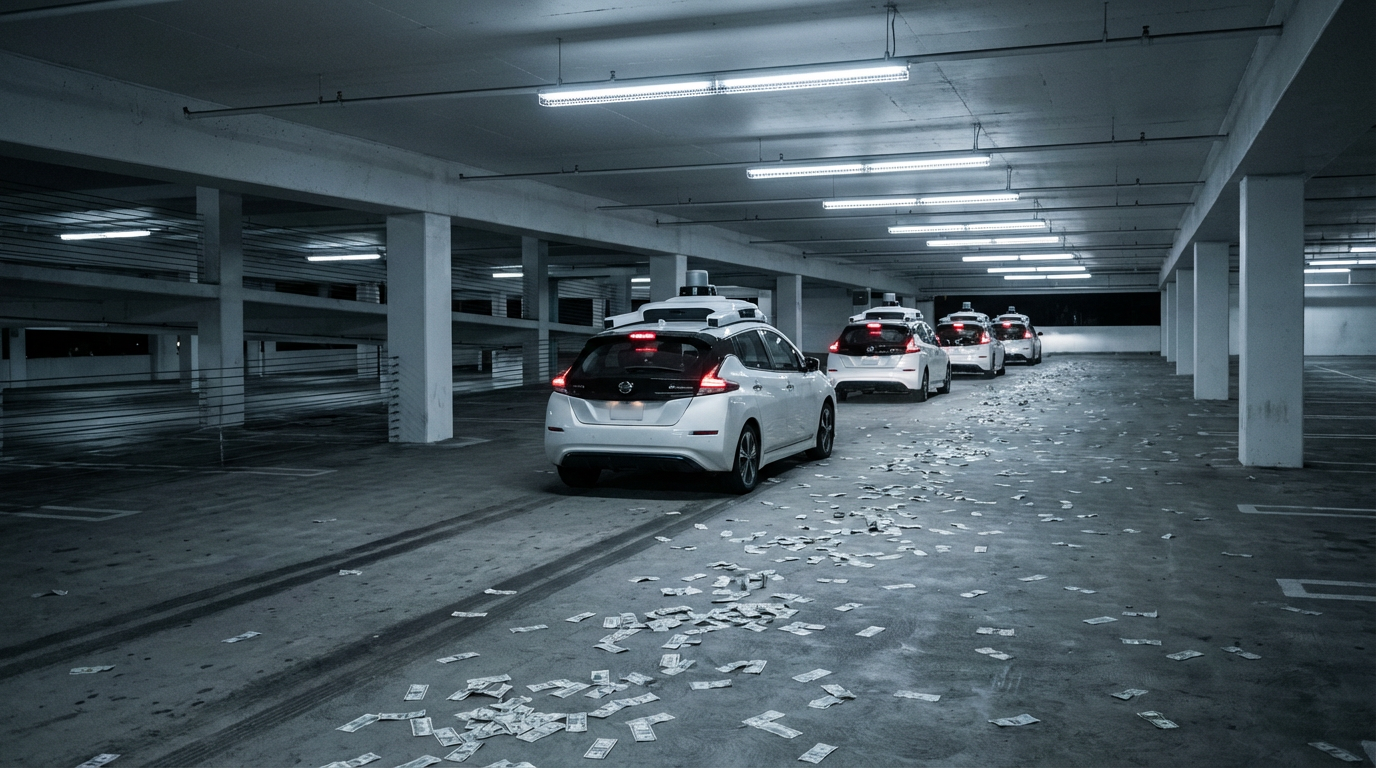
$330. That's what it costs Waymo to deliver the average ride you pay $18 for. Divide Alphabet's Other Bets burn — roughly $5 billion attributable to Waymo in 2025 — by 15 million completed rides, and that's your unit economics in one ugly fraction. No amount of press-release language about "scaling efficiently" makes that ratio comfortable.
On February 25, Waymo flipped the switch in Dallas, Houston, San Antonio, and Orlando simultaneously. Four cities in one day — more new markets than the company opened in its first four years of commercial operation combined. Phoenix launched in 2020. San Francisco didn't go fully public until 2024. Waymo now operates in ten U.S. cities, runs north of 400,000 paid rides per week, and is targeting one million by December. Co-CEO Tekedra Mawakana confirmed the target on Bloomberg, February 11.
Swiss Re analyzed 96 million autonomous miles. The gap: 88% fewer property damage claims, 92% fewer bodily injury claims. Nobody else has data like that. Safe and solvent, though — different spreadsheets.
Where the $5 Billion Goes
Alphabet's Other Bets segment posted a $7.52 billion operating loss for 2025. Waymo eats 60–75% of that, depending on overhead allocation — call it $4.5 billion to $5.6 billion. Strip a one-time $2.1 billion stock-based compensation charge tied to the $16 billion funding round and the operating loss still lands north of $2.4 billion.
Hardware isn't the culprit anymore. Gen-6 "Ojai" sensor suite: under $20,000, down 87% from the original Jaguar I-PACE config at $150,000. Paired with the Zeekr RT platform — roughly $75,000 fully equipped — the capital cost per car lives in a different zip code from five years ago.
The money goes to everything that doesn't ride on four wheels. Remote ops staff monitoring every car. Cleaning crews cycling through the fleet. Charging depots in every city. Mapping teams cataloguing lane markings, construction zones, and intersection geometry for each new geofence. Political operatives smoothing things over with city councils. Houston's overwide intersections aren't Orlando's theme-park traffic surges. Each edge case costs headcount. Nashville, the newest fully driverless market, launched through a Lyft partnership — revenue sharing layered on top of operating costs. That's the opposite direction from profitability.
The Generalization Bet
Waymo's counter: the per-city cost is collapsing. The company built what it calls a "generalizable Driver." Base model handles most urban driving. City-specific fine-tuning layers bolt on. Previously, each market meant extensive retraining. If the generalization holds, city #15 costs a fraction of city #5.
Hardware supports the claim. 6th-gen system uses 42% fewer sensors than Gen-5 while improving field coverage. Disengagement rate: 14,000 miles between human interventions. An order of magnitude beyond any competitor publishing data.
Here's what those numbers mean at scale. At 400,000 rides per week, average trip roughly 5 miles, that's 2 million miles per week — about 200 remote interventions per day. Hit the million-ride target: 500 daily. Every one needs a trained operator on standby within seconds. Staffing curve flattens. It doesn't disappear.
The Per-Ride Math
This is where the competitive picture gets uncomfortable.
| Metric | Waymo | Uber/Lyft | Tesla (projected) |
|---|---|---|---|
| Rider price per mile | $1.00–$1.80 | $1.00–$2.00 | ~$1.00 |
| Vehicle cost | ~$95,000 | Driver-owned | $20,000–$25,000 |
| Miles between interventions | 14,000 | N/A (human driver) | ~500 |
| Marginal cost per ride | ~$330 (all-in) | ~$0 to platform | Unknown |
| Fleet owner | Waymo (Alphabet) | Driver | Tesla / vehicle owner |
Uber's driver gets ~75% of the fare but owns the car, buys the gas, handles maintenance. Uber's marginal cost per additional ride approaches zero. Waymo owns the $95,000 vehicle, the charging infrastructure, and every human in the operations stack. Every ride carries inventory cost.
Tesla is the structural threat. Cybercab targets $20,000–$25,000 per vehicle. Zero lidar. Cameras and neural-net inference only. Disengagement rate — roughly 500 miles between interventions — is 28× worse than Waymo's. But the vehicle costs 3.8× less. A few state regulators decide 500-mile disengagement rates clear the bar for geofenced urban routes, and Tesla's cost advantage swamps Waymo's safety lead. Riders don't comparison-shop crash statistics. They tap whichever app arrives first at the lowest price.
And the field is crowding. Amazon's Zoox signed a strategic partnership with Uber on March 11. Pony.ai started mass-producing a Gen-7 robotaxi with Toyota at a 70% cost reduction. Baidu launched an Uber partnership in Dubai. Three well-capitalized fleets entering the ride-hailing supply chain in one quarter. Global price floor is forming. Waymo's cost structure sits above it.
The Patience Calculation
Alphabet has sunk north of $30 billion into Waymo since the project started as Google's self-driving car program in 2009. The February raise — $16 billion at a $126 billion valuation — was partially external. Dilutes ownership but distributes the burn. Someone outside Mountain View still believes the unit economics eventually work.
At projected 2026 volumes of 40–45 million rides generating $700–$800 million in revenue, per-ride costs may drop 30–50% as utilization improves and fixed costs spread. "Drop" still means $4.5–$6 billion in operating losses. Not profitability. Not the neighborhood of profitability.
Waymo's defense is regulatory moat. Cities choosing between Swiss Re's 91%-fewer-serious-crashes fleet and a cheaper option with thinner safety data will favor the proven record. Insurance companies will price accordingly. That moat is real. Maintaining it costs $5 billion a year, and every new competitor with decent safety numbers chips away at the premium.
The Bottom Line
Ten cities. 400,000 rides a week. The best safety record ever measured on public roads. And a per-ride loss that would bankrupt any company without Alphabet's balance sheet behind it. Volume might cure the economics. Volume might also just make the hemorrhage larger. December's million-ride milestone will tell us which.
Sources
- Electrive, "Waymo launches Robotaxi service in four additional US cities," Feb 25, 2026
- GCBC, "Twelve Cities, $16 Billion, One Million Rides: Waymo's 2026 Blitz," Feb 13, 2026
- Next Big Future, "Waymo Losses About $5 Billion," Feb 16, 2026
- Automotive World, "Waymo's 6th-gen Driver goes live with 42% fewer sensors," 2026
- Reinsurance News, "Waymo shows 90% fewer claims than advanced human-driven vehicles: Swiss Re"
- Electrek, "Waymo begins fully autonomous ops with 6th-gen Driver, targets 1M weekly rides," Feb 12, 2026
- Uber Investor Relations, "Zoox and Uber Announce Strategic Partnership," March 11, 2026