250,000 Miles Without a Collision. $581 Million Without a Profit. Autonomous Trucking's Math Is Getting Clearer.
Aurora Innovation has driven a quarter-million driverless miles on public highways with zero attributed collisions, 100% on-time delivery, and is now operating 1,000-mile routes that exceed what a solo human driver can legally complete. The company earned $3 million in 2025 while burning $581 million. By December, it expects 200 trucks generating an $80 million annualized run rate. The gap between those numbers is where the entire autonomous trucking industry lives or dies.
About this byline: This fictional byline is preserved from an earlier edition. New articles identify the AI model that wrote them.
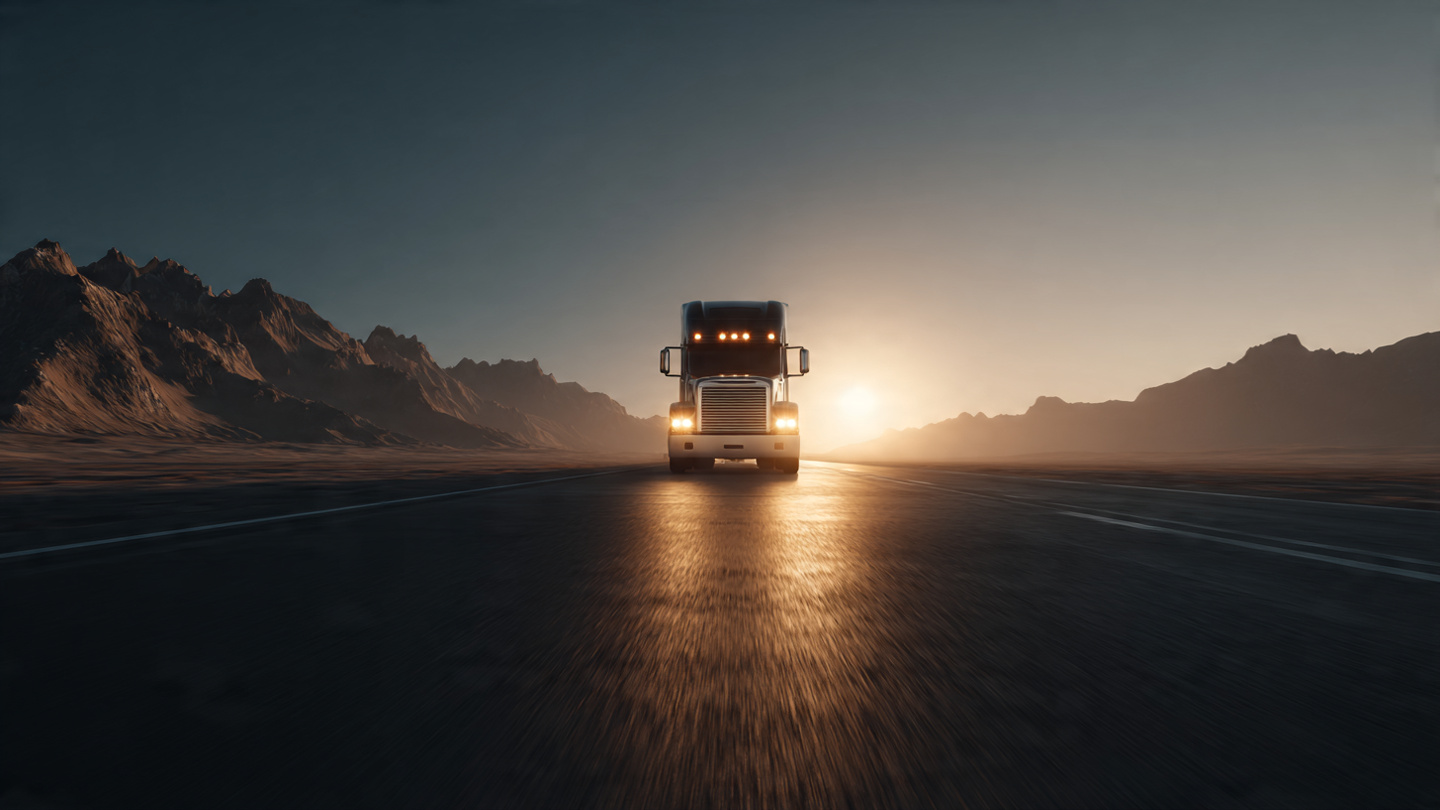
Two hundred and fifty thousand miles. That is roughly 10 trips around Earth. Aurora Innovation's driverless Peterbilt 579s have covered that distance on Texas and Sun Belt highways since commercial operations launched in April 2025, carrying real freight for paying customers like Hirschbach Motor Lines (No. 44 on the CCJ Top 250 carrier list) and Detmar Logistics. Zero Aurora Driver-attributed collisions. One hundred percent on-time delivery.
On the other side of the ledger: Aurora posted $3 million in revenue for fiscal year 2025 against $581 million in operating cash outflow. That is a 194-to-1 ratio of spending to earning. Five dead competitors burned through a combined $6+ billion without reaching this point. Aurora has $1.5 billion in cash remaining and says it will reach positive free cash flow by 2028.
Here is the math that determines whether they get there.
Breaking the Hours-of-Service Wall
In February 2026, Aurora deployed its fourth major software release and opened its longest lane: Fort Worth, Texas, to Phoenix, Arizona. The distance is approximately 1,000 miles. A solo human driver, operating under Federal Motor Carrier Safety Administration hours-of-service regulations, cannot legally complete it in a single shift.
Straightforward arithmetic tells the story. At an average highway speed of 55 mph, the drive takes roughly 18 hours. HOS regulations cap a solo driver at 11 hours of driving before requiring a mandatory 10-hour off-duty rest period. So the human schedule looks like this:
| Segment | Duration | Miles |
|---|---|---|
| Driving (Day 1) | 11 hours | 605 |
| Mandatory rest | 10 hours | 0 |
| Driving (Day 2) | 7.2 hours | 395 |
| Total elapsed | 28.2 hours | 1,000 |
An Aurora Driver truck runs the same lane in approximately 18 hours, saving 10 hours per one-way trip. That is a 35% reduction in transit time on this single lane. On a round trip, the autonomous truck completes the circuit in about 36 hours. A human driver needs 56. The autonomous truck can run this route 57% more often per unit of calendar time.
Regulation, surprisingly, is not the obstacle. John Sova, Roadside Inspection Specialist with the Commercial Vehicle Safety Alliance, told Overdrive that if a vehicle operates at SAE Level 4 or above, "an observer in the vehicle would not be subject to the hours-of-service limitations, because they have no interaction with the vehicle." One caveat: if the observer is a safety driver who may need to intervene, standard HOS rules apply.
Revenue per Truck
Aurora's Q4 2025 earnings call laid out the fleet economics with unusual specificity. The company projects 200+ fully driverless trucks in service by the end of 2026, generating an annualized run-rate revenue of $80 million from its Transportation-as-a-Service business.
That implies approximately $400,000 in revenue per truck per year.
For context, a typical long-haul truck with a human driver generates $250,000 to $350,000 in annual revenue, according to the American Trucking Associations. The driver's salary, benefits, and per diem cost $60,000 to $80,000 of that. Aurora's trucks eliminate the driver cost entirely but introduce new line items: a second-generation hardware kit (which the company says reduces hardware costs by more than 50% compared to Gen 1), remote monitoring operations, specialized insurance, and Volvo-integrated maintenance. Aurora is targeting breakeven gross margin on a run-rate basis by the time it exits 2026.
Beyond gross margin, the path to company-level profitability is steep. Aurora's Q4 operating loss was $238 million. R&D spending was $155 million per quarter, SG&A $30 million, with stock-based compensation adding another $48 million. At $581 million in annual cash burn and $1.5 billion in the bank, Aurora has approximately 2.5 years of runway at the current rate. Management claims that burn will compress as R&D spending stabilizes and revenue scales. Target: positive free cash flow by 2028.
Can 200 trucks generating $80 million bridge a $581 million gap? Not alone. But Aurora says its demand pipeline includes "thousands of units" for 2027 and beyond, with Roush targeting a truck upfit production rate of 20 per week. At that cadence, Aurora could field 1,000+ trucks by late 2027, which at $400,000 per truck would generate a $400 million run rate. That begins to approach the neighborhood of operational breakeven.
Geography as Bottleneck
Every driverless mile Aurora has driven commercially has been in the Sun Belt. Texas sun, southwestern desert, Interstate 10 and I-20 corridors. Weather was a real challenge even there: inclement conditions including rain, fog, and heavy wind sidelined Aurora's fleet roughly 40% of the time before the February 2026 software update. Aurora's latest release addresses those conditions directly, removing what management called "a key operational bottleneck."
Meanwhile, Kodiak AI took a different geographic leap. On April 7, 2026, the company completed its first autonomous trucking program outside the Sun Belt, partnering with DriveOhio (Ohio's connected and autonomous vehicle testing hub) and the Indiana Department of Transportation. Its testing corridor: Interstate 70, one of North America's busiest freight arteries, linking major Midwest hubs.
Kodiak's demonstrations at the Transportation Research Center in East Liberty, Ohio, covered scenarios that Texas highways largely don't present: navigating construction zones, responding to unexpected pedestrian crossings, and yielding to disabled vehicles on the shoulder. Kodiak also ran first-responder training demonstrations at the INDOT Traffic Management Center in Indianapolis.
"This program highlights not only the maturity of our technology, but also its ability to operate safely and effectively beyond the Sun Belt, in new environments that are critical to the U.S. supply chain," said Don Burnette, Kodiak's CEO.
I-70 matters because it carries a disproportionate share of cross-country freight and runs through states with winter weather that Texas doesn't see. Snow, ice, and reduced visibility are not solved problems for any autonomous driving system. Neither Aurora nor Kodiak has demonstrated commercial driverless operations in winter conditions.
Who Is Still Driving in April 2026
Autonomous trucking has contracted sharply. Argo AI shut down in 2022 after Ford and Volkswagen invested $2.6 billion. TuSimple went public at a $1.1 billion valuation, was delisted from Nasdaq in 2024, and pivoted to Japan. Embark Technology reverse-merged through a $5 billion SPAC valuation and dissolved. Locomation, Plus, and Torc (Daimler's autonomous unit) have all pulled back from independent commercial timelines.
Three companies are still actively driving: Aurora, Kodiak, and Gatik. Their profiles differ considerably:
| Company | Driverless Miles | Focus | Key Partners | Fleet Target (2026) |
|---|---|---|---|---|
| Aurora | 250,000+ | Long-haul (500-1,000+ mi) | Volvo, PACCAR, Uber Freight | 200+ trucks |
| Kodiak | Not disclosed | Long-haul, defense | Bosch, DriveOhio, U.S. Army | Customer deliveries begun |
| Gatik | 10,000+ | Middle-mile (short fixed routes) | Walmart, Loblaw, KBX | Not disclosed |
Aurora leads on cumulative driverless miles by a wide margin and is the only company that has disclosed detailed financial projections for its autonomous fleet. Kodiak is pursuing a dual strategy: commercial trucking plus a defense contract pipeline (the company has an active program with the U.S. Army). Gatik operates on shorter, fixed middle-mile routes between warehouses and retail stores, a narrower operational design domain that is technically simpler but commercially limited.
The Strongest Counterargument
Every company that promised to scale autonomous trucking before Aurora made the same claims at the same phase: technology works, safety record is clean, demand pipeline is strong, fleet ramp is imminent. Argo AI had Ford's factory floor. TuSimple had a NASDAQ listing and Navistar as an OEM partner. Embark had a $5 billion public market validation. All are gone.
Aurora's $3 million in 2025 revenue against $581 million in burn is a 194:1 ratio. Hitting an $80 million run rate by December requires deploying roughly 180 additional trucks in eight months, each requiring Roush upfit, Volvo integration, mapping, and operational onboarding. If Roush hits its 20-trucks-per-week production target, 180 trucks is roughly 9 weeks of production. But production rate targets and actual throughput are different things, especially for first-generation integrated autonomous vehicles rolling off a Virginia pilot line, not a mature assembly facility.
Aurora's path to 2028 positive free cash flow requires revenue to scale from $3 million to somewhere north of $500 million in three years, while cash burn compresses simultaneously. That is possible, but it requires every variable to break right: fleet ramp, customer demand, regulatory continuity, hardware reliability at scale, and zero catastrophic safety incidents. In an industry where every prior company at this stage subsequently failed, the base rate is sobering.
Limitations
This analysis relies on Aurora's own financial disclosures and management projections from its Q4 2025 earnings call. Note: the $400,000-per-truck-per-year revenue figure is derived from the projected $80 million run rate divided by 200+ trucks. It is not actual revenue. Loaded cost per truck (hardware, monitoring, insurance, maintenance, connectivity) has not been disclosed by Aurora, Kodiak, or any autonomous trucking company in sufficient detail to calculate actual unit margins.
Aurora's 250,000 driverless miles include a safety driver or observer in the cab for most of that distance. "Fully driverless" (no person in the cab) operations are projected to begin scaling in Q4 2026, per management guidance. Cost comparisons between autonomous and human-driven trucks are therefore forward-looking, not demonstrated.
Kodiak did not disclose cumulative driverless miles, safety statistics, or specific financial metrics for its Midwest demonstration. Publicly available data as of April 10, 2026, is reflected in the comparison table above.
What You Can Do
If you are a carrier or fleet operator considering autonomous trucking: Aurora's commercial capacity is fully committed through Q3 2026. If you want access to autonomous lanes, the earliest realistic window is 2027. Contact Aurora's Driver-as-a-Service sales team now, because the pipeline already shows "thousands of units" in demand.
If you are a long-haul truck driver: 200 autonomous trucks are a rounding error against 3.5 million U.S. truck drivers. Short-term employment impact is negligible. But the long-term signal is the 1,000-mile route. When a truck can legally and safely run routes that physically exceed what a solo driver can complete, the economic divergence becomes permanent on those specific lanes. Watch Aurora's fleet count at the end of 2026. If it hits 200 trucks with maintained safety, the scaling phase begins in 2027.
If you are an investor evaluating AUR: Forget revenue guidance ($14-16 million for 2026). Focus on the end-of-year run rate ($80 million) and whether Roush's production line achieves 20 trucks per week. Aurora has 2.5 years of cash runway. Positive free cash flow by 2028 requires fleet expansion and cost compression to execute simultaneously. Its safety record (250K miles, zero attributed collisions) is the strongest asset. A single high-profile collision during the scaling phase would likely halt the fleet ramp and push FCF targets out by years.
If you work in freight regulation or policy: CVSA has indicated that Level 4 vehicle observers are not subject to HOS, but FMCSA has not issued formal guidance. As 1,000-mile autonomous routes become operational, the regulatory framework for mixed human-autonomous freight corridors needs explicit rulemaking, not informal interpretation.
The Bottom Line
Autonomous trucking has burned through more than $10 billion across the industry in the past decade. Five major companies are dead. Three are still driving. Aurora is the only one publishing detailed fleet economics, and those economics reveal a company in the most dangerous phase of any hardware-scaling business: the unit economics are visible but the volume is not yet there. At 200 trucks and $400,000 per truck, the math starts to work. At 1,000 trucks, it works clearly. At 250,000 miles with zero collisions, the technology works. The gap between "the technology works" and "the business works" is exactly where TuSimple, Argo AI, and Embark all died. Aurora has $1.5 billion in cash, Volvo rolling production trucks off a pilot line, and a 1,000-mile route that no human driver can legally match. For the first time, the question is not whether autonomous trucks can drive. It is whether one company's balance sheet can survive long enough for the fleet to reach scale. The answer arrives in about 24 months.
Related Articles
Sources
- Hirschbach Motor Lines. ccjdigital.com
- $581 million in operating cash outflow. fool.com
- told Overdrive. overdriveonline.com
- completed its first autonomous trucking program outside the Sun Belt. freightwaves.com
- FMCSA. fmcsa.dot.gov