🚀 Space
Voyager 1 Just Crossed One Light-Day. A Reply Now Takes 48 Hours.
On November 18, Voyager 1 became the first human-made object one light-day from Earth: 25.9 billion kilometers, 173 times the Earth-Sun distance, reached after 49 years at 61,155 km/h, on a radio link that now takes a full day each way.
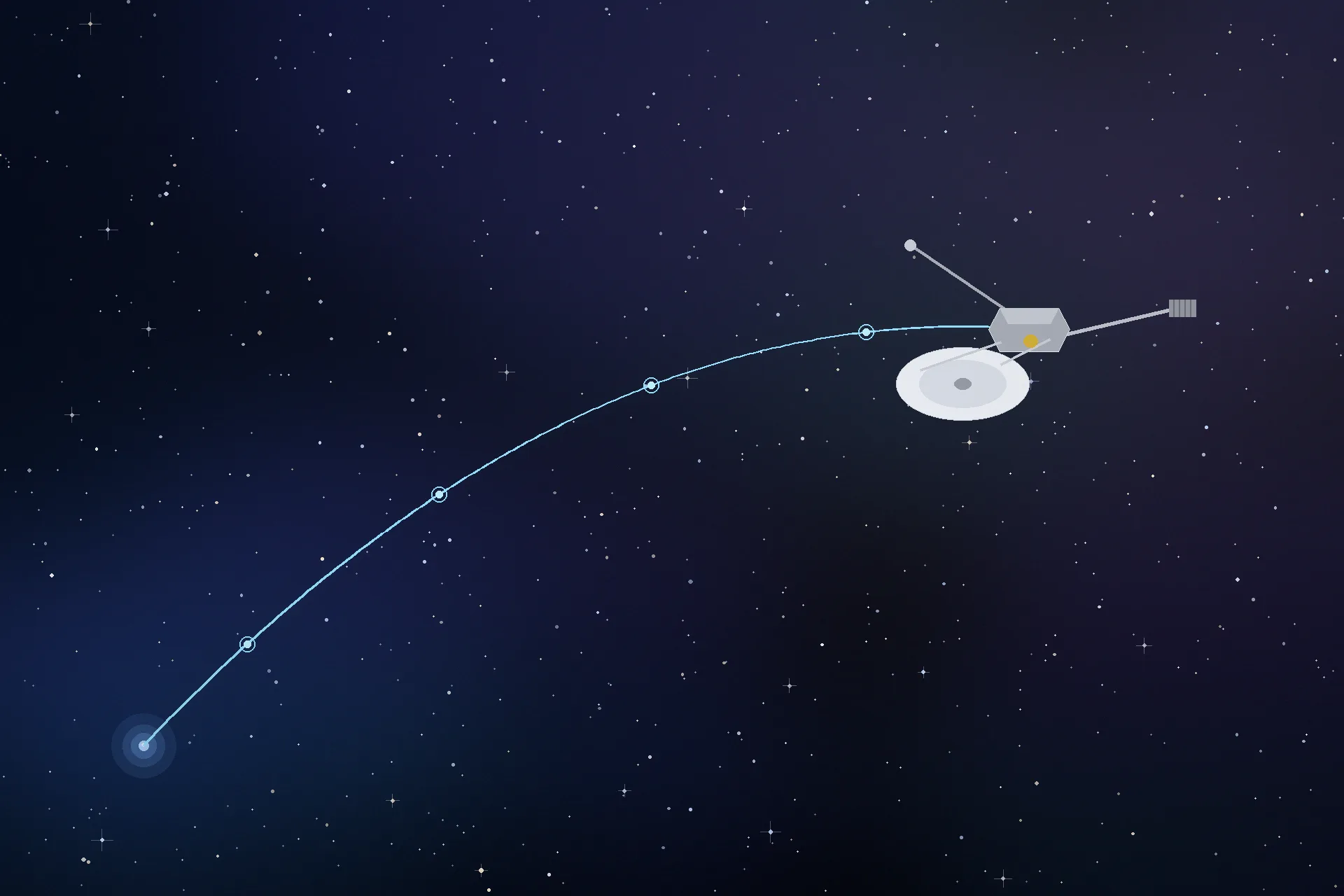
Forty-eight hours. That is now the shortest possible conversation with the farthest thing humanity has ever built, which crossed one light-day from Earth at 2:16 AM Pacific time on Wednesday, November 18, 25.9 billion kilometers out after 49 years of continuous travel since its launch on September 5, 1977, and nothing built by human hands had ever needed a full day for its signal to arrive.
One Light-Day, Verified to the Digit
A light-day is not a place. It is a unit of distance defined by a clock, how far light travels in 24 hours, so multiply the speed of light in vacuum, 299,792.458 kilometers per second, by 86,400 seconds in a day and the answer is 25,902,068,371 kilometers. NASA's figure for the milestone is 25.902 billion kilometers. It matches to the digit. The number was computed from the spacecraft's trajectory and confirmed when its carrier signal arrived on Earth 24 hours later, early Thursday, exactly on schedule.
Put it next to something: sunlight takes about 1.3 seconds to reach the Moon and about four hours to reach Neptune, but it takes 24 hours to reach Voyager 1, six times the Neptune figure, or 173.14 AU against Neptune's 30.07, a ratio of 5.76. Every day the probe covers 1,467,720 kilometers, 3.82 Earth-Moon distances. Even at that pace, one light-year takes about 17,650 years.
The 48-Hour Phone Call
Distance here is not scenery but latency, and latency now exceeds a day in each direction. "We listen to Voyager 1 every day and send commands to the spacecraft weekly," said Suzanne Dodd, the Voyager project manager at NASA's Jet Propulsion Laboratory. "Even traveling at the speed of light, signals now take 24 hours to reach the spacecraft and 24 hours to reach us." Send a command today and the earliest possible confirmation arrives the day after tomorrow. That is the physics floor, and since JPL prepares commands over days and sends them weekly, a real question-and-answer cycle runs longer still.
There is a wrinkle NASA did not hide. Mission engineers have received no science or engineering data from Voyager 1 since November 14, but the carrier signal still arrives, the bare radio tone that normally carries the data, and the team used that tone plus trajectory calculations to confirm the milestone, and engineers are still analyzing the interruption. A record confirmed by a carrier tone rather than a data packet is still a record, but it is one set by a spacecraft that may be in trouble.
A 22-Watt Whisper Across 173 AU
Talking to something 173 times farther than the Sun requires shouting very quietly and listening very hard. Voyager 1's transmitter radiates about 22 watts, roughly the power of a refrigerator light bulb, through a 3.7-meter dish, and by the time that signal has spread across 25.9 billion kilometers, published estimates put the power arriving at Earth near 10^-16 watts. Run the ratio and the loss is about 173 decibels, caught by 70-meter dishes in California, Spain, and Australia, their cooled amplifiers straining to hear a tone weaker than the receiver's own thermal noise.
What comes back arrives at a trickle: Voyager 1 downlinks at about 160 bits per second, slower than a 1980s dial-up modem by orders of magnitude. At that rate a single megabyte takes 14.6 hours to download, and a 3-megabyte smartphone photo would take about 44 hours. A full day of downlink carries about 1.73 megabytes in total, less than one phone photo per day, from a machine that left Earth before personal computers existed.
| Calculation | Arithmetic | Result |
|---|---|---|
| Light-day distance | 299,792.458 km/s x 86,400 s | 25,902,068,371 km |
| Distance in AU | 25,902,068,371 / 149,597,870.7 km | 173.14 AU |
| Moon distances per day | 1,467,720 km / 384,400 km | 3.82 per day |
| Years to one light-year | 9.4607 trillion km / 61,155 km/h | About 17,650 years |
| One megabyte at 160 bps | 8,388,608 bits / 160 bits/s | 14.6 hours |
| Daily downlink volume | 160 bits/s x 86,400 s | 1.73 MB per day |
| RTG power today | 470 W minus 4 W/yr x 49.2 yr | About 273 W |
| Signal path loss | 10 x log10(22 W / 10^-16 W) | About 173 dB |
273 Watts and Falling
Voyager 1 runs on three radioisotope thermoelectric generators that produced about 470 watts at launch and lose about 4 watts every year as their plutonium-238 decays, so after 49.2 years the spacecraft has roughly 273 watts left, less power than three 100-watt light bulbs, with its transmitter alone taking about 8 percent of that. Keeping the probe alive has become an exercise in subtraction, so engineers switched off the cosmic ray subsystem in February 2025 and the low-energy charged particle instrument in April 2026, leaving the magnetometer and the plasma wave instrument running, and NASA expects at least one instrument to keep working into the 2030s.
Meanwhile the probe keeps flying toward a star it will never reach. Voyager 1 is headed for Gliese 445, more than 17 light-years away, with closest approach in about 40,000 years, carrying the Golden Record, greetings in 55 languages and 115 images of Earth, addressed to whoever finds it. Sometime in the 2030s the power will run too low to run the transmitter, and the spacecraft will go silent.
What You Can Do
If you follow spaceflight, watch the data outage before the distance: NASA's Voyager mission page shows whether science data has resumed. If you build hardware or software meant to last, study the Voyager playbook, because a 1977 spacecraft still operating in 2026 is a masterclass in designing for degradation, and every subsystem was built to be switched off or run on a backup. If you teach or parent, use the 48-hour phone call as the cleanest demonstration of light speed ever handed to a classroom.
Limitations
This analysis relies on NASA's November 2026 release. Three numbers came from secondary reporting: the 160 bits-per-second downlink, the roughly 22-watt transmitter, and the switch-off dates of February 25, 2025 and April 17, 2026. If NASA's published figures differ, the photo-transfer and daily-volume math shifts proportionally. The roughly 10^-16 watt received-power figure is a published estimate, so the 173-decibel path-loss calculation inherits its uncertainty. The roughly 273-watt current output is computed from NASA's stated 4-watts-per-year decay rule; real decay is not perfectly linear. Engineers had not identified the cause of the data interruption as of November 19.
The Strongest Case Against This Analysis
Here is the best case against treating this as a great event. A light-day is a round number in human units, not a physical boundary, and nothing changed aboard Voyager 1 on November 18: no instrument switched, no new region began, no science result landed. The scientifically meaningful boundary, the heliopause, was crossed in 2012. Worse, the milestone was confirmed while the spacecraft is in trouble, with no science or engineering data since November 14. Most of that is correct. The milestone matters not because space changed. It matters because the physics floor for talking to the probe crossed one day, which permanently changes how the mission must be flown. The data outage, not the distance, is the story to watch next.
The Bottom Line
Forty-nine years after launch, a machine with 69 kilobytes of memory and less power than three light bulbs has traveled farther than anything humanity has built, to a place where its own signal needs a full day to reach home, on a plutonium battery losing 4 watts a year, a 22-watt transmitter, and a downlink slower than dial-up. The number that matters is not 25.9 billion kilometers. It is 48 hours: the minimum time for a question and an answer, a limit set by physics itself, and one that will only grow from here. Voyager 1 will keep flying long after it goes silent. What it proved, on November 18, is that the farthest conversation in human history now takes two days, and the machine on the other end is still answering.
Related
- It Costs $1.2 Million to Land One Kilogram on the Moon. Starship Could Do It for $900.
- NASA Spent $2 Billion on Satellite Repair and Cancelled It. A Startup Just Did It for $30 Million.
- Google's First AI Answer From Orbit Was a Haiku. Its 4 TPUs Average 14-19% of One H100.
Sources: NASA, "NASA's Voyager 1 Makes History Reaching One Light-Day From Earth"; NASA APOD, "V-G-R" (2026-11-20); CNN, "Voyager 1, the farthest human-made object, is now one light-day from Earth" (2026-11-18); OrbitalRadar, Voyager 1 live tracker; TerraDaily, Voyager 1 explainer. All ratios, energy figures, and comparisons are the author's own calculations on the cited numbers.