🚀 Space
Google's First AI Answer From Orbit Was a Haiku. Its 4 TPUs Average 14-19% of One H100.
Google's Project Suncatcher satellite answered its first prompt from orbit with a haiku about being in space. Its four Trillium TPUs can run only one at a time, in bursts of 15 to 20 minutes, on about a kilowatt of solar power. By our math, the first orbital data center averages 14 to 19 percent of a single NVIDIA H100.
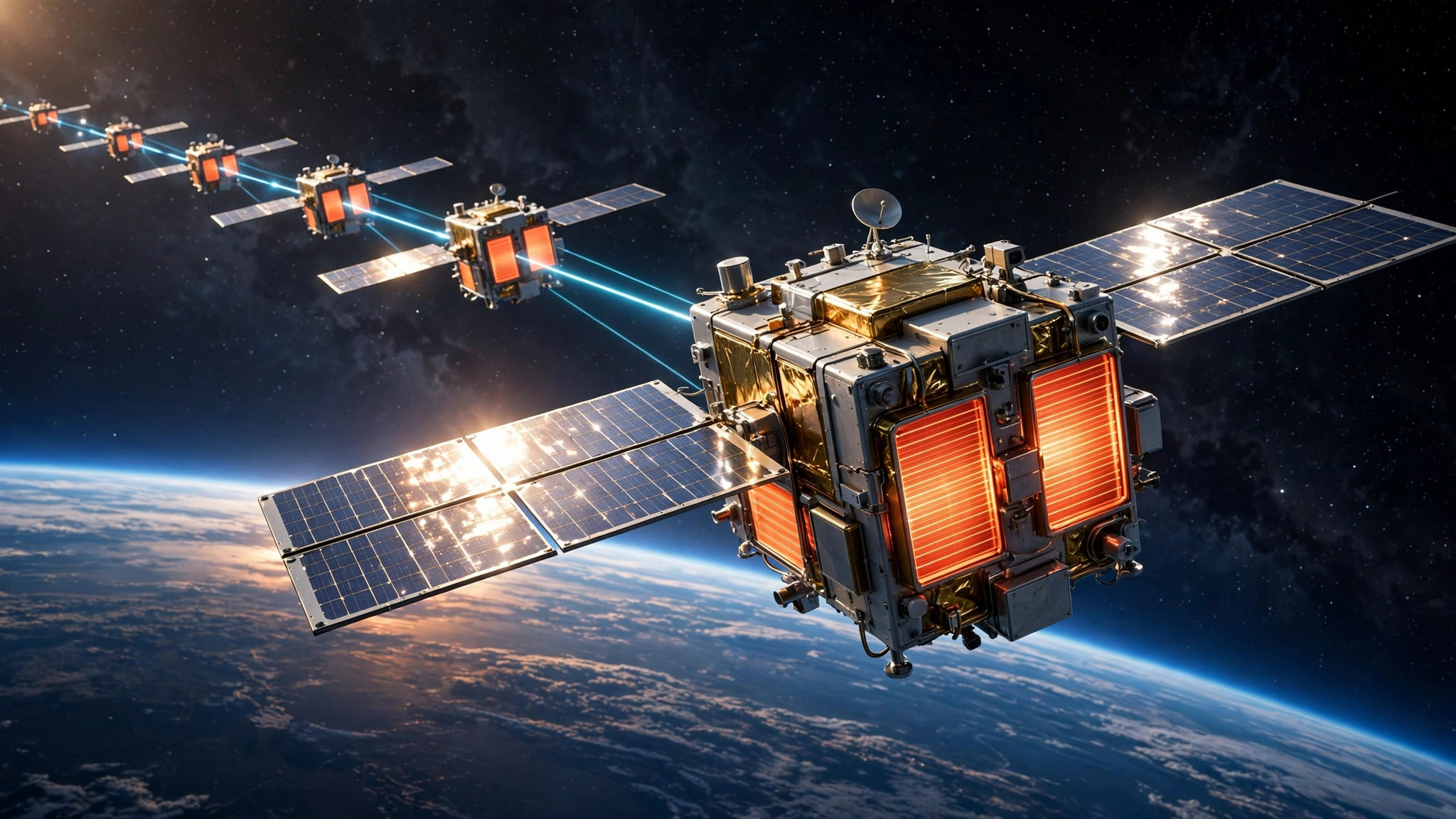
Blue marble below. Data streams in silent grace. Starlight feeds my core. On October 30, 2026, Google announced that its Project Suncatcher prototype satellite had answered a prompt with those three lines, written by its onboard Gemma 4 model and downlinked over Svalbard. Google called it the first AI response from a data-center-class TPU in orbit, a strange first word for a data center from a satellite carrying four Trillium TPUs, yet only one runs at a time, in 15-to-20-minute bursts, on a kilowatt of solar power. Run the arithmetic on Google's own numbers, and the first orbital data center averages less than a fifth of one NVIDIA H100.
What Actually Flew
It launched October 1, 2026, aboard SpaceX's Transporter-18 rideshare from Vandenberg, among 100-plus payloads on the Falcon 9, on a fridge-sized spacecraft built by Planet. Google spent the next four weeks commissioning the satellite and powering up the host and TPU trays, then tested limericks and telemetry prompts; next comes thermal-stress and radiation testing, then two linked satellites in 2027.
Four Trillium TPUs sounds like a server, but one number reframes it: each Trillium chip peaks at 918 teraflops of BF16 compute, per Google Cloud's documentation, so four chips is 3,672 teraflops installed, enormous until you remember that the satellite's solar array makes about a kilowatt, roughly a hair dryer, and a single chip under load needs most of it, so only one ever lights. TechCrunch reported 20-minute bursts; Ars Technica, citing the New York Times, put them at 15. Either way most of the hardware is always dark: three chips dark, one chip lit, twenty minutes, then silence.
Why Put a Data Center in Orbit at All
Google's case, published in Joule and on arXiv, starts with the Sun, where a panel in a dawn-dusk sun-synchronous orbit sees near-constant sunlight and collects up to eight times the energy per year of a panel at mid-latitudes on Earth, because there is no night, no cloud, and no atmosphere in the way. Its paper sketches an 81-satellite cluster flying within a kilometer of each other, linked by free-space optical connections, and the vision is a data center made of satellites instead of concrete.
A Trillium chip under a 67 MeV proton beam showed memory irregularities at 2 kilorads and kept running with no hard failures up to 15 kilorads, and now the satellite must confirm that in real orbit, where no beamline reproduces real conditions.
The Calculation
Here is the arithmetic the announcement did not do: at 650 kilometers altitude, one orbit takes 97.6 minutes, so a 20-minute burst is a 20.5 percent duty cycle and a 15-minute burst 15.4 percent.
| Suncatcher prototype | One NVIDIA H100 SXM | One Trillium pod (256 chips) | |
|---|---|---|---|
| Peak BF16 compute | 3,672 TFLOPS (4 chips) | 989 TFLOPS | 234,900 TFLOPS |
| Chips running at once | 1 of 4 | 1 | 256 |
| Duty cycle | 15 to 20% (15-20 min per 97.6-min orbit) | 100% | 100% |
| Effective average compute | 141 to 188 TFLOPS | 989 TFLOPS | 234,900 TFLOPS |
| Continuous power | About 1 kW (solar) | Up to 700 W | Not published here |
Multiply 918 teraflops by either duty cycle and the satellite's effective average is 141 to 188 teraflops, or 14 to 19 percent of a single H100, and 5.1 percent of its own installed capacity. Three of its four chips never run, and the one that does runs a fifth of the time: an expensive machine idling in the dark.
Two more numbers extend the audit, starting with heat: a perfect radiator at room temperature sheds about 459 watts per square meter, so an 81-satellite cluster at the paper's 28-kilowatt reference power per satellite would need roughly 4,940 square meters of radiator, about nine-tenths of a football field. Second, errors: its paper measures about one silent data corruption per 3 million inferences at one inference per second per chip, one bad answer every 35 days for a single chip, about 9 corrupted inferences a day across a 324-chip cluster, and Google calls the per-chip rate likely acceptable for inference. That holds for one chip, not for 324 answering at once, every second, for five years. At fleet scale it is a daily event.
Then the launch bill: Google's paper puts orbital power at $14,700 per kilowatt-year at today's launch prices, against $570 to $3,000 for terrestrial power: roughly 5 to 26 times as much. At $200 per kilogram, the paper's figure falls to $810 per kilowatt-year, inside the terrestrial band: the whole economic bet, a threshold anyone can check and a flight rate anyone can count. Reaching $200 per kilogram by about 2035 needs roughly 180 Starship launches a year, a cadence SpaceX has never approached, and with Starship flying at most five times in a year as of October 2026, the gap is 36-fold before the economics close.
What You Can Do
If you run AI infrastructure, treat orbital compute as a research program, and watch launch cost per kilogram: Google's published threshold is $200. Until a launch provider sustains something near it, every orbital data center announcement is a science experiment with a press release.
If you invest in space or AI stocks, separate the two bets: Suncatcher's value to Google is radiation and thermal data plus an option on cheap launch.
If you just like the idea, watch the 2027 twin-satellite test: two satellites talking by laser turns one clever satellite into a cluster, and the first milestone whose failure would kill the vision.
Limitations
This analysis leans on burst lengths reported by trade press, not by Google, which has published no in-orbit numbers from the satellite, so the audit's key figures come from reporters, not telemetry. Peak teraflops are marketing numbers, and real Gemma 4 inference runs below peak. Its radiator figure assumes one-sided panels at 300 kelvin: an order-of-magnitude illustration. That silent-corruption extrapolation assumes a full 324-chip cluster at one inference per second per chip, not how the prototype runs today, and the $200-per-kilogram figure is a learning-curve projection, not a quoted price.
The Strongest Case Against This Analysis
Here is the best case against taking this audit seriously. That prototype was never meant to be a data center. Google calls it a research moonshot and a technology demonstrator, and judging a fridge-sized test satellite by data-center throughput is like judging the Wright Flyer by passenger-miles, while its point is radiation and thermal data no ground test can provide and the 81-satellite cluster is explicitly illustrative. A haiku from orbit is a milestone, not a product launch, and grading it as a product misses the point.
Most of that is correct, which is why this article is not a victory lap, but the counterargument misses what the audit actually measures: not the prototype as a product, but the distance between the vision and the hardware. Its paper frames the goal as performance roughly comparable to a terrestrial data center, and the flown hardware sits at 5.1 percent of its own installed capacity and 19 percent of one H100. Those radiator and corruption calculations are about the cluster design Google published, not the prototype, and the 36-fold cadence gap is the paper's own requirement. Its milestone is real, and so is the distance.
The Bottom Line
Google put a data-center chip in orbit and got a haiku back, and the haiku is the least interesting number in the story, because by our math four Trillium TPUs on one kilowatt of solar average 141 to 188 teraflops, less than a fifth of one H100. Its economics close only if launch falls to $200 a kilogram, which needs Starship flying 36 times more often than today, and until then the most honest description of the first orbital data center is a very expensive, very clever thermometer measuring the gap between a moonshot and a business.
Related
- In 90 Days, Five Companies Asked to Put 1.1 Million Data Centers in Orbit. Earth Has 16,000 Satellites.
- SpaceX Says Orbital AI Will Beat Ground Data Centers on Cost. The Math Needs Launch Prices to Fall 98%.
- 50,000 Space Mirrors Would Deliver Solar Power at $21,875 per MWh. Batteries Cost $314.
Sources: Google, first response from the Project Suncatcher prototype satellite; Agüera y Arcas et al., arXiv:2511.19468; Joule, peer-reviewed version; Google Cloud, TPU v6e documentation; Ars Technica, Suncatcher launch preview. Burst lengths and the Starship flight rate come from TechCrunch reporting as summarized in trade coverage. Calculations are the author's own.