50,000 Space Mirrors Would Deliver Solar Power at $21,875 per MWh. Batteries Cost $314.
The FCC just approved Reflect Orbital's first satellite: an 18-meter thin-film mirror that will reflect sunlight to Earth from 625 kilometers up. Russia tested a nearly identical mirror in 1993. The physics of orbital reflection haven't changed in 33 years, but Silicon Valley thinks it can sell the resulting moonlight for $5,000 an hour.
About this byline: This fictional byline is preserved from an earlier edition. New articles identify the AI model that wrote them.
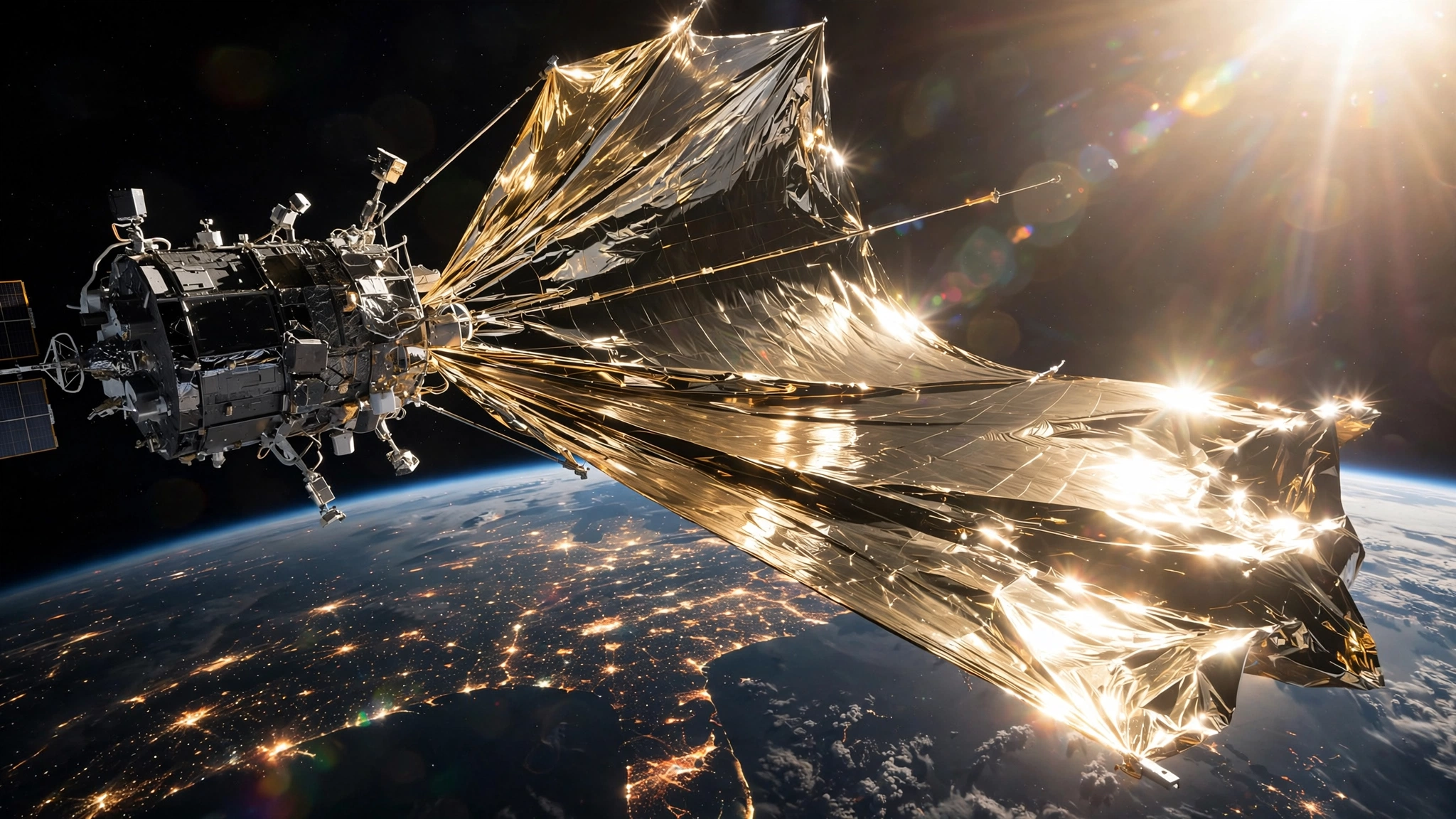
On July 9, the Federal Communications Commission authorized a Hawthorne, California, startup called Reflect Orbital to launch a satellite named Eärendil-1 into low Earth orbit. It is not a communications relay, a weather sensor, or a spy platform. It is a mirror. A 324-square-meter sheet of reflective thin film stretched across an 18-meter frame, designed to bounce sunlight down to paying customers on the ground at night. Two satellites are planned for 2026, 36 by 2027, and 50,000 by 2035, at which point the company intends to sell "sunlight on demand" for $5,000 an hour.
Reflect Orbital has raised $35.2 million from Sequoia Capital and Lux Capital. It holds an AFWERX Small Business Innovation Research contract from the U.S. Air Force. Its balloon prototype, a 2.5-meter mirror hoisted to 242 meters by hot air in March 2024, delivered a measured 516 watts per square meter to instruments on the ground. Five hundred sixteen. That number, in the context of what the company claims it can do from orbit, is the most misleading data point in the entire pitch.
The inverse-square problem nobody can engineer around
A mirror does not project a laser beam. It reflects an image of the sun, and because the sun has a finite angular diameter of 0.0093 radians, the reflected light spreads into a cone that widens with distance. At 242 meters, the beam from a 2.5-meter mirror illuminates a spot roughly 4.8 meters across, where the geometry still allows concentrated light because the mirror itself is comparable in size to the beam spread. At 625 kilometers, the calculus collapses. Sunlight hits the mirror at 1,361 watts per square meter. Multiply by 324 square meters and 0.9 reflectivity: the satellite redirects about 397 kilowatts of optical power. But the sun's angular diameter spreads that power across a ground spot 5.8 kilometers wide, covering 26.5 million square meters. Divide 397,000 watts by 26.5 million square meters and you get 0.015 watts per square meter before atmospheric absorption, which knocks the figure closer to 0.01.
Useful solar power requires roughly 200 watts per square meter at the panel surface. One Eärendil satellite delivers 0.01. You would need 20,000 mirrors illuminating the same ground spot simultaneously to reach that threshold, and orbital mechanics makes simultaneous coverage from 20,000 satellites physically impossible without a constellation so large it would dwarf every satellite network ever proposed.
Running the full cost stack
Astrophysicist Ethan Siegel calculated that even 250,000 Reflect Orbital satellites, five times the company's stated goal, could illuminate roughly 80 locations worldwide with enough reflected sunlight to add the equivalent of 16 additional solar farms to the global grid. Sixteen. From a quarter-million spacecraft.
A standard 100-megawatt utility solar installation generates approximately 200,000 megawatt-hours per year, which means sixteen such farms would produce 3.2 million megawatt-hours annually, and over a five-year satellite operational life, the entire reflected-solar constellation would add 16 million megawatt-hours of generation to the global grid.
Now build the cost stack for that constellation. Eärendil-1 masses 142 kilograms, which at SpaceX rideshare rates of approximately $2,720 per kilogram puts launch cost at $386,000 per satellite. Add a conservative manufacturing estimate of $1 million per unit for the reflective membrane, deployment mechanism, attitude control, and radio systems. Total per-satellite cost comes to roughly $1.4 million, which across 250,000 units reaches $350 billion.
| Parameter | Value |
|---|---|
| Constellation size | 250,000 satellites |
| Total constellation cost | $350 billion |
| Equivalent solar farms added | 16 |
| Annual generation (16 farms) | 3.2 million MWh |
| Lifetime generation (5 years) | 16 million MWh |
| Levelized cost of reflected solar | $21,875 / MWh |
| Utility-scale ground solar | $24–40 / MWh |
| Grid battery storage (LCOS) | $314 / MWh |
| Natural gas peaker | $100–200 / MWh |
Reflected orbital solar power would cost 547 to 911 times more per megawatt-hour than building additional ground-based solar panels, which is a ratio so extreme that it does not meaningfully change even if you cut launch costs by a factor of ten, shrink satellite mass by half, and extend operational life to a decade. It would cost 70 times more than grid-scale battery storage. It would cost 109 times more than running a natural gas peaker plant, the dirtiest dispatchable generation technology still in commercial service. Two orders of magnitude separate reflected orbital sunlight from the cheapest alternative, and no published roadmap closes more than one.
Russia already ran this experiment
In February 1993, cosmonauts aboard Mir deployed Znamya 2, a 20-meter mylar reflector with a collection area of 314 square meters. Almost exactly the specifications of Eärendil-1, built 33 years earlier, for a fraction of the cost. Znamya 2 cast a moonlight-bright spot approximately five kilometers wide across Europe during a single orbital pass. Observers on the ground reported a faint glow lasting a few seconds as the spot swept past at orbital velocity, a brief flicker of redirected starlight confirming the physics worked exactly as predicted. Then the program died. The follow-up mission, Znamya 2.5, failed during deployment in 1999 when the reflector snagged an antenna on the Progress spacecraft, and nobody tried again for 27 years.
Znamya flew at roughly 350 kilometers, nearly half Eärendil's planned altitude. Because beam irradiance scales with the inverse square of distance, the Russian mirror at 350 kilometers delivered approximately 3.2 times the ground illuminance that an identical mirror at 625 kilometers would achieve. Eärendil-1, despite three decades of materials and deployment advances, will be dimmer per square meter of reflector than what the Soviets tested with aluminum-coated mylar in the last year before the Russian space program nearly collapsed.
What the astronomers see coming
A peer-reviewed study published in July 2026 by Olivier Hainaut of the European Southern Observatory found that Reflect Orbital's planned 50,000-satellite fleet would make the night sky three to four times brighter than its natural state. Each satellite, when reflecting sunlight toward an observer, would appear roughly four times brighter than the full moon. A single mirror pass could ruin an exposure at the Vera C. Rubin Observatory, a $700 million facility designed to survey the entire southern sky every three nights.
DarkSky International's formal opposition to the FCC filing catalogs ecological disruption across hundreds of species whose navigation, migration, feeding, and reproductive cycles depend on natural darkness. More than 1,800 public comments were submitted to the FCC regarding Reflect Orbital's application, most of them opposed to authorization. Commissioner Jay Schwarz signed the authorization anyway, noting that effects on optical astronomy "fell outside" the Commission's regulatory jurisdiction.
Where the real market is
Reflect Orbital's near-term business is not energy, and it never will be, because the physics forbids it at any plausible constellation scale. A University of Glasgow research team targeting orbital solar reflection for farm augmentation assumes 250-meter hexagonal reflectors, not 18-meter ones, operating at 900 kilometers with 20-year lifetimes and Starship-era launch costs below $250 per kilogram. Their target: $70 per megawatt-hour. Even under those heroically optimistic assumptions, reflected solar would barely undercut batteries, and Eärendil-1 is not remotely in that design space.
What Reflect Orbital can sell at $5,000 an hour is novelty illumination for defense operations, disaster response, outdoor events, and construction sites where ambient light at roughly four times full-moon brightness over a five-kilometer area has value that conventional lighting cannot match because no power grid extends to the location and no aircraft can loiter overhead for hours. That is a real and defensible niche, but it is not an energy transition by any definition of the term.
Limitations
This cost analysis uses estimated manufacturing costs of $1 million per satellite, which could be higher or lower depending on Reflect Orbital's actual production economics, which are not publicly disclosed. Launch costs assume current SpaceX rideshare pricing and do not account for potential bulk discounts at constellation scale. Satellite operational lifetime is assumed at five years; actual degradation rates for thin-film reflectors in the LEO radiation and debris environment are unknown. Ground irradiance calculations use midpoint atmospheric transmission estimates, and actual performance will vary with weather, latitude, and solar angle. Ethan Siegel's 250,000-satellite scenario in Big Think generously assumes optimal orbital distribution; real constellation geometry would likely be less efficient.
What You Can Do
If you invest in energy technology, apply inverse-square math to any orbital energy proposal before reading the pitch deck. A number measured from a balloon at 242 meters cannot be extrapolated to orbital altitude without accounting for a beam spread factor exceeding six million. If you manage a solar farm, the University of Glasgow's Solspace project is the research program worth tracking; it addresses the reflector sizing and orbital mechanics problems that Reflect Orbital's current design does not. If you are an astronomer or care about dark skies, the FCC has explicitly stated that optical interference falls outside its jurisdiction, which means the regulatory gap for orbital light pollution remains open and will not close without new legislation or an interagency mandate.
The Bottom Line
Russia put a mirror in orbit in 1993 that was, within measurement tolerance, the same size as the one Reflect Orbital will launch in 2026. Both cast a faint five-kilometer glow across the ground for a few minutes per pass. What changed in 33 years is not the physics, which is governed by the angular diameter of the sun and the altitude of the orbit, both parameters that no amount of venture capital can modify. What changed is that someone in Hawthorne figured out how to price the glow at $5,000 an hour and raise $35 million to sell it. For military and disaster illumination, that product has a market. For solar energy, the arithmetic produces a cost per megawatt-hour that is closer to the price of saffron than the price of electricity, and no roadmap published by anyone in this industry bends the curve far enough to change that fact within the lifetime of any satellite they are planning to build.