In 90 Days, Five Companies Asked to Put 1.1 Million Data Centers in Orbit. Earth Has 16,000 Satellites.
Between January and March 2026, SpaceX filed for one million orbital data center satellites, Blue Origin filed for 51,600 under Project Sunrise, Starcloud planned 88,000, Google revealed an 81-satellite TPU cluster called Suncatcher, and Orbital Inc. proposed 10,000 solar-powered inference nodes. Combined total: 1,149,681 new satellites. Nobody in any of these filings addressed what happens when you add them all together.
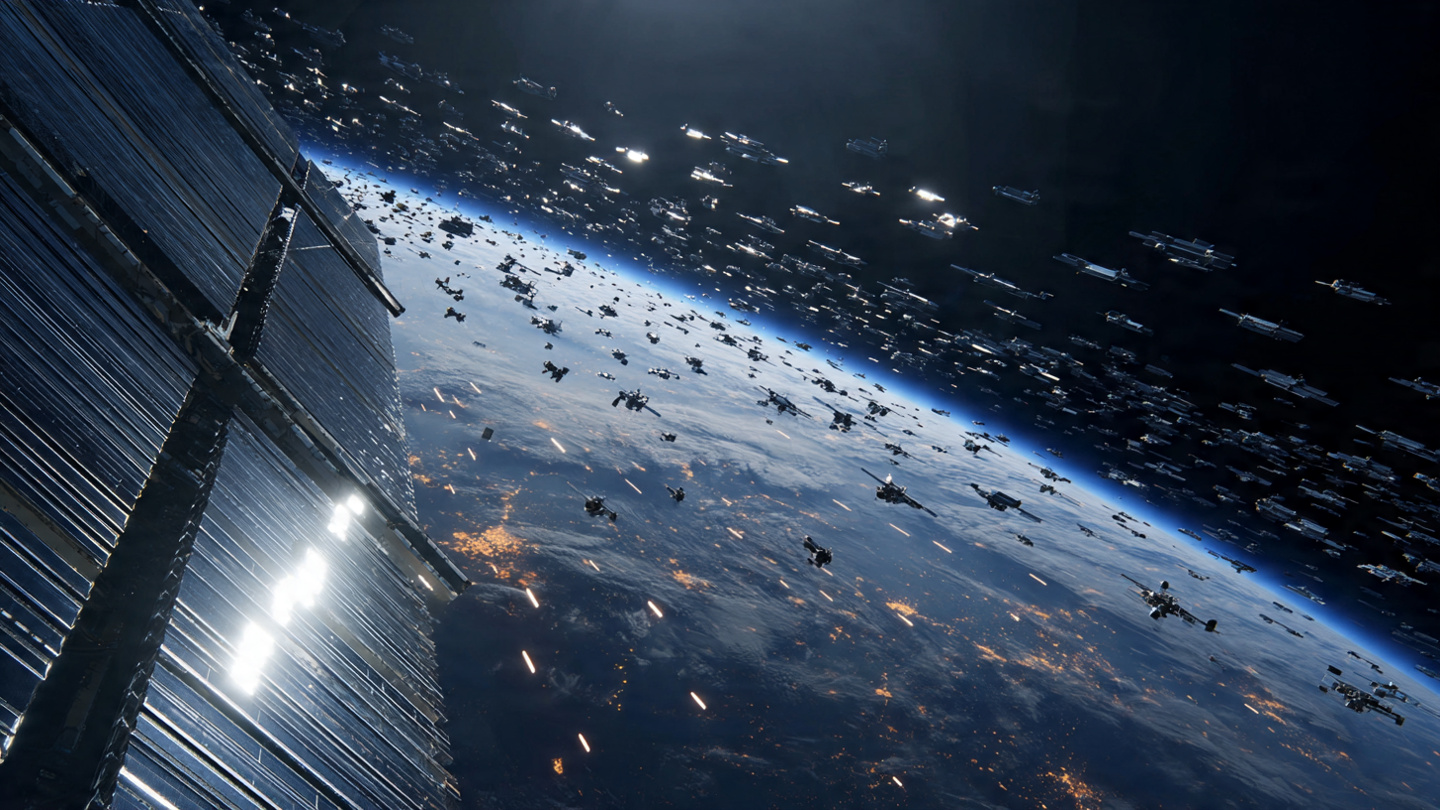
One point one million. That is the combined satellite count that five companies requested permission to launch between January 31 and March 21, 2026, all for the same purpose: running AI workloads from orbit. Each filing treats the others as background noise. None of the applications submitted to the Federal Communications Commission accounts for the aggregate orbital population that would result if even two of them succeed.
Today there are roughly 16,000 active satellites circling Earth, more than half operated by SpaceX's Starlink broadband network. These five proposals, taken together, would multiply the orbital population by 72 times.
The Filings
SpaceX moved first. On January 31, the company submitted an FCC application for up to one million satellites dedicated to orbital data centers. Its filing argued that "the compute required to train and operate the next generation of AI systems is outpacing what terrestrial power, land, and cooling can deliver on the timelines that matter." Each satellite, which SpaceX calls the AI Sat Mini, would generate 100 kilowatts of power for onboard AI processors, carry a radiator panel spanning roughly 100 square meters to shed waste heat, and stretch more than 170 meters in length. Future versions could reach one megawatt per unit.
Blue Origin followed seven weeks later. On March 19, Jeff Bezos's space company filed for Project Sunrise, requesting authorization for 51,600 satellites in sun-synchronous orbits between 500 and 1,800 kilometers altitude. Blue Origin's filing described free-space optical inter-satellite links through a partnership with TeraWave and projected that "space-based data centers can dramatically reduce the per-unit cost of compute for machine learning workloads." NASA objected to the filing in May, citing safety risks and debris concerns.
Between those two, Starcloud, a Y Combinator-backed startup, had already put hardware in orbit. Starcloud launched its first satellite carrying an NVIDIA H100 GPU in November 2025 and claims it was the first to train an AI model in space. In March 2026, Starcloud raised $170 million at a $1.1 billion valuation, becoming the fastest YC company to reach unicorn status. Its roadmap calls for up to 88,000 satellites, including a three-ton Starcloud-3 spacecraft generating 200 kilowatts.
Google, it turns out, started earlier and said less. Project Suncatcher, first described in a November 2025 preprint, proposes 81-satellite clusters flying in tight formation at 650 kilometers altitude, each carrying Google's Trillium v6e tensor processing units. Bloomberg reported on May 12 that Google is now in talks with SpaceX about using Starship to launch the clusters, signaling a shift from paper architecture to procurement.
Orbital Inc. rounds out the field with plans for 10,000 small satellites, each generating 100 kilowatts through solar arrays, with a test launch planned for 2027. IEEE Spectrum reported on the company's exit from stealth on May 10.
| Company | Filing Date | Satellites Requested | Power Per Unit | Status |
|---|---|---|---|---|
| SpaceX | Jan 31, 2026 | 1,000,000 | 100 kW (AI Sat Mini) | FCC review; pre-IPO doubts |
| Starcloud | Operating | 88,000 | 200 kW (Starcloud-3) | $1.1B valuation; H100 in orbit |
| Blue Origin | Mar 19, 2026 | 51,600 | Not disclosed | FCC review; NASA objection |
| Orbital Inc. | Announced | 10,000 | 100 kW | 2027 test launch |
| Nov 2025 preprint | 81 (initial cluster) | TPU-class, TBD | SpaceX launch talks | |
| Total | 1,149,681 |
The Power Math
The appeal is straightforward, and it rests on physics that cannot be argued with. A satellite in a dawn-dusk sun-synchronous orbit at 650 kilometers receives roughly eight times more solar energy per square meter than a ground-level panel, because there is no atmosphere to scatter photons, no night cycle to interrupt collection, and no weather to block the sun. Google's Suncatcher preprint lays out the calculation explicitly.
Now apply SpaceX's own numbers. One million AI Sat Mini units at 100 kilowatts each produce 100 gigawatts of orbital compute power. For comparison, the International Energy Agency estimated that global data center electricity consumption reached approximately 50 to 60 gigawatts in 2025. SpaceX's proposal alone would generate nearly twice the power currently consumed by every data center on Earth, combined, from solar panels that never see a cloud.
Add Blue Origin's constellation, Starcloud's fleet, and Orbital Inc.'s cluster, and the figure climbs further still, though none of these companies have disclosed precise per-satellite power specifications to allow exact summation beyond SpaceX and Orbital Inc.'s 100 kW baseline.
The Launch Cost Wall
Here is where the physics stops being helpful and the economics start being brutal. SpaceX's AI Sat Mini stretches over 170 meters long. Elon Musk has not disclosed exact mass, but scaling against known spacecraft of comparable dimensions and power output suggests each unit weighs in the range of five to ten metric tons, conservatively. At ten tons each, one million satellites totals ten billion kilograms that must reach low Earth orbit.
Starship's aspirational cost target is $200 per kilogram to LEO. That number has never been demonstrated at scale. At that price, launching SpaceX's constellation alone would cost $2 trillion, just in fuel, vehicles, and pad operations, before a single chip is fabricated, a single radiator is assembled, or a single line of code runs in orbit.
At current Falcon 9 launch costs of roughly $1,500 per kilogram, the figure balloons to $15 trillion. Google's own Suncatcher viability analysis, published in the November 2025 preprint, identifies a "5-to-10x gap" between current launch costs and the threshold that makes orbital compute competitive with terrestrial data centers. SpaceX's bet on Starship closing that gap is not a statement about orbital physics. It is a statement about manufacturing a reusable megarocket at automobile-scale production cadence.
The Atmosphere Nobody Models
Satellites do not last forever. Low Earth orbit imposes drag, radiation damage, and component degradation. A typical design life runs three to seven years before deorbit. Assume a five-year average lifespan for one million satellites. That means 200,000 controlled reentries per year, or roughly 548 per day, or one every two minutes and thirty-seven seconds, each vaporizing aluminum, lithium, copper, and exotic alloys into the upper atmosphere at hypersonic velocity.
Eloise Marais, professor of atmospheric chemistry at University College London, has studied satellite reentry pollution. "It's daunting because we're doing this sort of experiment with the atmosphere when we don't really know what the result will be," she told the CBC. Current reentry rates sit at a few hundred per year globally, concentrated in small, lightweight broadband satellites. One reentry every 157 seconds, from multi-ton compute platforms, is a qualitatively different regime that no atmospheric model has validated.
Aaron Boley, co-director of the Outer Space Institute at the University of British Columbia, sees the orbital environment itself changing irreversibly. "We saw this transition from thousands of satellites to 10,000 satellites largely done through SpaceX," he told the same report. "And we were very worried about maintaining a healthy orbital environment with that. This just blows right past that."
The Collision Arithmetic
John Barentine, an astronomer and dark-sky consultant, ran simulations on SpaceX's million-satellite proposal. His models suggest tens of thousands of satellites bright enough to see without binoculars at any given moment, including at midnight, because sun-synchronous orbits keep the spacecraft illuminated even when ground observers are in darkness.
Collision math compounds the problem in ways that individual FCC filings do not address. Current autonomous collision avoidance systems manage roughly 16,000 active objects plus tracked debris. SpaceX's own filing would multiply that number by more than 60 before accounting for any other constellation. Researchers who have modeled orbital density at these scales estimate that collision probability per satellite could exceed 50 encounters over a mission lifetime, creating conditions one orbital mechanics specialist described as a "kinetic minefield" where autonomous avoidance maneuvers begin to interfere with each other.
Lena Okafor of this publication reported in April that current LEO debris trajectories already place the orbital environment within 2.8 days of a potential chain-reaction collision cascade. Adding a million large, power-generating satellites with massive radiator arrays does not improve that timeline.
The Tell in the Fine Print
Perhaps the most revealing data point comes from SpaceX itself. In April 2026 pre-IPO filings reviewed by Reuters, the company warned investors that its orbital AI compute efforts "involve significant technical complexity and unproven technologies, and may not achieve commercial viability." SpaceX President Gwynne Shotwell told Time magazine, "I don't know that we'll get to a million, but it's much easier to ask at the beginning and then march towards the goal."
That is a standard regulatory tactic: file for the maximum, negotiate down, and build what the economics actually support. SpaceX did the same thing with Starlink, originally requesting 42,000 satellites and operating about 10,000. The question is what "negotiating down" means when the combined filings of five companies already request 72 times the current orbital population, and each company treats its own application as if the others do not exist.
Demand is real enough. Anthropic, which makes the Claude AI, signed a deal on May 6 to purchase all capacity at SpaceX's terrestrial Colossus 1 data center, more than 300 megawatts, and separately "expressed interest in partnering with SpaceX to develop multiple gigawatts of orbital AI compute capacity." CEO Dario Amodei said Anthropic's growth in Q1 2026 ran at an annualized rate of 80 times the prior year's levels, outstripping even its own exponential projections.
ARK Invest's Cathie Wood has projected that SpaceX's orbital data center business could generate $160 billion in annual revenue, potentially surpassing Starlink. Its valuation ahead of its anticipated IPO sits at $1.75 trillion.
The Strongest Case For
SpaceX operates 10,000-plus satellites today and has launched more mass to orbit than any organization in history. It manufactures its own rockets, is building its own chip fabrication plant (Terafab, targeting one terawatt of specialized processors per year, which would represent 50 times current global output for advanced chips), and has a radiation-hardened D3 chip designed to run hotter than any ground-based processor. If orbital compute is going to work, SpaceX has the most plausible path to making it work, because no other entity controls the full vertical stack from silicon to launch vehicle to satellite bus to ground station.
Google's Suncatcher data adds technical credibility that concept slides cannot. Bench tests of 1.6 terabits per second bidirectional throughput over free-space optical links demonstrate that inter-satellite bandwidth is not the bottleneck. Radiation testing of Trillium v6e TPUs showed that high-bandwidth memory subsystems survived three times the expected five-year mission dose before irregularities appeared, with no hard failures at 15 kilorads on a single chip. Two prototype satellites are scheduled to launch with Planet Labs by early 2027. This is not vaporware.
And the terrestrial constraints are genuine. Data centers consumed 29 million gallons of water in a single Georgia facility during a drought, with no fine. Grid capacity in Northern Virginia, the world's densest data center corridor, is allocated through 2030. NIMBY opposition has delayed or killed data center projects across Ireland, the Netherlands, and Singapore. That argument, that we are running out of good places on Earth to put AI hardware, is not theoretical. It is playing out in zoning hearings, water board meetings, and utility rate cases right now.
What This Analysis Did Not Prove
The mass estimate for SpaceX's AI Sat Mini (five to ten metric tons) is inferred from the disclosed 170-meter length and 100-kilowatt power specification, scaled against comparable spacecraft. SpaceX has not published an official mass figure. If the actual mass is significantly lower, the launch cost calculations above overshoot, though Starship's $200-per-kilogram target remains undemonstrated regardless.
Blue Origin and Starcloud have not disclosed per-satellite power or compute specifications in enough detail to calculate aggregate orbital power with precision. That 1,149,681 total is a satellite count, not a power or compute equivalence.
Google's 1.6 Tbps optical link has been bench-tested in a laboratory, not in the vibration, thermal cycling, and radiation environment of actual orbit. The Planet Labs mission in 2027 will be the first real validation.
Atmospheric models for reentry pollution at this scale do not exist. Current models are calibrated against hundreds of reentries per year, not hundreds of thousands. The environmental impact of one satellite burning up every 157 seconds is genuinely unknown, and scientists studying the problem say so openly.
Finally, FCC filings are applications, not binding commitments. The aggregate total represents a ceiling, not a forecast. Gwynne Shotwell's candid admission that a million satellites may never fly is probably the most honest data point in this entire story.
What You Can Do
If you work in space policy, orbital mechanics, or atmospheric science, the single most useful action right now is to submit technical comments to the FCC dockets for SpaceX's orbital data center application and Blue Origin's Project Sunrise before the comment periods close. More than 1,000 public comments have been filed so far, most opposing the proposals, but the agency's engineers need quantitative analysis of aggregate collision risk, aggregate atmospheric metal deposition, and aggregate electromagnetic interference across all five proposed constellations simultaneously, not just one at a time.
If you are an investor evaluating orbital compute claims, ask one question: what is the demonstrated cost per GPU-hour in orbit versus the terrestrial equivalent? Starcloud is the only company that has actually run an AI workload in space. Nobody has published a cost comparison. Until that number exists, every revenue projection, including ARK's $160 billion estimate, is a physics argument dressed up as a financial model.
If you are an AI company evaluating compute capacity, the terrestrial bottleneck that makes orbital sound attractive is real, but the timeline matters enormously. Google's own viability table shows that launch costs need to drop 5 to 10 times before orbital compute becomes competitive. SpaceX's Starship is the vehicle that could close that gap, but Starship has not yet demonstrated routine cargo delivery at the cadence these constellations require. Anthropic's deal with SpaceX is smart hedging: buy terrestrial capacity now, option the orbital future, and see which constraint breaks first.
The Bottom Line
Five companies looked at the same problem, the fact that Earth is running out of good places to put AI hardware, and arrived at the same answer within 90 days of each other: put it in space. The physics of orbital solar power are sound. The engineering of radiation-hardened chips and terabit optical links is progressing faster than most analysts expected. Google has bench data. Starcloud has flight data. SpaceX has the rockets. But nobody has added up what happens when you try to multiply the orbital population by 72 in a decade while vaporizing hundreds of multi-ton satellites into the upper atmosphere every day and trusting autonomous collision avoidance systems that have never operated at one percent of the proposed density. The FCC is reviewing these applications one at a time, each company treating its own constellation as if the sky is empty. It is not.