A Data Center Drained 29 Million Gallons During a Drought. The Fine Was Zero.
A Blackstone-owned data center in Fayetteville, Georgia consumed 29 million gallons of water over 15 months without a single bill, while the county told residents to stop watering their lawns. The company eventually paid $147,474 and was never fined, even as residents faced conservation orders during a declared state drought emergency. Nationally, North American data centers consumed 264 billion gallons in 2025, and no federal or state framework requires facility-level water disclosure.
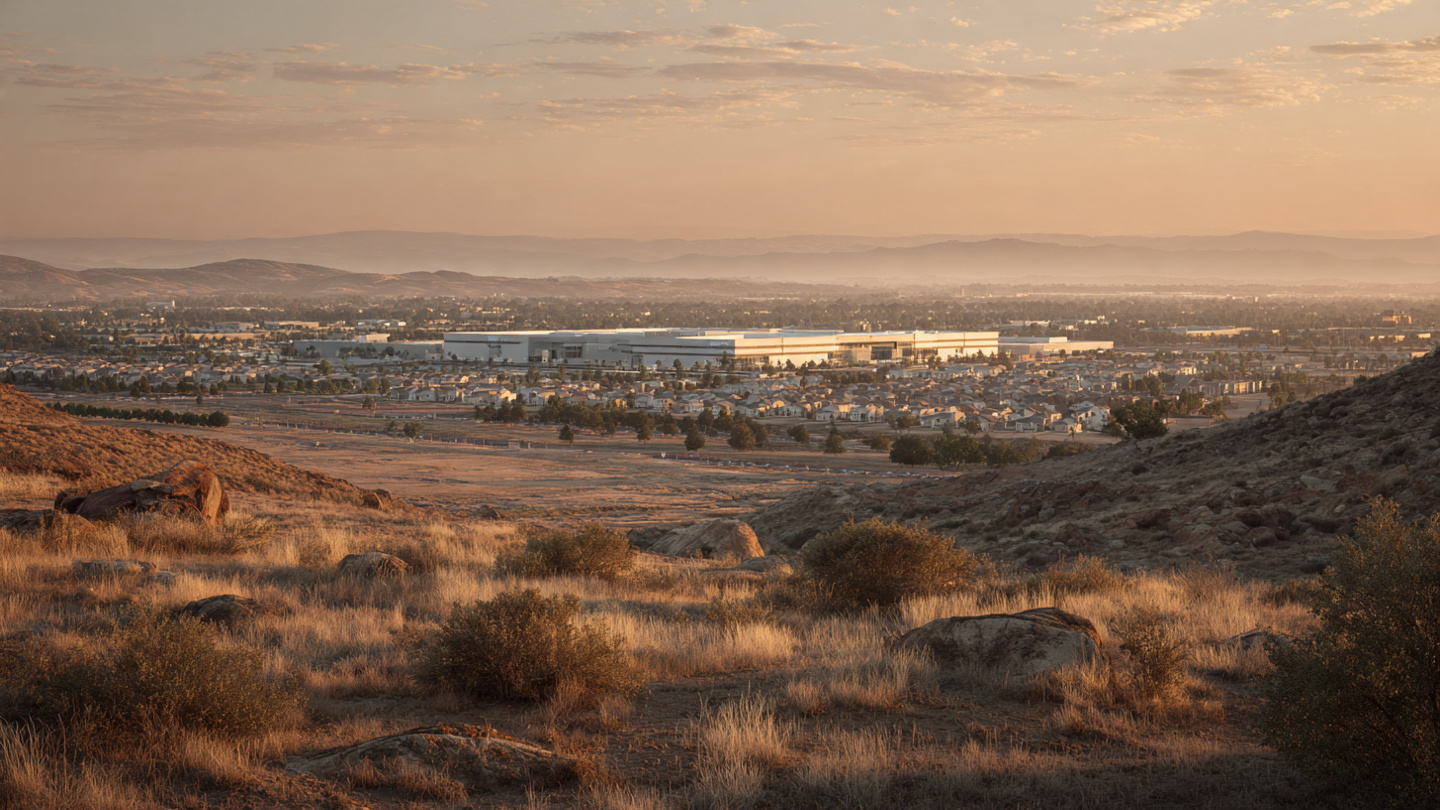
Twenty-nine million gallons. That is how much water Quality Technology Services, a data center developer owned by the private equity firm Blackstone, consumed at its 615-acre campus in Fayetteville, Georgia between early 2024 and May 2025 without paying a cent or even appearing on the county water system's billing records, according to a Politico investigation published May 8 based on county documents obtained through a public records request.
Twenty-nine million gallons is 44 Olympic swimming pools. It is enough to supply 265 average American households for a full year, based on the U.S. Geological Survey's estimate of 300 gallons per household per day. All of it drained through two industrial-scale water hookups that county utility workers either did not know existed or forgot to connect to an active account while transitioning to a cloud-based metering system that, by Tigert's own admission, was not functioning correctly during the period in question.
Nobody noticed until the showers went cold, because the county's metering system, the utility's inspection staff, and the billing department all failed simultaneously.
How Residents Found Out
In 2025, homeowners in Annelise Park, an upscale subdivision near the QTS campus roughly 20 miles south of Atlanta, began complaining to the Fayette County Water System about dropping water pressure. County utility officials investigated and traced the problem to two unmetered high-capacity connections at the data center, one of which had been installed without the utility's knowledge. On May 15, 2025, the county sent QTS a letter stating the company owed $147,474 for the 29 million gallons it had consumed.
That letter sat in county files for a year. James Clifton, a local attorney now running for county commissioner, obtained it through a public records request and posted it to a neighborhood Facebook group in early May 2026. Fury was immediate. Justifiably so. Residents had spent the same period under conservation orders from the county during a statewide drought emergency declared by Governor Brian Kemp amid some of the worst wildfires Georgia has experienced in years, and they had complied with those restrictions while a Blackstone subsidiary drank 44 Olympic pools' worth of water off the books.
"We get this notification from Fayette County water system saying you need to stop watering your lawns to help conserve water," Clifton told Politico. "And the first thing they do is lean on the individuals and the citizens to stop water consumption, when we have QTS that's just absolutely draining us."
The Math Nobody Ran
QTS paid the $147,474 retroactive bill without any fines, penalties, or surcharges for violating peak-usage restrictions during a drought. That works out to $0.00509 per gallon, roughly the same residential rate that any Fayette County homeowner pays for ordinary household consumption.
Georgia drought regulations authorize water utilities to impose escalating surcharges on customers who exceed conservation limits during declared emergencies. Residential customers in Georgia districts with tiered drought pricing typically face surcharges of two to four times the base rate for excessive consumption. If the county had applied the same drought-penalty structure to QTS that residential customers face, the bill would have landed between $295,000 and $590,000.
Fayette County did not apply it, and nobody in county government appears to have considered doing so, even after the scale of the unauthorized consumption became public. Vanessa Tigert, the director of the Fayette County Water System, explained her reasoning to Politico with a sentence that has since become the most-quoted line of the entire controversy: "They're our largest customer and we have to be partners. It's called customer service."
Gregory Pierce, director of UCLA's Water Resources Group, offered a blunter assessment. "I don't know exactly what's happening here," he said, "but they probably don't want to upset one of their new and largest customers."
Construction Water or Operational Water?
QTS attributed the 29 million gallons to temporary construction activities: pouring concrete, controlling dust, and preparing the site for what will eventually be a 6.2-million-square-foot data center campus, one of the largest in America. A company spokesperson told Politico that the facility's "closed loop" cooling system, once fully operational, will consume water equivalent to only four U.S. households per month for domestic needs like bathrooms and kitchens.
That claim deserves scrutiny, and the numbers available from the broader industry suggest it is optimistic at best. Data centers that use evaporative cooling consume roughly 25 million liters (6.6 million gallons) of water per megawatt of capacity per year, according to a 2026 global data center water report. If the QTS campus reaches its planned capacity, even a closed-loop system with supplemental evaporative towers during peak heat would use significantly more than four households' worth, and Georgia summers are long and brutal. QTS has not disclosed the facility's planned power capacity, and the county did not require it as a condition of the water hookup.
Meanwhile, Clifton posted on social media that the data center had been watering its landscaping "nearly continuously" for four consecutive days, which is not concrete work and not dust suppression. Whether the county's single overextended inspector has time to verify QTS's claims about what is construction-phase and what is operational is an open question. Tigert acknowledged her staff limitations to Politico: "I've got one person that's doing inspections and plan review, so he's spread pretty thin."
Georgia's 200 Data Centers and the Water They Don't Report
Georgia hosts more than 200 data center facilities, attracted by cheap electricity, generous tax incentives, and a regulatory environment that does not require facility-level water consumption disclosure. Meta's data center in Newton County consumes 10 percent of the entire county's daily water supply, according to Politico's reporting. QTS's campus is far larger than Meta's Newton County facility.
Nationally, the numbers are staggering. North American data centers consumed nearly 1 trillion liters of water in 2025, approximately 264 billion gallons, according to data cited in shareholder resolutions filed by Trillium Asset Management and other investors against Amazon, Microsoft, and Google. Meta's global water consumption rose 51 percent between 2020 and 2025. By 2030, hyperscale data centers alone are projected to consume 150.4 billion gallons annually, the equivalent of 4.6 million American households, with water-related expenditures exceeding $4.1 billion, according to industry forecasts from Datacentre Solutions.
A peer-reviewed study in AGU's Earth's Future journal found that no standardized framework for facility-level data center water reporting exists in any U.S. jurisdiction. Companies voluntarily disclose aggregate global water figures in annual sustainability reports, but those figures are not auditable, not comparable across companies, and not broken down by facility. In Fayette County, the QTS incident was discovered not by any regulatory mechanism but by a private citizen filing a public records request after his shower lost pressure.
The Electricity Bill You're Already Paying
Water is only half the collision. Residential electricity prices across the United States rose 7.1 percent during the past year, more than double the rate of general inflation, according to Consumer Reports. In some states the increase topped 20 percent. Areas with high concentrations of data centers saw electricity prices spike 267 percent over the past five years.
A January 2026 report by Bloom Energy projects that total U.S. data center power demand will nearly double from 80 gigawatts to 150 gigawatts between 2025 and 2028. That is the energy equivalent of adding Spain to the American power grid. In three years. According to the Electric Power Research Institute, data centers will consume 9 to 17 percent of total U.S. electricity by 2030, with Virginia and seven other states likely to exceed a 20 percent share. PJM Interconnection, the largest power grid operator in the country, saw its 2026/2027 capacity auction prices rise 22 percent, driven overwhelmingly by data center demand.
Fayetteville's city council, after the QTS scandal, banned new data center construction entirely. It is one of several municipalities across the country now imposing moratoriums. The backlash is accelerating, and the political arithmetic has changed permanently in places where residents now understand exactly how much water their taxes subsidized.
Strongest Counterargument
Microsoft announced in April 2026 that its next-generation data centers will consume zero water for cooling, using direct-to-chip liquid cooling in closed-loop systems that eliminate evaporative towers entirely. Microsoft claims these designs reduce annual water consumption by more than 125 million liters per facility. If the entire industry follows this path, the water problem becomes a transitional issue rather than a structural one, and municipalities that ban data centers now may forfeit the tax revenue and jobs that a cleaner generation of facilities would bring.
Fair enough, and it matters. Closed-loop cooling is real engineering, not a press release promise, and companies that adopt it will genuinely use less water. But "next-generation" means new construction, and Georgia's 200-plus data centers already operating, the facilities Meta is running in Newton County at 10 percent of daily water supply, and the campus QTS is building in Fayetteville are not next-generation. They are this generation, they are operating now, and they are operating without disclosure requirements, without metering reliability, and without penalty structures that treat industrial drought violations the same way they treat residential ones. Microsoft's announcement is a roadmap for 2028. Fayette County's problem is 2026. And it is not alone.
What This Analysis Did Not Prove
The $295,000-to-$590,000 penalty estimate uses residential drought surcharge structures as the baseline. Georgia does not publish a standardized industrial drought penalty schedule, and it is possible that no county in the state has ever applied drought surcharges to an industrial water customer at this scale. Our estimate illustrates the regulatory asymmetry rather than a specific legal liability. QTS may be technically correct that its construction-phase water use is not covered by drought restrictions designed for irrigation and residential consumption, which would make the absence of fines legally defensible even if it is politically indefensible. That 29 million gallons figure comes from the county's own letter to QTS; independent verification through meter data is not possible because the meters were not functioning during the relevant period. Finally, QTS's claim that its operational facility will use water equivalent to four households per month has not been tested against operational data because the facility is not yet fully operational.
What You Can Do
If you live near a data center or in a county considering one, file a public records request for the facility's water connection permits, metering records, and monthly consumption data. Fayette County's scandal was exposed entirely because one resident asked for a document that was already sitting in county files. Most utilities are required to produce these records within days, and the effort is minimal compared to the leverage it creates.
If you sit on a municipal council or county commission weighing data center tax incentives, require facility-level water and electricity metering with public quarterly disclosure as a condition of approval. No disclosure, no permit, no exceptions, no grandfathering. Smart meters that report in real time cost less than the property tax abatements most jurisdictions hand out to attract these facilities in the first place.
If you are an investor in data center operators or their parent companies, support the shareholder resolutions that Trillium Asset Management and over a dozen institutional investors have filed at Amazon, Microsoft, and Google demanding standardized water and power reporting. Today's disclosure regime lets a company claim "water positive" in a glossy sustainability report while its subsidiary drains 29 million gallons from a drought-stricken county without anyone noticing, and the gap between the claim and the reality is precisely the size of a public records request that nobody filed until it was far too late.
Vanessa Tigert called it customer service. A more precise term is regulatory capture at the municipal level: the point in the system where a single industrial customer generates so much tax revenue that the local utility cannot afford to treat it like any other customer, even when that customer violates the same drought restrictions that every homeowner on the same water main is expected to obey without question or exception.
The Bottom Line
Fayette County is not unique. It is merely the first one where a resident with a lawyer's instinct for public records pulled the thread hard enough to break the story open. North American data centers consumed 264 billion gallons of water last year, and the uncomfortable question hanging over every county water system in America is how many of those gallons were metered, how many were billed, and how many vanished the way QTS's 29 million gallons vanished: silently, invisibly, and at the residential rate.