Low Earth Orbit Is 2.8 Days From a Chain-Reaction Collision. In 2018, It Was 121.
A team of astrophysicists built a clock that counts down to orbital catastrophe. The clock has lost 97.7 percent of its margin in seven years. SpaceX performed 149,000 collision avoidance maneuvers in 2025 alone, up 50 percent from the year before. Russia flew two military satellites within three meters of each other in April. And the sun does not read memos about orbital traffic management.
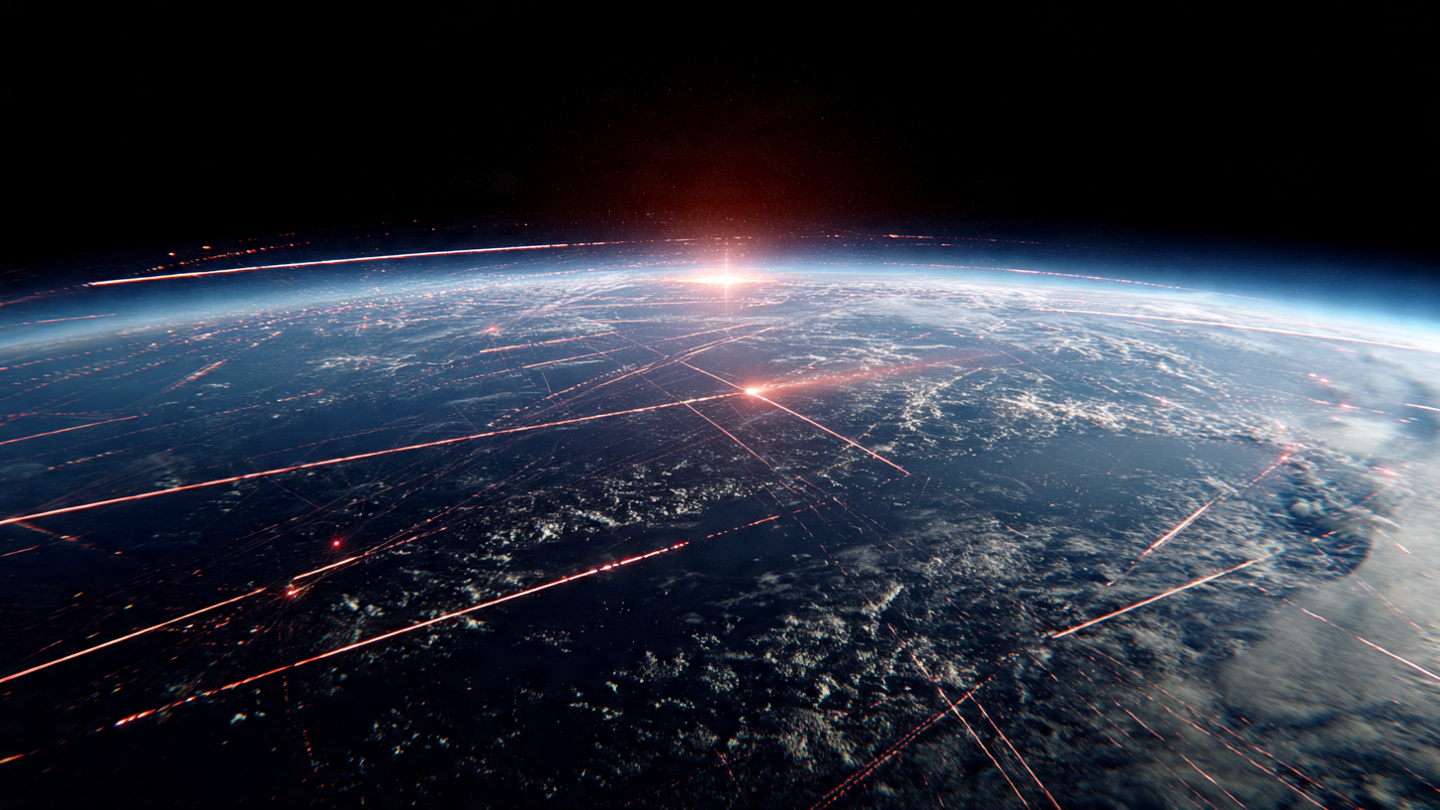
Once every 22 seconds, two satellites in low Earth orbit pass within one kilometer of each other. That is not a projection. That is the measured rate, right now, across the full constellation of objects circling the planet between 200 and 2,000 kilometers up. For SpaceX's Starlink network alone, a close approach happens every 11 minutes. Survival depends on every satellite with functioning thrusters receiving commands to dodge, and the dodging never stops, and the commands keep arriving, and the tracking data stays accurate, and the atmosphere behaves within predicted bounds. Five dependencies. Remove any one of those conditions for long enough and the system does not degrade gracefully. It breaks.
How long is "long enough"? A paper by Sarah Thiele and colleagues, released as a preprint in December 2025 and updated in January 2026, attempted to answer that question with a new metric called the CRASH Clock, short for Collision Realization and Significant Harm. It calculates how many days would pass before a catastrophic collision if every satellite operator simultaneously lost the ability to command avoidance maneuvers. In 2018, before the megaconstellation era reshaped the orbital environment, the CRASH Clock read 121 days; by June 2025, it had plunged to 2.8.
That is a 43-fold reduction. Seven years.
The Dodging Never Stops
SpaceX disclosed that its Starlink satellites performed approximately 149,000 collision avoidance maneuvers in 2025, representing a 50 percent increase over 2024's roughly 100,000 and a staggering escalation from the 25,000 total maneuvers recorded across 2022 and 2023 combined. The company projects reaching one million maneuvers annually by 2027. At that rate, SpaceX would be executing roughly one avoidance maneuver every 31 seconds, around the clock, 365 days a year.
Each maneuver consumes xenon propellant from the satellite's Hall-effect thrusters. Starlink satellites carry a fixed fuel supply, and no tanker truck visits them in orbit. More dodging means shorter operational lifespans, which means more replacement satellites launched sooner, which means more objects in orbit, which means more close approaches, which means more dodging. None of this is theoretical. The maneuver count already traces an exponential curve: 12,500 per year in 2022, 100,000 in 2024, 149,000 in 2025, and one million projected for 2027. Plot those points. The doubling time is roughly 14 months.
SpaceX deserves credit for setting a collision avoidance threshold far more conservative than the industry norm, a degree of operational caution that its competitors have been slow to match and that no regulatory body has yet codified as a mandatory standard for LEO constellation operators. The company initiates avoidance maneuvers at a collision probability of 3 in 10 million, while most operators wait until the odds reach 1 in 10,000, a threshold 33 times more relaxed. This conservatism inflates the maneuver count but meaningfully reduces actual collision risk under normal operating conditions. But "normal operating conditions" is a phrase that presupposes continuous, uninterrupted command authority over every satellite in the constellation, and solar storms do not care about your command authority.
What a Solar Storm Actually Does
Solar storms are not a vague, hand-wavy risk. They attack the orbital management system through two specific mechanisms that Thiele and her co-authors document in detail.
First, a storm heats the upper atmosphere. Heated air expands, increasing atmospheric drag on satellites at typical Starlink altitudes. Higher drag alters orbital trajectories in ways that diverge from predictions, widening the uncertainty envelopes around every satellite's projected path. Wider uncertainty means more potential conjunctions, which means more maneuvers needed at precisely the moment when trajectory predictions are least reliable.
Second, and more dangerous: a strong enough storm can disable the satellite's own navigation and communication systems. If the ground cannot talk to the satellite, the satellite cannot dodge. If the satellite cannot determine its own position, autonomous collision avoidance fails too. A single-point failure in the command chain converts every satellite in the constellation from an actively managed asset into an unguided projectile traveling at 7.8 kilometers per second, which is fast enough to cross the entire width of Manhattan in one second flat and would release the kinetic energy of a small bomb on impact with any object in its path.
During the Gannon Storm of May 2024, the strongest geomagnetic storm in two decades, more than half of all satellites in low Earth orbit had to expend fuel on repositioning maneuvers, according to the Thiele paper. It lasted roughly 48 hours, and while drag-induced orbital uncertainty spiked dramatically across every constellation in low Earth orbit, command links held, satellites dodged, and the system survived by a margin too thin for anyone to celebrate.
The Arithmetic of Catastrophe
Thiele's team ran the numbers. Given a scenario where satellite operators lose command for 24 hours during a major solar storm, the probability of at least one catastrophic collision is approximately 30 percent. That single collision would not end the world. What it would do is scatter thousands of debris fragments across orbital altitudes, each one an uncontrollable projectile that cannot dodge anything. Those fragments would trigger further collisions with other satellites and other debris, producing more fragments, in a cascade known as Kessler Syndrome, named after the NASA scientist who first described it in 1978.
Kessler Syndrome does not play out in hours. It unfolds over years and decades, gradually rendering entire orbital altitude bands unusable as each collision generates thousands of fragments that trigger further collisions in a self-sustaining chain reaction no currently available cleanup technology can reverse or even significantly slow. Debris does not clear quickly because there is no friction to slow it down significantly in the higher reaches of low Earth orbit. SpaceX has announced plans to lower 4,400 Starlink satellites from their current 550-kilometer orbits down to 480 kilometers, a reduction that would cut ballistic decay time by roughly 80 percent and ensure that failed satellites and debris fragments deorbit substantially faster during solar maximum periods when atmospheric drag is elevated. That is a meaningful engineering response, and it addresses the deorbiting timeline for Starlink's own failed satellites. It does not address the CRASH Clock arithmetic, because the CRASH Clock measures the aggregate behavior of all objects in LEO, not just one company's constellation.
Here is the trajectory that should concern anyone who depends on GPS, weather forecasting, financial transaction timing, military communications, precision agriculture, or aviation. Between 2018 and June 2025, the CRASH Clock fell from 121 days to 2.8 days. If we fit an exponential decay to those two data points, the halving time is approximately 13 months. At that rate, the CRASH Clock would pass below one day sometime in mid-2026 and reach 12 hours by early 2027. Those projections assume no corrective action and a constant rate of new satellite deployment, neither of which is guaranteed. But the corrective actions being taken, like SpaceX's orbit-lowering program, are incremental engineering improvements competing against an exponential growth curve in orbital congestion.
Russia Tested the Margins
On April 28, 2026, Russian military satellites COSMOS 2581 and COSMOS 2583 passed within three meters of each other in low Earth orbit. Three meters. At orbital velocity, that separation translates to roughly 0.4 milliseconds of timing difference between a successful maneuver and a collision that would have scattered debris across orbital paths for decades. This was not an accident. Tracking analysts identified the event as part of a coordinated inspection campaign, where one satellite deliberately approaches another to observe it up close. Russia, the United States, and China all conduct such operations.
What the COSMOS close pass illustrates is a dimension of orbital risk that the CRASH Clock does not capture: intentional close approaches by military operators who are not obligated to share tracking data with civilian conjunction assessment services. Run by the United States Space Force's 18th Space Defense Squadron, the civilian Space Surveillance Network tracks roughly 45,000 objects in orbit. It cannot track what it cannot see, and it cannot predict maneuvers it is not informed about. A deliberate close pass like the COSMOS event, conducted without prior notification to civilian operators, introduces collision risk that no amount of automated avoidance maneuvering can mitigate because the automated systems rely entirely on tracking data that does not account for unreported military maneuvers, classified orbital changes, or inspection campaigns whose trajectories are withheld from the public conjunction database.
What the Carrington Event Would Do
The strongest solar storm in recorded history hit Earth on September 1, 1859. Named after the British astronomer who observed the solar flare that preceded it, the Carrington Event induced geomagnetically driven currents so powerful they set telegraph offices on fire across North America and Europe and allowed operators to send messages with their battery power supplies physically disconnected, running on geomagnetically induced current alone. A 2013 study by Lloyd's of London and the Atmospheric and Environmental Research group estimated that a Carrington-class event today would cause $0.6 to $2.6 trillion in damage to the United States alone, primarily through multi-year disruption to electrical grid transformers.
That estimate preceded the megaconstellation era by nearly a decade, calculated before SpaceX, Amazon, China, and a half-dozen other operators began filing plans to deploy tens of thousands of additional satellites into the orbital bands most vulnerable to storm-driven drag increases. Overlay the CRASH Clock onto a Carrington-class scenario and the picture sharpens considerably. A storm of that magnitude would likely disable satellite command links for well over three days, and the CRASH Clock says catastrophic collision arrives in 2.8. In May 2024, the Gannon Storm was classified as G5, the highest category on the geomagnetic storm scale, but it lasted only about 48 hours and its peak intensity was a fraction of Carrington-class estimates. A true Carrington repeat would be both stronger and longer, exceeding the CRASH Clock margin by a comfortable factor.
Economic exposure extends far beyond the satellites themselves. Starlink's constellation represents roughly $10 to $15 billion in deployed hardware. Amazon's planned Kuiper constellation adds another $10 billion in committed investment. OneWeb, Telesat, and various government systems bring the total LEO commercial and military satellite infrastructure to somewhere between $30 and $50 billion. But the real exposure is downstream. A 2019 study commissioned by the National Institute of Standards and Technology estimated that GPS alone contributes $1.4 trillion per year to the U.S. economy through its role in financial transactions, transportation, agriculture, telecommunications, and emergency services. Kessler Syndrome would not merely destroy satellites; it would lock humanity out of low Earth orbit for decades, stranding GPS replenishment, weather satellite replacement, and any future crewed missions that need to transit through the debris field.
The Strongest Case That This Is Managed Risk
SpaceX and its defenders argue, with some justification, that the high maneuver counts are a feature, not a bug. SpaceX's 3-in-10-million collision probability threshold means it routinely dodges hazards that most operators, working under the standard 1-in-10,000 threshold, would dismiss as statistical noise and ignore entirely, and a substantial majority of those 149,000 maneuvers therefore represent extreme operational precaution against low-probability conjunctions rather than genuine near-misses. SpaceX's autonomous collision avoidance system processes conjunction data from the 18th Space Defense Squadron and commercial tracking providers, plans maneuvers without human-in-the-loop approval for routine threats, executes them faster than any human operator could, and has scaled from handling a few hundred conjunctions per day in 2022 to managing thousands without a single collision attributable to system failure. Lowering orbits to 480 kilometers further demonstrates engineering seriousness, cutting deorbit time so that failed satellites and debris clear the lane faster.
Beyond that, the CRASH Clock is a theoretical construct from a preprint paper that has not yet passed formal peer review in a journal. Its 2.8-day figure is based on conditions from June 2025 and assumes a complete, simultaneous loss of command authority across all operators, a scenario that no real solar storm has yet produced. Even the Gannon Storm, the strongest in two decades, did not cause total command loss. Operators adapted, satellites maneuvered, and the system held.
These are real points, and they are also the structural argument that every complex system's operators make right up until the edge case arrives. Wall Street's risk models held beautifully until 2008. Fukushima's seawall was adequate for every tsunami except the one that came. What separates "we have never lost total command" from "we cannot lose total command" is the gap between empirical observation and rigorous engineering proof across every conceivable failure mode including ones that have not yet occurred in the satellite era, and the CRASH Clock exists precisely to quantify what lives in that gap.
What This Analysis Did Not Prove
The CRASH Clock is not a prediction that a catastrophic collision will occur in 2.8 days. It is a stress-test metric that quantifies the margin between normal operations and catastrophe under a specific failure mode. Real-world solar storms produce partial command degradation, not total blackout, and operators have some ability to pre-position satellites into safer orbits when storm warnings arrive, though solar storm forecasting provides at best one to two days of advance notice.
Projecting the CRASH Clock exponentially to sub-one-day values by mid-2026 should be treated as directional, not deterministic. SpaceX's orbit-lowering initiative, improved tracking capabilities from the 18th Space Defense Squadron, and potential regulatory action by the FCC and international bodies could all bend the curve. What remains is whether those incremental improvements can outpace exponential growth in orbital congestion when SpaceX, Amazon, China's Thousand Sails program, and various government operators on three continents all plan to deploy thousands of additional satellites into the same crowded altitude bands over the next three to five years.
Value-at-risk figures, ranging from $30 to $50 billion in deployed hardware to the $1.4 trillion annual GPS contribution estimated by NIST, are order-of-magnitude estimates that combine sources with different methodologies, base years, and assumptions about the downstream economic impact of prolonged orbital denial. They indicate scale, not precision.
What You Can Do
If you work in space policy, the CRASH Clock paper should be required reading for anyone drafting orbital debris mitigation rules, and the metric itself should be incorporated into the regulatory frameworks that currently treat collision risk as a problem individual operators can solve in isolation. Today's regulatory framework, split across the FCC, FAA, NOAA, and the UN Committee on the Peaceful Uses of Outer Space, treats collision avoidance as an operator-by-operator responsibility. What the CRASH Clock demonstrates is that the system's fragility is an emergent property of the aggregate constellation environment, not any single operator's behavior, and no amount of individual-operator compliance can eliminate a risk that arises from the sheer density of objects sharing the same orbital altitude bands. Regulating individual operators while ignoring the system-level metric is like setting speed limits on individual cars without monitoring highway capacity.
If you manage satellites or invest in space ventures, factor the maneuver budget into lifetime economics. A satellite that needs 41 avoidance maneuvers per year in 2025 may need 100 or more by 2028 based on current trajectory. That is not a fuel cost footnote. It is a fleet replacement schedule accelerator that compounds across the entire business case. Ask your constellation operator what their CRASH Clock exposure is and watch whether you get a number or a deflection.
If you care about whether humans can continue to use low Earth orbit as the backbone of modern infrastructure, track two numbers: the CRASH Clock value and the annual maneuver count. If the Clock drops below one day and the maneuver count crosses one million per year, the system will have entered a regime where a single bad solar storm, of a severity that has demonstrably occurred before in human history, can trigger a debris cascade that no amount of engineering can reverse within a human generation. We are not there yet. We are close enough that the researchers who built the metric chose the phrase "house of cards" to describe it, and they are professional astrophysicists, not headline writers.
The Bottom Line
Fourteen thousand satellites orbit Earth in a dance choreographed by continuous ground commands, autonomous avoidance algorithms, and a tracking network that catalogs 45,000 objects. SpaceX alone dodged potential collisions 149,000 times last year, a number growing at roughly 50 percent annually, headed toward one million by 2027. It works because it never stops working. The CRASH Clock tells us what happens if it pauses: in 2018, the world had four months of margin. Today, it has less than three days. A solar storm strong enough to freeze the command links for three days, of a type that has occurred at least once in recorded history and that current space-weather forecasting technology can predict with at most 48 hours of useful advance warning, would push the system past the threshold within which catastrophic collision becomes more likely than not. The satellites that underpin $1.4 trillion in annual U.S. economic activity, plus weather forecasting, military intelligence, and every future crewed mission through low Earth orbit, would be operating in an environment where the house of cards has lost its table. Nobody is building a backup table. The card count keeps going up.