A $30 Million Robot Just Passed Its Final Exam to Save a $500 Million Telescope Falling From the Sky
NASA's Neil Gehrels Swift Observatory has been the planet's premier gamma-ray burst detector for 21 years. Solar Cycle 25 dragged its orbit from 600 kilometers to 400 kilometers, and the telescope now faces a 90 percent chance of uncontrolled atmospheric reentry by the end of 2026. A twelve-person startup in Flagstaff, Arizona, had eight months and $30 million to design, build, and test a robotic spacecraft that can grab a tumbling satellite with no docking port and push it back up. The robot, called LINK, just cleared its final environmental tests at NASA Goddard. It launches in June from a rocket dropped out of a plane over the Marshall Islands.
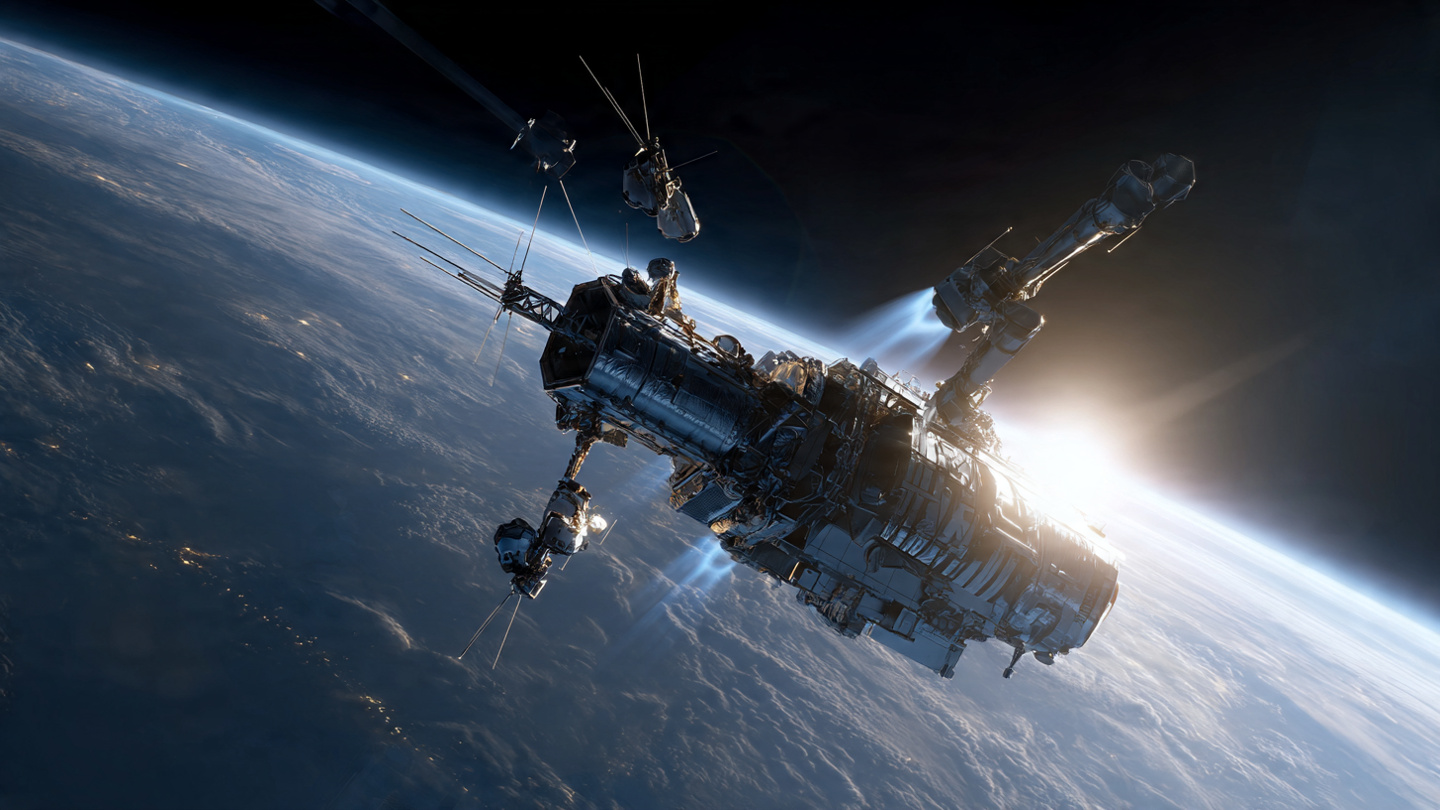
Ninety percent. That is the probability that the Neil Gehrels Swift Observatory, a $500 million space telescope that has been cataloging the most violent explosions in the known universe since November 2004, will fall back through Earth's atmosphere uncontrolled before the calendar turns to 2027. It has detected over 1,500 gamma-ray bursts, the cataclysmic flashes triggered when massive stars die and new black holes are born or when neutron stars collide. It has no propulsion system. It never needed one, because the original mission plan called for Swift to decay naturally when its science was done. Then the sun intervened.
Solar Cycle 25 peaked harder and earlier than forecasters predicted, pumping energy into the upper atmosphere and inflating it like a slow balloon. Swollen air dragged Swift from a comfortable 600-kilometer orbit down to roughly 400 kilometers, according to a NASA NESC study on orbital decay that modeled Swift's trajectory alongside the Hubble Space Telescope. Its descent is accelerating. By mid-2026, the odds of reentry cross 50 percent. By December, they hit 90 percent.
In September 2025, NASA awarded a $30 million contract to Katalyst Space Technologies to build and launch a spacecraft that could rendezvous with Swift, grab it, and push it to a higher orbit. Katalyst had less than eight months from award to launch. For context, NASA's James Webb Space Telescope took 25 years from concept to first light. NASA's Vera C. Rubin Observatory is in its fifteenth year of development. Katalyst's timeline represents a compression factor of roughly 15 to 38 times, depending on which comparator you choose.
Three Arms, No Docking Port
LINK is a compact robotic servicing spacecraft built at Katalyst's facility in Broomfield, Colorado, with the company's core engineering team based in Flagstaff, Arizona. It carries three xenon-powered ion thrusters for propulsion and three articulated robotic arms tipped with a custom grappling mechanism designed to latch onto a feature on Swift's body.
That last detail is the hard part. Swift was never designed to be serviced. It has no docking port. No grapple fixture. No cooperative reflectors for proximity guidance. Swift is a 1,470-kilogram cylinder tumbling through space at 7.6 kilometers per second with nothing on its exterior that says "grab here." Katalyst's engineers had to study Swift's structural drawings and identify a feature sturdy enough to bear the load of an orbital reboost without cracking the telescope's thermal blankets or warping its instrument bus.
"We're in an unusual situation where the schedule dictates how much risk we're willing to accept, rather than the other way around," Kieran Wilson, LINK's principal investigator at Katalyst, told NASA. "The clock is ticking on Swift's descent, so we have to find a balance between testing and problem solving that gives the mission the best chance of success."
On May 4, LINK completed its full slate of environmental testing at NASA's Goddard Space Flight Center in Greenbelt, Maryland. Engineers ran vibration tests to simulate the shaking of launch, then moved the spacecraft into Goddard's 27-foot-wide Space Environment Simulator for thermal vacuum testing: air pumped out, temperatures swung between space-like extremes while Katalyst fired all three ion thrusters and deployed one of the robotic arms inside the chamber. Goddard's own team tested Swift itself in the same facility before its 2004 launch, and the chamber is currently preparing the Nancy Grace Roman Space Telescope.
A Rocket Dropped From a Plane
The launch vehicle is a detail that belongs in a screenplay. Northrop Grumman's Pegasus XL is an air-launched rocket strapped to the belly of an L-1011 TriStar, a widebody jet originally built for commercial airlines in the 1970s. At 40,000 feet over the Pacific, the rocket drops from the aircraft, free-falls for five seconds, and then ignites its first stage. Launch is scheduled for late June 2026 from the Marshall Islands.
Pegasus was chosen for a reason that most ground-based rockets cannot solve. Swift orbits at a 20.6-degree inclination to the equator, a trajectory specifically designed to dodge the South Atlantic Anomaly, a weak spot in Earth's magnetic field that bathes satellites in higher radiation. Launching from Cape Canaveral (28.5 degrees latitude) or Vandenberg (34.7 degrees) would burn enormous amounts of propellant to plane-change into Swift's orbit, making those sites economically unworkable. An air-launched rocket can fly the carrier plane to any latitude before release, reaching orbital inclinations that ground pads cannot efficiently serve.
This will be Pegasus's first flight since a 2021 U.S. Space Force mission, a five-year gap. "Pegasus is the only system that can meet the orbit, timeline, and budget simultaneously," Katalyst stated when it selected the vehicle.
Numbers Nobody Ran
Here is the cost calculation that has not appeared in any of the coverage so far. Swift's $500 million price tag bought 21 years of continuous gamma-ray science, which works out to roughly $23.8 million per year of operations. If Katalyst's $30 million rescue succeeds and extends Swift's mission through 2030, that adds approximately four more years of data collection at $7.5 million per year, which is 3.2 times cheaper per year of science than the original mission.
A replacement telescope with comparable multi-wavelength capability would cost between $1 billion and $2 billion at 2026 prices, based on inflation adjustments to Swift's original budget and the cost growth observed in comparable NASA astrophysics missions. At the low end, that is 33 times more expensive than the rescue. At the high end, 67 times.
| Scenario | Cost | Science Years | Cost per Year |
|---|---|---|---|
| Swift original (2004-2025) | $500M | 21 | $23.8M |
| LINK rescue (2026-2030) | $30M | ~4 | $7.5M |
| Replacement mission (est.) | $1-2B | ~15-20 | $50-133M |
"This is a forward-leaning, risk-tolerant approach for NASA," said Shawn Domagal-Goldman, acting director of NASA's Astrophysics Division. "Attempting an orbit boost is both more affordable than replacing Swift's capabilities with a new mission, and beneficial to the nation, expanding the use of satellite servicing to a new and broader class of spacecraft."
The Bigger Market Behind One Telescope
Swift's rescue is one data point in a market that barely existed five years ago. On-orbit satellite servicing was valued at roughly $3.1 billion in 2025 and is projected to reach $9 billion to $12.6 billion by the early 2030s, growing at approximately 11 percent annually.
Most often cited as precedent is Northrop Grumman's Mission Extension Vehicle program. In 2020, MEV-1 docked with the Intelsat 901 communications satellite in geostationary orbit and extended its operational life by five years. Northrop has since expanded its life-extension contracts and is developing robotic servicing pods that can attach to satellites in orbit. But MEV-1 worked with a cooperative target: Intelsat 901 had a standard apogee kick motor nozzle that MEV was designed to interface with, and the satellite was in a stable geostationary orbit with no urgency.
LINK's mission is harder on every axis. Its target is non-cooperative, meaning it has no docking interface and was not built for servicing. Its orbit is low-Earth, which means atmospheric drag is an active threat during the approach and docking phase. Its timeline gave Katalyst months, not years. If it works, it establishes a new category of space capability: rapid-response, non-cooperative satellite servicing in LEO, where the majority of the world's operational satellites fly.
Strongest Case Against
A credible objection: $30 million spent extending a 22-year-old telescope equipped with 2000s-era detectors might yield less science per dollar than investing in next-generation instruments. China's Einstein Probe, launched in January 2024 by the Chinese Academy of Sciences and ESA, carries lobster-eye X-ray optics with a wider field of view than Swift's X-Ray Telescope. France and China's joint SVOM mission, launched in June 2024, was designed explicitly as a next-generation gamma-ray burst detector. Both are newer, both are operational, and both overlap with portions of Swift's science portfolio.
At the fleet level, though, redundancy does not work the way the objection assumes. In transient astrophysics, no two telescopes are redundant because every instrument brings a different energy range, field of view, slew speed, and orbital geometry. Swift remains the only mission that can pivot from a gamma-ray trigger to ultraviolet follow-up observations within 90 seconds, a capability that neither Einstein Probe nor SVOM fully replicate. Losing Swift would leave a hole in the global multi-messenger astronomy network that coordinates detections across electromagnetic, gravitational-wave, and neutrino channels. Rescue is not sentimental attachment to an old satellite. Twenty-one years of continuous baseline data become exponentially more valuable with each additional year, and no new mission can provide backward continuity with Swift's existing archive.
What This Analysis Did Not Prove
LINK has not docked with anything yet. The mission is labeled "high-risk, high-reward" by NASA's own mission director. Environmental testing verifies that a spacecraft can survive the conditions of space. It does not verify that an autonomous rendezvous with a non-cooperative target in a decaying orbit will succeed on the first attempt. Katalyst is a small company with limited prior on-orbit demonstration heritage, and the eight-month development timeline, while impressive, is also a concession to urgency rather than a validation of reduced risk.
The $500 million figure for Swift reflects 2004 dollars. Inflation-adjusted to 2026, the replacement cost would be substantially higher, but the precise figure depends on assumptions about technology maturation and mission scope that are not publicly documented. The cost-per-year calculations above use the nominal $500 million, which understates the true replacement cost and therefore makes the rescue look slightly less dramatic than it actually is.
The on-orbit servicing market projections cited above range from $5.1 billion to $17.6 billion by the early 2030s, depending on the research firm and methodology. Treat the $9-12.6 billion mid-range as directional, not precise. The industry has exactly one fully demonstrated commercial life-extension program (Northrop Grumman's MEV), and its real-world growth rate over the next five years will determine which projection, if any, was right.
What You Can Do
If you work in space policy or procurement, the Swift rescue is a case study in what rapid commercial contracting looks like when it works. NASA went from "this telescope is falling" to "here is $30 million, you have eight months" to "the robot passed its tests." Watch whether this model scales or whether it was a one-off enabled by a specific set of circumstances: a target in a known orbit, a pre-existing air-launch vehicle, and a startup that had already been developing servicing technology before the contract landed.
If you manage satellites, the lesson is blunt. Any spacecraft without onboard propulsion is one solar cycle away from Swift's predicament. The cost of adding even minimal stationkeeping capability during design is a rounding error compared to a $30 million emergency rescue or a $1 billion replacement. The satellites most vulnerable are scientific observatories and government Earth-observation platforms launched in the 2000s and 2010s without propulsion, which number in the dozens across NASA, ESA, and JAXA fleets.
If you are a space investor or entrepreneur, track what happens after June. A successful LINK mission validates a service category. A failed one does not invalidate the category, but it extends the market's proof-of-concept phase by years, because the next non-cooperative servicing attempt will face the question: "What makes this different from the Swift rescue that did not work?"
The Bottom Line
A $500 million telescope that has reshaped our understanding of how the universe's most extreme events unfold is falling out of the sky because nobody put an engine on it in 2004 and the sun got hotter than expected in 2024. An Arizona startup built a three-armed robot in eight months to grab it with no docking port and push it back up using ion thrusters on a spacecraft launched from a 1970s-era jumbo jet over the Pacific. The robot cleared its final tests on May 4. It ships to Virginia this month, integrates with a rocket, flies to the Marshall Islands, and attempts the first non-cooperative satellite rescue in low Earth orbit sometime in late June. The cost of the entire operation is six cents on the dollar compared to what the telescope originally cost. It is either a proof point for an entirely new space industry or the most expensive miss in orbital mechanics since the Hubble mirror was ground to the wrong curve. There is no middle outcome.