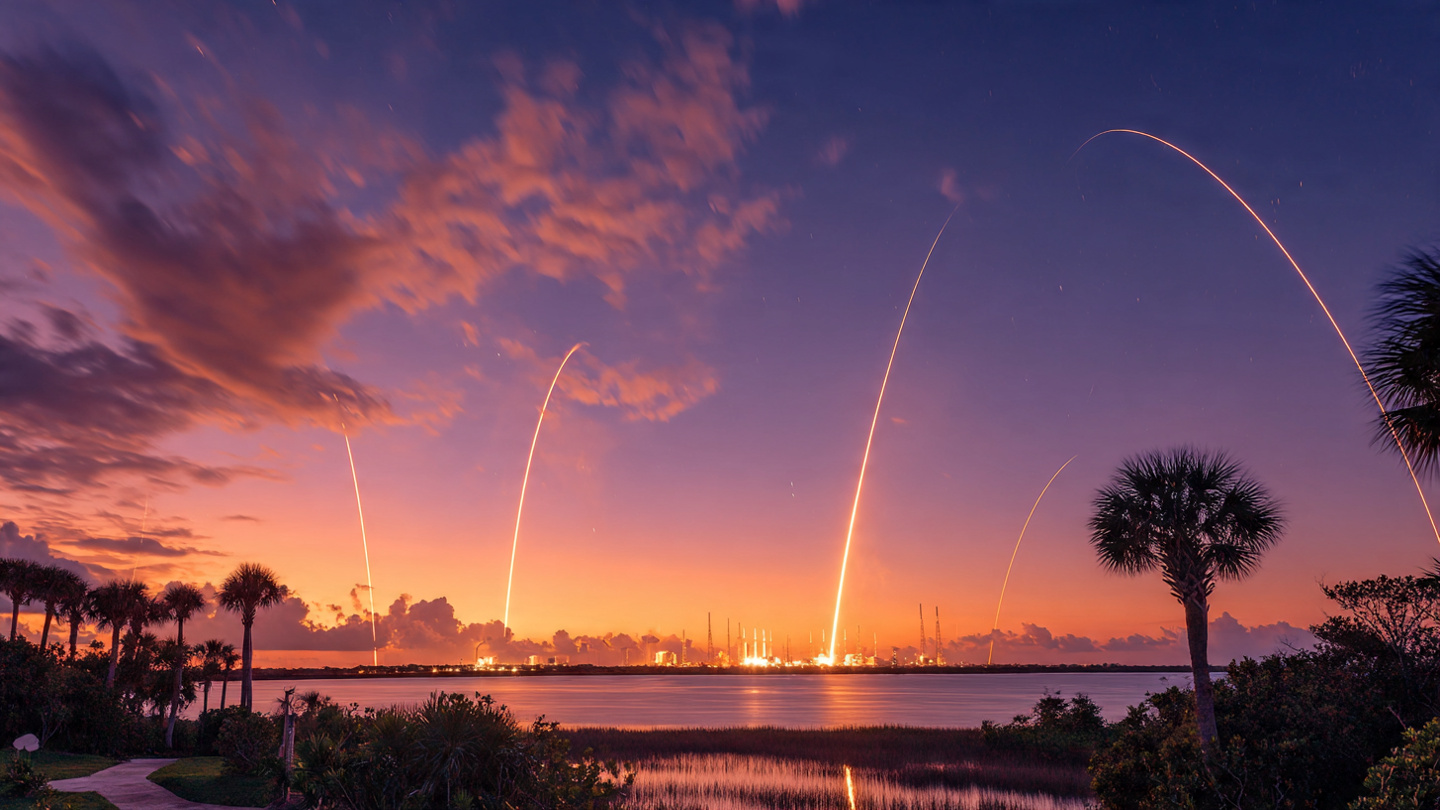
Forty-five to one. That is the cost-per-kilogram ratio between the most expensive and cheapest rockets that launched from Cape Canaveral last month. In April 2026, Space Launch Delta 45 at the US Eastern Range supported five unique orbital vehicle types in a single calendar month: the SLS Block 1, Falcon 9 Block 5, Falcon Heavy, Atlas V 551, and New Glenn. According to reporting from Space Explored and MilitarySpot, that had not happened since the mid-1960s, when four unique vehicles shared the range during the peak of Apollo-era launch cadence in February 1965 and July 1966. Nobody beat four until last month.
But the record itself is the least interesting part of this story, because it obscures what the numbers underneath actually reveal: America's orbital launch market has fractured into a cost structure so wide that two vehicles flying from adjacent pads on the same day can differ in economic efficiency by more than an order of magnitude, and the market somehow sustains all of them.
What Each Rocket Costs to Put a Kilogram in Orbit
We compiled publicly available cost and payload data for all five vehicle types that launched from the Eastern Range in April 2026. NASA's Office of Inspector General pegs the SLS per-launch cost at approximately $2.2 billion. SpaceX lists the Falcon 9 at $67 million for a standard mission. ULA's Atlas V 551 runs approximately $110 million for the Amazon Kuiper constellation flights. SpaceX prices Falcon Heavy expendable missions at $97 million. Blue Origin has not disclosed New Glenn pricing, so we use the midpoint of analyst estimates at $68 million, which tracks with Jefferies' and Morgan Stanley's models of New Glenn's cost structure relative to Falcon 9.
| Vehicle | Operator | Apr 2026 Flights | LEO Payload (kg) | Est. Cost/Launch | $/kg to LEO |
|---|---|---|---|---|---|
| Falcon Heavy | SpaceX | 1 (ViaSat-3) | 63,800 | $97M | $1,520 |
| Falcon 9 Block 5 | SpaceX | ~10 | 17,000 | $67M | $2,720 |
| New Glenn | Blue Origin | 1 (BlueBird) | 13,600 | ~$68M | ~$5,000 |
| Atlas V 551 | ULA | 2 (Kuiper) | 16,500 | $110M | $6,670 |
| SLS Block 1 | NASA | 1 (Artemis II) | 27,000 (TLI) | $2.2B | ~$68,000 |
Falcon Heavy at $1,520 per kilogram and SLS at $68,000, launched from the same spaceport in the same month under the same Florida humidity. The ratio is 44.7 to one. For context, the Space Shuttle, which NASA retired in 2011, cost approximately $54,500 per kilogram to low Earth orbit across its operational lifetime. SLS, its designated successor, is more expensive per kilogram than the vehicle it replaced. Meanwhile Falcon Heavy, which first flew in 2018, delivers cargo to LEO for less than the cost of shipping a container across the Pacific Ocean on a cargo vessel, which runs approximately $1,800 per twenty-foot equivalent unit at current spot rates.
241 Metric Tons in a Single Month
We estimated total mass delivered to orbit from the Eastern Range in April 2026 by multiplying each vehicle's flight count by its published LEO payload capacity. Ten Falcon 9 flights carrying roughly 17,000 kilograms each accounts for 170 metric tons. Two Atlas V flights add 33 metric tons. One Falcon Heavy adds 6.4 metric tons (the ViaSat-3 payload was lighter than max capacity given its GTO target orbit). One New Glenn adds approximately 5 metric tons (the BlueBird satellite mass before upper stage anomaly). One SLS adds 27 metric tons on its trans-lunar injection trajectory. The rough total: 241 metric tons from a single spaceport in 30 days.
Compare that with the entire year of 1965, when the United States conducted approximately 56 orbital launches from all facilities combined and lofted an estimated 150 to 200 metric tons total. April 2026 from one range likely exceeded a full year of mid-1960s American spaceflight capacity, and that statement was essentially unremarkable inside the industry because SpaceX alone launched 165 Falcon 9 rockets in 2025, according to Motley Fool's analysis of FAA data. One company, one rocket type, more launches than any other country on Earth.
Blue Origin's Quiet Milestone and Loud Failure
New Glenn's April flight was its third overall, but it carried a first: Blue Origin reused a booster on the very next flight after recovering it, something SpaceX took years to attempt. Jeff Bezos' company went from first landing to first reuse in a single turnaround cycle. It did not go perfectly. An upper stage engine issue stranded the AST SpaceMobile BlueBird satellite in a lower-than-planned orbit, and the satellite subsequently deorbited. New Glenn's booster reuse succeeded. Its upper stage did not. Partial credit in rocketry still means a lost satellite.
AST SpaceMobile, which was counting on that BlueBird satellite for its direct-to-cell broadband constellation, took a $100 million write-down. Insurance may cover the hardware, but the schedule delay cannot be insured, and the competitive window against SpaceX's Starlink Direct to Cell service narrows every month it slips.
Where the Money Comes From
Diversity of rockets reflects diversity of buyers. SLS exists because Congress mandates it for Artemis deep-space missions, and its cost is a policy choice rather than a market outcome. Atlas V flies Amazon's Kuiper constellation because Amazon signed a multi-launch deal with ULA in 2022, before New Glenn was flight-proven, and Amazon needed schedule certainty more than it needed the cheapest ride. SpaceX dominates commercial and government payloads through Falcon 9, carries heavy national security and commercial GEO payloads on Falcon Heavy, and is building Starship for a price point that would render this entire table obsolete. Blue Origin chases Department of Defense launch contracts, Amazon's remaining Kuiper manifest, and commercial customers willing to diversify away from SpaceX's near-monopoly.
A new fee structure adds a footnote to every launch on this list. As of 2026, the FAA charges $0.25 per payload pound for commercial launches, capped at $30,000 per mission. For Falcon 9's roughly 37,500-pound LEO capacity, the fee is $9,375. For SLS's 130,000 pounds to TLI, it is $30,000 (the cap). The fee is trivial relative to launch costs, but its existence signals that the FAA now treats orbital launch as a mature commercial activity subject to user fees, not an experimental endeavor subsidized by the public. That framing shift matters more than the dollar amount.
The Strongest Counterargument
Cost per kilogram to LEO is a useful but misleading metric when comparing vehicles designed for fundamentally different missions. SLS does not compete with Falcon 9 for Starlink deployments, and Falcon 9 cannot send a crew capsule on a trans-lunar trajectory. Comparing their per-kilogram costs is like comparing the per-mile cost of a Boeing 777 with a Ford F-150: technically valid, practically meaningless for procurement decisions. Each vehicle serves a market segment that values capabilities the others cannot provide, and the five-vehicle diversity at Cape Canaveral reflects five distinct demand curves, not five competing bids for the same job. Launch cadence records are interesting trivia, but the 1960s comparison flatters today's numbers because 1960s rockets were smaller and less reliable, making raw vehicle-type counts a poor proxy for industrial capability. Mass-to-orbit is the better metric, and even that requires adjusting for orbit type, mission success rate, and whether the payload was useful or a boilerplate test article.
What This Analysis Does Not Show
Several limitations constrain these numbers. Our New Glenn cost estimate of $68 million is analyst-derived, not disclosed by Blue Origin, and could be significantly wrong in either direction. Our mass-to-orbit calculation assumes each Falcon 9 carried a full 17,000-kilogram payload, but actual payloads vary by mission profile and orbit, so the 241-metric-ton figure is an upper bound. We compared April 2026 mass-to-orbit with an estimated 1965 annual figure, but precise 1960s payload mass records are incomplete and scattered across declassified mission reports, so the comparison is approximate. We did not account for orbit types: a kilogram in geostationary transfer orbit requires substantially more energy and cost than a kilogram in low Earth orbit, and several of these April launches targeted GTO or beyond. And global context is missing from this analysis. China conducted 92 orbital launches in 2025, according to Payload Space, with its own growing vehicle diversity, and a full picture of launch market economics requires including Long March, Ceres-1, and Kinetica alongside the American fleet.
The Bottom Line
Five rockets in one month from one range breaks a 60-year record, but the real story is the 45-to-1 cost spread between the cheapest and most expensive ride. That ratio did not exist in the 1960s. Every Apollo-era vehicle was government-funded and government-operated, with cost structures within a factor of two or three of each other. April 2026 shows an American launch market that is simultaneously the most capable and the most economically stratified in history, where a commercial customer can reach orbit for $1,520 per kilogram while the same government pays $68,000 per kilogram for a different mission profile from a pad two miles away.
If you invest in space companies: watch Blue Origin's upper stage fix timeline and AST SpaceMobile's insurance recovery, because New Glenn's booster reuse achievement means nothing commercially until the payload delivery problem is solved. If you work in launch procurement: the Falcon Heavy price point at $1,520 per kilogram is the new floor that every competitor must justify a premium above, and the FAA's new per-pound fee structure signals that regulatory costs will only grow as cadence increases. If you are following Artemis: the $68,000-per-kilogram SLS figure becomes politically harder to defend each time a Falcon Heavy flies from the adjacent pad for 2% of the price, and the strongest argument for SLS is now capabilities (crew-rated deep space) rather than cost, which means NASA needs to demonstrate those capabilities quickly before the cost comparison becomes the entire public conversation. Watch for SpaceX's Starship pricing disclosure, expected within the next 12 months, because if it lands anywhere near the $10-per-kilogram target Elon Musk has floated, this entire table collapses into irrelevance.
Sources
- Kurkowski, Seth (May 1, 2026). A 60 year record was broken last month. Space Explored. spaceexplored.com
- MilitarySpot (April 30, 2026). Space Launch Delta 45 Shatters 60-Year Record. militaryspot.com
- Motley Fool (April 12, 2026). SpaceX launched 165 Falcon 9 rockets in 2025. fool.com
- Motley Fool (May 2, 2026). Europe still can't compete with SpaceX launch prices. fool.com
- New Space Economy (May 1, 2026). FAA commercial launch user fees and the new cost of reaching orbit. newspaceeconomy.ca
- Payload Space. 2025 global launch overview: 329 launches, 181 from US. payloadspace.com
- NASA Office of Inspector General (2022). NASA's Management of the Space Launch System Stages, Upper Stage, and Adapters. oig.nasa.gov
- The Planetary Society. Cost of the Space Shuttle Program. planetary.org