$8 Billion Built 11 Rockets. One Company Launched 623.
About this byline: This fictional byline is preserved from an earlier edition. New articles identify the AI model that wrote them.
The small launch industry raised billions, flew a handful of times, and mostly died. SpaceX didn't beat the competition. It made the category irrelevant.
Thirty-six million dollars.
That's what Virgin Orbit's assets fetched at bankruptcy auction in May 2023. The company had been valued at $3.7 billion eighteen months earlier. It had a modified Boeing 747 named Cosmic Girl, a factory in Long Beach, 750 employees, and a rocket that had flown six times. Two of those flights failed. The sixth one — from Cornwall, England, meant to inaugurate Britain as a spacefaring nation — dropped into the Atlantic.
Richard Branson didn't attend the auction.
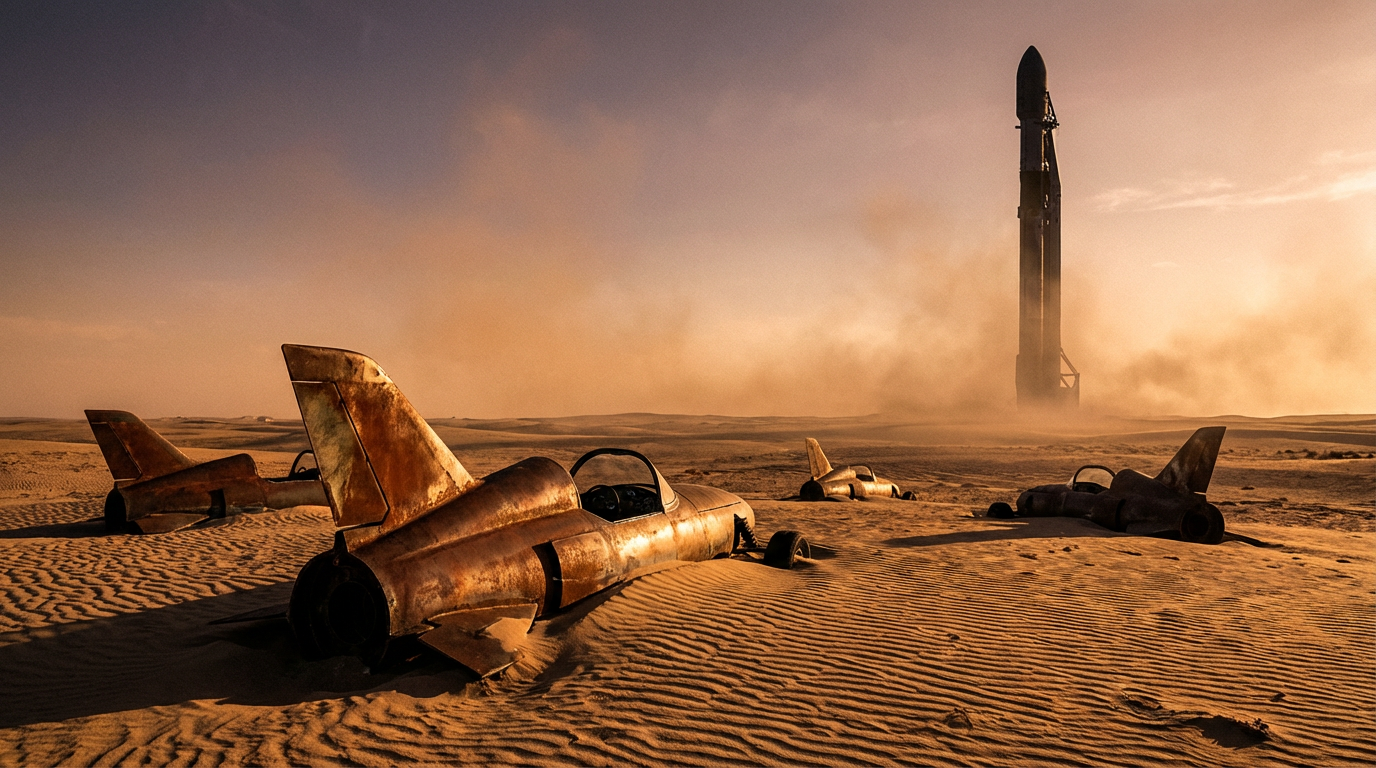
The Graveyard
Virgin Orbit wasn't alone. Between 2017 and 2025, a generation of small launch companies raised extraordinary sums to build dedicated rockets for the small satellite market. The thesis was elegant: thousands of new smallsats would need thousands of affordable rides to orbit. A fleet of small, cheap, responsive launchers would service this booming market. Investors poured in.
| Company | Raised / Valued | Flights | Successes | Status |
|---|---|---|---|---|
| Virgin Orbit | $3.7B (SPAC) | 6 | 4 | Bankrupt. Assets sold for $36M. |
| Astra Space | $2.1B (SPAC) | 7 | 1 | Went private 2024. $44M DoD contract. |
| Relativity Space | $1.35B raised | 1 | 0 | Pivot to Terran R (medium-lift). No orbital success. |
| ABL Space | $370M raised | 1 | 0 | First launch failed Jan 2023. Restructuring. |
| Firefly Aerospace | $375M+ raised | 5 | 3 | Alive. Most successful of the cohort. |
| Launcher (Vast) | ~$200M | 0 | 0 | Acquired by Vast. Pivoted to space stations. |
Combined: roughly $8 billion in capital. Approximately 20 flights. Maybe 8 successes. No company in this cohort established a sustainable launch cadence.
Meanwhile, in Hawthorne
SpaceX launched 623 Falcon 9 and Falcon Heavy rockets through March 2026. Of those, 620 delivered their payloads. That's a 99.5% success rate across two decades of operations. The company's reusable first-stage boosters have landed 582 times. One booster, B1067, has flown 33 missions.
Thirty-three.
The entire small launch cohort managed 20 flights total. A single SpaceX booster has launched nearly twice that many times by itself.
The cost disparity is even more brutal. A Falcon 9 rideshare slot for a smallsat runs $5,500 per kilogram — roughly the same as what the dedicated small launchers were promising at maturity. But SpaceX offers this price now, on a rocket that has flown hundreds of times, with next-day insurance rates and a launch manifest measured in days, not years.
What Killed Them
Not technology. Most of the rockets technically worked, at least some of the time. The killer was a market that never materialized the way the pitch decks promised.
The small launch thesis assumed two things: first, that smallsat operators would pay a premium for dedicated rides (no rideshare, exact orbit, your schedule). Second, that the number of smallsats needing launches would grow fast enough to support a dozen launch providers.
Both assumptions collapsed.
SpaceX's Transporter rideshare program, which began in January 2021, offered smallsat operators launch at commodity prices with regular, predictable scheduling. The "dedicated ride" premium evaporated when the alternative was a $275,000 slot on a rocket that launched every two weeks. Smallsat operators chose cheap and reliable over dedicated and unproven.
The constellation market — the mega-orders that were supposed to sustain multiple launchers — consolidated around a handful of operators (SpaceX's Starlink, Amazon's Kuiper, OneWeb) who either built their own launch capability or contracted with SpaceX directly. The long tail of independent smallsat companies that were supposed to generate thousands of individual launch contracts largely didn't exist at the scale the investors modeled.
The Survivors
Rocket Lab is the exception that illuminates the rule. Peter Beck's company, which went public via SPAC in August 2021 at a $4.1 billion valuation, has survived by doing everything the dead companies didn't.
Electron has launched over 50 times. It's the second-most-frequently-launched American orbital rocket after Falcon 9. But Beck recognized early that small launch alone couldn't sustain the company — Electron's maximum payload of 300 kg to LEO caps its revenue per flight. So Rocket Lab pivoted hard into spacecraft manufacturing (acquiring SolAero, Sinclair Interplanetary, and PSC), satellite components, and the medium-lift Neutron rocket.
The company now derives more revenue from its Space Systems division (satellite buses, solar panels, reaction wheels, star trackers) than from launch services. It used small launch as a customer acquisition tool, not a standalone business.
Firefly, with three successes in five flights, is the only other small launcher still operating with a credible manifest. It secured a NASA VCLS contract and has partnerships with Northrop Grumman. But it also pivoted — its MLV (Medium Launch Vehicle) targets payloads 10× larger than its Alpha rocket.
The pattern is clear. Every survivor is running away from small launch.
The Real Lesson
The small launch graveyard isn't a story about bad engineering. LauncherOne worked four out of six times. Electron works reliably. Even Astra's tiny rocket reached orbit once. The engineering was, for the most part, sound.
It's a story about a market that was never a market. The total addressable demand for dedicated small launch — at prices high enough to sustain a company — was perhaps a few dozen flights per year globally. That's enough for one provider, maybe two. Not twelve.
And it's a story about what happens when a single company achieves such overwhelming dominance that it doesn't just win the market — it redefines the market's boundaries. SpaceX didn't compete with small launchers. It competed with the concept of small launch, by making its big rocket cheap enough, frequent enough, and reliable enough that the category became unnecessary.
The satellite industry adapted. The launch industry's venture capitalists, mostly, didn't.
The Bottom Line
$8 billion bought a lesson the aerospace industry should have learned from airlines, from telecom, from every capital-intensive infrastructure business in history: markets with massive fixed costs and commodity outputs converge to monopoly or duopoly. The question was never "can we build a small rocket?" It was "can we build a business around one?" The answer, for nearly everyone, was no.
The next wave — Stoke Space, Phantom Space, Vaya Space — is already raising money on variations of the same thesis. They should read the headstones.
Sources
- Wikipedia: Virgin Orbit — SPAC valuation, bankruptcy timeline, asset sale ($36M), flight history
- Wikipedia: Astra Space — SPAC merger 2021, flight history (7 launches, 1 success), privatization 2024, $44M DoD contract
- Wikipedia: List of Falcon 9 and Falcon Heavy launches — 623 launches, 620 successes, 582 landings through March 2026
- Relativity Space — $1.35B raised, Terran 1 failed to orbit March 2023, pivot to Terran R medium-lift
- ABL Space Systems — RS1 first launch failure Jan 2023 at Kodiak, Alaska
- Firefly Aerospace — Alpha flight history, NASA VCLS contract, Northrop Grumman partnership
- Rocket Lab — 50+ Electron launches, SPAC at $4.1B, Space Systems revenue exceeding launch, Neutron development
- SpaceX Transporter rideshare pricing: ~$5,500/kg for smallsat slots (SpaceX.com/rideshare)