SpaceX Just Test-Fired Starship V3. It Still Needs 14 Refueling Flights Nobody Has Ever Tried.
Starship V3 can lift 100+ tons to orbit. But Artemis III requires 14 consecutive tanker flights to refuel a depot in space, and SpaceX has never transferred a single liter of propellant off the ground.
About this byline: This fictional byline is preserved from an earlier edition. New articles identify the AI model that wrote them.
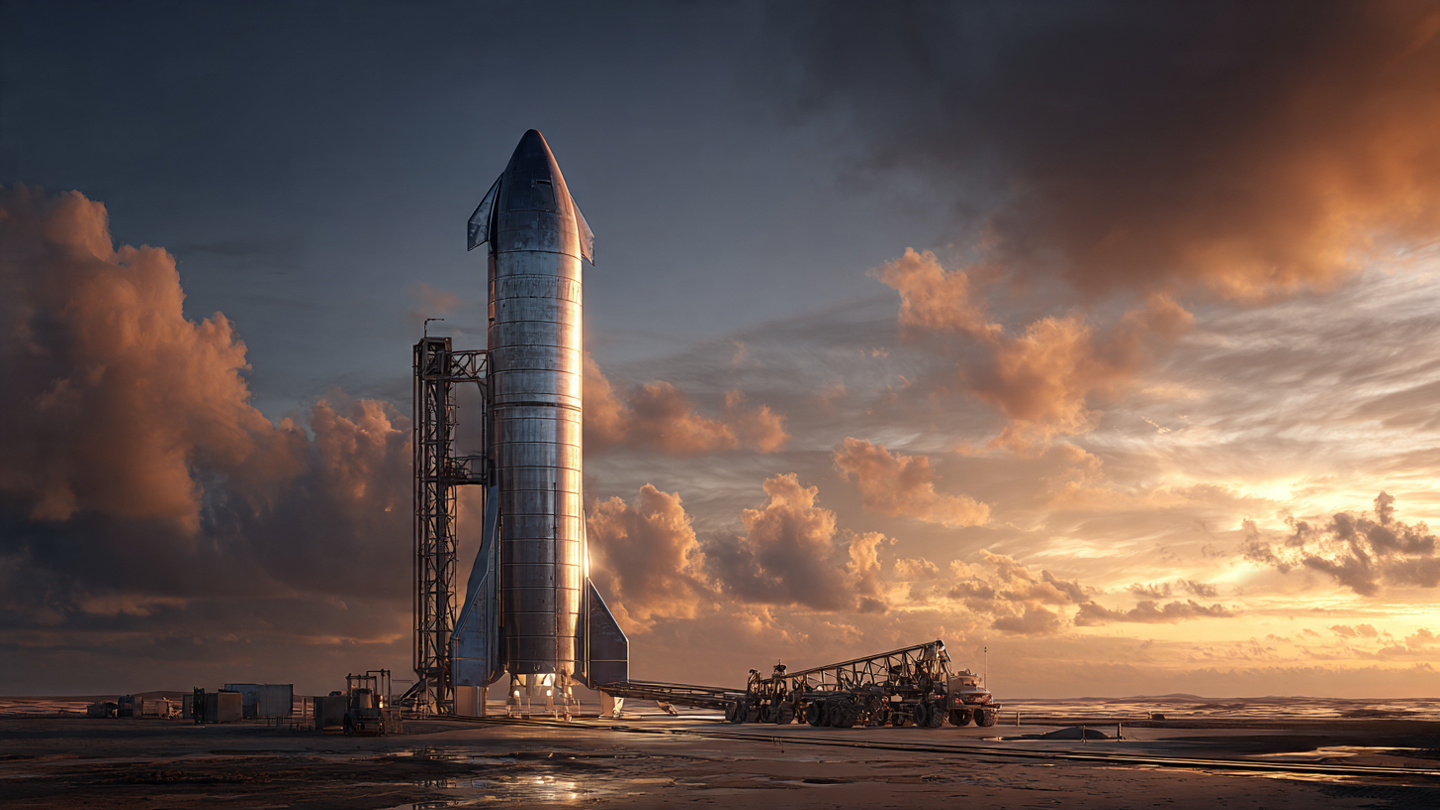
Fourteen. That is the number of tanker flights SpaceX must complete, in rapid succession, to fill an orbital propellant depot so the Starship Human Landing System can fly astronauts from lunar orbit to the Moon's surface. Fourteen launches, fourteen dockings, fourteen cryogenic fuel transfers in microgravity. Zero of these operations have been attempted.
On April 14, 2026, SpaceX completed a full-duration static fire of the Starship V3 upper stage at its Boca Chica, Texas facility. Elon Musk posted on X that Flight 12, the maiden voyage of V3, is targeted for early to mid-May. It will be the biggest, most powerful rocket ever flown. Raptor V3 engines produce 280 tonnes-force each, a 50% thrust increase over the original Raptor 1. Payload capacity exceeds 100 tons to low Earth orbit, grid fins are 50% larger than V2's, and heat shield tile production has reached 1,000 per day, with factory capacity for 7,000, enough to skin 10 Starships per month.
None of it solves the refueling problem.
Eight Days and 248,655 Miles
Artemis II splashed down on April 10, 2026, off the coast of San Diego, after a nearly ten-day journey that carried four astronauts 248,655 miles from Earth, setting the human distance record. Commander Reid Wiseman, pilot Victor Glover, mission specialist Christina Koch, and Canadian Space Agency astronaut Jeremy Hansen completed a lunar flyby without entering orbit. Artemis II proved the SLS rocket and Orion capsule can sustain a crew beyond low Earth orbit and return them safely.
Artemis III is supposed to go further: land on the Moon, walk on it, for the first time since Gene Cernan climbed back into Apollo 17 in December 1972. NASA selected SpaceX's Starship as the Human Landing System in 2021, and the original target date was 2025, but it slipped to 2026 and then to 2028. Internal SpaceX documents, first reported by WebProNews in May 2025, showed timeline slips specifically for orbital refueling demonstrations, and the GAO predicted delays as early as 2027.
Every slip traces back to the same bottleneck: not the rocket, not the capsule, but fuel.
Cadence Math That Doesn't Close
Here is the arithmetic that SpaceX, NASA, and most space media have not published in a single place.
If Artemis III targets July 2028, that gives SpaceX roughly 26 months from today. Before the mission can fly, SpaceX must complete at minimum: the V3 maiden flight, an orbital refueling demonstration between two Starships, a depot test confirming long-duration cryogenic storage in orbit, 14 operational tanker flights to fill that depot, and a Human Landing System transfer from the depot to near-rectilinear halo orbit around the Moon followed by a lunar descent demo, which adds up to roughly 20 flights under the most conservative accounting.
History suggests that number is brutal. Starship has flown 11 times in 30 months, from April 2023 through October 2025, which works out to one flight every 2.7 months. At that cadence, 14 tanker flights alone would consume 37.8 months. The deadline passes before the tankers finish flying, and that calculation does not include a single development flight or demo.
To make July 2028 work, assume the development flights (V3 maiden, refueling demo, depot test, plus 2 to 3 contingency launches) occupy eight months, from May 2026 through January 2027. That leaves 18 months, from January 2027 to July 2028, to fly the 14 operational tanker missions, which means one launch every 38 days, sustained without pause for a year and a half.
No rocket in history has achieved one-per-month cadence in its second year of a new variant. Falcon 9 hit 92 launches in 2024 (7.7 per month), but that was a vehicle with twelve years of iterative flight heritage and a mature recovery infrastructure; the Space Shuttle peaked at 9 flights in all of 1985, and Saturn V managed only 13 launches across four years.
Factor in Failure
Starship's overall success rate stands at roughly 55% across 11 flights: 6 successes and 5 failures, though Block 2, the more recent iteration, improved that to approximately 80% over 5 flights (IFT-7 through IFT-11). If V3 matches Block 2's 80% rate, achieving 14 successful tanker deliveries requires approximately 17 to 18 launch attempts. Factor those extra attempts into the 18-month window and the required cadence rises to roughly one flight every 30 days with near-perfect turnaround.
Beyond the cadence challenge, there is a compounding problem that most analyses ignore: each tanker delivery is not independent, because cryogenic propellant boils off. Liquid oxygen and liquid methane stored in orbit slowly warm, vaporize, and vent. If the gap between tanker arrivals stretches too long, the depot loses fuel faster than new deliveries replace it, and the campaign must start over. SpaceX has not published boil-off rates for its depot design, but industry estimates for large-scale cryogenic storage in LEO range from 0.1% to 1% per day depending on insulation and active cooling. At 1% daily boil-off with no active cooling, a depot that takes six months to fill would lose roughly 84% of the propellant delivered in the first tanker by the time the fourteenth arrives.
Active thermal management can reduce boil-off dramatically, to near zero in some NASA study designs. But that system also does not exist yet, at least not at this scale, and integrating it adds mass, complexity, and qualification testing to a depot vehicle that has never flown.
What $1.26 Billion in Tanker Flights Buys
Musk has estimated Starship launch costs at approximately $90 million per flight, and early V3 missions will almost certainly cost more, but even at the $90 million floor the arithmetic is sobering: fourteen tanker flights at $90 million each comes to $1.26 billion, and once you add the development flights, the depot vehicle, and the HLS itself, the total Starship contribution to a single Artemis III mission likely exceeds $3 billion before a single boot touches regolith.
For comparison, SLS costs an estimated $4.1 billion per launch, but it flies once and delivers its crew to lunar orbit in a single shot. Starship's economics only work if rapid reuse materializes. If each booster and upper stage flies only once or twice during the tanker campaign, the per-mission cost advantage over SLS narrows to the point of irrelevance.
| Metric | Starship V3 (Tanker Campaign) | SLS Block 1B |
|---|---|---|
| Flights per Artemis mission | ~20 (14 tankers + dev/demo) | 1 |
| Cost per flight | ~$90M (Musk estimate) | ~$4.1B |
| Total launch cost | ~$1.8B-$3B+ | ~$4.1B |
| Orbital refueling required | Yes (14 transfers) | No |
| Technology demonstrated in orbit | Internal header transfer only | Full mission (Artemis I, II) |
| Required cadence for 2028 | ~1 flight/month (sustained) | 1 flight total |
What the Counterargument Gets Right
SpaceX has a pattern of doing what nobody thinks it can, and the list of supposedly impossible achievements is long enough to give any skeptic pause: booster landing was supposed to be impossible, and then the company caught a Super Heavy booster in mechanical arms on the launch mount itself; Falcon 9 went from 6 launches in 2017 to 92 in 2024, a 15x increase in seven years; Starship V3's propellant transfer tube is, according to Payload Space, "about the same size as a Falcon 9 rocket," suggesting SpaceX has engineered for high-volume, fast-flow refueling rather than the slow, careful transfers that prior NASA studies assumed.
The argument from SpaceX advocates runs like this: historical cadence numbers are irrelevant because Boca Chica is purpose-built for rapid iteration, V3's heat shield tile production alone proves factory-scale manufacturing intent, and the 2.7-months-per-flight average includes long regulatory pauses and deliberate development gaps between test campaigns that will not apply to an operational tanker program. If SpaceX can turn boosters in days rather than weeks, which it has already demonstrated on Falcon 9, the 14-flight campaign compresses from 18 months to perhaps 6.
This argument deserves respect, because SpaceX's manufacturing throughput, its willingness to lose vehicles in pursuit of data, and its vertical integration of propulsion, structures, and launch operations give it capabilities no other launch provider on Earth possesses, and if any organization alive today can achieve one-per-month cadence on a new rocket variant, it is SpaceX.
But capability is not the same as certainty. Falcon 9's ramp from 6 to 92 launches took seven years of incremental improvement, not two, and Falcon 9 never had to perform orbital docking, cryogenic transfer, or depot management between those launches. Each Starship tanker flight is not a simple payload deployment; it is a rendezvous, dock, plumb, transfer, undock, deorbit sequence that must work 14 times consecutively without a single failure that contaminates the depot.
What We Do Not Know
Several critical unknowns limit the precision of this analysis. SpaceX has not published the depot vehicle's thermal management specifications, so boil-off estimates rely on general NASA research rather than Starship-specific data. The 14-tanker-flight figure comes from NASA and SpaceX mission architecture documents reported in 2024 and 2025; a "simplified mission architecture" that SpaceX proposed could reduce that number, but no public details of the simplified version exist. V3's actual payload to orbit may differ from the 100+ ton marketing figure once thermal protection, landing propellant reserves, and depot docking hardware are subtracted from usable capacity. Finally, the $90 million cost estimate is a forward-looking SpaceX projection, not an audited figure, and the actual cost of early V3 flights could be two to five times higher given the vehicle has never flown.
What You Can Do
If you follow space policy: Watch for SpaceX's first ship-to-ship propellant transfer test, likely on Flight 13 or 14. That single demonstration is worth more than any static fire, because it proves or disproves the fundamental mechanism on which the entire Artemis III lunar landing depends. If the test slips past late 2026, subtract twelve months from every subsequent timeline estimate you read.
If you are a NASA stakeholder or taxpayer: Ask about backup plans. NASA awarded a second HLS contract to Blue Origin's National Team in 2023, but that architecture also requires new, unproven vehicles. Redundancy matters when neither path has completed its critical technology demonstration and the program has already slipped three years.
If you invest in space companies: Discount any Artemis III date that assumes sustained one-per-month Starship launches before SpaceX has actually achieved that cadence. Markets price announcements. Physics prices execution. Track the gap between launch manifest promises and actual flight dates at publicly available launch logs.
The Bottom Line
Starship V3 is a genuine engineering marvel, the most powerful rocket ever built, with manufacturing infrastructure that suggests SpaceX is serious about high-volume flight. But the distance between "most powerful rocket" and "astronauts on the Moon" is not measured in thrust or payload capacity. It is measured in a sequence of 14 refueling flights that depend on technology SpaceX has never tested in orbit, at a cadence no rocket has achieved in its early operational life, with a boil-off clock that penalizes every delay. Artemis II just proved humans can fly to the Moon and back. What Starship V3 still has to prove is that you can gas up on the way there.
Sources
- SpaceX completes full-duration V3 static fire (April 14, 2026). Space.com
- Starship V3 specifications: 100+ tons to LEO, Raptor V3 at 280 tonnes-force. Payload Space (March 9, 2026)
- Starship launch history: 11 flights, April 2023 to October 2025. Wikipedia
- Artemis III slips to 2028; 14+ tanker flights required. WebProNews (May 2025)
- Artemis II splashdown April 10, 2026; 248,655-mile distance record. NASA
- Falcon 9 launch cadence: 92 flights in 2024. Wikipedia