Artemis II Costs $4.27 Million Per Astronaut-Hour. It Won't Even Orbit the Moon.
NASA's Space Launch System lifted four astronauts toward the Moon yesterday at a marginal launch cost of $4.1 billion. That works out to $4.27 million per astronaut-hour for a 10-day flyby that will not enter lunar orbit. In 1968, Apollo 8 orbited the Moon 10 times, and NASA landed on the surface seven months later.
$4,270,833.
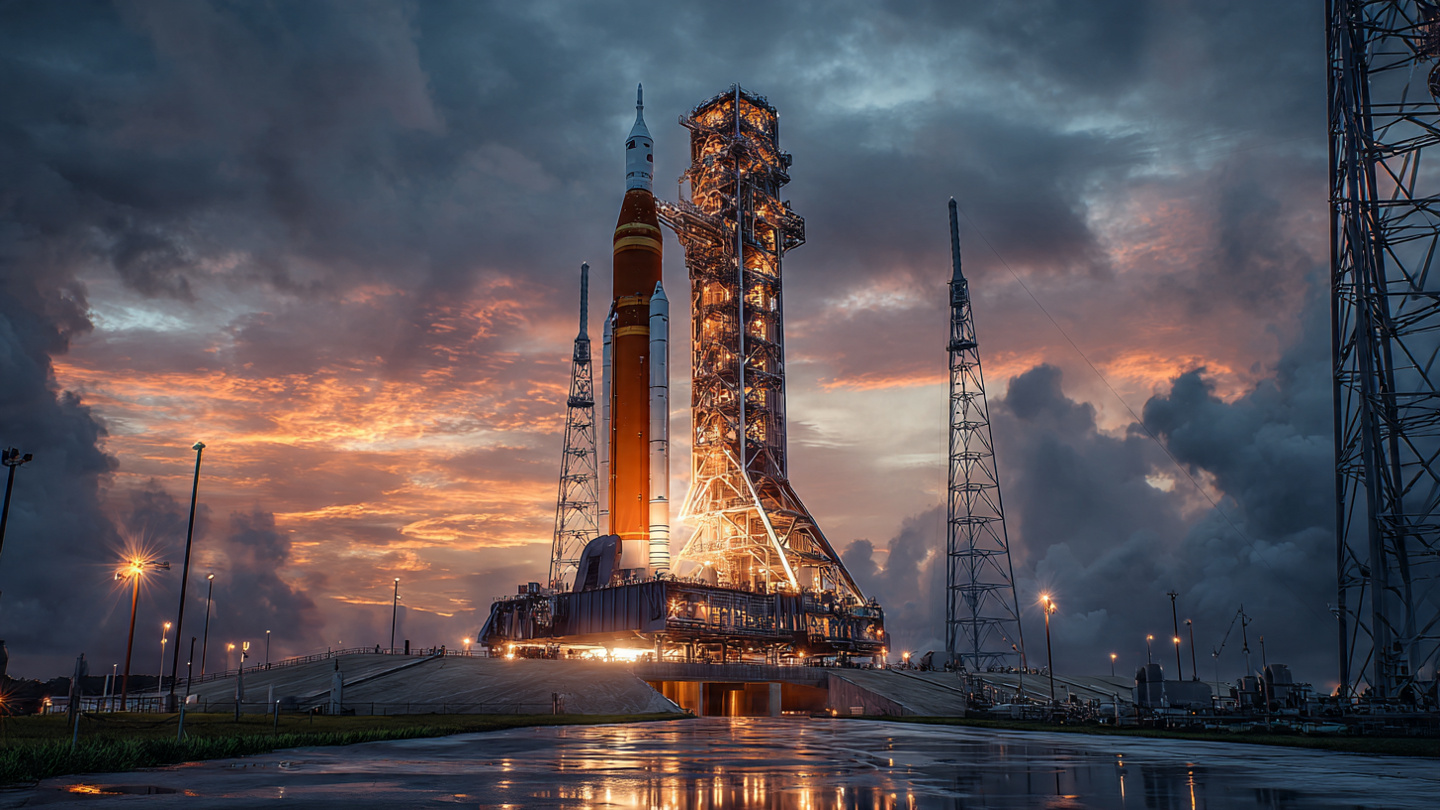
That is the cost of one astronaut spending one hour inside the Orion capsule during the Artemis II mission, calculated from the marginal launch cost alone. On April 1, 2026, at 6:35 PM ET, NASA's Space Launch System lifted Reid Wiseman, Victor Glover, Christina Koch, and Jeremy Hansen from Kennedy Space Center's Launch Complex 39B on a trajectory that will loop around the Moon and bring them home in roughly 10 days. It was the first time humans left low Earth orbit since December 1972.
Nobody disputes the achievement. Four people are flying to the Moon. What warrants scrutiny is the price tag, the pace, and how both compare to a program that did essentially the same thing 58 years ago, then landed on the lunar surface seven months later.
The Marginal Math
NASA's Office of Inspector General estimated in November 2021 that each SLS launch costs approximately $4.1 billion in marginal expenditure. This covers the rocket, the Orion capsule integration, the solid rocket boosters from Northrop Grumman, the RS-25 engines from Aerojet Rocketdyne, and ground processing through Exploration Ground Systems.
Artemis II carries four crew for approximately 10 days, or 240 hours.
Four astronauts multiplied by 240 hours yields 960 astronaut-hours.
$4.1 billion divided by 960 astronaut-hours: $4,270,833 per astronaut-hour.
That is the marginal figure. It does not include the development costs sunk into making SLS and Orion flight-ready. When you allocate those, the number roughly triples.
The Fully Loaded Number
According to The Planetary Society's ongoing cost tracker, total development spending on SLS, Orion, and Exploration Ground Systems reached approximately $60 billion through fiscal year 2025. SLS development alone consumed $28.4 billion from 2011 onward. Orion, whose development traces back to the Constellation program in 2006, accounts for roughly $24.3 billion. Ground systems add another $7.5 billion.
NASA currently plans six Artemis missions. Spread $60 billion across six flights and each mission carries a $10 billion development allocation. Add the $4.1 billion marginal cost and a single Artemis mission costs roughly $14 billion, fully loaded.
At 960 astronaut-hours per mission: $14.6 million per astronaut-hour.
Apollo 8: Lunar Orbit for Less
In December 1968, Frank Borman, Jim Lovell, and Bill Anders became the first humans to orbit the Moon. Apollo 8 completed 10 lunar orbits over 20 hours, photographed potential landing sites, and returned safely after 6.1 days (approximately 147 hours). It was the mission that produced "Earthrise."
Artemis II will not orbit the Moon. Its free-return trajectory brings the crew within roughly 8,000 kilometers (5,000 miles) of the lunar surface before swinging back to Earth. In capability terms, Artemis II achieves less than Apollo 8 did.
The Apollo program's total cost was approximately $25.8 billion in 1973 dollars. Adjusted for inflation, that is roughly $208 billion in 2026 dollars. Across 11 crewed Apollo missions, each carried an approximate development allocation of $18.9 billion.
Apollo 8: 3 crew, 147 hours, 441 astronaut-hours.
$18.9 billion divided by 441 astronaut-hours: $42.9 million per astronaut-hour, fully loaded.
So yes, Apollo 8 was more expensive per astronaut-hour than Artemis II. But Apollo 8 entered lunar orbit. And the program went from its first uncrewed test flight (AS-501, November 1967) to lunar landing (Apollo 11, July 1969) in 20 months.
The Pace Gap
Artemis I, the uncrewed test flight, launched in November 2022. Artemis II launched in April 2026, 41 months later. Artemis III, the first planned lunar landing, is currently targeted for mid-2027 at the earliest. That puts the test-flight-to-landing timeline at roughly 56 months.
Apollo covered the same ground in 20 months.
| Milestone | Apollo | Artemis |
|---|---|---|
| First uncrewed test | Nov 1967 (AS-501) | Nov 2022 (Artemis I) |
| First crewed mission | Oct 1968 (Apollo 7, LEO) | Apr 2026 (Artemis II, flyby) |
| Lunar orbit | Dec 1968 (Apollo 8) | Not planned before landing |
| Lunar landing | Jul 1969 (Apollo 11) | ~mid-2027 (Artemis III, target) |
| Test-to-landing | 20 months | 56+ months (planned) |
The comparison is imperfect. Apollo operated under Cold War urgency with a peak NASA budget of 4.4% of federal spending (versus 0.48% today). Apollo killed three astronauts during a ground test and accepted risks that would be unthinkable in 2026. Artemis inherits vastly more complex safety requirements, congressional oversight, and a contractor base that spans all 50 states by design.
But the pace difference is not primarily about safety. Between Artemis I and Artemis II, NASA replaced the heat shield material after discovering unexpected charring during Artemis I's reentry. That alone consumed roughly two years. The SLS production pipeline is designed to build one core stage per year at most. There is no surge capacity.
Comparison Table: Cost Per Astronaut-Hour
| Mission/Program | Astronaut-Hours | Cost Basis | $/Astronaut-Hour |
|---|---|---|---|
| ISS (annual operations) | 52,596 | $3.5B/year (NASA share) | $66,500 |
| SpaceX Crew Dragon (per mission) | ~2,880 | ~$220M (marginal) | ~$76,400 |
| Starship (projected, at $50M/launch) | 960 | $50M (target) | $52,100 |
| Artemis II (marginal) | 960 | $4.1B | $4,270,000 |
| Artemis II (fully loaded) | 960 | ~$14B | $14,600,000 |
| Apollo 8 (fully loaded, 2026$) | 441 | $18.9B | $42,900,000 |
The ISS produces astronaut-hours at roughly $66,500 each because it operates continuously with six crew. NASA's annual ISS expenditure runs approximately $3 to $4 billion. SpaceX's Crew Dragon flights to the ISS cost roughly $220 million per mission, carrying four astronauts for about 30 days. Starship has not flown crew, but even at 25x Elon Musk's stated $2 million target, it would deliver astronaut-hours at 82 times less than Artemis II's marginal rate.
The Industrial Base Argument
SLS exists partly because Congress mandated it. The 2010 NASA Authorization Act directed the agency to build a heavy-lift rocket using Space Shuttle components, specifically RS-25 engines and five-segment solid rocket boosters. This was not subtlety. Senator Richard Shelby of Alabama, whose state houses Marshall Space Flight Center and much of the SLS workforce, co-authored the legislation.
Boeing builds the SLS core stage in Michoud, Louisiana. Northrop Grumman produces the solid rocket boosters in Promontory, Utah. Aerojet Rocketdyne manufactures and refurbishes RS-25 engines in Stennis, Mississippi. Lockheed Martin assembles Orion in New Orleans and Denver. The supply chain touches every congressional district that matters.
This is not corruption. It is how American aerospace procurement works. The program sustains tens of thousands of skilled jobs and maintains industrial capabilities (large solid motor production, RS-25 cryogenic engine manufacturing) that would be expensive to rebuild if lost. But it produces one launch every 2 to 4 years. Artemis I flew in November 2022. Artemis II flew in April 2026. That is a 41-month gap between flights from a program spending approximately $4.7 billion annually on SLS, Orion, and ground systems.
At $4.7 billion per year and one launch every 3.4 years, the standing army cost between flights is roughly $16 billion per launch, before the rocket leaves the ground.
What Artemis II Is Actually Testing
Dismissing Artemis II as a flyby undersells what the mission validates. Orion's life support system is maintaining four humans for 10 days in deep space for the first time. The heat shield will handle Mach 32 reentry at lunar-return velocity, a speed no crewed American vehicle has survived since 1972. The European Service Module, built by Airbus for ESA, is providing propulsion, power, and consumables on its first crewed flight. Navigation and communication through the Deep Space Network at lunar distances, with crew aboard, has not been tested in this configuration.
These are not trivial validation targets. The heat shield charring discovered on Artemis I required material redesign. Getting it right with crew aboard is the entire point.
Limitations
This analysis relies on the NASA OIG's 2021 marginal launch cost estimate of $4.1 billion. Actual Artemis II launch costs may differ; NASA has not published an updated per-launch figure. Development cost allocation across six planned missions is arbitrary. If Congress funds additional Artemis missions beyond the current plan, the per-mission share drops. Starship cost projections are targets, not demonstrated figures. The Apollo cost data is well-established in aggregate but allocation across 11 crewed missions is approximate. Comparing astronaut-hours across different mission types (LEO station keeping vs. lunar flyby vs. lunar landing) treats all hours as equivalent, which obscures significant differences in scientific and operational value.
The Strongest Case for SLS
Artemis II is a test flight, not the destination. Judging the program by its crewed test flight's cost per hour is like judging a factory by the first unit off the line. Orion's 21-day rated mission duration, its deep-space radiation protection, and its Mach 32 reentry heat shield do not exist in any other vehicle flying today. Starship has not carried crew. Crew Dragon is not rated for lunar distances. If the question is "which vehicle can take humans to the Moon right now," the answer is Orion atop SLS, and nothing else.
If Artemis reaches a two-launch-per-year cadence by the early 2030s, and the per-launch marginal cost drops as NASA transitions from cost-plus to fixed-price contracting for future core stages, the economics improve considerably. The SLS was always expensive infrastructure intended to enable a lunar program that delivers value over decades.
The Bottom Line
Four people are on their way around the Moon right now. That matters. But at $4.27 million per astronaut-hour on the rocket alone, Artemis II is a reminder that the program's economics were designed in Washington, not mission control. Apollo went from first test to first landing in 20 months. Artemis is on pace to take 56 months, at roughly three times the annual cost in inflation-adjusted terms. The question is not whether Artemis can get people to the Moon. It proved the answer yesterday. The question is whether $4.7 billion a year for one flight every three years is the most productive way to keep them going back.
Related
Sources
- estimated in November 2021. oig.nasa.gov
- The Planetary Society's ongoing cost tracker. planetary.org