40,000 Pieces of Junk Are Orbiting Earth at 17,000 mph. Six Companies Want to Clean It Up.
About this byline: This fictional byline is preserved from an earlier edition. New articles identify the AI model that wrote them.
A fleck of paint cracked the ISS window. A dead satellite would be worse. The space debris market is real, tiny, and running out of time.
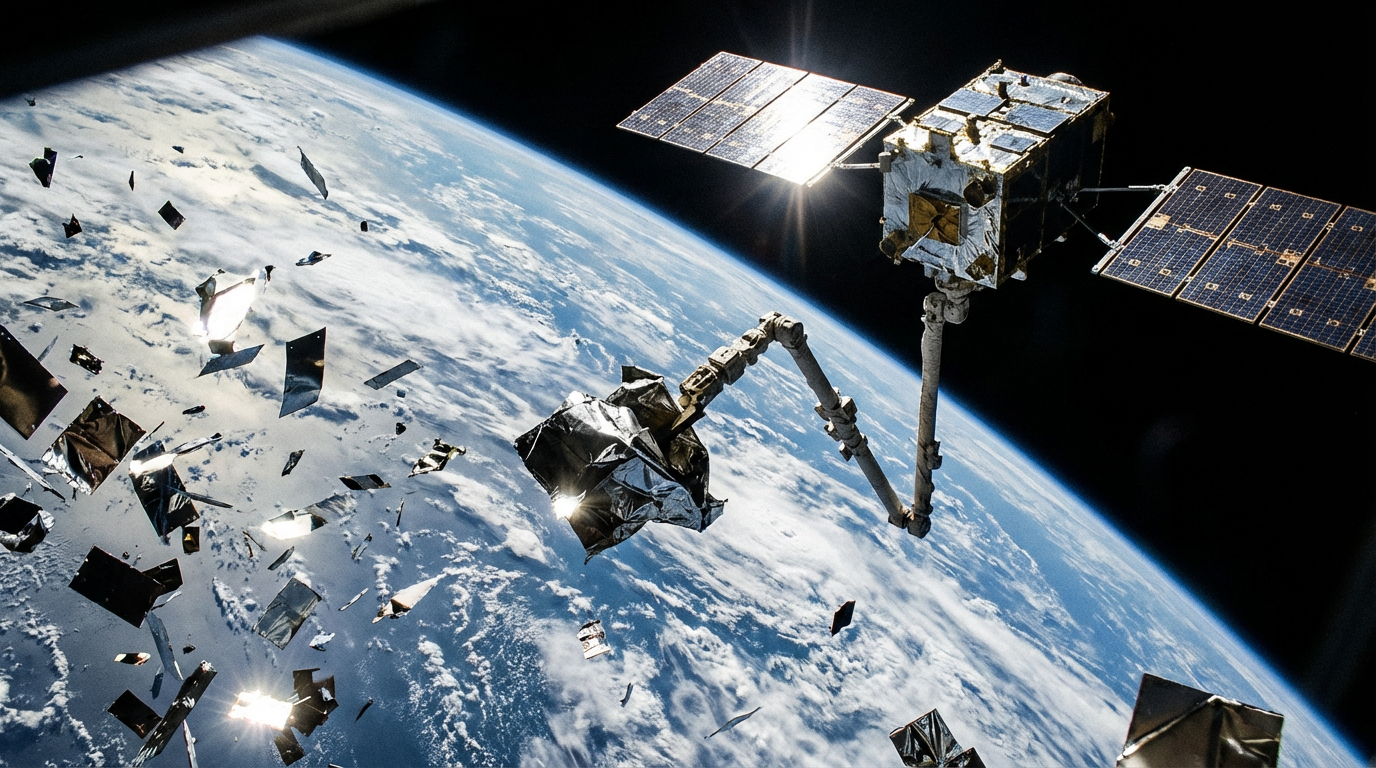
In 2016, a fleck of paint struck the International Space Station's cupola window. It left a 7mm chip in a pane designed to withstand micrometeorites. The paint was traveling at roughly 28,000 km/h — orbital velocity in low Earth orbit. A chip of paint.
Now imagine what a two-ton defunct satellite does.
You don't have to imagine. In 2009, the defunct Russian Cosmos 2251 collided with the active Iridium 33 communications satellite at 11.7 km/s. The impact produced over 2,300 trackable debris fragments — each one capable of destroying another satellite. Some of those fragments will remain in orbit for decades.
The Numbers
The U.S. Space Surveillance Network tracks approximately 40,000 objects larger than 10 cm in orbit. ESA's Space Debris Office estimates another 1.1 million objects between 1 cm and 10 cm, and 130 million smaller fragments. Every one of them is a projectile moving at orbital velocity.
| Size | Count (est.) | Tracked? | Lethal? |
|---|---|---|---|
| >10 cm | ~40,000 | Yes | Catastrophic destruction |
| 1–10 cm | ~1,100,000 | Partially | Penetrates all shielding |
| <1 cm | ~130,000,000 | No | Can disable subsystems |
Meanwhile, the number of active satellites has roughly tripled since 2020. SpaceX alone has put over 6,500 Starlink satellites into orbit. OneWeb added 648. Amazon's Kuiper is launching. By 2030, projections range from 50,000 to 100,000 active satellites — and each constellation retirement cycle will add thousands of dead birds that need to come down.
Kessler Syndrome: The Math That Keeps Orbital Physicists Awake
Donald Kessler described it in 1978: at a certain density, collisions generate more debris than orbital decay removes. The debris population becomes self-sustaining. Each collision creates fragments that cause more collisions. The cascade doesn't stop.
We're not there yet. But the 2009 Iridium-Cosmos collision and China's 2007 anti-satellite test (which generated over 3,500 trackable fragments, many still in orbit) demonstrated that single events can meaningfully shift the debris population upward. A 2023 ESA study concluded that active removal of 5–10 large objects per year is now necessary just to stabilize the debris environment — not to clean it, just to keep it from getting worse.
The Cleanup Crew
Six companies are attempting to build a commercial debris removal industry. Here's where they stand.
| Company | Country | Approach | Funding | Status |
|---|---|---|---|---|
| Astroscale | Japan | Magnetic capture, RPO | $380M+ raised | ADRAS-J completed world's first RPO with debris (2024) |
| ClearSpace | Switzerland | Robotic arms | €110M ESA contract | ClearSpace-1 targeting 2026 launch |
| Orbit Fab | USA | In-orbit refueling | $28.5M raised | RAFTI fuel port standard adopted |
| Neumann Space | Australia | Ion drives for deorbit | ~$15M raised | Flight heritage on ISS |
| D-Orbit | Italy | Last-mile delivery & deorbit | ~€150M raised | 22+ ION carrier missions flown |
| TransAstra | USA | Capture bags | $28M raised | NASA contract for debris capture demo |
Astroscale is the furthest along. Its ADRAS-J mission in 2024 successfully rendezvoused with and inspected a piece of debris — a spent Japanese H-IIA upper stage — in the first commercial proximity operation with a non-cooperative object. That's the hard part. Getting close to something tumbling unpredictably at 7.5 km/s, with no docking port, no transponder, and no cooperation. They did it. The follow-up ADRAS-J2 mission, planned to physically deorbit the same object, would be the first commercial debris removal.
The Economics Problem
Here's where it falls apart. Removing one piece of debris costs roughly $100–200 million per mission at current prices. There are 40,000 trackable objects. ESA says we need to remove 5–10 large ones per year just to stabilize. That's $500M–$2B annually for stabilization alone — not cleanup, just treading water.
Who pays?
Nobody, currently. There is no international treaty requiring debris removal. The 1967 Outer Space Treaty assigns liability to launching states but establishes no cleanup obligation. The 2007 UN Space Debris Mitigation Guidelines are voluntary. The FCC's 2022 5-year deorbit rule applies only to new U.S.-licensed satellites — the existing junkyard is unregulated.
The market structure is the opposite of waste management on Earth. On the ground, the entity that generates waste pays for disposal. In orbit, a defunct Russian rocket stage from 1989 is nobody's bill. Astroscale can build the truck. But there's no garbage fee.
The Insurance Angle
The global space insurance market — roughly $500M in annual premiums — might be the catalyst. Collision risk is already the fastest-growing actuarial variable in space underwriting. Swiss Re and Munich Re are both exploring policy structures that would require insured satellite operators to carry debris removal provisions. If insurance mandates removal bonds, the market bootstraps itself.
But premiums are tiny relative to the problem. The entire space insurance industry's annual revenue wouldn't cover removing five objects at current costs.
The Starlink Variable
SpaceX has been oddly responsible here. Starlink satellites are designed for autonomous deorbit within 5 years of end of life, using onboard propulsion to lower their orbit until atmospheric drag pulls them down. The system works — SpaceX has deorbited hundreds of satellites already, and the constellation orbits at 550 km, low enough that unpowered satellites reenter within a few years.
But SpaceX is the exception. OneWeb operates at 1,200 km, where debris persists for centuries without active removal. Amazon's Kuiper constellation will orbit at 590–630 km — better, but borderline. The real problem sits at 800–1,000 km: dense, uncooperative, and effectively permanent without intervention. That's where China's 2007 ASAT test deposited 3,500 fragments that will orbit until the 2040s.
The Kessler Clock
How much time do we have? The modeling is uncertain but directional. NASA's ORDEM (Orbital Debris Engineering Model) and ESA's MASTER model both project that, without active removal, the debris population in low Earth orbit will approximately double by 2060 even with no new launches — just from cascading collisions among existing objects.
With the current launch rate? Faster.
The irony is almost too neat. The same launch cost revolution that made mega-constellations economically viable — SpaceX dropping the price to orbit from $54,500/kg (Space Shuttle) to roughly $2,700/kg (Falcon 9) — also made the problem exponentially worse. Cheap access to space means more stuff in space means more collisions means more debris means, eventually, no access to space.
A civilization locked out of orbit by its own garbage. Kessler didn't call it a syndrome for nothing.
What Would Actually Work
Three things, none of which are happening.
First: An international debris removal fund, financed by a per-kilogram launch fee. At $100/kg on a projected 20,000 tonnes to orbit by 2030, that's $2B/year — enough to stabilize. The politics of getting China, Russia, the U.S., and the EU to agree on a space tax are approximately as difficult as the orbital mechanics.
Second: Mandatory deorbit bonds. Before launch, operators post a bond (say, $10M per satellite) refundable upon verified deorbit. Failed operators forfeit the bond, which funds removal. The FCC considered this in 2020 and shelved it.
Third: Military cleanup as strategic investment. The U.S. Space Force's budget for 2025 is $33.3B. Debris threatens every military satellite, every GPS signal, every early-warning system. Spending $1–2B/year on active removal is a fraction of what a single collision cascade would cost in degraded capability. The Space Force has the budget. It lacks the mandate.
None of these will happen before the first cascading collision event makes them obvious. That's how policy works: the building burns, then we fund the fire department.
Sources
- ESA Space Debris Office — Space Debris by the Numbers
- NASA Orbital Debris Program Office
- Astroscale ADRAS-J Mission
- ClearSpace-1 ESA Contract
- FCC 5-Year Deorbit Rule (2022)
- Swiss Re Space Insurance
- Kessler, D.J. & Cour-Palais, B.G. (1978). "Collision frequency of artificial satellites: The creation of a debris belt." Journal of Geophysical Research, 83(A6), 2637–2646.
- UN COPUOS Space Debris Mitigation Guidelines