🚀 Space
It Costs $1.2 Million to Land One Kilogram on the Moon. Starship Could Do It for $900.
A contract-by-contract audit of every NASA CLPS lunar delivery mission reveals costs have tripled since the program began, the failure-adjusted price sits between $1.9 million and $3.8 million per kilogram, and a Japanese company just placed the first commercial bet that Starship will collapse the whole pricing model.
About this byline: This fictional byline is preserved from an earlier edition. New articles identify the AI model that wrote them.
$1.2 million. That is the median cost, per kilogram, to land a payload on the lunar surface under NASA's Commercial Lunar Payload Services program, calculated across the nine publicly disclosed CLPS task order contracts awarded between 2019 and 2026. On July 8, Reuters reported that Tokyo-based ispace has purchased 500 kilograms of cargo capacity on a SpaceX Starship moon lander, with a target landing date of 2030, to build what amounts to the first lunar freight brokerage. The company plans to construct a surface vehicle that rides on Starship and hosts payloads from clients worldwide who want to share the ride. No rocket, no lander development, just wholesale capacity resold at retail.
To understand why that announcement matters, you have to understand what the Moon currently charges for freight.
What Every CLPS Contract Actually Costs Per Kilogram
NASA created CLPS in 2018 to buy lunar delivery as a service rather than building its own landers. The agency picks commercial vendors, gives them payloads, pays a fixed price, and accepts the risk. Nine task orders have been awarded, four have flown, and one fully succeeded. Nobody, as far as I can find in the published literature, has assembled every contract into a single $/kg comparison table.
| Mission | Provider | Contract | Capacity (kg) | $/kg | Outcome |
|---|---|---|---|---|---|
| Peregrine M1 (Jan 2024) | Astrobotic | $79.5M | 90 | $883K | Failed (propellant leak) |
| IM-1 Odysseus (Feb 2024) | Intuitive Machines | $118M | 130 | $908K | Landed sideways, 7 days ops |
| IM-2 Athena (Feb 2025) | Intuitive Machines | ~$70M | 130 | $538K | Tipped over, ~1 hour data |
| Blue Ghost M1 (Mar 2025) | Firefly Aerospace | $93.3M | 150 | $622K | Full success |
| IM-3 (2026) | Intuitive Machines | $77.5M | 92 | $843K | Upcoming |
| ispace Mission 3 (2030) | ispace | $55M | 95 | $579K | Delayed from 2026 |
| Blue Ghost M2 | Firefly Aerospace | $176.7M | ~150 | $1.18M | Upcoming |
| IM-5 (2030) | Intuitive Machines | $180.4M | 75 | $2.41M | Upcoming |
Sources: NASA CLPS task order announcements, Intuitive Machines SEC filings, SpaceNews contract reporting.
Every row screams the same direction. Early CLPS contracts, awarded between 2019 and 2021, priced delivery at $538,000 to $908,000 per kilogram. Recent awards have pushed that to $1.18 million and $2.41 million. Lunar delivery is getting more expensive, not less. Intuitive Machines' latest contract, IM-5, costs 3.9 times more per kilogram than the original Firefly award. For a program designed to drive costs down through commercial competition, that trajectory is a problem.
The Failure Tax Nobody Talks About
Those numbers assume every kilogram of contracted capacity reaches the surface and operates, which it does not. Of the four CLPS missions that have flown as of July 2026, one was a total loss (Peregrine never reached the Moon), one landed sideways and returned limited science data (IM-1), one tipped over and transmitted for about an hour (IM-2), and one worked as planned (Blue Ghost M1). The success rate, generously defined to include the two partial failures as partial deliveries, is somewhere between 25% and 75% depending on how you score a lander that falls over.
Run the math on what NASA actually got. Total CLPS spending across the four flown missions: approximately $360.8 million. Payload mass that operated successfully on the lunar surface under conservative accounting (Blue Ghost only): 94 kilograms. That yields a failure-adjusted cost of $3.84 million per kilogram. Even under a liberal count that includes partial returns from IM-1, you get roughly $1.94 million per kilogram. That is the real price of putting science instruments on the Moon in 2026.
Enter the 100-Ton Truck
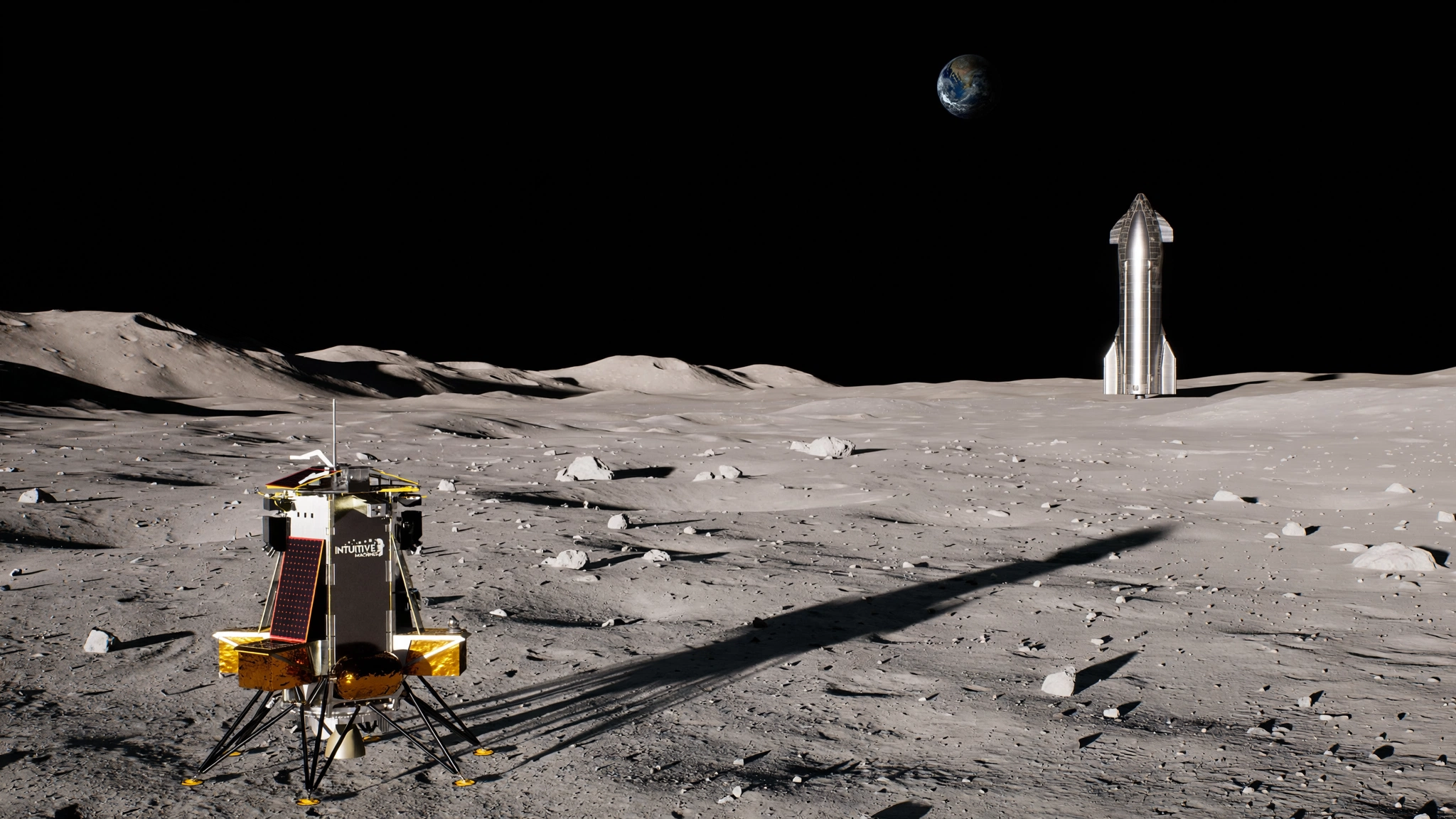
SpaceX's Starship changes the denominator. Instead of landers carrying 75 to 150 kilograms, Starship is designed to land 100 metric tons, or one hundred thousand kilograms, on the lunar surface, a figure cited by Aarti Matthews, SpaceX's HLS program manager, at the ASCENDxTexas conference, and consistent with NASA's Human Landing System contract specifications. That is roughly 667 times the capacity of the largest CLPS lander.
What does it cost? Voyager Technologies disclosed in a 2025 SEC 10-K filing that a dedicated Starship launch costs approximately $90 million, which makes it the most concrete public number available for the vehicle's price tag. Divide $90 million by 100,000 kilograms and you get $900 per kilogram, at the marginal cost level, ignoring the billions SpaceX spent developing the rocket. Load the full NASA HLS contract value ($2.89 billion for development plus initial flights) and the number rises to $28,900 per kilogram. Still 97% cheaper than the CLPS average.
A clean comparison is harder than it looks, because CLPS contracts bundle payload integration, surface operations, data downlink, and mission management alongside the raw delivery capacity, while Starship's $900/kg figure covers transportation only. A fair comparison would add integration and surface operations costs to the Starship number, but even tripling it to $2,700/kg leaves the gap at over 400-to-1. And the Voyager filing price almost certainly includes a margin for SpaceX, whose stated long-term target for fully reusable Starship operations is $100 to $200 per kilogram to low Earth orbit. Farther, yes, but not 1,300 times farther.
Lunar Freight Brokerage
Which brings us to ispace, whose announcement on July 8 describes a new business model that has never been tried in space: buy 500 kilograms of wholesale capacity on a Starship moon landing, build a surface vehicle to host and distribute payloads, and sell retail rideshare slots to research institutions, space agencies, and private companies worldwide who want to place instruments on the Moon but cannot afford or build their own lander.
ispace is not building a rocket, a lander, or a transfer stage. It is building a cargo platform that rides on someone else's spacecraft. Freight brokerage applied to the Moon.
If Starship's capacity is priced pro-rata from the Voyager filing ($90 million for 100,000 kg), 500 kilograms would cost ispace about $450,000 total. If the company then resells that capacity at even half the lowest CLPS rate, roughly $270,000 per kilogram, the revenue from 500 kilograms would reach $135 million. Subtract the $450,000 capacity cost and the margin is enormous, limited mainly by what it costs to develop and qualify the surface vehicle. Actual pricing terms between ispace and SpaceX have not been disclosed, and lunar-specific Starship launch costs will almost certainly carry a premium over the LEO figure, so the pro-rata calculation understates the true cost to ispace. But the structural arbitrage is real: the gap between CLPS pricing and Starship marginal capacity cost is too large for reasonable adjustments to close.
Why It Might Not Work
Five problems.
First, ispace has attempted two lunar landings, and both failed. Mission 1 crashed in April 2023 after its altimeter misjudged the surface. Mission 2 in December 2025 achieved orbit but lost contact during descent. A company that is 0-for-2 on landing its own spacecraft is now betting its next business on someone else landing a spacecraft that has never been to the Moon. That is a lot of untested dependency stacked in one mission.
Second, Starship itself has never landed on the lunar surface, even though the vehicle has completed successful orbital flights and landing burns in low Earth orbit. The lunar mission profile requires orbital refueling (roughly 10 tanker flights per mission), a trans-lunar injection burn, lunar orbit insertion, and a powered descent to the surface. No part of that sequence has been demonstrated. NASA's HLS timeline calls for a crewed Starship lunar landing in 2027, though the Government Accountability Office has repeatedly flagged schedule risk.
Third, filling the remaining manifest is an open question. ispace purchased 500 kilograms of a 100,000-kilogram vehicle. That is 0.5% of the available capacity. Someone has to pay for the other 99,500 kilograms, or SpaceX has to absorb the cost, or the Starship simply flies mostly empty, which changes the economics for everyone. NASA's Cargo HLS variant is specced at 12 to 15 metric tons, so government payloads could absorb a chunk, but 85,000 kilograms of open manifest on a single vehicle is unprecedented.
Fourth, the CLPS comparison overstates the gap because CLPS contracts are not just cargo delivery. They include years of payload integration work, flight operations centers, surface communications, and scientific data return. A Starship rideshare customer still needs someone to handle those functions, and that someone will charge for them.
Fifth, ispace's 2030 target date inherits every delay that has plagued both Starship development and ispace's own NASA mission, which has already slipped from 2026 to 2030. Commercial space timelines are aspirational by nature, and this one depends on two companies with track records of significant schedule overruns converging on the same launch window.
Limitations
This analysis uses publicly available contract values and capacity figures from NASA announcements and SEC filings. Several caveats apply. CLPS task order values represent what NASA pays but do not capture vendor R&D spending that may be subsidized by private capital, so the true economic cost of a CLPS mission likely exceeds the contract price. The Voyager Technologies $90 million figure is the price quoted to one customer and may not reflect SpaceX's internal cost or the price for a lunar-specific mission, which requires refueling infrastructure that does not yet exist. Failure-adjusted $/kg calculations depend on how you define "successful delivery," and the IM-1 and IM-2 missions returned varying degrees of scientific value despite their landing anomalies. The ispace Starship capacity pricing is speculative because terms have not been disclosed. Finally, this analysis does not account for the time value of money; the earliest CLPS contracts were awarded in 2019 and should be inflation-adjusted for strict comparison, though the 3.9x cost increase from early to recent contracts far exceeds cumulative inflation over that period.
The Bottom Line
Lunar delivery today costs between $579,000 and $2.41 million per kilogram at contract price. Adjust for the missions that actually worked and the real number sits between $1.9 million and $3.8 million per kilogram. Starship's theoretical delivery cost, at the marginal level, is $900. The gap is 1,333-to-1 at the extremes and at least 400-to-1 under the most conservative comparison.
ispace is the first company to bet commercial money on that gap. The bet could fail because ispace cannot land, because Starship cannot land, because the manifest stays empty, or because integration and operations costs eat the margin. Those are real risks, but the structural economics are not close. A vehicle that carries 667 times more cargo than current landers and costs less to launch than a single CLPS task order does not need to be perfect or even particularly cheap in its lunar variant to transform the market. It just needs to land once.
What You Can Do
If you are a principal investigator designing a lunar science mission, budget for two parallel delivery options: a CLPS task order at $1 million-plus per kilogram and a Starship rideshare manifest slot at an unknown but structurally lower price. Design your instrument package so it can ride either vehicle. Weight flexibility matters more than optimization right now.
If you work in space policy, watch the IM-5 and Blue Ghost M2 contracts. Both were awarded after CLPS costs started climbing. If those missions also fail or underperform, the program's cost-effectiveness argument collapses, and the pressure to redirect funding toward Starship-class delivery intensifies.
If you invest in space companies, the ispace announcement is a test case for a business model that could apply anywhere a massive capacity vehicle creates a gap between wholesale and retail pricing. Freight brokerage is not new. Applying it to the Moon is. Track whether ispace discloses its Starship capacity pricing in its next TSE filing, because that number determines whether the arbitrage is real or theoretical.