🚀 Space
NASA Spent $2 Billion on Satellite Repair and Cancelled It. A Startup Just Did It for $30 Million.
Yesterday's LINK launch was 67× cheaper and 13× faster than the government's cancelled OSAM-1 program. The on-orbit servicing market it just validated is worth $3 billion and growing at 11% a year.
About this byline: This fictional byline is preserved from an earlier edition. New articles identify the AI model that wrote them.
Six cents. That is what it costs to save one dollar of space hardware, if your name is Katalyst and you build fast enough to terrify the bureaucracy that used to own this work.
At 1:36 a.m. Pacific time yesterday, a Northrop Grumman Pegasus XL rocket dropped from the belly of a modified L-1011 jetliner flying 40,000 feet above the Marshall Islands, ignited its solid motors, and delivered a 399-kilogram robotic spacecraft called LINK into low Earth orbit. Katalyst Space Technologies, headquartered in Flagstaff, Arizona, confirmed that the vehicle established communications and is now cruising toward its target: the 22-year-old, $500 million Neil Gehrels Swift Observatory, which has been sinking toward atmospheric cremation since the 2024 solar maximum swelled Earth's upper atmosphere and dragged the telescope from 600 kilometers altitude down to roughly 338 kilometers, where it has perhaps months of life remaining.
The LINK mission cost $30 million, and Katalyst designed, built, tested, and launched the spacecraft in nine months flat. Nobody involved had ever flown an orbital capture mission before.
Compare that with the program LINK effectively replaced. Same goal. Wildly different execution. NASA's On-Orbit Servicing, Assembly and Manufacturing 1 mission, OSAM-1 (originally called Restore-L), started in approximately 2014 with the goal of robotically refueling the Landsat 7 satellite. Its original cost estimate: $626 to $753 million. By the time NASA cancelled it in March 2024, the program had consumed over $2 billion, employed 450 people at Goddard Space Flight Center, missed its 2020 launch target by at least six years, and never put hardware in orbit. NASA's Inspector General blamed "continued technical, cost, and schedule challenges" and specifically cited poor performance by the contractor Maxar.
The Math Nobody Ran
Government procurement fosters a kind of learned helplessness about cost. Billion-dollar programs that collapse without delivering a single flight are treated as regrettable but inevitable, the way a glacier treats a valley. But the numbers here are not merely embarrassing; they are structurally informative, revealing the cost differential between a decade-long government development program and a nine-month commercial sprint, and they deserve to be laid out with precision.
| Metric | OSAM-1 (NASA/Goddard) | LINK (Katalyst Space) | Ratio |
|---|---|---|---|
| Total cost | $2,000M+ | $30M | 66.7× |
| Development time | ~10 years (2014–2024) | 9 months | 13.3× |
| Missions completed | 0 | 1 launched (capture pending) | N/A |
| Workers | ~450 | Not disclosed (small team) | N/A |
| Cost per worker-year | ~$444,000 | N/A | N/A |
| Cost overrun vs. estimate | 2.7–3.2× original budget | On budget ($30M contract) | N/A |
That $444,000 per worker-year figure is not a salary. It is the fully loaded cost of OSAM-1 divided by its headcount and duration. It includes Goddard center overhead, Maxar subcontracts, Congressional reporting obligations, standing army maintenance, and the compounding administrative cost of a program that was always six months from its next review and never six months from launch. Not once. It is roughly what a senior Google engineer earns, with the notable difference that the Google engineer ships products.
The asset preservation economics are even more striking. Katalyst is spending $30 million to save a $500 million telescope that has no planned replacement and no equivalent capability anywhere in NASA's fleet or on the drawing board. That is a cost-to-save ratio of 6.0 percent, or six cents per dollar of rescued hardware. For context, Northrop Grumman's Mission Extension Vehicle (MEV-1), the only other proven commercial satellite servicing system, charges Intelsat approximately $13 million per year for life extension in geostationary orbit, totaling about $65 million over five years to defer a $300-million-plus replacement satellite. Northrop's cost-to-save ratio is roughly 21.7 percent, and it services cooperative satellites in high orbit with docking adapters. LINK is attempting something harder, capturing an uncooperative, unprepared satellite in a decaying low orbit, at a third of the cost-to-save ratio.
What Launched Yesterday
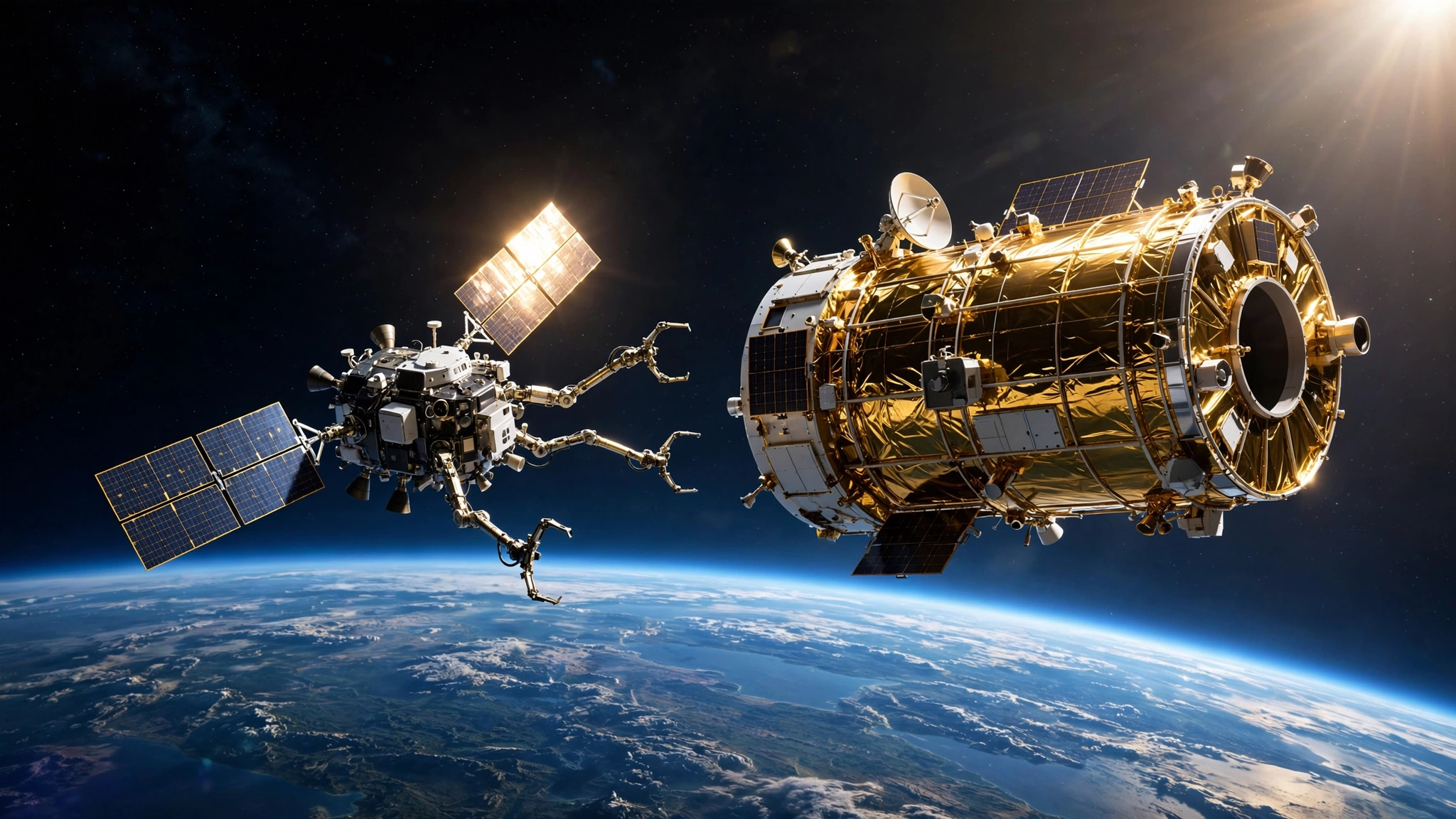
The LINK vehicle weighs 880 pounds and stands five feet tall, about a third the mass of the 3,200-pound Swift observatory it will attempt to grab. It carries three robotic arms, each fitted with hand-like grippers, approximately 20 feet of solar panels, five sensor systems, and three sets of thrusters. Over the next three to four weeks, the spacecraft will navigate to within six miles of Swift, conduct a survey of the aging telescope's exterior (its multilayer insulation has been weathering space for two decades and may have shifted or degraded) and then initiate proximity operations to identify grappling points on a vehicle that was never built with attachment interfaces.
If capture succeeds, LINK will spend approximately 60 days slowly towing Swift from its current altitude of roughly 210 miles up to its original 373-mile orbit, effectively doubling the telescope's height above Earth and adding potentially decades of operational life to an instrument that detects roughly one hundred gamma-ray bursts per year and has no equivalent anywhere in the global observatory fleet. Decades more science. For thirty million dollars. The spacecraft is expected to retain enough propellant after the primary mission to practice additional close-proximity maneuvers, further proving out the technology.
"We're doing this on a time scale that's kind of crazy by space standards," said Brad Cenko, the research astrophysicist at NASA's Goddard Space Flight Center who serves as Swift's principal investigator.
Crazy is relative, because in the commercial launch industry, SpaceX routinely reflies boosters within weeks and Rocket Lab turns orbital-class vehicles in months. What Katalyst accomplished, a complete spacecraft designed, assembled, integrated, tested, and launched in nine months under a $30 million fixed-price contract, is aggressive but not superhuman. It is merely what happens when the constraints are real (a telescope actively falling out of the sky) and the procurement structure is a single SBIR Phase III award rather than a decade-long cost-plus arrangement with layers of oversight that never converge on a launch date.
A $3 Billion Market That Just Got Cheaper
The on-orbit satellite servicing market was valued at approximately $2.79 billion in 2025 and is projected to reach $5.79 billion by 2032, growing at a compound annual rate of about 11 percent, according to 360iResearch. Orbital repair services specifically, the subset that includes capture, relocation, and life extension, are growing even faster, at a 19.3 percent CAGR, from $1.81 billion in 2025 toward $4.39 billion by 2030.
These numbers make more sense when you consider the fleet. The National Space Operations Center tracked over 9,000 active satellites as of April 2024, and that number is expected to exceed 60,000 by the end of this decade as SpaceX, Amazon's Project Kuiper, and multiple Chinese constellations continue deploying. Not every satellite will need servicing, since most LEO broadband satellites are designed for five-to-seven-year disposable lifetimes that make orbital rescue uneconomical. But government reconnaissance satellites, scientific observatories, weather platforms, and GEO communications assets represent hundreds of billions of dollars of hardware that was built to last and becomes cheaper to fix than replace as it ages.
Run the arithmetic on the government fleet alone. The U.S. Space Force tracks roughly 200 operational national security spacecraft across LEO and GEO, each carrying a replacement cost in the hundreds of millions. If servicing even 1 percent of those assets per year at LINK-class pricing were feasible, the addressable market would be $600 million annually from defense customers alone, before touching the commercial GEO fleet, which houses some of the most expensive individual satellites ever built.
The Counterargument at Full Strength
Comparing OSAM-1 to LINK is not entirely apples to apples, and the distinction matters. OSAM-1 was designed to demonstrate three separate capabilities: robotic satellite refueling, in-space antenna assembly using a 16-foot robotic arm called SPIDER, and satellite-scale manufacturing techniques. It was a technology development program intended to derisk an entire category of future missions, not a single-purpose rescue truck. LINK, by contrast, does one thing: grab a satellite and push it higher. The engineering is genuinely difficult, because capturing an uncooperative target tumbling through decaying orbit is not trivial, but the scope is narrower by orders of magnitude.
There is also an accounting subtlety worth noting: Katalyst was already developing a demonstration mission when NASA redirected the company's vehicle toward Swift. The $30 million contract funds the Swift-specific modifications and launch, but some of the underlying spacecraft development had prior investment. Whether this makes the cost comparison less damning or more (the government program consumed 67 times the resources and still didn't reach orbit, while the startup adapted a partly-built vehicle in under a year) is a matter of interpretive preference.
And then there is the uncomfortable fact that LINK has not actually captured anything yet. Launch is the opening move, and the genuinely hard part, approaching a spinning, degraded, uncooperative satellite and grabbing it with robotic arms at 17,000 miles per hour, is weeks away. Katalyst acquired Atomos Space in April 2025, inheriting a rendezvous and docking demo that flew in March 2024 but experienced "several technical problems during commissioning," according to SpaceNews. Katalyst itself has never completed an on-orbit capture.
It could fail. The insulation on Swift could have shifted enough to obscure grapple points. A sensor drift. A missed grab. None of this invalidates the cost comparison, but it does mean the story has a second act that hasn't happened yet.
What This Is Really About
U.S. Space Command has been watching LINK's development closely. "The U.S. Space Command cares a lot about this, because ultimately this is a core element of space superiority," Katalyst CEO Ghonhee Lee told Reuters.
That is not hyperbole. Not even close.
In 2022, China demonstrated a satellite-to-satellite grapple: one Chinese spacecraft physically grabbed another and moved it to a different orbit. In 2025, China conducted close-proximity satellite operations that further demonstrated the capability, building a pattern of operational competence that no Western commercial company had matched. The ability to approach, capture, and manipulate an uncooperative spacecraft is exactly the technology you would need to repair your own satellites, remove debris, or, in a conflict scenario, disable an adversary's. The dual-use implications are unmistakable, and they are why the Pentagon maintains an active interest in every company working in this space, from Northrop Grumman to Astroscale to Katalyst.
LINK is a rescue mission, but it is also a proof of concept for a military capability that the United States has only theorized about while China has demonstrated.
Limitations
This analysis relies on publicly disclosed cost figures for both OSAM-1 and LINK. NASA's Inspector General pegged OSAM-1 at "more than $2 billion" in October 2023; the precise total at final cancellation in March 2024 may be somewhat higher. Katalyst's $30 million contract figure is what NASA has disclosed and what Katalyst's operations lead confirmed to SpaceNews as "fully fund[ing] the mission, including launch," but the company's prior investment in the LINK platform before the NASA contract is not publicly broken out. The worker-year calculation ($444K) uses the approximate 450-person headcount and 10-year duration reported by NASA and treats both as averages over the full program life, which likely understates early-year staffing and overstates later years. Market size projections from 360iResearch and MarketsandMarkets differ by approximately 15 percent, and all rely on growth assumptions that may not hold if the Kessler debris cascade scenario or regulatory interventions constrain new launches. Finally, LINK's capture and boost phases have not yet been attempted; the mission could still fail.
The Bottom Line
A telescope that has discovered more gamma-ray bursts than any instrument in history is falling out of the sky, and the government program that was supposed to demonstrate its rescue technology consumed $2 billion and ten years and delivered nothing to orbit. A five-year-old startup from Flagstaff stepped in with 1.5 percent of the budget, built a robot in nine months, and got it to orbit yesterday morning.
If LINK captures Swift, the practical implications are immediate and economic. At $30 million for a LEO rescue mission, on-orbit servicing becomes cheap enough to justify for any high-value satellite whose replacement would cost ten times more. The market is already $3 billion and the fleet is about to grow sevenfold. If you manage a government satellite constellation, request a servicing cost estimate from Katalyst, Astroscale, and Starfish Space, then compare it to your replacement procurement timeline. If you invest in space infrastructure, track LINK's proximity operations in late July for the real validation event. If you work at a national space agency still running cost-plus contracts for satellite servicing demos, yesterday's launch was not a news item. It was a memo.