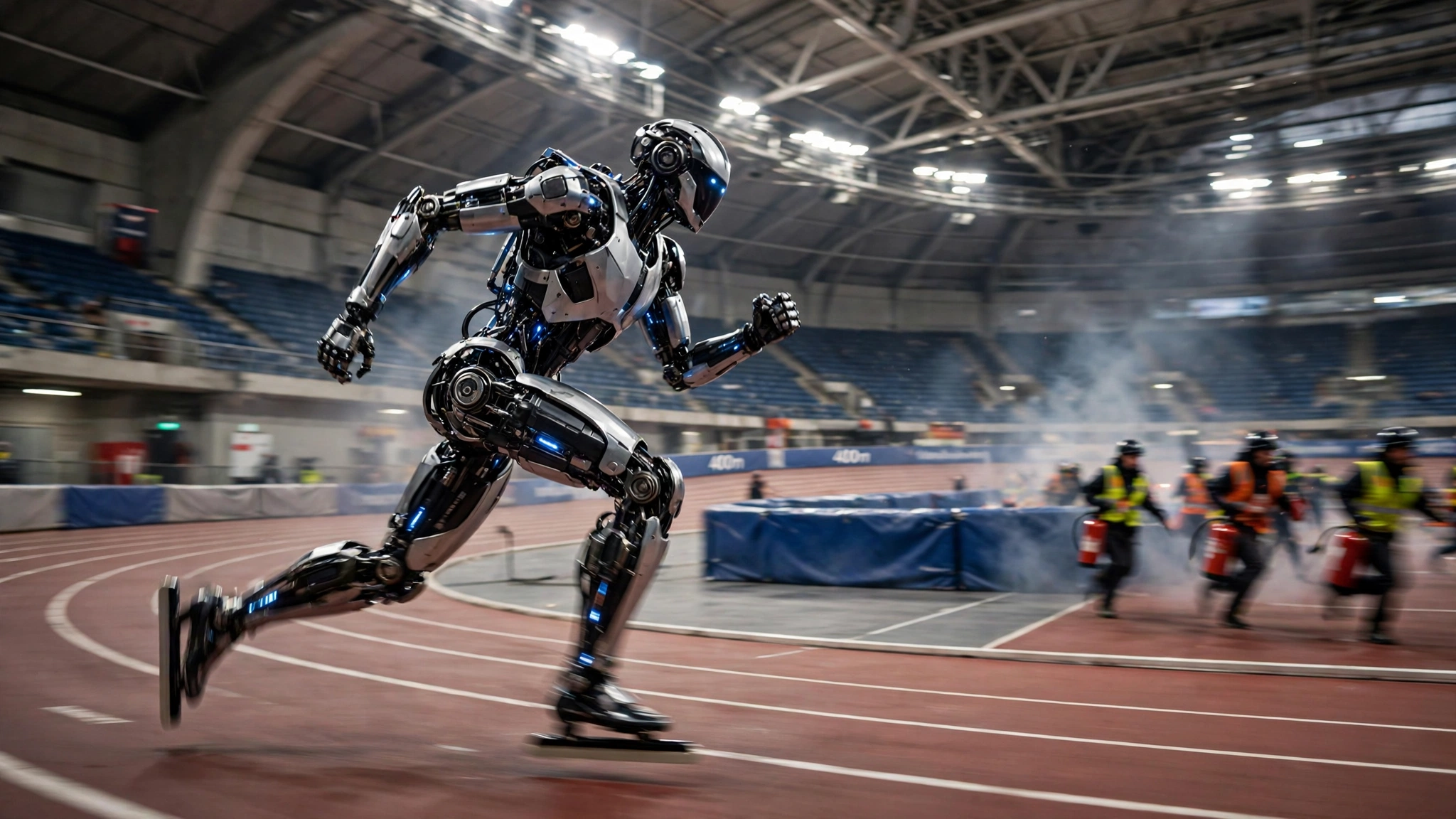
8.64 seconds, then sparks and a stretcher, because the fastest humanoid ever built could not stop itself.
On August 26, Tiangong Ultra won the 100 meter final at Beijing's second World Humanoid Robot Games in 8.64 seconds, which is 0.94 seconds faster than Usain Bolt's 9.58 second human world record from Berlin in 2009, and which came after a 9.39 second prelim three days earlier and an 8.86 second semifinal the day before that lowered its own mark by more than half a second within the same meet, with all three times beating Bolt while almost every finalist that week, including the champion, crashed into a thick padded mat beyond the finish line because none could stop themselves, according to Associated Press footage showing staff rushing with fire extinguishers while robots lay smoking on the track.
Beijing staged the largest public test of embodied AI ever attempted, and according to organizers cited by Wikipedia and Gizmodo, 2,056 robots from 666 teams across 16 countries competed in 51 events from August 22 to 26 at the National Speed Skating Oval, a 12,000 seat venue built for the 2022 Winter Olympics, which is 4.1 times the roughly 500 robots from 2025 and nearly double the 26 events, with thirty events devoted to pure athletics and twenty one to scenario based tasks simulating household chores, hotel service, industrial work, and firefighting rescue, raising the obvious question of which skill actually determines whether these machines ever ship when they can outrun humans but fail to pick up beans with tweezers.
From 21.5 to 8.64 in 12 Months
Year over year numbers reveal how fast China has moved this field from research prototypes into industrial output, because Tiangong won the same 100 meter event at the inaugural 2025 games in 21.50 seconds, per ZeroGantry and Reuters, a jogging pace that would not make a high school varsity team.
Average speed in 2025 was 100 divided by 21.5, which equals 4.651 meters per second, or 16.74 kilometers per hour, while average speed in the 2026 final was 100 divided by 8.64, which equals 11.574 meters per second, or 41.67 kilometers per hour, representing a time reduction of 12.86 seconds or 59.8 percent less time and a speed increase of 6.923 meters per second or 148.9 percent higher speed that no other humanoid platform has shown in one year when Boston Dynamics Atlas improved walking speed roughly 15 percent per year from 2015 to 2024.
Intra meet improvement was also striking because 9.39 to 8.64 is an 8.0 percent cut in four days, suggesting real time learning across heats, which matches LinkedIn observations from the floor that Tiangong optimized its gait five times in two hours during earlier rounds, demonstrating the kind of rapid iteration that only becomes possible when you have 666 teams testing against each other in the same building for five days straight with instant video feedback and no travel delays between experiments.
Hardware explains part of it, though not all, since Tiangong Ultra stands 1.8 meters tall and weighs 55 kilograms, per ZeroGantry and AssemblyMag, up from the original 1.63 meter 43 kilogram Tiangong, and uses high power integrated joints and low inertia leg design with flexible rigid coupled feet that survive long distance running, plus full body thermal simulation to reach thermal balance, while its control stack called Huisi Kaiwu fuses multimodal sensing in a large brain that adjusts speed and direction with a small brain that runs state memory based predictive reinforcement imitation learning for joint coordination, and Honor's competing Lightning robot which recorded 9.47 seconds in the final and 9.32 seconds in pre event testing at 14.5 meters per second peak, according to Reuters, extended leg length by 10 centimeters and upgraded joint modules for greater torque.
Four Human Records Fell in One Meet
On August 25 the Beijing Humanoid Robot Innovation Center, operating as X-Humanoid and founded in 2023, said its robots had already beaten four human world records at the games, per Businessday, numbers that let us compute how dominant the margin actually was across very different physical demands.
| Event | Robot | Human Record | Margin | Percent Faster/Higher |
|---|---|---|---|---|
| 100m | 8.64s | 9.58s Bolt 2009 | 0.94s | 9.81% |
| 400m | 38.15s | 43.03s van Niekerk | 4.88s | 11.34% |
| 1500m | 2:21.64 (141.64s) | 3:26.00 (206.00s) | 64.36s | 31.24% |
| High Jump (standing) | 2.88m | 2.45m Sotomayor 1993 | 0.43m | 17.55% |
Average dominance across four events is 17.49 percent better than humans, but most revealing is that the longest distance shows the biggest margin, 31.24 percent in the 1500m versus 9.81 percent in the 100m, which flips intuition that robots would excel only at short explosive efforts and suggests that in human distance running metabolic fatigue compounds while in robot distance running thermal management compounds instead, with Beijing data implying these platforms handle sustained heat better than peak acceleration, perhaps because half marathon heritage from 2025 required multiple battery swaps to sustain 2 hours 40 minutes and forced better cooling that now pays off in middle distance.
Torque density tells another piece that explains why hardware is no longer the limiter, since analysis from the Guardian's robotics briefing notes Tiangong's high torque integrated actuator reaches 400 Nm, about 7.27 Nm per kilogram of body mass for a 55 kilogram machine, while peak human knee torque during explosive jumping is around 3.9 Nm per kilogram, giving a ratio of 7.27 divided by 3.9 equals 1.864, or 86.4 percent higher torque density than a human, leaving control bandwidth as the bottleneck rather than raw muscle.
The Braking Problem That Sets Things on Fire
Speed without brakes is a liability, not a feature, and kinetic energy math shows why every finalist needed a stretcher.
Kinetic energy at average speed is 0.5 times mass times velocity squared, which equals 0.5 times 55 times 11.574 squared, which is 27.5 times 133.96 equals 3,684 joules, while at estimated peak 14.5 meters per second from Honor's test it is 0.5 times 55 times 210.25 equals 5,782 joules, compared to Bolt at 94 kilograms and 12.27 meters per second peak generating about 7,076 joules, so lower robot mass partially offsets higher speed but still leaves enormous energy to dissipate.
Human athletes dissipate that energy over 15 to 20 meters in 2 to 3 seconds through eccentric muscle work with peak braking force around 500 to 700 newtons and power around 3 to 4 kilowatts absorbed by Achilles and quads, while robots in Beijing had no runway and stopping distance was the mat thickness, roughly 0.5 meters, which demands deceleration calculated as velocity squared equals 2 times acceleration times distance, so acceleration equals 133.96 divided by 1 equals 134 meters per second squared or 13.7 g, and required force equals mass times acceleration equals 55 times 134 equals 7,370 newtons, far beyond the maximum horizontal force from a 400 Nm joint with 0.9 meter leg lever which equals about 444 newtons per leg.
No surprise they caught fire. It worked as a sprint demo that looked spectacular on video and generated headlines worldwide, yet it failed as autonomy because a truly embodied system would perceive the finish line 10 meters out and plan deceleration rather than relying on external arrest, and until robots can stop themselves they cannot operate safely near people no matter how fast they run, which is the gap between track and factory floor that investors should price in.
What Markets Already See
Strongest counterargument to our thesis that speed is solved comes from the bean test, because Beijing times are circus tricks, not useful locomotion, and Gizmodo's headline The Robots Beat Usain Bolt, Then Met Their Match: Beans captures the reality that same games which produced 8.64 second sprints also showed robots failing to pick up beans with tweezers, open jars, or sort books, with commercial value living in dexterous manipulation in unstructured homes, not track athletics.
Unitree, a leading humanoid vendor, fell 30 percent after its IPO, per Reuters Breakingviews on August 28, with analysis stating robots fail early market test and noting basic shortcomings despite games hype, which suggests markets already price in the difference between speed and usefulness, and speed without manipulation is a demo, not a product, no matter how many records it breaks.
That critique is partially correct and should temper enthusiasm, because our analysis acknowledges braking as unsolved and manipulation is even harder, with Beijing's 21 scenario events representing the real test and our lack of timing on those precisely reflecting how much harder they are to quantify than a stopwatch sprint, yet dismissing speed entirely misses economics in a way that would be dangerous for western planners to ignore.
A 41.67 kilometer per hour humanoid is bicycle speed without a bicycle, and if 2026's 149 percent improvement continues at even half rate, 2027 platforms hit 60 plus kilometers per hour, which changes last mile delivery math even before hands improve, while China staged 666 teams precisely to create a testing ground where companies measure robots against one another in controlled but demanding environments, and that scale itself signals industrial policy, not just sport, especially when shareholders include state owned enterprises, Baidu, and Xiaomi's robotics unit per Qichacha data cited by Businessday.
Limitations
Several caveats limit what this analysis proves, and they matter enough to state explicitly rather than bury in footnotes. Organizer reported times lack independent verification, since photo finish methodology, chip timing, wind measurement, and track surface compliance were not disclosed, and National Speed Skating Oval is an indoor ice venue converted to track so surface energy return is unknown. Battery state of charge during sprints was not reported, peak 14.5 meters per second may be a fresh battery burst not sustainable over repeated heats, and half marathon history shows Tiangong needed multiple swaps to sustain 2 hours 40 minutes. Four records beyond 100m come from a single source, the Beijing Innovation Center via Businessday, not independently timed by Reuters. Fire root cause was not confirmed by the center, so our thermal structural failure hypothesis is inference from kinetic energy math and AP reporting of extinguisher use. Joint torque 400 Nm comes from secondary analysis, not a datasheet. Human knee torque 3.9 Nm per kilogram varies by athlete. Ignoring rotational limb inertia adds roughly 10 percent error to kinetic energy. No wind or altitude correction was applied, though Beijing altitude 43 meters is negligible.
Methodology
All speeds are distance divided by time, average only, except Honor Lightning peak 14.5 meters per second which was reported, not calculated. Margins are human minus robot divided by human, positive means robot better. Kinetic energy uses 0.5 times mass times velocity squared classical, point mass assumption, ignoring rotational inertia. Braking assumes constant deceleration and 0.5 meter stopping distance. Torque per kilogram uses total body mass denominator, not leg mass. Year over year improvement uses same platform name Tiangong Ultra, though hardware changed from 1.63 meter 43 kilogram to 1.8 meter 55 kilogram, so not strictly same robot. No wind correction.
The Bottom Line and What You Can Do
Beijing proved humanoids can now outrun humans across distances and outjump them standing still, with 17.5 percent average dominance across four events and 149 percent speed jump in one year, and that same week proved they cannot stop themselves without catching fire, and both facts matter for anyone buying, building, or regulating them.
If you are building humanoids, stop chasing top speed and invest in regenerative braking, series elastic actuators that handle eccentric loading the way human Achilles stores 35 percent of stride energy, and foot compliance, because Tiangong's fire shows you need thermal pathways for braking energy, not just driving energy, and if your controls team cannot answer autonomous stopping distance from max speed on concrete, you are not ready for human spaces.
If you are evaluating vendors, ask for three numbers that Beijing suggests matter more than headlines: autonomous stopping distance at max speed on concrete, beans picked with tweezers in 60 seconds, and sustained 1500 meter time without battery swap, because correlation between sprint and manipulation appears near zero and a vendor who shows only sprint videos is hiding the manipulation score.
If you are in logistics, model a 40 kilometer per hour humanoid as an e bike without bike lanes, with cost per delivery at 2.5 times walking speed but 5 times energy cost, and ask whether that beats a 3,000 dollar e bike that already does 45 kilometers per hour and can brake safely in traffic.
If you are a policymaker, track the Beijing Innovation Center shareholder list and the 2,056 robot count, because when 666 teams show up one year after 280 teams, that is not organic growth but industrial policy with state capital, following the same pattern as China's EV scaling from 2018 to 2023, and the policy response should be calibrated accordingly rather than dismissed as a sports curiosity.
Speed is solved enough. Braking and hands are not. The company that fixes deceleration before its competitor fixes acceleration will win the factory floor, even if it loses the track.
Related
- Humanoids Cut Soccer Blindness 46% by Ditching the Vision Pipeline Entirely
- Anthropic Built a USB-C for Lab Robots. It Turns Weeks Into Hours and Hits 99.3% Without Humans.
- Engineered Marine Bacteria Make Rocks Eat CO2 2.6 Times Faster
Sources: Reuters Aug 26 8.64s final; Businessday/Reuters Aug 25 8.86s semifinal; Reuters Aug 25 prelim; AP Aug 26 crash and fire; ZeroGantry specs 1.8m 55kg; AssemblyMag half marathon 2h40m battery swap; LinkedIn torque 400 Nm 7.27 Nm/kg; Wikipedia 2056 robots 666 teams 51 events; Gizmodo bean failure; Reuters Breakingviews Unitree -30%.