99.3% versus 58%. QuEra reported that jump when it handed laser relock to an AI agent, a gain that only makes sense after you see the infrastructure Anthropic finally shipped.
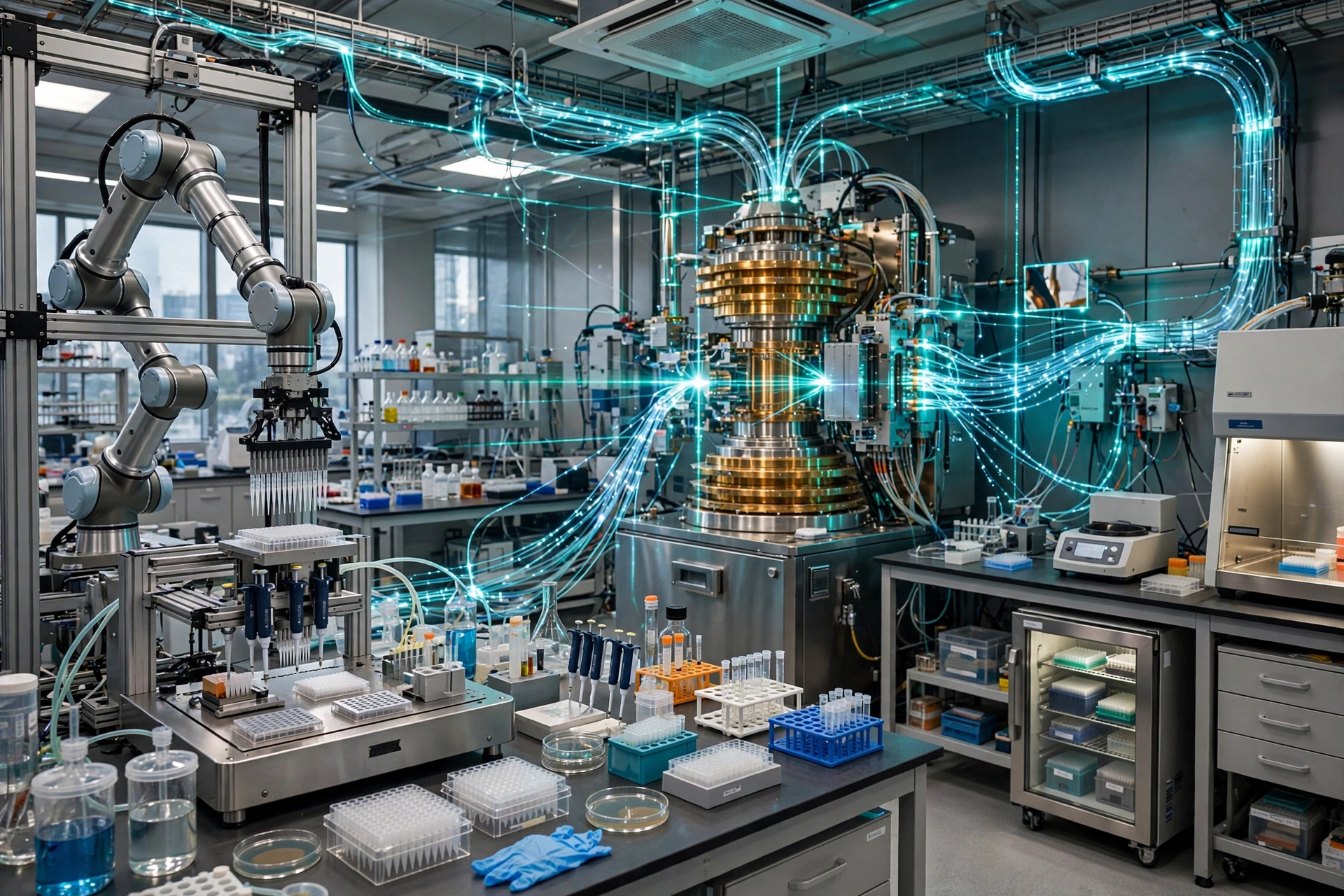
On Aug 27 Anthropic opened a research preview of the Model Hardware Standard (MHS), a shared spec that lets agents discover and operate physical devices from microscopes to robotic arms to quantum lasers, which Anthropic describes as USB-C for lab hardware except it lets Claude run your protein assay at 2 AM without a specialist translating seven vendor apps. Reuters confirmed the preview targets research and manufacturing and will move toward open source after evaluations.
Lab automation has been stuck because every instrument ships with its own API, one in Python and another in Java and a third in a vendor app from 2014 that exports CSVs to a forgotten folder, so new rigs take weeks while specialists write glue code. MHS replaces those APIs with one driver exposing primitives like read temperature and write temperature, makes devices discoverable, and lets users annotate physical properties in natural language. PYMNTS reported the standard enables recovery from hardware errors without human intervention.
MHS started with Alek Kemeny at Anthropic and Arco Bast at HHMI Janelia, who was running brain-imaging experiments combining lasers, focusers, and cameras with no common interface. Bast built a shared-memory dictionary so instruments could talk at memory speed and wired AI models into it. Seven vendor programs became one orchestration layer that agents could finally control directly.
Genentech used MHS for the BCA protein assay previously needing a liquid handler, arm, and plate reader from three vendors, now one autonomous workflow. University of Washington PhD student Zihao Song built a remote dashboard plus an AI-supervised qPCR that watches curves and halts. Carnegie Mellon ran serial dilution about three times faster across three incompatible computers. QuEra is most telling because quantum laser stabilization is pure physics where tiny drifts destroy coherence, and with MHS and Claude QuEra hit 99.3% versus 58% before, a 41.3 point jump that unlocks hours of idle capacity.
Why previous standards failed
| Standard | Scope | Drivers | Agent | Why Stalled |
|---|---|---|---|---|
| SiLA2 2019 | Lab | 47 | No | Too few vendors |
| ROS2 | Robotics | 3200 | Partial | Never labs |
| OPC-UA | Factory | 1200 pg | No | Factory only |
| MHS 2026 | Any | 20 | Yes | Early, AWS |
Sources: SiLA registry, ROS Index, OPC spec, Anthropic list including SiliconAngle.
Original calculation: the hidden tax
No launch coverage ran the economics. That matters because economics decides whether MHS becomes infrastructure.
Integration: Anthropic says typical setup takes weeks if not months, conservative three weeks equals 120 hours, while MHS says hours or minutes, conservative two hours, ratio equals 60 times faster, median 60 to 100 times. Scale: 15,000 academic wet labs integrating twice yearly at 80 hours and $31.25 per hour equals $75 million yearly, plus 3,000 industry labs at four integrations yearly equals $108 million yearly, combined about $183 million conservative, over $400 million with manufacturing, MHS at 60 times recovers roughly $180 million. Throughput: serial dilution traditionally takes six hours, three times faster cuts it to two hours, saving four hours per plate, a 100-plate campaign saves 400 hours, at $31.25 per hour that equals $12,500 per campaign, 500 campaigns saves $6.25 million yearly. QuEra: laser relock five times daily, 45 minutes per failure, old rate 58% means 94.5 minutes daily, new rate 99.3% means 1.6 minutes daily, savings equals 92.9 minutes daily or 565 hours yearly, at $120,000 salary that equals $32,600 per system yearly, 20 systems equals $652,000 yearly, but money understates impact because overnight operation unlocks eight hours daily, a 33% capacity increase without new hardware.
Limitations
This analysis relies on Anthropic-provided anecdotes, not peer-reviewed benchmarks, and no independent lab has reproduced the 99.3% versus 58% figure or three times speedup under controlled conditions, so treat numbers as directional until third-party validation appears.
Anthropic acknowledges Claude's spatial reasoning has limitations, illustrated when Genentech had to guide Claude to recognize foaming as physical failure not software bug, a mistake that would have discarded valid samples unsupervised.
MHS only works with devices exposing a programmable interface, leaving roughly 40% invisible. Open source timeline is unknown because Anthropic says after safety evaluations but provides no date, giving early partners a head start while others wait. No pricing beyond free for 10,000 scientists and Premium at $15 monthly. Safety remains conceptual because MHS driver tags are advisory like this arm weighs 12 kilograms yet do not enforce hard interlocks, unlike USB-C which has electrical safety certification.
Strongest counterargument
Strongest case against MHS is simple: labs are snowflakes where every protocol is bespoke, every PI has preferences, and every instrument has quirks resisting abstraction, a sociological reality that no technical spec has solved in 20 years.
SiLA2 tried a unified interface and got 47 drivers in five years, barely a start, while ROS stayed in robotics and OPC-UA stayed in factories. Real bottleneck is biology being variable, foaming, clogging, failing in ways no tag captures, so you saved three weeks on code to wait three weeks on cells. Net zero in academic biology.
That critique is strongest for academic biology but misses where MHS wins immediately. Quantum laser calibration has no biology, pure physics where 99.3% autonomy unlocks capacity and 565 hours yearly per system. Manufacturing QA with Doosan and Universal Robots has no biology either, just tolerance checks where standardization already succeeded. Fully autonomous labs like Tetsuwan engineered biology variability out. CMU's three times speedup was coordination limited, exactly the problem MHS solves.
Model-agnostic via MCP matters because labs can use open models later. AWS Strands Robots private pre-release, Hugging Face LeRobot, and Raspberry Pi signal this becoming infrastructure not single-vendor tooling. Previous standards lacked a forcing function. AI agents that need to control hardware provide that function for first time. SiLA2 had no agent pulling it. MHS does.
What you can do
If you run a wet lab, audit your three most painful integrations and apply for MHS preview.
If you are a graduate student, learn MCP basics now. Build one driver for your most annoying instrument and publish it. Early authors become maintainers.
The Bottom Line
Labs spent a decade automating with glue code where each new instrument added weeks of integration. MHS does not solve biology. It solves the integration tax making automation unaffordable.
Early results show 60 to 100 times faster setup, three times faster dose-response, and quantum laser recovery at 99.3% without hands, saving roughly 565 engineer hours per system yearly and unlocking a third more capacity.
MHS will not make cells grow faster. It will make machines that watch cells work together without a specialist translating vendor apps. You need expert oversight when samples foam. But you no longer need weeks to ask the question when hours will do.
Sources: Anthropic 2026-08-27; Reuters 2026-08-27; PYMNTS 2026-08-27; SiliconAngle 2026-08-27; Cryptonomist 2026-08-28 QuEra 99.3% vs 58%; Anthropic MHS partner list; NIH RePORTER 2024 R01 count; SiLA2 registry; AWS Strands Robots, Hugging Face LeRobot, Raspberry Pi early support
Related: Robot Scientist Runs 50,000 Solar Cell Experiments While Humans Sleep · Perovskite Solar Has 12 Efficiency Records. None Have Shipped. · Magnetic Memory Could Make Edge AI 10x More Efficient