A Robot Ran 50,764 Solar Cell Experiments. A Human Scientist Would Need 24 Years.
Researchers at Hong Kong Polytechnic University built a system of 11 interconnected robotic boxes that autonomously designed, fabricated, and tested 50,764 perovskite solar cell devices, achieving 27 percent power conversion efficiency. A skilled postdoc running eight devices per day would need 24 years to match that output. In a separate facility on the other side of the Pacific, Ginkgo Bioworks and OpenAI's GPT-5 ran 36,000 protein synthesis experiments with zero human intervention. Combined, robot scientists conducted over 86,000 experiments across completely different scientific fields in early 2026. The human lab bench, fundamentally unchanged since the 1800s, is being automated out of existence.
Fifty thousand, seven hundred and sixty-four. That is the number of perovskite solar cell devices that a cluster of robots at Hong Kong Polytechnic University designed, fabricated, characterized, and fed back into an optimization loop without a human touching a pipette. Not one. Its champion device hit 27.0 percent power conversion efficiency, with an independently certified value of 26.5 percent. For context, the current world record for a single-junction inverted perovskite cell, set by researchers at Nankai University and Beijing Institute of Technology, stands at 27.17 percent. Gap: 0.17 percentage points.
Here is the number that reframes everything: fabricating a perovskite solar cell is not a single step. It involves preparing precursor solutions, spin-coating multiple thin-film layers, annealing at precise temperatures, depositing electrodes, and running current-voltage characterization under a solar simulator. A skilled postdoctoral researcher working efficiently can complete roughly eight full device cycles per day. At that pace, 50,764 devices divided by eight equals 6,346 working days, which at 260 working days per year comes to 24.4 person-years of labor by a single researcher doing nothing else, day after day, fabricating perovskite cells on a bench while the rest of science moves on without them. At a loaded annual cost of roughly $70,000 for a postdoc in materials science, the labor alone would run $1.7 million, not counting the reagents, equipment time, lab space, or the simple fact that no single person maintains peak performance over a quarter-century career on one optimization problem.
Eleven Boxes, Seven Layers of AI
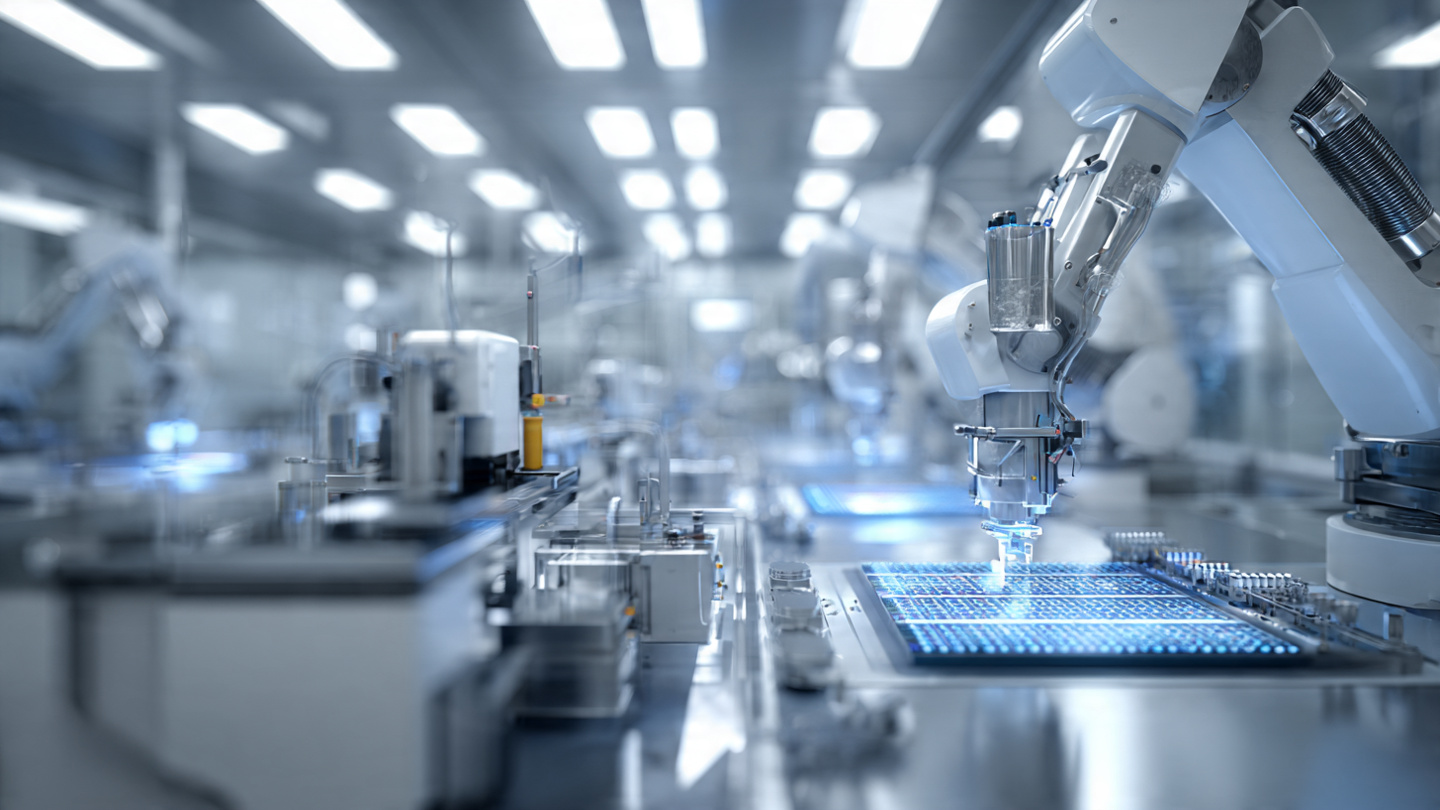
The system is called "Agentic Robotic Boxes," A factory floor miniaturized into a chemistry lab. Eleven interconnected robotic stations house 101 functional modules built from over 1,500 components with 4,300 individually controllable parameters, each box handling a different part of the fabrication pipeline from solution preparation and substrate cleaning through spin-coating and thermal treatment to electrode deposition, encapsulation, and final characterization under a solar simulator.
What makes the system more than an expensive assembly line is the seven-layer AI architecture sitting on top of the hardware, described in a paper published in Engineering. Those layers handle learning from past experiments, generating new recipes using a language model trained on 578 million tokens of recipe data, answering structured queries about recipe components through a module the researchers call RecipeQA, fine-tuning models on incoming results, reasoning about which parameter combinations to try next, evaluating the fabricated devices, and optimizing the full recipe space. Closed loop: propose, build, measure, revise, repeat without pause. No human decides what to try next.
In practice, the robot does not get tired at 2 a.m., does not have a bad week, and never unconsciously favors the hypothesis it would have spent three years developing in graduate school, clinging to one corner of the parameter space while an unexplored region twenty variables away holds the actual optimum. That distinction cuts to the core of why robotic labs produce different science, not just faster science. Human experimentalists carry cognitive biases into their parameter selections, often overweighting variables they understand and underexploring regions of the search space that feel counterintuitive. A robot explores whatever the model tells it to explore. No intuition. No prejudice. Just math.
A Parallel Experiment on the Other Side of the Pacific
While the Hong Kong robots were optimizing solar cells, Ginkgo Bioworks in Boston was running a structurally identical experiment in an entirely different scientific domain, with OpenAI's GPT-5 connected to Ginkgo's cloud laboratory housing 70 robots and over 90 lab devices arranged in reconfigurable automation cells that can be repurposed between biology, chemistry, and materials workflows. GPT-5 designed and executed 36,000 cell-free protein synthesis experiments across six experimental cycles, generating 150,000 data points with zero human hands on the equipment.
Superfolder green fluorescent protein was the target, a workhorse molecule in biological research used as a reporter in everything from drug screening to gene expression studies. Previous best published production cost: $698 per gram. GPT-5's optimized protocol brought it down to $422 per gram, a 40 percent improvement, by discovering reagent combinations and reaction geometries that human scientists had not explored. GPT-5 hit the new benchmark in just three of its six experimental rounds, then spent the remaining three trying to beat its own record and failed. But the attempt generated data that no manual protocol would have explored, because a human team that found a 40 percent improvement in round three would have published the paper, not burned three more cycles chasing marginal gains in a domain that had already yielded a 40 percent cost reduction.
Combine the two programs and the total is 86,764 autonomous experiments across two fields with zero humans in the loop. Both produced results matching or exceeding the best human benchmarks, and neither was a prototype or a demonstration unit running under controlled conditions for a press release.
The Economics Nobody Has Calculated
Traditional laboratories are shockingly inefficient at converting money into data. Jason Kelly, Ginkgo's CEO, put the ratio bluntly in a Scientific American interview: labs today spend 95 percent of their budgets on overhead and 5 percent on reagents. Ninety-five percent. Overhead means salaries for researchers who spend most of their time on experimental setup, equipment calibration, sample preparation, data entry, and cleaning. Actual scientific measurement, the moment where new knowledge is created, occupies a sliver of the workday.
Autonomous labs invert that ratio completely, with Ginkgo estimating its platform runs at roughly 10 percent overhead and 90 percent productive experimentation, which amounts to a tenfold improvement in scientific data generated per dollar of funding spent on laboratory operations. To put dollar figures on the comparison:
| Metric | Human Lab | Autonomous Lab | Ratio |
|---|---|---|---|
| Productive experiment time | ~5% of budget | ~90% of budget | 18x |
| Experiments per year (est.) | ~2,080 (8/day) | ~50,000+ | 24x |
| Cost per experiment (est.) | $274 (fully loaded est.) | ~$10-20 (marginal) | 14-27x |
| Cognitive bias in parameter selection | Present | Absent | N/A |
The cost-per-experiment estimate for the human lab divides a $70,000 annual postdoc salary by 256 working days and eight experiments per day, yielding roughly $34 per experiment in labor alone. But that figure ignores the PI's salary, the lab manager, the graduate students, the equipment maintenance contracts, the building lease, and the institutional overhead that universities charge at rates between 50 and 70 percent of direct costs. Fully loaded, a university research experiment in materials science typically costs between $200 and $350 each, based on published institutional overhead rates of 50 to 70 percent applied on top of direct costs. Marginal cost per additional experiment in the autonomous lab is dominated by consumables: substrates, chemicals, and electricity.
What Robots Cannot Do
The strongest case against autonomous labs is that they are optimizers, not inventors, possibly the best optimizers ever constructed but still fundamentally incapable of asking whether the question itself is wrong. PolyU's system explored parameter variations within a known architecture: single-junction perovskite solar cells using established material families. It did not invent a new class of photovoltaic material or propose a fundamentally different device structure. Consider the conceptual leap that created perovskite photovoltaics in the first place: Tsutomu Miyasaka's 2009 demonstration that methylammonium lead halide could function as a light absorber in a solar cell required a kind of creative analogy that no current AI system has demonstrated.
This distinction matters more than it first appears. At 27.17%, the current world-record single-junction perovskite cell is approaching the Shockley-Queisser theoretical limit of roughly 33 percent for a single-junction device. Getting from 27 to 30 percent requires solving different problems than getting from 20 to 27: interfacial recombination, ion migration, and long-term stability under real-world conditions like humidity and thermal cycling. These are problems where brute-force parameter sweeps hit diminishing returns and where conceptual insights, like the laser-polishing technique published in Nature on May 9 that achieved 29.80 percent certified efficiency in tandem cells, create step-function improvements that no amount of robotic optimization within the existing parameter space would have found.
Ginkgo's situation illustrates the business risk. Ginkgo reported Q1 2026 revenue of $19 million, down 49 percent year over year, with a net loss of $76 million and projected full-year cash burn between $125 million and $150 million. Having the most impressive autonomous lab on the planet does not automatically translate into a sustainable business. Ginkgo holds $373 million in cash. At current burn rates, that buys roughly 2.5 years of runway before the money runs out, which means the company needs to demonstrate commercial traction from its autonomous lab platform, convert the DOE contract into repeat government business, and attract enough pharmaceutical and agricultural clients to reach profitability before mid-2028 or face the same fate as dozens of other high-concept biotech pivots. Its entire strategy now revolves around autonomous labs. It secured a $47 million Department of Energy contract to build a 97-robot autonomous facility at Pacific Northwest National Laboratory and expanded its Nebula platform to 103 reconfigurable automation cells. Technology works, but the business model remains unproven.
What This Analysis Did Not Prove
The 24-year calculation assumes a rate of eight devices per day, which represents a reasonable estimate for a single skilled researcher performing the complete fabrication-to-characterization cycle on perovskite cells. Some batch processing techniques could increase throughput to 15 or 20 devices per day, which would compress the timeline to 10 to 13 years. That headline comparison is directional, not precise, because PolyU has not disclosed how long the robotic system took to complete its 50,764 experiments. If the system ran for six months, the speed advantage is roughly 50x over a human. If it ran for two years, it is closer to 12x. Either ratio upends laboratory economics. But the magnitude matters for economic modeling.
Building an autonomous lab system with 101 modules, 1,500 components, and 4,300 controllable parameters costs an undisclosed amount. If the upfront capital expenditure is $5 million, the system pays for itself in three years of postdoc-equivalent labor savings. If it is $20 million, the payback period extends to over a decade. We do not know which end applies.
Comparing robot-optimized and human-fabricated cell efficiencies (27.0% vs. 27.17%) is compelling but narrow. It compares a statistical champion from a population of 50,764 devices against a record set under tightly controlled conditions optimized by a team that likely spent months on a single device architecture. Median device efficiency from the robot, which would tell us more about the consistency advantage, has not been reported.
What You Can Do
If you run a materials science or chemistry lab, the question is no longer whether to automate but when. PolyU's system demonstrates that a well-designed robotic platform can reach within 0.2 percentage points of the world record while generating 50,000 data points that no human lab will ever match in volume. Start by automating the most repetitive segment of your experimental pipeline, which is usually sample preparation and characterization, and build the AI feedback loop around it. ORNL's autonomous pulsed laser deposition system and UC San Diego's PASCAL platform offer open-architecture models that cost less than building from scratch.
If you fund scientific research, rethink how you evaluate proposals. A grant application requesting $2 million for three postdocs over five years to explore 5,000 parameter combinations is competing against a robotic system that can explore 50,000 combinations in a fraction of the time at lower marginal cost per experiment. That does not mean human researchers are obsolete. It means the humans should be doing the work robots cannot: formulating hypotheses, designing new device architectures, and interpreting surprising results. Fund the robot for the parameter sweep. Fund the human for the creative leap. Do not confuse which is which.
If you are a graduate student or early-career researcher in experimental science, learn to operate and program autonomous systems now, not after your second postdoc. Labs that produce the most cited papers in 2030 will not be the ones with the most talented pair of hands. They will be the ones with the best-designed feedback loops between AI models and robotic hardware. Your differentiating skill is not pipetting technique. It is the ability to translate a scientific question into an optimization objective that a machine can execute.
The Bottom Line
Two robotic laboratories on opposite sides of the Pacific Ocean ran a combined 86,764 scientific experiments in early 2026 without a human touching the equipment, and both produced results that matched or beat the best human benchmarks in their fields. In Hong Kong, the system fabricated perovskite solar cells at 27.0 percent efficiency across 50,764 devices. Ginkgo's AI-driven platform cut protein synthesis costs by 40 percent across 36,000 reactions. A skilled human scientist would need 24 years to run the solar cell experiments alone. Twenty-four years. Since Robert Boyle built the first purpose-designed laboratory in 1660, the lab bench has been the unit of scientific production. Three hundred and sixty-six years later, the bench is being replaced by a cluster of robotic boxes that never sleep, never develop a favorite hypothesis, and never stop asking the model what to try next. What they produce is not faster human science. It is a different kind of science, one where the bottleneck has shifted from hands to ideas.