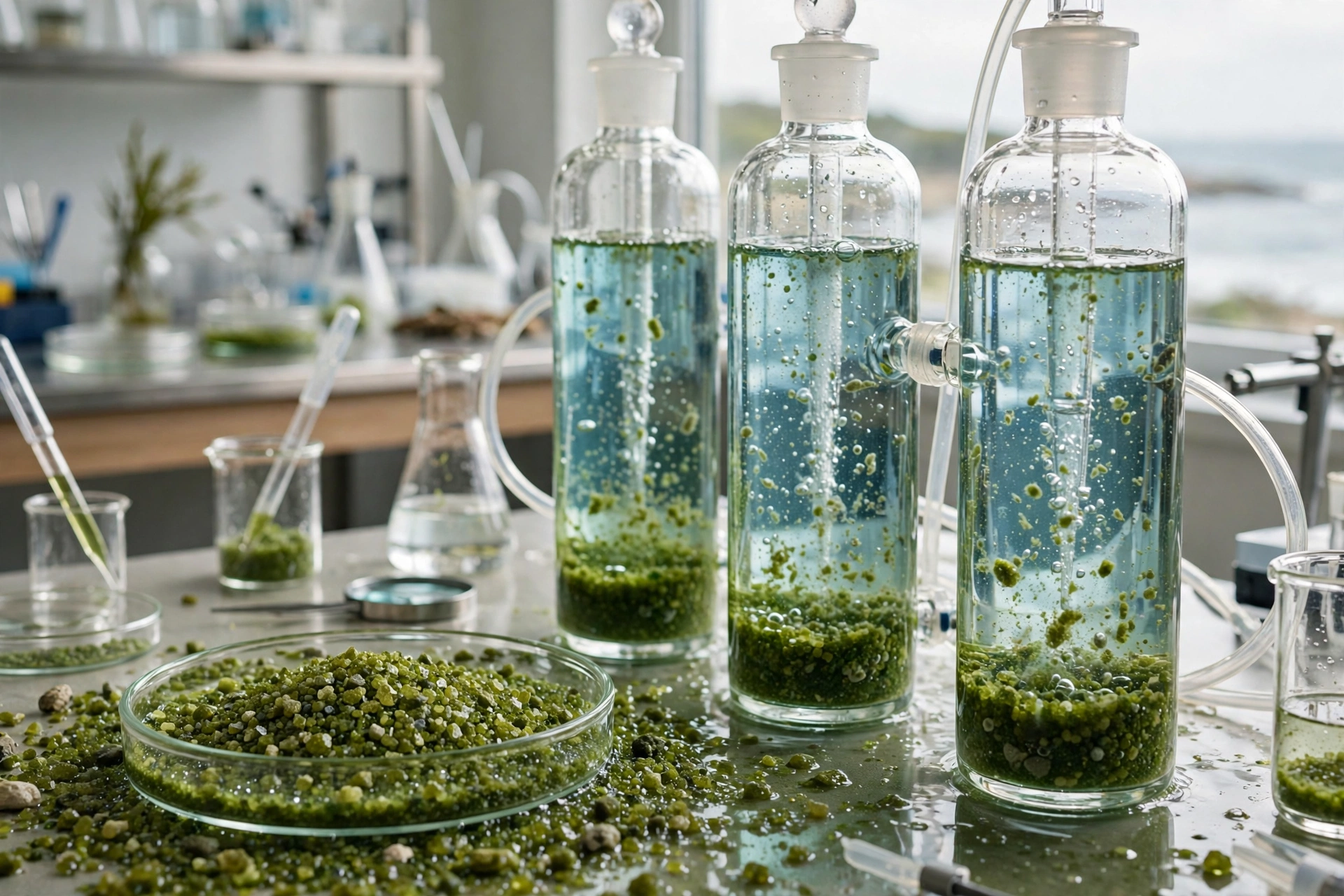
Half a gram per day does not sound like climate salvation, yet that is how much CO2 a pilot reactor full of green olivine sand and raw Boston Harbor seawater pulled from the air last month while demonstrating a biological trick that could make enhanced rock weathering actually measurable at industrial scale.
Researchers at Harvard's Wyss Institute, Harvard Medical School, and Stanford's Doerr School of Sustainability rewired a widespread marine bacterium, Alteromonas macleodii, to ignore its own iron hunger and keep producing siderophores, molecules that pry rust off minerals, even when swimming in iron-rich olivine slurries that normally shut wild bacteria down completely.
Normally this bacterium makes petrobactin only when starved for iron, and as soon as it dissolves enough olivine to get iron, it stops, which is self-defeating at industrial scale where you want continuous derusting of mineral surfaces for months, not hours, to generate alkalinity.
Lead author Neil Dalvie and colleagues decoupled that regulation by putting the entire petrobactin synthesis operon asb under synthetic constitutive promoters from the Anderson library, creating variant asb+P with promoter J23100 that makes more than 100 times more petrobactin than wild type when growing on olivine, and a genomically integrated version asb+G with the strongest promoter J23101 that survives without antibiotics and is suitable for open seawater basins.
Continuous mineral bioreactors, modified eVOLVER chemostats that retain olivine sand by settling while seawater flows through, showed why this matters. Wild-type bacteria expressed siderophore genes only with low olivine mass and high dilution rates, a narrow iron-limited sliver of operating space. With high olivine loads, the kind you would actually use at scale, expression collapsed completely. Engineered strains kept asbA and asbC switched on across all conditions tested, from iron-starved to iron-replete.
Dissolution followed the genetics. Using nickel as a proxy for olivine breakdown, because magnesium background in seawater is too high to detect small changes at lab scale, engineered bacteria increased nickel release 2.6 plus minus 1.0 fold versus abiotic controls, p equals 0.03 with n equals 4 after Tukey correction, while wild type was not significantly different from abiotic controls under identical iron-replete conditions.
Pilot-scale vessels, more than 4 kilograms of construction-grade olivine submerged under 2.5 liters of raw Boston Harbor water with 1.5 liters per day flow, gentle stirring at 200 rpm, weekly reinoculation of 140 milliliters saturated asb+G culture, and continuous nutrient feed at 1 to 50 dilution, achieved 3.1-fold magnesium release increase over abiotic seawater and 0.57 grams calcium carbonate alkalinity per day, which translates to 0.50 grams CO2 removed per day as bicarbonate assuming conservative carbonate chemistry.
Doing the math nobody did
Theoretical maximum helps ground these numbers in physical reality that no press release bothered to calculate. Olivine forsterite Mg2SiO4 weighs about 140.7 grams per mole and can sequester 4 moles CO2 as 4 bicarbonate ions via Mg2SiO4 plus 4CO2 plus 4H2O to 2Mg2+ plus H4SiO4 plus 4HCO3 minus, and since four moles CO2 weigh 176 grams, dividing 176 by 140.7 yields 1.25 kilograms CO2 per kilogram olivine if fully dissolved, with real olivine MgFeSiO4 mix averaging closer to 1.17 kilograms CO2 per kilogram.
Pilot data show 0.5 grams CO2 per day from 4000 grams olivine, or 0.125 grams CO2 per kilogram olivine per day, meaning to dissolve one kilogram olivine fully at that rate would take 1170 divided by 0.125 equals 9360 days, about 25.6 years of continuous operation, while abiotic seawater at 2.6 times slower would need roughly 66.6 years, still faster than geological weathering that takes centuries but nowhere near fast enough for gigaton-scale climate relevance without massive parallelization.
Life cycle analysis from Stanford coauthors Abigail Fitzgibbon and Steven Davis, who have developed models to quantify carbon emissions of industrial processes and air quality effects, modeled a hypothetical industrial unit holding 150 tons olivine sand beneath 0.3 meters stirred seawater, about 24,000 liters continuously replaced, and found control seawater alone grosses 0.71 kilograms CO2 per day with pumping and procurement emitting only 0.06 kilograms for net 0.65 kilograms per day.
Wild bacteria fed enough carbon and nitrogen to incorporate all iron released from olivine into biomass and force continuous iron limitation grossed 1.81 kilograms per day, a 2.6-fold improvement mirroring lab data, but needed so much glucose that emissions hit 63.09 kilograms per day, or 11.71 kilograms even with renewable feedstock, turning the supposed carbon removal system into a substantial net emitter that would make climate change worse if deployed.
Engineered plus renewable acetate grossed same 1.81 kilograms per day, upstream emissions only 0.68 kilograms per day because nutrient requirement to make siderophores is substantially lower than requirement to make whole biomass, netting 1.13 kilograms per day, a 74 percent increase over control that finally makes biological acceleration climate-positive, at least on paper with optimistic feedstock assumptions.
Annualized, 1.13 times 365 equals 412 kilograms CO2 per year per 150-ton reactor, control does 237 kilograms per year, extra 175 kilograms per year is the engineered advantage that synthetic biology buys you, which sounds modest until you remember this is a single small basin.
Scale that to one megaton CO2 per year and the numbers become sobering. One billion kilograms divided by 412 equals 2,424,536 reactors, each holding 150 tons olivine for standing inventory of 363 million tons olivine, each circulating 24,000 liters seawater for total volume of 58 billion liters in continuous flow, with construction-grade olivine at 15 to 30 dollars per ton from USGS 2024 pricing implying 2,250 to 4,500 dollars mineral capex per reactor or 5.5 to 10.9 billion dollars mineral inventory alone for one megaton per year capacity, before basins, pumps, acetate, or weekly inoculation logistics.
Direct air capture today runs 500 to 1000 dollars per ton CO2, so one megaton via DAC costs 500 million to one billion dollars per year operational, meaning this bioreactor fleet would have similar capex in rock alone plus ongoing biological maintenance, which is not cheap, yet measurability matters enormously for carbon markets where unmeasured enhanced rock weathering credits trade at deep discounts or not at all.
Why this approach stands out
Previous attempts to accelerate weathering used acids. Cornell teams engineered Gluconobacter oxydans to make organic acids that dissolved olivine 58 times faster in 2024 and 2025 papers, extracting up to 75 percent of magnesium plus nickel and cobalt from olivine in 15 days, but acids destroy alkalinity, and the whole point of enhanced weathering is to generate bicarbonate alkalinity that stores CO2 long term in seawater as stable dissolved inorganic carbon.
Harvard's siderophore route works at neutral pH in seawater, the cheapest abundant medium on Earth, and produces alkalinity directly without chemical inputs that preclude net carbon removal. Siderophores solubilize ferric iron that otherwise forms rust Fe2O3 on mineral surfaces and passivates them, preventing further dissolution in a process that mirrors how natural weathering stalls in the field after initial rapid dissolution coats grains in iron oxides.
Promoter characterization showed more than 30-fold fluorescence range across Anderson library, with strongest promoter J23101 lethal on plasmid yet tolerated when genomically integrated, a detail that matters for scale-up because plasmid strains need antibiotic selection that is impossible in open seawater basins resembling sewage plants, while genomic integrants remain stable without selection pressure.
Limitations
This analysis relies on nickel as proxy at lab scale because seawater magnesium background masks small dissolution signals, while magnesium was used at pilot scale but calcium removal was observed in both break-in and test periods, suggesting calcium carbonate precipitation may be occurring and would release CO2, partially offsetting removal in ways that alkalinity accounting, which subtracts inlet and nutrient background, does not fully capture due to buffered seawater carbonate chemistry where some bicarbonate could re-equilibrate with atmosphere if not permanently stored at depth.
Fold increase 2.6 plus minus 1.0 has large uncertainty, 95 percent confidence interval roughly 1.6 to 3.6, p equals 0.03 borderline significant with four replicates per condition after Tukey correction, pilot 0.5 grams per day averaged over days 36 to 48 only after one month break-in, biofilm accumulated on all reactor surfaces after about three weeks which could clog flow paths long term and was not quantified for impact on dissolution rates or maintenance requirements.
Engineered strain asb+G remained stable for about seven residence times in unprocessed seawater before declining, versus wild type stable about twenty residence times, which matches LCA requirement of at least one week survival to maximize net removal but requires weekly reinoculation forever, with operational cost and logistics of growing 140 milliliters saturated culture per reactor per week at million-reactor scale not modeled in current LCA.
Biosafety assessment is limited to calling the strategy easily applicable and risk-free, proposing to grow strains in large basins resembling sewage plants continuously pumping unprocessed seawater in and releasing alkaline seawater back into ocean where bound carbon would be harmless and buffered away, with no data presented on horizontal gene transfer of synthetic constitutive promoter plus asb operon to wild marine bacteria, ecological impact of constitutive iron chelation in coastal waters, or fate of engineered cells after release into ocean ecosystems where iron availability limits phytoplankton growth.
Feedstock assumption drives net negativity and was handled conservatively in LCA using zero kilograms CO2 per kilogram carbon for renewable acetate versus 2.8 kilograms for glucose which also acidifies medium losing more than 3 milligrams calcium carbonate per gram glucose fed and overwhelming alkalinity gain, while claimed renewable acetate from Lectrolyst removes about 1.5 kilograms CO2 per kilogram acetate via CO2-consuming electrochemical production that is not validated at scale, creating circular dependency where carbon removal depends on carbon removal feedstock.
The strongest case against this
Simplest counterargument says this is an elaborate Rube Goldberg machine to do what chemistry already does cheaper. Spreading crushed olivine on farmland or beaches costs 20 to 80 dollars per ton CO2 according to Isometric and 2024 ERW estimates, using existing agricultural spreaders and free rainwater, no bioreactors, no sterile seawater, no weekly engineered inoculations, no acetate feedstock, no Boston Harbor water trucking, no 11-liter glass vessels with 200 rpm stirring.
Paper's own industrial reactor nets 0.65 kilograms per day control or 1.13 kilograms engineered, that is roughly 0.4 tons per year from a facility holding 150 tons rock. Mass of CO2 removed per year equals 0.27 percent of mass of olivine held. You would need to turn over entire olivine stock every 370 years to reach theoretical capacity. Enhanced weathering on land, while hard to measure, has already been deployed at megaton scale by startups like Lithos, Eion, and InPlanet with far lower capex and operational complexity, and while measurement remains their Achilles heel, at least they are moving tonnage today.
If goal is measurable carbon dioxide removal with clear MRV, direct air capture with geologic storage is already at 500 dollars per ton and falling, with accepted measurement protocols and growing policy support, and voluntary carbon markets may pay premium for measurable alkalinity but will not pay for 2.4 million reactors to make one megaton, which makes this bacterial acceleration, while clever synthetic biology, potentially solving the wrong bottleneck in a field that needs cheap mass deployment more than elegant molecular derusting.
Authors would respond that tank-based processing enables measurement, which is ERW's Achilles heel, because field trials cannot measure CO2 removal when weathering is too slow and diffuse, citing refs 4 and 5 in paper, and their bioreactors with continuous flow and unbuffered alkalinity measurement provide verifiable CDR pathway that voluntary markets will pay premium for, unlike land ERW where credits trade at deep discount or not at all. Speed matters less than decoupling insight. Wild bacteria will never work at scale because olivine itself shuts them off. Engineering breaks that feedback loop, and feedstock problem is solvable with CO2-electrolysis acetate that actually consumes CO2, turning liability into negative-emissions loop, while pilot 0.5 grams per day is proof-of-principle, not final economics, similar to early DAC prototypes that captured grams per day in 2008 and now do kilotons.
What you can do
For carbon removal developers, stop feeding wild marine bacteria to accelerate enhanced rock weathering. Paper proves it will always be net CO2 positive emissions due to nutrient requirements, even with renewable feed. If pursuing bioweathering, you must engineer iron-regulation decoupling and source renewable acetate, ideally from CO2-electrolysis producers like Lectrolyst. Test acetate acidification in your own reactors before scaling, use nickel not magnesium as dissolution marker in seawater medium at small scale, expect calcium removal artifact that complicates alkalinity accounting, monitor biofilm after three weeks, and plan for weekly reinoculation as current best practice rather than hoping for long-term colonization.
For synthetic biologists, Alteromonas macleodii is a tractable chassis for marine deployment with more than 30-fold promoter range using Anderson library, but plasmid maintenance without antibiotic fails long term in raw seawater with competing microbiome. Genomic integration asb+G is required for stability. Survival about seven residence times in raw seawater is the benchmark to beat, so sequence your integrants carefully, test competition with wild seawater microbiome early using qPCR for strain abundance, and quantify siderophore consumption after iron binding because current LCA assumes siderophores are not consumed which may underestimate nutrient need substantially.
For investors and policy professionals, tank-based enhanced rock weathering with MRV may command 200 to 400 dollars per ton premium over unmeasured land ERW at 20 to 80 dollars per ton, but only if measurement is continuous and verifiable. Ask startups for continuous alkalinity data and nickel or magnesium dissolution rates, not just olivine tonnage spread. If they cannot show siderophore regulation decoupling or equivalent mechanism to break iron feedback, they have scaling ceiling that will hit as soon as olivine mass increases. Request LCA with feedstock emissions broken out separately. Glucose or other sugar feedstocks make process net emitter regardless of dissolution boost, so any pitch using sugar is immediate disqualification.
For researchers, eVOLVER chemostats with settling retention are a reproducible platform for mineral weathering studies that enable steady-state measurement impossible in batch cultures. Replicate with 0.4 grams per liter olivine threshold that enables iron-limited growth measurement, use chrome azurol S agar assay for petrobactin screening where yellow halos indicate iron sequestration from blue dye, quantify siderophore consumption after iron binding, and watch for biofilm formation that will eventually require mechanical cleaning or reactor redesign.
Coastal municipalities or wastewater treatment plant operators with seawater access and large settling basins should note this design resembles sewage plant basins intentionally, because authors propose exactly that infrastructure for scale-up, continuously pumping unprocessed seawater in and releasing alkaline seawater back to ocean where bound carbon would be harmless and buffered away. Before volunteering basins, demand biosafety data on horizontal gene transfer and phytoplankton iron limitation impacts, and require closed-loop piloting with contained effluent monitoring rather than open ocean release.
The bottom line
Enhanced rock weathering has always been caught between two truths that refuse to reconcile. It is thermodynamically inevitable and ecologically safe, and it is too slow to matter on human timescales without help. This study does not make it fast enough to matter alone. It makes it controllable, which in a field desperate for measurement may be more valuable than raw speed.
By engineering a marine bacterium to ignore iron feedback and keep scrubbing rust off olivine, Dalvie and colleagues turned a geological process into a biological unit operation that can be measured, modeled, and optimized in tanks rather than guessed at in fields. Net 1.13 kilograms CO2 per day per 150-ton reactor will not save the planet, yet proving that wild-type regulation is the scaling bottleneck and that synthetic constitutive expression breaks it gives every future bioweathering effort a design rule that will persist even if this specific chassis is replaced.
Decouple siderophore production from environmental iron levels, or do not bother scaling. In a field where everyone spreads rock and prays for rain, that is progress you can put in a reactor and watch alkalinity rise.
Sources: Dalvie et al., Nature Biotechnology (2026), DOI 10.1038/s41587-026-03288-w; Wyss Institute announcement; Phys.org chemistry and bioreactor details; bioRxiv 2025.04.08.647837 mechanism figure