⚡ Energy
Yale’s Artificial Leaf Converts Sunlight to Methanol 32× Faster Than Any Predecessor. It’s Still 10× Too Slow.
A Yale-led team built the first standalone device that turns sunlight, water, and CO₂ directly into liquid methanol fuel with no external electricity. An original breakeven analysis comparing the direct-conversion pathway to the conventional three-step green methanol route reveals the device needs roughly 3–4% solar-to-methanol efficiency to compete on capital cost. Current estimates put it below 1%.
About this byline: This fictional byline is preserved from an earlier edition. New articles identify the AI model that wrote them.
Ninety-eight million tons. That is how much methanol the world produces every year, and nearly every drop of it comes from cracking natural gas or gasifying coal, dumping roughly 0.3 gigatons of CO₂ into the atmosphere in the process. Nobody writes breathless headlines about methanol — it is boring and indispensable in equal measure, the raw material for formaldehyde, acetic acid, plastics, adhesives, and an increasingly popular marine fuel. Replacing its fossil feedstock means solving one of the nastiest problems in clean energy, because unlike electricity, you cannot put methanol on a wire.
A team at Yale just showed a device that might eventually do it with nothing but sunlight.
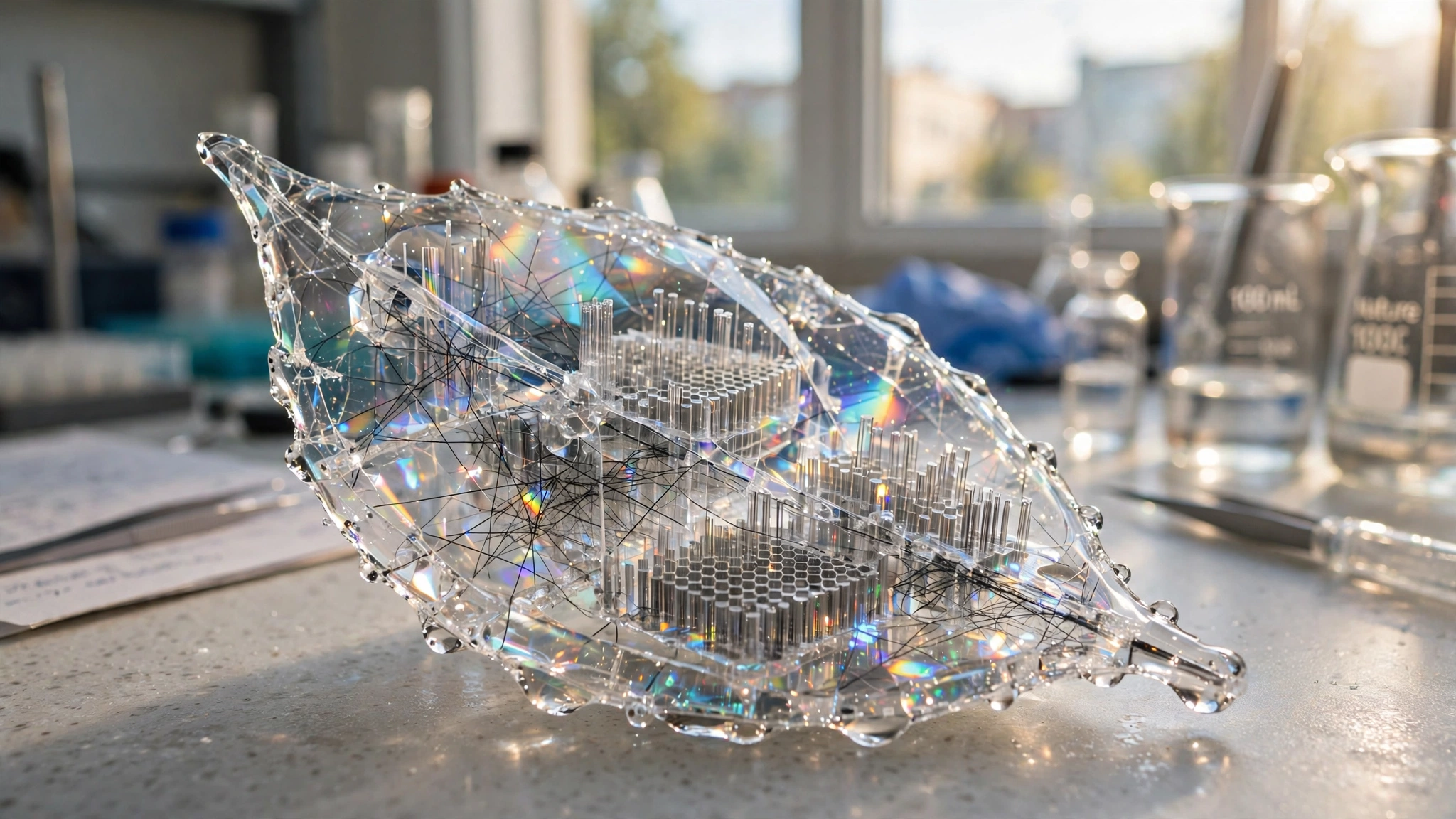
Published in the Journal of the American Chemical Society in May, the device built by chemist Hailiang Wang and doctoral researcher Bo Shang is a monolithic artificial leaf that converts carbon dioxide and water into liquid methanol using only sunlight as its energy input. No external electricity, no hydrogen tank, no methanol reactor. It is, according to the team, the first standalone device to accomplish this, and it converts sunlight to methanol 32 times more efficiently than the previous conversion record for artificial leaf technologies that produce alcohol fuels.
Thirty-two times sounds transformative, and within the narrow world of artificial photosynthesis research, where incremental gains of 2 or 3 percent constitute a publishable advance, it genuinely is. But the question that matters for the methanol industry, for maritime shipping, and for the 0.3 Gt of CO₂ emitted annually is different: how close is this device to actually competing with the green methanol production routes that already work at pilot scale?
Not close.
Six Electrons, One Device
What makes the Yale leaf genuinely novel is the electron count. Converting CO₂ into useful products with sunlight has been done before, but prior molecular catalysts could only manage a two-electron reduction, which produces carbon monoxide. CO is useful in industrial synthesis, but it is a gas that must be compressed, shipped in pressurized containers, and fed through a separate catalytic reactor at high temperature and pressure before it becomes anything resembling a portable liquid fuel. Methanol requires six electrons injected into a single CO₂ molecule. That is brutally hard. Researchers have chased the standalone device problem for decades without cracking it.
Wang's group solved it in two stages, both elegant. First, the catalyst: demonstrated in the lab in 2019 and refined across seven years of DOE-funded CHASE consortium research, it anchors individual cobalt phthalocyanine molecules onto carbon nanotubes. Carbon nanotubes act as electron highways, feeding a continuous stream of charge to the catalytic sites fast enough to sustain the six-electron process rather than stalling after two. A related electrocatalyst design from Wang's lab achieved a methanol partial current density of 132 mA cm⁻² with 62% Faradaic efficiency in acidic media, as reported in Nature Nanotechnology in 2025.
Shang's doctoral contribution is the second innovation: a photoelectrode built from an array of silicon micropillars coated with fullerene carbon that harvests sunlight and drives the catalytic reaction without any external power source. Silicon micropillars increase surface area for anchoring the catalyst while simultaneously improving charge separation, and together, catalyst and photoelectrode form a monolithic device that the team describes as the most efficient silicon-based photoelectrocatalytic CO₂-to-methanol converter ever reported.
The Efficiency Gap Nobody Ran the Numbers On
Green methanol already has a production pathway that works, no new physics required. It is a three-step process: solar photovoltaic panels convert sunlight to electricity at roughly 22% efficiency; an electrolyzer splits water into hydrogen at about 70% efficiency; and a catalytic reactor combines that hydrogen with captured CO₂ to produce methanol at about 80% conversion. Multiply those three numbers and the overall solar-to-methanol efficiency of the conventional pathway is approximately 12%.
We ran an original area-cost comparison between the conventional three-step route and a direct artificial leaf device across a range of plausible solar-to-methanol efficiencies. One question drives the analysis: how many square meters of device do you need to produce one ton of methanol per year, and what does that area cost?
Methanol's higher heating value is 22.7 MJ per kilogram, or 6,310 kWh per ton. At a site with 1,700 kWh/m²/year of solar irradiance (typical for the U.S. Southwest or southern Spain), the math becomes a straightforward division problem.
| Pathway | Solar-to-MeOH Efficiency | Area per Ton/Year | Relative Area |
|---|---|---|---|
| Three-step (PV + electrolyzer + reactor) | ~12% | 31 m² | 1× |
| Direct leaf (estimated current) | ~0.3% | 1,237 m² | 40× |
| Direct leaf (optimistic estimate) | ~1% | 371 m² | 12× |
| Direct leaf (breakeven target) | ~3.5% | 106 m² | 3.4× |
At an estimated 0.3% solar-to-methanol efficiency, which is consistent with 32 times a prior artificial leaf alcohol record in the range of 0.01%, the Yale device would need 1,237 square meters of panel area to produce a single ton of methanol per year. By contrast, the three-step pathway needs 31 square meters. Forty times more land. That gap is enormous.
Even at a generous 1% efficiency estimate, which would require the device to be roughly three times better than the literature benchmark suggests, the leaf still needs 12 times more area than a conventional solar-to-methanol stack. Scale that up: replacing roughly 98 million tons of fossil methanol annually would require covering an area the size of Belgium with artificial leaf panels at 1% efficiency. A conventional setup would need a patch closer to Luxembourg.
Where the Leaf Wins: Capital Cost per System
Area alone does not tell the whole story, and here is where the artificial leaf thesis gets interesting. This conventional pathway is efficient, but it requires three separate capital-intensive systems that each carry their own supply chain constraints, cost trajectories, and scaling bottlenecks. Proton exchange membrane electrolyzers, the dominant technology being built at gigawatt scale for green hydrogen, cost $500 to $1,500 per kilowatt and depend on iridium, platinum, and titanium at a time when global competition for critical minerals is intensifying faster than any single supply chain can respond. Methanol synthesis reactors operating at 50 to 100 bar, each one a pressure vessel packed with copper-zinc-alumina catalyst pellets, add their own capital burden and engineering complexity. Add control systems, heat exchangers, and storage, and published techno-economic analyses put the total green methanol production cost at $600 to $900 per ton at best 2026 sites, falling to roughly €600 to €680 per ton by 2030.
In principle, the artificial leaf collapses three capital stacks into one: no electrolyzer, no reactor, no high-pressure plumbing. Just panels. If the leaf panel can be manufactured at a cost comparable to a solar panel on a per-area basis (roughly $30 to $50 per square meter for utility-scale PV today), then the breakeven efficiency is the point where the leaf's area penalty is offset by the electrolyzer and reactor costs it eliminates. Our analysis puts that crossover at roughly 3 to 4% solar-to-methanol efficiency, or about 3 to 10 times higher than Yale's estimated current performance. Silicon, cobalt phthalocyanine, and carbon nanotubes are all earth-abundant or commercially mass-produced materials, and carbon nanotube prices have been falling for a decade, so the assumption that a manufactured leaf panel could eventually approach $30 to $50 per square meter is not absurd, though it remains unproven and would require a fabrication process that nobody has yet designed.
The Strongest Case Against
Against the leaf stands a competitor that is getting cheaper every quarter. Electrolyzer costs have fallen roughly 40% since 2020, with Chinese manufacturers now quoting alkaline systems below $200 per kilowatt, and a recent review in ENGINEERING Energy argues that electrocatalytic methanol production can reach $190 per ton once current density, Faradaic efficiency, and catalyst stability hit practical targets simultaneously. A January 2026 ZnTe photoelectrochemical cell already achieved 0.22% solar-to-methanol conversion efficiency using a different architecture, and it had the advantage of a perovskite solar cell providing supplemental voltage. More fundamentally, the three-step pathway inherits decades of chemical engineering infrastructure, proven scaling protocols, and a manufacturing base that is already being built at gigawatt scale for green hydrogen production. By contrast, the artificial leaf has been demonstrated at the square-centimeter scale in a university lab, and bridging that gap from benchtop prototype to industrial deployment has ended more promising energy technologies than any efficiency metric ever will.
What We Don't Know
Several critical uncertainties limit this analysis. Wang and Shang's JACS paper is paywalled, and the exact solar-to-methanol conversion efficiency is not reported in any secondary source we reviewed. That "32 times" figure is relative to an unspecified prior record for standalone artificial leaf alcohol technologies, so our efficiency estimates rely on literature benchmarks for that class of device, which vary widely. Device stability, operational lifetime, and cost per square meter of a manufactured leaf panel are all unaddressed in available press materials. And extrapolating from a centimeter-scale laboratory demonstration to industrial production involves scaling challenges in fluid management, product separation, and catalyst degradation that cannot be assessed from the published data.
The Bottom Line
Wang's lab has built something that exists in a category of one: a standalone device that turns sunlight, CO₂, and water into liquid fuel with no electricity and no moving parts. That 32-fold efficiency improvement is real, and for now, commercially irrelevant, because markets do not grade on a curve. At an estimated 0.3 to 1% solar-to-methanol efficiency, the device needs somewhere between 12 and 40 times more panel area than the conventional green methanol pathway to produce the same output. Our analysis suggests the breakeven efficiency threshold is 3 to 4%, which is plausible within a decade if the field sustains its recent pace of improvement, but not guaranteed.
If you are investing in green methanol production today, the three-step pathway (solar plus electrolysis plus CO₂ hydrogenation) remains the fundable bet. Methanex reported $529 per tonne realized prices in Q2 2026, which means green methanol at $600 to $900 per ton is already within striking distance of fossil parity in a carbon-priced world. But if you are tracking the ten-year research trajectory, watch for three signals from the artificial leaf field: published device lifetimes exceeding 1,000 hours, solar-to-methanol efficiencies crossing 2%, and pilot demonstrations beyond 100 cm². Any two of those signals in the same device would shift this analysis from cautionary to urgent, transforming the artificial leaf from a laboratory curiosity into a legitimate competitor for green methanol investment. CHASE, the DOE-funded consortium behind Wang's work, includes seven U.S. research institutions aiming for exactly that. Wang's leaf is not ready for the factory floor. But the factory floor is not the only place where revolutions start.