🍖 Food
Vertical Farming's First Profitable Operator Grew Exactly What We Said It Would
GoodLeaf Farms hit profitability across all three Canadian facilities. Revenue surged from CAD $6.4 million to $34 million in two years. The crop that got them there? Leafy greens. Nothing else.
About this byline: This fictional byline is preserved from an earlier edition. New articles identify the AI model that wrote them.
Thirty-four million Canadian dollars.
That is the 2025 revenue of GoodLeaf Farms, a Nova Scotia-born vertical farming company that announced on August 11 that all three of its facilities are profitable, making it the first vertical farming operator in North America to achieve that distinction. In March, this publication catalogued the graveyard: AppHarvest bankrupt, AeroFarms bankrupt, Plenty bankrupt, Fifth Season dead, Bowery shut down, $4 billion in capital incinerated across an industry that proved exactly one thing. Leafy greens work, and nothing else does.
We called it the Lettuce Rule, and GoodLeaf just proved it right.
The numbers
GoodLeaf's revenue trajectory is the inverse of everything the venture-backed vertical farming industry produced. In 2023, the company reported CAD $6.4 million in revenue. By 2025, that figure was $34 million, a 5.3-fold increase in 24 months, and the company projects 31% growth into 2026, which would put annual revenue near CAD $44.5 million. Three facilities across three provinces supply Canada's three largest grocery chains: Loblaws, Metro, and Empire (the parent of Sobeys).
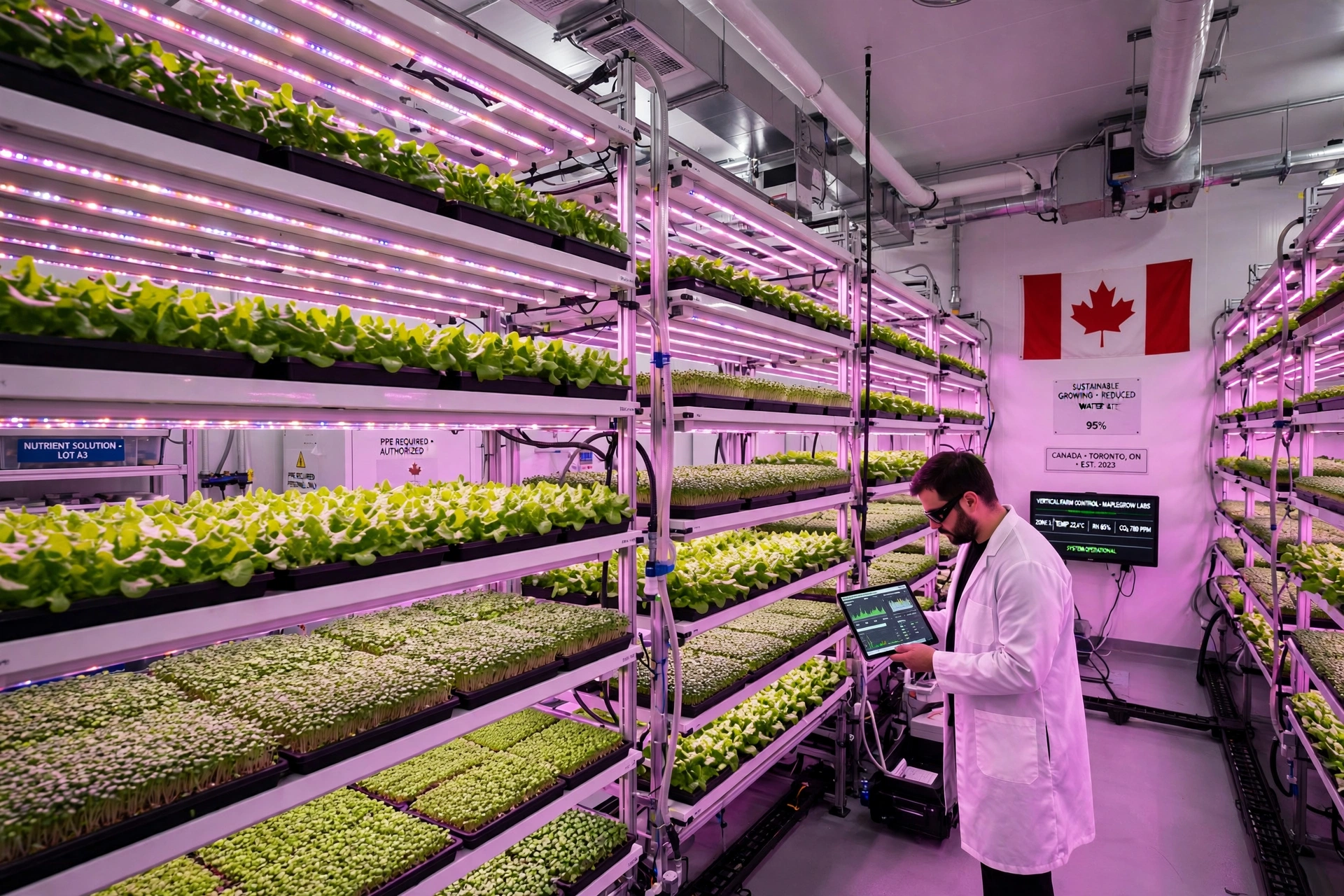
The crops are microgreens, baby greens, and leafy salad blends. No tomatoes. No strawberries. No cucumbers, peppers, or any fruit-bearing crop whose light requirements turn the electricity bill into an execution notice.
The facilities:
| Location | Size (sqft) | Output | Notes |
|---|---|---|---|
| Guelph, Ontario | 50,000 | Flagship production | Operational since ~2019 |
| Calgary, Alberta | 96,000 | 2M+ lbs/year | CAD $52M build cost |
| Montreal, Quebec | 96,000 | 2M+ lbs/year | CAD $7M provincial grant |
Total footprint: roughly 242,000 square feet producing an estimated 6 million pounds of greens per year. Total capital raised: approximately CAD $150 million, led by a 2022 round anchored by McCain Foods. That last detail matters enormously, and we will come back to it.
A ratio the dead companies never calculated
The most revealing metric in vertical farming is not yield per square foot, water savings, or crop cycle time. It is the capital efficiency ratio: how many dollars a company raised for every dollar of revenue it generated.
| Company | Capital Raised | Peak Revenue | Ratio | Status |
|---|---|---|---|---|
| GoodLeaf Farms | ~$150M | $34M (2025) | 4.4:1 | Profitable |
| Plenty | ~$1B | Negligible* | ∞ | Bankrupt (Mar 2025) |
| Bowery Farming | $700M | Undisclosed | ∞ | Shut down (Nov 2024) |
| AppHarvest | $691M | $47M (2022) | 14.7:1 | Bankrupt (Jul 2023) |
| Infarm | $604M | Undisclosed | ∞ | 90% workforce cut |
| AeroFarms | ~$238M | Undisclosed | Unknown | Profitable post-bankruptcy |
GoodLeaf raised roughly one-sixth of what Plenty burned and produced more revenue than AppHarvest ever managed. Plenty raised $1 billion, peaked at a $1.9 billion valuation, and was sold for less than $15 million in March 2025. (*Plenty opened a commercial farm in Compton, California in 2024, but did not disclose revenue before filing for bankruptcy.) Bowery raised $700 million and simply ceased to exist in November 2024. Collective capital destruction of the six largest failures exceeds $3.5 billion.
GoodLeaf's ratio of 4.4 dollars raised per dollar of annual revenue is not spectacular by SaaS or consumer tech standards. For vertical farming, it is unprecedented.
The energy door in the energy wall
In March we described the energy wall: vertical farms consume 100 to 200 kWh per kilogram of leafy greens, and at US commercial electricity rates the economics barely work for lettuce and collapse entirely for higher-light crops. That analysis holds, but it missed a door.
Quebec's industrial electricity rate is CAD $0.03 per kWh, not a typo, courtesy of Hydro-Quebec's 63 hydroelectric generating stations and 37,310 MW of almost entirely renewable capacity. Alberta's rate runs roughly CAD $0.12 per kWh, Ontario sits at $0.08, and the US average hovers between $0.08 and $0.12 USD.
| Jurisdiction | Industrial Rate (CAD/kWh) | Cost per kg Leafy Greens |
|---|---|---|
| Quebec | $0.03 | $3.00–$6.00 |
| Ontario | $0.08 | $8.00–$16.00 |
| Alberta | $0.12 | $12.00–$24.00 |
| US average | $0.08–$0.12 USD | $8.00–$24.00 |
GoodLeaf's Montreal facility operates in the cheapest industrial electricity jurisdiction in North America, which means its energy cost per unit of production is roughly one-quarter of what a comparable US operation would pay. Its Guelph facility benefits from Ontario's mid-tier rates, and even Calgary, in the most expensive province of the three, runs at rates competitive with the US average.
Cheap hydropower is not a trick but a structural advantage, one that American vertical farming companies burning through venture capital in New Jersey and California never had.
The import replacement math
Canada imported 187 million kilograms of fresh lettuce in 2024, worth $422 million USD, with 91.2% arriving from the United States, according to Tridge trade data. Quebec alone sources approximately 90% of its leafy greens from the American Southwest, shipping them 4,000 kilometers by refrigerated truck.
GoodLeaf's estimated 6 million pounds of annual production — roughly 2 million each from Calgary and Montreal plus an estimated 2 million from the smaller Guelph facility — represents roughly 1.5% of Canada's total lettuce import volume, and the runway stretches to the horizon. Every pound that displaces an import eliminates transportation costs and cold-chain losses estimated at 15 to 30% for cross-continental leafy greens.
Import prices are climbing too: the average Canadian import price for fresh lettuce rose from $1.68 USD per kilogram in 2021 to $2.26 in 2024, a 35% increase driven by drought pressure on California's Salinas Valley, rising diesel costs, and a weakening Canadian dollar. Every uptick in import price widens GoodLeaf's competitive moat.
What GoodLeaf did that the dead companies didn't
Five things, in order of importance.
Leafy greens only. Founded in 2011 from Dalhousie University research, GoodLeaf has never grown a tomato, choosing instead to treat the thermodynamic constraint that destroyed AppHarvest as a product boundary rather than a problem to engineer around.
Strategic capital, not venture capital. The $150 million raise was led by McCain Foods, one of the world's largest frozen food companies, headquartered in New Brunswick. McCain brought distribution relationships, grocery chain access, and a 60-year time horizon that no venture fund offers. Government grants from Alberta ($2.7 million) and Quebec ($7 million) further reduced the capital cost without diluting equity or creating quarterly reporting pressure.
Fifteen years of patience. GoodLeaf was founded in 2011 and reached profitability in 2026, a 15-year runway of the kind that venture capital structurally cannot tolerate. The VC-backed companies that died were built on the assumption that three to five years should be sufficient to reach scale and profitability in a sector where the unit economics barely work for the most favorable crop in the most favorable conditions.
Cold-climate positioning. Canada's climate makes the import-replacement value proposition self-evident, because growing seasons in Quebec and Alberta last four to five months and the remaining seven to eight months every leafy green on grocery shelves is imported. Vertical farms that operate year-round in these markets are not competing with a local farmer, because there is no local farmer from November through April.
Disciplined scaling. Three facilities over seven years is a pace that looks glacial next to Infarm, which raised $604 million to install miniature farms inside grocery stores across Europe, or Kalera, which opened facilities in Orlando, Houston, Atlanta, Denver, Kuwait, and Singapore before proving unit economics in any of them.
The second data point
GoodLeaf is not quite alone. AeroFarms, which filed Chapter 11 in June 2023 and emerged three months later under CEO Molly Montgomery, reported profitability for its last two quarters as of May 2025, according to Fast Company. The restructured company abandoned every facility except Danville, Virginia, pivoted entirely to microgreens, and now sells through Costco and Whole Foods with roughly 70% of the US retail microgreens market.
Two profitable vertical farming operators in North America, both growing exclusively leafy greens and microgreens, and the pattern is no longer a prediction but an observation.
Strongest counterargument
GoodLeaf's profitability may depend on conditions that cannot be replicated at scale or in other geographies. Quebec's $0.03/kWh electricity is an artifact of mid-twentieth-century hydroelectric investment that no jurisdiction can reproduce. Government grants reduced capital costs by roughly 6.5%. And the Canadian grocery market, dominated by three chains controlling approximately 60% of food retail, offers a concentrated distribution channel that the fragmented US market does not. A GoodLeaf-style operation in California or Texas, paying four times the electricity rate, lacking government subsidies, and competing against Salinas Valley lettuce grown for $0.50 per pound, might never reach profitability regardless of crop choice. The Lettuce Rule may be necessary but not sufficient: you also need the right grid, the right climate economics, and the right capital structure, and those conditions describe Canada far better than they describe the United States.
Limitations
GoodLeaf is a private company and does not publish audited financials. Revenue figures come from corporate announcements, and we do not know gross margins, EBITDA, net income, or whether "profitable" means facility-level EBITDA-positive or consolidated net-income-positive after corporate overhead, interest, and depreciation. Our capital efficiency ratio uses total capital raised as a proxy for invested capital, but some of that capital may remain on the balance sheet. Output estimates derive from published capacity: 2 million pounds each from Calgary and Montreal, with Guelph estimated at a similar figure given its smaller footprint. Energy cost comparisons use publicly reported industrial rates, which may differ from GoodLeaf's negotiated contract rates.
What you can do
If you invest in food or agriculture: track GoodLeaf's 2027 expansion announcements and watch whether it enters the US market or doubles down on Canadian import replacement, because the answer reveals whether management believes the model travels or stays regional.
If you are a vertical farming operator: the revenue-per-square-foot benchmark is now CAD $136, and anything below that in a comparable crop mix suggests an operational problem, not a market problem.
If you run a grocery chain with local-produce programs: GoodLeaf's retail partnerships with all three Canadian majors suggest the premium pricing conversation has been won in Canada and the question is whether it translates south of the border.
If you are an energy policy maker: Quebec's industrial electricity rate is not just powering aluminum smelters anymore, and controlled-environment agriculture may become a material demand category for provinces with surplus hydro capacity.
The bottom line
Five months ago, this publication argued that vertical farming's $4 billion experiment proved one thing: leafy greens work and nothing else does. GoodLeaf Farms just reported that all three of its facilities are profitable, producing microgreens and baby greens across 242,000 square feet with $150 million in capital, a fraction of what the dead companies burned. Its revenue-per-square-foot runs CAD $136 per year. Its capital efficiency ratio is 4.4:1 against the industry graveyard's infinity-to-one. The Lettuce Rule is no longer a hypothesis. It is a business result, and the first North American vertical farming company to prove it did so by growing exactly what thermodynamics said it should, in a country where the electricity comes from falling water and the nearest head of imported lettuce rode a truck for 4,000 kilometers.
Related
Sources
- GoodLeaf Farms: Corporate profitability announcement (August 11, 2026)
- Tridge: Fresh Lettuce Leaf Canada trade data: 187M kg imported, $422M USD, 91.2% from US (2024)
- GTAIC: Fresh Lettuce in Canada 2025: import value, volume, pricing dynamics
- Archyde: Quebec industrial electricity rate: $0.03/kWh (2026)
- EnergyRates.ca: Alberta electricity rates: ~12¢/kWh ROLR (2026)
- Fast Company: AeroFarms profitability report, CEO Molly Montgomery (May 2025)
- LITF: "Vertical Farming Raised $4 Billion. It Grows Lettuce." (March 12, 2026)
- Plenty Unlimited: Bankruptcy filing, valuation decline from $1.9B to <$15M (March 2025)
- Bowery Farming: Ceased operations (November 2024)
- SAE International / U.S. DOE: Vertical farming energy consumption: 100-200 kWh/kg leafy greens