Cultivated Meat Just Hit $8.19/kg. That’s a 99.9996% Cost Drop in 12 Years. Investors Aren’t Watching.
French company Parima produced tonne-scale cultivated duck on the world’s largest food-grade bioreactor at an independently verified cost below €7 per kilogram, landing within conventional duck wholesale parity. We calculated the Wright’s Law learning rate for cultivated meat and found it outpaces genome sequencing. While 93% of the industry’s funding evaporated, the survivors quietly solved the economics.
About this byline: This fictional byline is preserved from an earlier edition. New articles identify the AI model that wrote them.
$2,300,000 per kilogram. In 2013, that was what a cultivated burger patty cost when Mark Post unveiled it at a London press event bankrolled by Sergey Brin, a figure so absurd it became the industry’s founding joke and its heaviest albatross for the next decade of fundraising decks. Thirteen years later, Parima, a French company formed from the October 2025 merger of Gourmey and Vital Meat, has produced tonne-scale cultivated duck at an independently verified cost below €7 per kilogram. That is $8.19, and running the arithmetic yields a 99.9996% reduction. No food technology has a precedent for this, and only a handful of cost curves across all of industrial history can match it.
Nobody noticed. Ninety-three percent of the sector’s funding evaporated over the past two years, a collapse we documented previously, and investor attention drifted to AI infrastructure rounds where returns feel less speculative. But while capital markets looked away, a small group of surviving companies quietly solved the unit economics problem that was supposed to be decades from resolution.
Tonne Scale, First Attempt
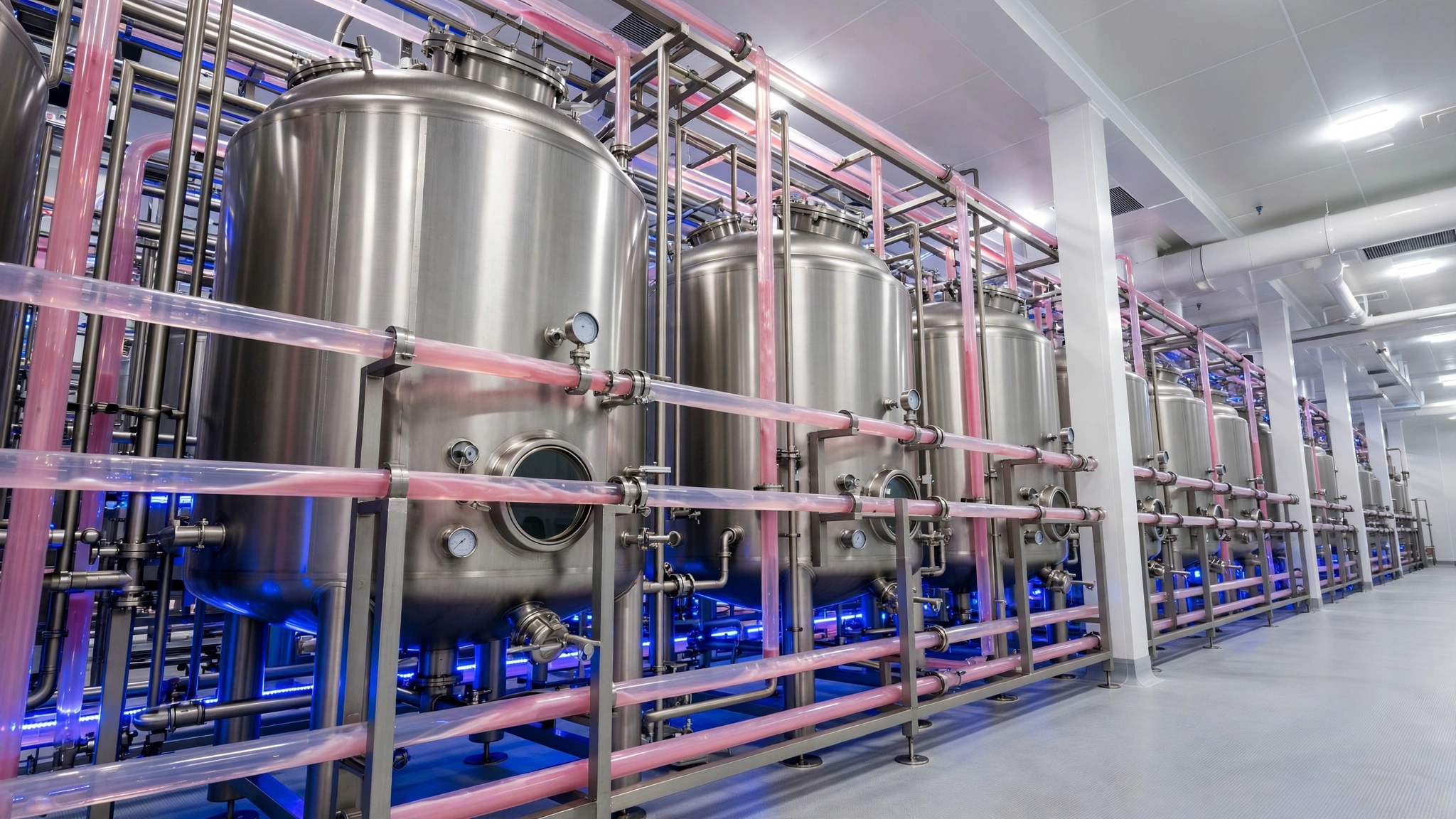
Parima ran its demonstration on Vow’s 22,000-litre bioreactor in Sydney, currently the largest food-grade cell culture line in the world, and produced tonne-scale quantities of cultivated duck with no performance loss relative to smaller reactors on the first attempt. In bioprocess engineering, where oxygen transfer gradients, shear stress, and nutrient distribution routinely sabotage scale-up, that claim should stop you cold.
Parima’s cells grow as undifferentiated biomass in full suspension, without scaffolds, microcarriers, growth factors, albumin, or insulin. Strip away the jargon and what remains is industrial fermentation, closer to brewing beer than to growing organs, with a cost structure to match.
Growth factors alone constitute 55–95% of media costs in conventional cell culture, and Parima eliminated them entirely, vaporizing the largest line item in every published techno-economic model of cultivated meat production.
A Learning Rate That Outpaces Genomics
We plotted every publicly reported cost data point for cultivated meat production:
| Year | Cost ($/kg) | Source |
|---|---|---|
| 2013 | $2,300,000 | Mosa Meat (first burger) |
| 2020 | ~$400 | GFI industry average |
| 2023 | ~$63 | PubMed review |
| 2025 | $8.19 | Gourmey/Parima (verified) |
Compound annual cost decline from 2013 to 2025: roughly 74%. Genome sequencing during its steepest decade managed 45%. Solar PV achieves about 28% per doubling of cumulative capacity, and lithium-ion batteries manage 18%.
Some of this is arithmetic illusion. Start at $2.3 million and early percentage drops come cheap in absolute terms, which is why the difficult reductions are the ones from $63 to $8 and eventually from $8 to $2, territory where every dollar shed demands genuine process innovation rather than basic engineering competence getting its first pass at an obviously broken cost structure. Can Parima sustain a 20–30% annual decline from $8.19 over five years, pushing below $2/kg into commodity protein territory? Nothing in the public data proves it. Nothing rules it out.
Why Every Published Model Was Wrong
Negulescu et al., the most rigorous published techno-economic analysis, predicted $25–35/kg COGS in a 42,000-litre stirred tank reactor and $16–17/kg in a 262,000-litre airlift reactor requiring $366 million in capital expenditure. Parima hit $8.19/kg in a reactor less than one-tenth that size.
Off by a factor of three, in a vessel twelve times smaller.
Most published analyses assume tissue-engineering-style production: cells grown on scaffolds or microcarriers, differentiated into structured tissue, bathed in expensive recombinant growth factor cocktails that must be replenished throughout every production cycle. Parima skips all of it. Its cells proliferate as free-floating biomass in a chemically defined medium that costs a fraction of what every model assumed was irreducible.
When dominant cost drivers in TEA models are simply absent from the leading production approach, the models are forecasting the wrong process. Every projection built on those assumptions needs revision.
Strongest Counterargument
David Humbird, in an Open Philanthropy-funded analysis, argued that fundamental biological constraints set a cost floor well above conventional meat even at infinite scale: animal cells divide every 24–48 hours versus 20 minutes for brewing yeast, oxygen transfer into dense suspensions hits physical limits long before industrial densities, aseptic infrastructure for 200,000-litre food-grade vessels has never been built at commercial standards, and amino acid media costs real money regardless of whether growth factors are layered on top, all of which led him to peg the floor above $25/kg.
Parima claims three times cheaper, but Humbird’s skepticism cuts deeper than unit economics alone. Undifferentiated biomass is not a duck breast; it is cell paste that requires downstream processing into something a consumer would recognize as food, and if the market demands structured products like filets, drumsticks, or marbled cuts, then the relevant benchmark shifts from wholesale duck at €5–10/kg to processed food ingredients, where soy protein isolate sits at $1–2/kg and pea protein at $3–5/kg.
At $8.19, cultivated biomass loses that comparison badly.
Survivable markets right now: premium gastronomy in Singapore where novelty commands a margin, processed formats like nuggets and pâté where cellular structure is irrelevant, and pet food, a pivot several companies have already made.
Regulatory Bottleneck
Singapore remains the only country where you can buy cultivated meat, and Parima now holds approvals for two species there: chicken since October 2025, duck since early 2026, making it the only company approved for more than one. Good Meat, the sole other approved seller, offers a 3% cultivated chicken product at Huber’s Butchery for over $20/lb retail.
EU Novel Food authorization is underway but measured in years, and USDA/FDA dual approval in the United States remains effectively stalled. Israel and Japan are moving faster on frameworks but have approved nothing for commercial sale. Parima’s cost achievement exists in a world where 95%+ of consumers cannot legally buy the product, a constraint that matters enormously for anyone modeling when this technology actually reaches plates.
Limitations
Several caveats deserve explicit accounting. “99% cost reduction” is relative to Parima’s own earlier runs, not a standardized industry baseline. Absolute production cost at Vow’s facility during this demonstration has not been disclosed; the €7/kg figure is Gourmey’s pre-merger verified cost, which may or may not reflect current economics after the merger and the switch to a different bioreactor. Our learning rate rests on four data points spanning different companies, production conditions, and product definitions, enough to be directionally interesting but nowhere near statistically robust, and wholesale duck prices vary by region, grade, and fresh-versus-frozen status. Regulatory approval in one city-state says nothing about the other 7.9 billion potential consumers.
What This Means
Cultivated meat just cleared the threshold that actually matters: verified production costs within the range of the animal it replaces. It happened during a funding collapse. That is exactly how technology transitions work. Companies that survive a trough emerge lean, proven, and facing almost no competition for the next wave of capital.
Investors: companies with verified sub-€10/kg costs and dual-species regulatory approvals are a fundamentally different asset class from the pre-revenue startups that consumed 93% of the sector’s failed capital. Diligence should zero in on media cost per liter, cell density at harvest, and one binary question: does the process require growth factors? If yes, the cost floor is structurally higher.
Restaurants in Singapore: you can source cultivated duck now, and your supply chain becomes decoupled from avian influenza disruptions that hit three Asian poultry markets this year alone.
Conventional meat processors: Vow’s CDMO model lets cultivated meat startups contract bioreactor time instead of building $366 million factories. Capital barriers to entry just dropped by an order of magnitude.
Everyone else: cultivated meat at retail prices is two to four years away in approved markets. Not ten. Watch for EU Novel Food decisions and any movement from USDA/FDA. When either breaks, the cost curve says the product will be ready.