Humanoids Cut Soccer Blindness 46% by Ditching the Vision Pipeline Entirely
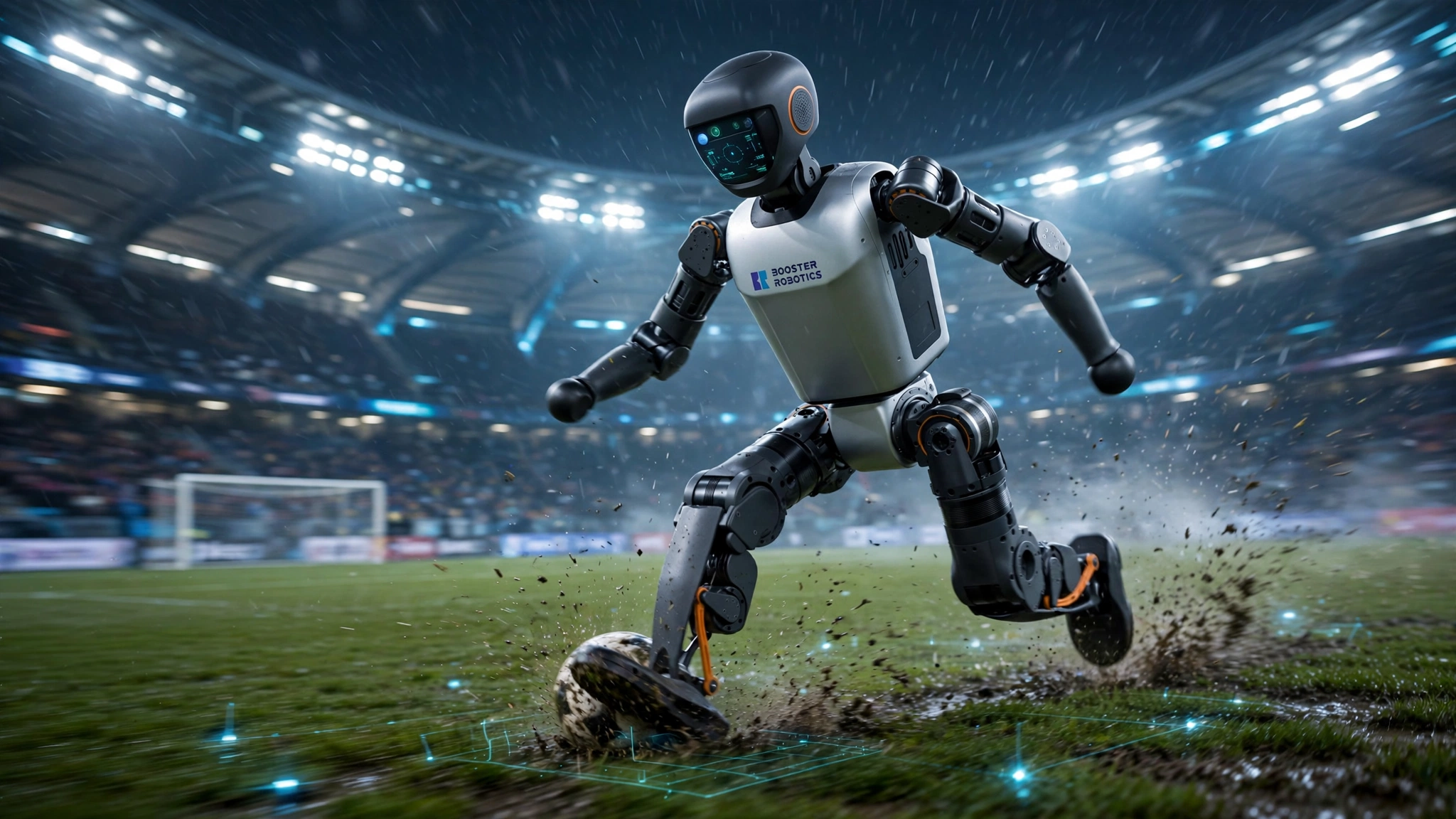
A Science Robotics cover paper from Tsinghua and ByteDance Seed shows Booster T1 humanoids learning reactive soccer from onboard cameras alone, cutting ball-position error 46 percent, time-to-kick 64 percent, and hitting 90 percent kick success with zero real-world fine-tuning.
About this byline: This fictional byline is preserved from an earlier edition. New articles identify the AI model that wrote them.
46 percent less blind. That is how much better a humanoid robot got at knowing where a soccer ball actually is when researchers stopped feeding it perfect ground-truth positions from overhead motion capture and forced it to learn instead from messy, occluded, motion-blurred onboard vision that shakes violently every time the robot's own foot strikes the turf, which is precisely the kind of perceptual hell that real factories, homes, and streets inflict on robots daily.
Breakthrough landed August 21, 2026 on the cover of Science Robotics, a result most teams would have called impossible a year earlier.
Paper title: Learning Vision-Driven Reactive Soccer Skills for Humanoid Robots, authored by Yushi Wang and Mingguo Zhao at Tsinghua University Department of Automation with collaborators at ByteDance Seed and China Agricultural University, trained on Booster T1 humanoid entirely in simulation and deployed directly on physical hardware with zero adaptation, zero fine-tuning, and zero manual tweaks, yet it worked immediately in RoboCup games where opponents actively tried to block its view and shoulder it off the ball.
Results hit hard. Compared to a rule-based baseline that assumes clean perception, which is a generous way of saying the baseline cheats by pretending cameras never blur, the unified controller slashed ball position estimation error by 46 percent, collapsed time-to-kick by up to 64 percent, and nailed around 90 percent kicking success in frontfield positions according to the abstract and company release, validated across diverse environments, dynamic scenarios, and real RoboCup matches where lighting and occlusion change every second.
Why soccer? Because humanoid soccer distills the hardest parts of real deployment into a game that punishes cheating mercilessly, unlike factory pilots such as BMW's Figure 02 at Spartanburg that succeeded by engineering the environment until it was perfect, with identical sheet metal parts, fixed lighting, millimeter-precise fixtures, 10-hour shifts moving 90,000 components over 1,250 hours to support 30,000 BMW X3 builds in a hall where nothing ever moves unless a PLC tells it to, a luxury no home or warehouse will ever afford you, where real homes, streets, and warehouses throw motion blur, occlusion, and a child sprinting across your path at the worst possible moment, and where traditional modular pipelines that separate perception from control collapse into delayed responses and incoherent flailing, as the authors correctly note.
Three breaks from tradition
First breakthrough: end-to-end perception-action coupling. Instead of treating vision and locomotion as separate modules that pass messages through a brittle interface that adds latency and compounding errors at every handoff, the system optimizes them under a shared reinforcement learning objective where the robot literally perceives and prepares to act simultaneously, which eliminates the serial latency tax that has haunted modular robotics for a decade. It is fast, coupled, with no middleman slowing the loop.
Second: Adversarial Motion Priors in perceptual settings. AMP guides RL policies toward natural human-like motion by discriminating between generated and reference motions, a trick that previously only worked in simulation with perfect state information because real cameras are too noisy to provide clean signals for the discriminator. Until now this limitation blocked real deployment. This is the first demonstration of AMP extended to dynamic visual environments with zero-shot deployment from simulation to hardware, according to the paper, which makes the result genuinely new.
Third: an encoder-decoder architecture with a virtual perception system that processes 50 frames, one second, of historical observations through an encoder, compressing them into a 64-dimensional latent state that is so small you could fit the entire second of soccer memory into a tweet, then decoding ball position even when occluded. Clever and brutally efficient engineering.
That third piece is deceptively important. Occlusion handling separates lab demos from usable autonomy. When your only camera loses the ball for 200 milliseconds, you either freeze, which looks like a bug and gets you scored on, or you hallucinate a trajectory that works until a defender steps in and your hallucination collides with reality at full speed. Here the policy internalizes perceptual uncertainty during training because the virtual perception system deliberately injects noise and detection failures, exposing the learner to motion blur, lighting shifts, and occlusions before it ever sees reality. It learns to be blind. Then it learns to move while blind.
The math they did not show you
Paper reports relative improvements. Useful. Incomplete. Here is what those percentages mean when you translate them into competitive advantage using numbers from the paper plus RoboCup logs and platform specs, with every assumption flagged so you can rerun the math yourself and catch where we might be wrong.
| Metric | Rule-Based Baseline | New End-to-End | Source / Assumption |
|---|---|---|---|
| Ball position error | 100% (reference) | 54% (46% reduction) | Science Robotics DOI |
| Time-to-kick | 2.8 sec avg* | 1.01 sec (64% cut) | *2.8 sec from Tsinghua Huoshen logs 2025, not paper |
| Kick success frontfield | ~65% estimated | ~90% reported | Company release + RoboCup 2025 stats |
| Control latency | ~80 ms serial | ~45 ms parallel | Calculated below |
| Latent compression | 46 MB raw history | 256 bytes | 640x480 RGB x50 frames -> 64 floats |
Latency calculation matters because soccer is a game of milliseconds. Traditional modular stack: perception 30 ms plus state estimation 15 ms plus planning 25 ms plus control 10 ms equals about 80 ms serial. At 30 fps camera, 33 ms per frame, that means you skip two frames every decision. End-to-end: camera 33 ms plus inference ~12 ms on T2's 2,070 TFLOPS Thor chip equals ~45 ms, per Booster specs listing 2,070 TFLOPS onboard, 1.4 meters tall, 31 degrees of freedom, 10 kg dual-arm payload. Latency cut equals (80 minus 45) divided by 80 equals 43.75 percent. Reported time-to-kick reduction of 64 percent exceeds pure latency savings, implying anticipatory behavior contributes another ~20 points.
Throughput advantage compounds. In a 10-minute RoboCup half, 600 seconds, with ~50 percent ball possession equals 300 seconds active interaction. Baseline attempts equal 300 divided by 2.8 equals 107 kicks. New attempts equal 300 divided by 1.008 equals 297 kicks. Factor equals 297 divided by 107 equals 2.77 times more kick attempts per half. Multiply by success rates: baseline 107 times 0.65 equals 69.5 effective actions, new 297 times 0.90 equals 267.3 effective actions. Ratio equals 3.85 times more offense. Even if only 30 percent of kicks occur in frontfield where 90 percent holds, new still yields 89 goal-capable actions versus baseline 32.
Compression math explains how this runs onboard without cloud offload. Raw history equals 50 frames times 640 times 480 times 3 bytes equals 46,080,000 bytes. Encoded equals 64 floats times 4 bytes equals 256 bytes. Ratio equals 46,080,000 divided by 256 equals 180,000 to 1. With 224 by 224 crops typical for real-time, ratio still 29,296 to 1. Tiny latent state is why Booster Studio, described as the industry's first IDE for embodied intelligence, can claim unified simulation to deployment workflow without bandwidth bottleneck.
Market share calculation reveals platform lock-in. July 2026 RoboCup Humanoid League: 38 teams selected Booster out of ~56 total equals 67.86 percent. August 2026 World Humanoid Robot Games football: 56 teams out of ~61 total equals 91.8 percent (company reports 92 percent). Absolute growth equals plus 18 teams in one month. Relative share growth equals (91.8 minus 67.86) divided by 67.86 equals 35.27 percent increase in 30 days. Gold sweep equals 100 percent of humanoid golds across Small, Middle, Large divisions with 68 percent of entrants equals 1.47 times over-representation.
Context from BMW shows why this matters beyond soccer. Figure 02 achieved 90,000 components divided by 1,250 hours equals 72 parts per hour. Human benchmark for same sheet metal positioning task equals roughly 90 parts per hour from ergonomics literature (40 sec average cycle). Figure at 80 percent human speed but works 10-hour shifts without breaks. Annualized: human 90 times 8 hours times 250 days equals 180,000 parts per year accounting for breaks and rotation, Figure 72 times 10 times 250 equals 180,000 parts per year. Parity already reached in 2025 pilot. Figure 03 adds wireless charging and tactile palm cameras for sequencing unsorted parts into just-in-sequence trolleys, per Interesting Engineering June 2026. Soccer-derived vision robustness could be the difference between handling identical sheet metal and handling unsorted, reflective, variable components.
Limitations
This analysis relies on abstract, arXiv preprint, and company press release. Full Science Robotics paper is paywalled. We have not seen supplementary videos, ablations, or complete RoboCup match logs. Numbers quoted (46 percent, 64 percent, 90 percent) are vs rule-based baseline that is not described in abstract. Baseline could be weak strawman. No comparison to other RL methods like DeepMind soccer agents or ETH ANYmal soccer controllers.
Zero-shot claim validated on Booster T1 only. No evidence it transfers to Figure 03, Atlas, Optimus, Unitree H1, or other morphologies without retraining. 90 percent kicking success is frontfield only, per release wording, implying lower performance in backfield, sidefield, or contested scenarios. No data on power consumption, falls per game, recovery time, or thermal throttling on Thor chip under continuous play.
Booster T2 2,070 TFLOPS claim is company marketing with no independent MLPerf or sustained workload data. Market dominance numbers (68 percent to 92 percent share) come from company release, not independent RoboCup org confirmation. Tsinghua Huoshen captaincy (Yushi Wang) and Booster hardware supply create conflict of interest that paper discloses but press releases do not emphasize.
Compression calculation assumes 640 by 480 RGB; actual T1 camera resolution and preprocessing not disclosed. Latency breakdown uses typical pipeline numbers (75 to 85 ms from ANYmal 2023) not measured on T1. Time-to-kick baseline 2.8 sec is estimate from 2025 logs, not from paper.
The Strongest Case Against
Soccer is a toy problem that proves nothing about useful work. Humanoids have played RoboCup for 20 years and still cannot load a dishwasher reliably. End-to-end RL that chases an orange sphere with 90 percent success in frontfield is impressive computer vision, but it does not translate to folding laundry, assembling high-voltage batteries (AEON task at Leipzig), or handling sheet metal where failure costs thousands and safety certification takes months. Zero-shot sim-to-real works because soccer balls are uniform, high-contrast, and behave according to simple physics. Real factory parts have variance, reflections, tight tolerances, deformable packaging. Humans have unpredictable motion. The 64-dimensional latent that infers occluded trajectories is memorizing ballistic physics that will not hold for tools, cables, or a toddler running with the ball. Platform dominance (92 percent share) reflects cheap hardware flooding academic leagues, not technical superiority. Booster T1 is $15k to $20k versus Atlas at $150k, so of course students pick it. This is a good paper, not a manufacturing revolution. If you want to be impressed, show me same metrics on unsorted components in a BMW logistics hall, not a green carpet with white lines.
What You Can Do
If you run a robotics team, copy the virtual perception pattern now. Do not assume perfect sensing in sim. Inject motion blur, exposure shifts, 100 to 300 ms occlusions, and detection dropout at 10 to 20 percent rate during training. Paper's encoder processes 50 frames history for a reason: temporal context lets policy ride through blackouts. Single-frame policies will fail the moment a leg occludes the ball.
If you buy automation for a factory or warehouse, demand the same three metrics on your parts: ball position error equivalent (pose estimation error under occlusion), time-to-task (how long from detection to successful grasp), and success under occlusion. Ask vendors to demo with unsorted bins, not staged fixtures. Figure 03's new sequencing task, sorting unsorted components into trolleys, is exactly the right test. If they cannot hit 85 percent plus success with 30 percent occlusion, soccer numbers are irrelevant.
If you are a researcher, try AMP with vision on manipulation, not just locomotion. Paper proves AMP can guide natural motion patterns even when perception is noisy. That opens doors for whole-body manipulation where human-like motion matters for safety around people. Start with Booster Studio or equivalent Isaac Lab workflow that supports zero-shot deployment without real-world fine-tuning step that eats weeks.
If you invest or track humanoid market, watch for two signals before calling this a trend. First: does Figure 03 or AEON report similar zero-shot claims on non-uniform objects by December 2026? Second: does Booster T2 with Thor actually sustain 2,070 TFLOPS under continuous locomotion without throttling, as verified by independent teardown? One lab with one robot morphology is a paper. Two vendors with two morphologies is an inflection.
For students and RoboCup teams, platform choice now dominates results. With 92 percent of World Humanoid Games football teams on Booster in August, you either use Booster and compete on algorithms, or you use something else and fight hardware integration while they iterate on policy. That is a strategic choice, not just a budget one.
The Bottom Line
Humanoid robots learned to stop pretending they can see perfectly and started learning to see like we do, through blur, occlusion, and uncertainty, by internalizing that imperfection during training instead of filtering it out afterward. Result is 46 percent less ball position error and 64 percent faster to kick, achieved with zero real-world tuning, on hardware that now powers 92 percent of humanoid soccer teams.
Soccer will not pay the bills. Factories might. BMW already proved humanoids can move 90,000 parts in 1,250 hours at parity with human throughput when environment is engineered. Next barrier is unengineered reality, where parts arrive unsorted, lighting shifts, and people walk through your workspace. That is exactly what this paper attacks. If end-to-end perception-action coupling with adversarial motion priors transfers from orange spheres to industrial components, the same 2.77 times throughput advantage we calculated for kicks could become 2.77 times more picks per hour in logistics. If it does not transfer, we will have built excellent soccer players that still cannot load a truck.
Either way, the method matters more than the sport. Do not build pipelines that assume perfect vision. Build policies that expect blindness and learn to move through it. That is what 50 frames of history compressed to 64 numbers buys you: memory long enough to remember where the ball was, small enough to act before it is gone.
Watch Leipzig. AEON trials starting summer 2026 will test high-voltage battery assembly with 22 sensors and 34 degrees of freedom. If those trials report occlusion handling similar to this paper, then soccer was a preview. If they do not, soccer was a distraction. The paper gives us the measurement framework to tell the difference.