France Built a $105 Million Robot. Korea Put One in a Warehouse. Neither Has Legs.
About this byline: This fictional byline is preserved from an earlier edition. New articles identify the AI model that wrote them.
On Tuesday morning, a French startup called Genesis AI unveiled Eno, a general-purpose robot backed by $105 million in venture capital and former Google CEO Eric Schmidt's personal endorsement. The day before, South Korean media reported that Samsung-controlled Rainbow Robotics had placed its RB-Y1 mobile robot inside a Coupang fulfillment center for the company's first live commercial warehouse trial. These two companies share no investors, no technology, and no geography. What they share is a design decision: both robots move on wheels.
That matters.
The entire robotics industry spent the past three years pouring capital into humanoid bipedal machines on the premise that robots built like people can work in spaces designed for people, a thesis so intuitively appealing that it attracted $86 billion in commitments from Hyundai alone and prompted every major technology publication to declare that the humanoid era has arrived. But the first general-purpose robots to actually enter commercial service in 2026 look nothing like humans from the waist down, and the engineering reasons are more revealing than the marketing reasons.
The French Bet
Genesis AI was founded in early 2025 by Theophile Gervet, a former researcher at Mistral AI, and the company raised $105 million in its initial round, matching the record seed raised by Mistral itself and making it one of France's largest-ever early-stage fundraises (TechCrunch, May 2026). Eclipse and Khosla Ventures co-led; Eric Schmidt, Xavier Niel, and state investment bank Bpifrance also participated. The company now has 60 employees split between Paris, London, and California.
Eno runs on GENE-26.5, Genesis AI's multimodal foundation model that the company says gives the robot memory, reasoning, and the ability to plan multi-step tasks over time. The hands, built with Chinese partner Wuji Tech, offer 20 degrees of freedom each across a 54-DOF bimanual system capable of chopping tomatoes, solving a Rubik's Cube, pipetting lab samples, and playing piano in real-time demonstrations, though CEO Zhou Xian conceded the egg-cracking success rate hovers around 50 to 60 percent (eWeek, May 2026).
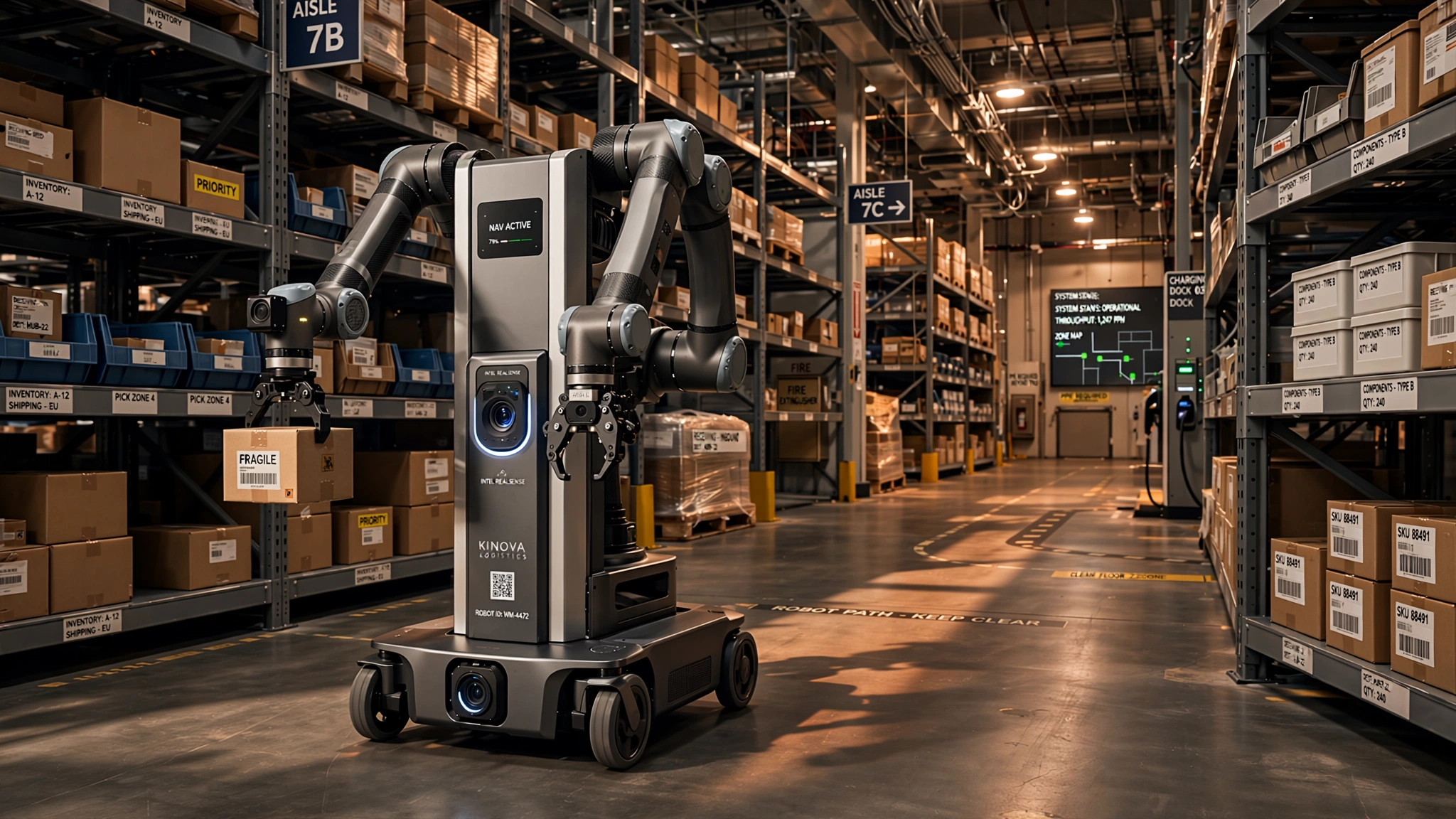
Below those hands sits a wheeled base. Not legs. Vivian Sun, Genesis AI's Vice President of Commercial and Strategy, told Reuters that "the wheeled base was chosen because most industrial customers operate on flat floors," adding that "legs would only make sense for use cases like climbing stairs." The company plans to begin production in the second half of 2026 and start customer deployments by year-end, targeting logistics and manufacturing first, with hospitals, hotels, and consumers following later.
The Korean Bet
Rainbow Robotics is a different animal. Controlled by Samsung Electronics, the company built the RB-Y1 as a mobile dual-arm robot: two arms with seven degrees of freedom each, mounted on a wheeled base that can move at 1.5 meters per second while copying the motions of a human torso. Payload is about three kilograms per arm, which limits early work to lighter picking and sorting rather than heavy lifting. Until this month, the RB-Y1 had gone mainly to universities and research centers, with factory trials at Samsung and Toyota.
Now it is inside a Coupang fulfillment center. Interesting Engineering reported that Coupang is evaluating the robot's reliability and sorting efficiency, with a larger deployment expected if the trial succeeds, citing industry sources via ETNews. Neither Coupang, Samsung, nor Rainbow Robotics has publicly confirmed the pilot, but the company is also reportedly in talks with CJ Logistics, with which it signed a robot-development agreement last year.
The economic incentive is particular to Korea. The country's Serious Accidents Punishment Act holds executives criminally liable for fatal workplace accidents, creating legal exposure that robots can reduce. Coupang has invested more than $84 million in global AI startups since 2023, swung to a $242 million operating loss in Q1 2026 driven by a data-breach compensation program, and is building an NVIDIA-powered AI factory for warehouse optimization. It is not experimenting with robotics for fun.
Why This Convergence Matters
Here is the deployment timeline that the humanoid narrative obscures.
Genesis AI: founded early 2025, model unveiled May 2026, full robot unveiled June 2026, commercial customer deployments planned by December 2026. Eighteen months from incorporation to paying customers, if the timeline holds.
Rainbow Robotics RB-Y1: commercial warehouse trial underway in June 2026.
Boston Dynamics Atlas: more than 30 years of development, product version unveiled at CES in January 2026, deployments at Hyundai RMAC and Google DeepMind in 2026 but not in production roles, factory deployment at Hyundai's Georgia Metaplant planned for 2028, component assembly tasks projected for 2030.
Wheeled general-purpose robots are reaching commercial warehouse floors two full years ahead of their legged counterparts. That gap is not a coincidence. Dynamic bipedal locomotion under variable loads remains one of the hardest unsolved problems in robotics, consuming degrees of freedom, battery capacity, and engineering hours that wheeled robots redirect entirely toward manipulation and task execution. Every actuator devoted to keeping a humanoid upright is an actuator not devoted to moving a box.
Gartner quantified this in January 2026: through 2028, fewer than 100 companies will move humanoid robots beyond early testing, and fewer than 20 will put them into live production. "In many cases, humanoid robots cost several times as much as other robots while delivering lower throughput and uptime," the firm wrote, recommending instead what it calls "polyfunctional robots," machines that use wheels, arms, and sensors placed where they work best rather than where a human body would put them. "For the majority of companies that will need to prioritize robots that maximize throughput-per-dollar invested," said Caleb Thomson, Senior Director Analyst at Gartner, "we expect polyfunctional robots to be the superior solution."
The Robot Density Paradox
South Korea already has the world's highest robot density at 1,220 industrial robots per 10,000 manufacturing employees, according to the International Federation of Robotics' World Robotics 2025 report, published in April 2026. Singapore follows at 818, Germany at 449, Japan at 446, the United States at 307. But those 1,220 robots are overwhelmingly traditional fixed-base industrial arms: welding cells, paint booths, pick-and-place units bolted to the floor in semiconductor fabs and auto plants. The transition to mobile general-purpose robots that can navigate a warehouse, identify objects, and manipulate them autonomously is a categorically different market. That even the most robot-saturated economy on Earth chose wheels for its first mobile warehouse deployment is a data point the humanoid investment thesis needs to answer.
Strongest Counterargument
The best case for legs is not abstract. Boston Dynamics' Atlas features 56 degrees of freedom, can lift 50 kilograms, reach 2.3 meters, and operate across temperatures from minus 20 to 40 degrees Celsius. Hyundai plans to deploy 25,000 Atlas units across its manufacturing plants starting in 2028 with a factory capable of producing 30,000 units annually, an investment scale that dwarfs anything in the wheeled robot market by orders of magnitude. KB Securities analyst Kang Sung-jin projects Boston Dynamics could capture 15 percent of the global humanoid market by 2035 and as much as 60 percent of the premium industrial segment.
The argument is simple: flat-floor warehouses are the easiest environment to automate, and optimizing for easy environments is how companies die slowly. The real value of a general-purpose robot lies in its ability to work in environments designed for humans, and those environments have stairs, uneven surfaces, curbs, and doorways with thresholds. A robot that can only roll will never follow a technician into a boiler room, climb scaffold at a construction site, or navigate a hospital ward where a gurney blocks the hallway and the floor is wet. Legs are expensive now because the problem is hard. The problem being hard does not mean the solution is wrong.
Limitations
This analysis rests on two unconfirmed commercial deployments. Coupang, Samsung, and Rainbow Robotics have not publicly acknowledged the RB-Y1 warehouse trial, which is sourced entirely from ETNews and Korea Herald citing unnamed industry contacts. Genesis AI has built "dozens of units" but has not disclosed a signed customer contract or a per-unit price. The 18-month founding-to-deployment timeline is a company projection, not a confirmed schedule. Meanwhile, the Gartner prediction covers only through 2028, and the humanoid robotics market could look entirely different by 2030 if Boston Dynamics' simulation-to-transfer training pipeline delivers on its promise of millions of training hours per day with one-hour physical transfer.
The Bottom Line
Legs are a bet on the long game. Wheels are a bet on this quarter. Two companies with no connection to each other made the same call: the first customers willing to pay for a general-purpose robot care about uptime, predictable cost, and the ability to start working on a flat warehouse floor this year, not about climbing stairs in 2030. If you run a warehouse, distribution center, or manufacturing floor with consistent surfaces, the wheeled mobile manipulators arriving in late 2026 are worth piloting now, because they will be cheaper to operate and faster to deploy than anything with knees. If you operate in environments with stairs, wet floors, and debris, wait for Atlas. Hyundai is spending $86 billion to solve that problem. Just know it is a 2028 problem, not a 2026 problem, and two years in robotics is a long time to watch your competitor's warehouse get faster while you wait for the perfect robot to walk through your door.