Three Nuclear Reactors Went Critical in 26 Days. Their Customer Pays $2,000 Per Megawatt-Hour.
For the first time in four decades, the United States achieved non-light-water reactor criticality. Then it did it twice more in a single month. An original cost analysis shows why these nuclear startups aren't repeating NuScale's fatal mistake of competing with solar on the grid. Instead, they are selling power behind the meter to data centers that paid $2,000 per megawatt-hour during last week's PJM price spike.
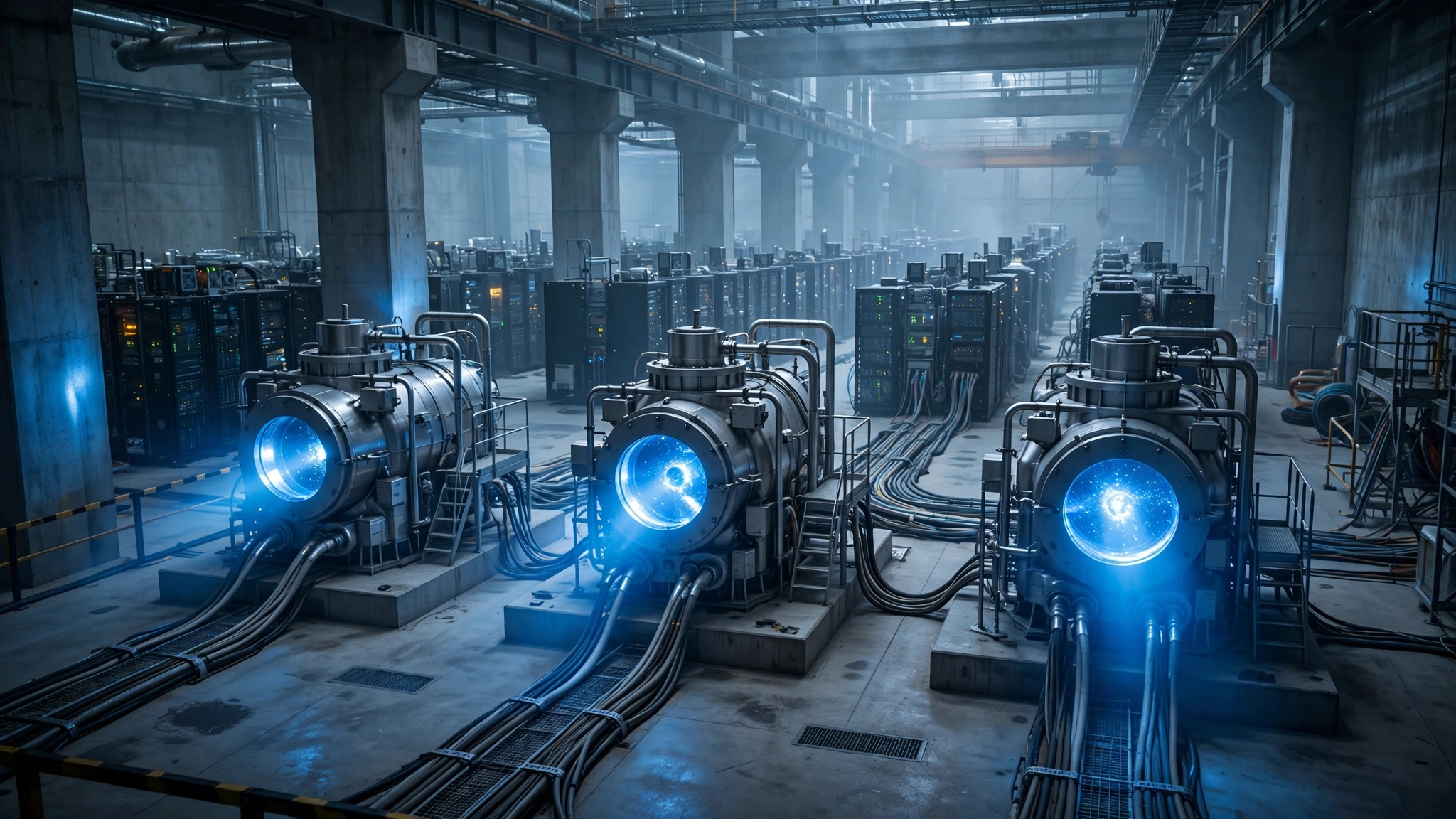
Twenty-six days, three startups, three completely different reactor designs. That is how long it took the United States to accomplish something it had not done since the early 1980s: bring a non-light-water reactor to self-sustaining criticality. On June 4, Antares Nuclear's Mark-0 microreactor went critical at Idaho National Laboratory. Valar Atomics' Ward 250 followed on June 18 at Utah's San Rafael Energy Lab. Deployable Energy's Unity completed the trifecta on June 30 back at Idaho, and the DOE declared the July 4 deadline met four days early.
Nothing like this has happened before. Not in France's golden 1980s build-out, when Électricité de France was commissioning four to six pressurized water reactors per year but stuck to a single standardized design, not during the Soviet Union's reactor sprint, and not in China's current expansion. Secretary of Energy Chris Wright called it "a milestone on a timeline many thought was unachievable." He is correct about the timeline, but the more interesting question is what these reactors will do next.
They are not going to power your house.
What Criticality Actually Means
Criticality is the moment a nuclear fission chain reaction becomes self-sustaining: neutrons split uranium atoms, those atoms release more neutrons, those neutrons split more atoms, and the process no longer needs an external push. Barron's compared it to turning on a car engine without pressing the accelerator: you have proven the engine works, but the car is still in park.
All three demonstrations were zero-power criticality tests, generating essentially no thermal energy and no electricity. Antares' Mark-0 uses TRISO fuel fabricated by BWX Technologies from HALEU secured through a DOE allocation; the company was founded in 2023 and built the reactor from machining its graphite core on January 12 to criticality on June 4, a span of about five months that would have been considered absurd a decade ago. Valar's Ward 250 is a Gen IV high-temperature gas-cooled reactor running helium coolant through graphite moderators at over 750°C, and it holds the distinction of being the first DOE-authorized reactor built and operated entirely outside the national laboratory system. Unity is blunter: a one-megawatt transportable nuclear battery that went from construction start to criticality in roughly 150 days at Idaho National Lab.
Different fuels, different coolants, different designs, same result: the physics works. Between physics demonstration and commercial electricity sits a long sequence of reactor experiments, power ascension, thermal testing, and regulatory licensing that typically takes years and has historically swallowed budgets whole. What makes this round different from every previous advanced nuclear milestone is not the reactors themselves but the customer waiting on the other end.
NuScale's $600 Million Lesson
In November 2023, NuScale Power terminated the Carbon Free Power Project with the Utah Associated Municipal Power Systems, killing what had been the most promising attempt to connect a small modular reactor to the American grid. The project had received $1.35 billion in DOE support over ten years and about $600 million in actual federal funding since 2014. NuScale was the first and still only company to certify a small modular reactor design with the Nuclear Regulatory Commission. None of that mattered.
Why? Between January and November 2023, NuScale's projected cost of electricity rose from $58 to $89 per megawatt-hour. Municipal utilities in the western United States, the very customers who were supposed to anchor the project, compared that number to solar power available for $30 to $45 per MWh, shrugged, and walked away, taking the entire subscription base with them. NuScale's stock dropped 37 percent in a single day. Today it trades at $9.76, down 75 percent in twelve months, with zero commercial reactors deployed.
Grid electricity was the wrong fight entirely. Solar and wind produce energy at prices that nuclear cannot match on a per-megawatt-hour basis, and every dollar NuScale spent trying to close that gap was a dollar wasted against an opponent that gets cheaper every year and requires neither enriched uranium nor a federal safety authorization. Antares, Valar, and Deployable Energy appear to have internalized this, because their approach is fundamentally different.
Behind the Meter: Where $200 Nuclear Beats $2,000 Grid
On July 1, two days after Unity's criticality, Valar Atomics routed a small amount of electricity from Ward 250 to an Nvidia Blackwell chip and temporarily hosted a website, barely a trickle of power but enough to prove the concept. The partnership announcement that accompanied the demonstration carried far more weight: Valar and Nvidia intend to jointly design a 30-megawatt data center that runs entirely behind the meter on nuclear power, using Nvidia's DSX closed-loop liquid cooling to eliminate water consumption altogether.
Water matters more than most people realize in this fight. Standard data center cooling evaporates roughly 2.6 million gallons per megawatt per year, according to Nvidia's own figures. Scale that. A 50 MW facility drinks 130 million gallons annually, enough to supply roughly 1,200 American households for a year. Multiply by the industry's projected growth trajectory, which McKinsey now estimates will push total US data center IT power demand from 21 gigawatts in 2023 to more than 50 gigawatts by 2030, and you understand why a Reuters/Ipsos poll from June found only one in three Americans approve of the current pace of data center construction.
But the more consequential number is the electricity price.
Last week in the PJM Interconnection, the grid operator covering 13 states and 65 million people from Virginia to Illinois, day-ahead power topped $2,000 per megawatt-hour. The Western Hub benchmark settled at $1,222.75 per MWh, nearly triple last summer's comparable peak. PJM's capacity market has hit $333.44 per megawatt-day, an eleven-fold increase from $28.92 just three auctions ago, and the answer to who is driving the spike is unambiguous: independent market monitor Monitoring Analytics attributes 63 percent of the capacity price increase to data center demand, a tab of roughly $9.3 billion now landing on ratepayers.
Here is the math that NuScale never had access to.
| Cost Component | Grid-Connected (PJM, 50 MW) | Behind-the-Meter Nuclear (30 MW) |
|---|---|---|
| Electricity (avg. wholesale or est. LCOE) | ~$50/MWh | ~$150-200/MWh (NREL est. for near-term SMR) |
| Capacity charges | $333/MW-day × 365 = $14/MWh equivalent | $0 |
| Transmission and distribution | ~$15-20/MWh | $0 |
| Peak-event exposure | $1,222-2,000/MWh during spikes | $0 (fixed cost) |
| Water consumption | 2.6M gal/MW/yr (standard) | Near zero (closed-loop) |
| Grid interconnection wait | 5+ years in most PJM zones | 0 (independent) |
Grid-connected data centers in PJM pay a blended effective cost of roughly $80 to $100 per MWh when you add wholesale electricity, capacity charges, and transmission fees, and that is the calm-weather number. During last week's heat wave, facilities without hedging contracts or on-site generation were exposed to prices exceeding $1,000 per MWh for sustained periods, with operating reserves dropping from 10,996 MW to 5,091 MW in a single day. At the high end of near-term SMR cost estimates, a nuclear reactor sitting next to a data center, generating steady baseload power twenty-four hours a day with no fuel-price volatility, no grid interconnection queue, no water complaints from neighbors, and no dependence on weather, starts to look not just competitive but obviously correct.
And the demand numbers reinforce how little relief is coming: PJM projects peak demand will grow by 32 gigawatts between 2024 and 2030, with all but 2 GW coming from data centers. The Boston Consulting Group estimates a 50 to 80 GW capacity shortfall nationwide by the same year. Lawrence Berkeley National Laboratory projects data centers consuming 9.5 to 15.3 percent of all US electricity by 2030. BloombergNEF's latest forecast pushes US data center demand to 106 GW by 2035.
NuScale was trying to sell nuclear power to customers who could buy solar instead. Valar is trying to sell it to customers who cannot buy anything fast enough.
Strongest Counterargument
Zero-power criticality does not equal commercial operation. No amount of favorable economics changes that physical reality. Antares, Valar, and Deployable Energy have proven their reactor physics work at a fundamental level, but none has generated sustained electricity, completed power ascension testing, or secured an NRC commercial license for operation outside a DOE lab site. Every one of these demonstrations occurred under DOE authorization at federal facilities, bypassing the NRC's commercial licensing process entirely, and operating a reactor at a private data center in Virginia or Texas would require full NRC licensing, a process that takes years, costs hundreds of millions, and has broken larger companies than any of these three.
NuScale had NRC design certification and still failed. It is entirely possible to clear every technical hurdle, every regulatory gate, and still not build a viable business because the market moved while you were waiting. Policy officials have suggested some SMRs could generate electricity "as early as next year," but no advanced reactor in the United States has ever made that transition from demo to commercial operation, and the history of nuclear cost projections is a history of optimism colliding with engineering reality in spectacular and expensive fashion. Of the ten companies selected for the DOE's Reactor Pilot Program, only three hit the criticality milestone, and what happened to the other seven is a question nobody is answering publicly.
What We Don't Know
LCOE estimates for microreactors are projections, not demonstrated costs, and the gap between projection and reality in nuclear is historically enormous. We used NREL's near-term SMR range of $150 to $200 per MWh for the comparison table, but actual costs could be significantly higher; the only modern US nuclear construction project, Vogtle Units 3 and 4, came in at roughly $15,000 per kilowatt, seven years late, at a total cost of about $35 billion. Antares has raised $140 million in private capital. Valar and Deployable Energy have not disclosed fundraising totals. Burn rates, per-unit manufacturing costs, and fuel cycle economics remain unknown for all three.
Behind-the-meter economics also depend on sustained high grid prices. If massive new generation capacity catches up with data center demand, the premium that makes nuclear attractive shrinks. PJM's $2,000 per MWh was an extreme event, not a daily rate, and using it as the anchor comparison overstates the short-term case. Still: the structural capacity shortage is real, growing, and driven by demand that every major forecaster agrees will accelerate through the end of the decade.
What You Can Do
If you run infrastructure procurement for a hyperscaler or colo provider, behind-the-meter nuclear should be in your 2028 planning conversations now. Valar's Nvidia partnership is a signal, not an anomaly. Request proposals from the three criticality achievers and from Aalo Atomics, which was on the verge of becoming the fourth as of late June. Ask specifically about DOE-authorized operating sites versus NRC-licensed commercial sites, because the regulatory pathway determines your deployment timeline by years.
If you invest in nuclear energy equities, understand the distinction between companies chasing grid electricity and companies chasing behind-the-meter contracts. NuScale (NYSE: SMR) at $9.76 still has no commercial reactor. Oklo (NYSE: OKLO) has not achieved criticality. Publicly traded nuclear companies with no revenue and no operating reactors are options on regulatory outcomes, not energy businesses.
If you are a ratepayer in PJM territory, watch the September supplemental capacity auction. Monitoring Analytics has attributed $9.3 billion of the recent capacity price run-up to data center demand. That cost lands on your electricity bill. Behind-the-meter nuclear would remove data center load from the grid entirely, relieving the capacity crunch that is driving your rates up. The irony is sharp: the technology that scares many Americans is the one that could stop data centers from making their power bills unaffordable.
The Bottom Line
America's 250th birthday arrived with a nuclear milestone that was genuinely historic: three first-of-a-kind reactor designs reaching criticality at a pace the industry has never seen. Criticality is not electricity, and electricity is not a viable business. But the companies that achieved it this month have one advantage that no previous generation of nuclear startups possessed. Their customer is not a municipal utility comparing nuclear to solar at $35 per MWh; their customer is a data center operator staring at a $2,000 per MWh spot price, a five-year interconnection queue, and a county government threatening to deny water permits. At those prices, nuclear does not need to be cheap. It needs to exist.